Version 1
Nov 27, 2026. Compare with the current version · Version history
Germany is a country in central Europe, a federal parliamentary republic of 16 states. A chancellor heads the government, a president is head of state, and the capital is Berlin.[1][2]
Developing story. This entry is updated as events change; every changing fact is dated.
At a glance
- Capital: Berlin.[2]
- Government: federal parliamentary republic of 16 states.[1]
- Chancellor: Friedrich Merz, since May 2025.[3]
- Parliament: the Bundestag and the Bundesrat.[4]
- Population: about 83.5 million in 2025.[5]
- Area: about 357,000 square kilometres.[5]
- Currency: the euro.[1]
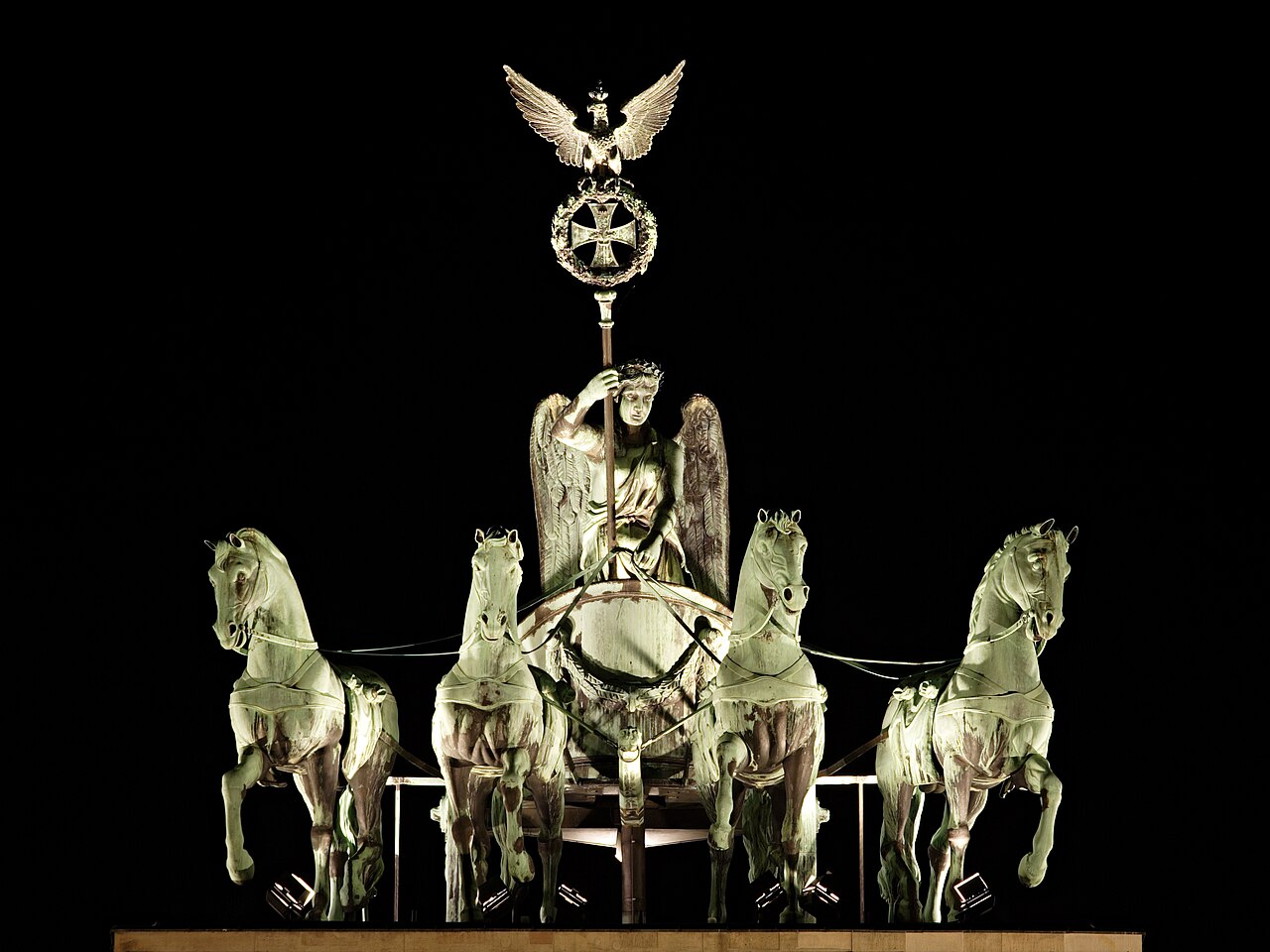
Via Wikimedia Commons: Brandenburg Gate Quadriga at Night by א (Aleph) Creator: Johann Gottfried Schadow, CC BY-SA 2.5.
Land
Germany stretches from the Danish border to the Alps.[2] The Rhine, Ems, Weser and Elbe flow towards the North Sea, the Oder and Neisse mark the border with Poland, and the Danube rises in the Black Forest and flows south-east into Austria.[6] The climate is moderate, maritime in the north-west and more continental inland.[7]
People
About 83.5 million people lived in Germany in 2025. About 82 per cent live in towns and cities, life expectancy was about 81 years in 2024 and about 24 per cent were 65 or older.[5] Three of the 16 states are cities: Berlin, Hamburg and Bremen.[1]
History
From tribes to empire
Germanic tribes inhabited northern Europe by about 500 BC and had reached central and southern Germany by 100 BC.[8] Charlemagne, who ruled the Franks from 768, was crowned emperor in Rome in 800; his realm covered much of western Europe.[9] When the Carolingian line ran out, the dukes of the eastern kingdom elected a German king, Conrad I, in 911, which some historians mark as the beginning of German history. Otto the Great followed within a generation.[10] From the mid-fifteenth century the imperial crown stayed almost continuously with the Habsburg family until the empire was dissolved in 1806.[11]
Reformation and religious war
In 1517 Martin Luther, a professor of theology at Wittenberg, issued ninety-five theses attacking the sale of indulgences.[12] The Peace of Augsburg of 1555 recognised both Lutheranism and Catholicism and let each ruler decide the religion of his state.[13] The Thirty Years' War broke out in 1618.[14] The Peace of Westphalia of 1648 settled the religious conflicts between the German states, gave them greater independence and left the Holy Roman Empire much weakened.[15]
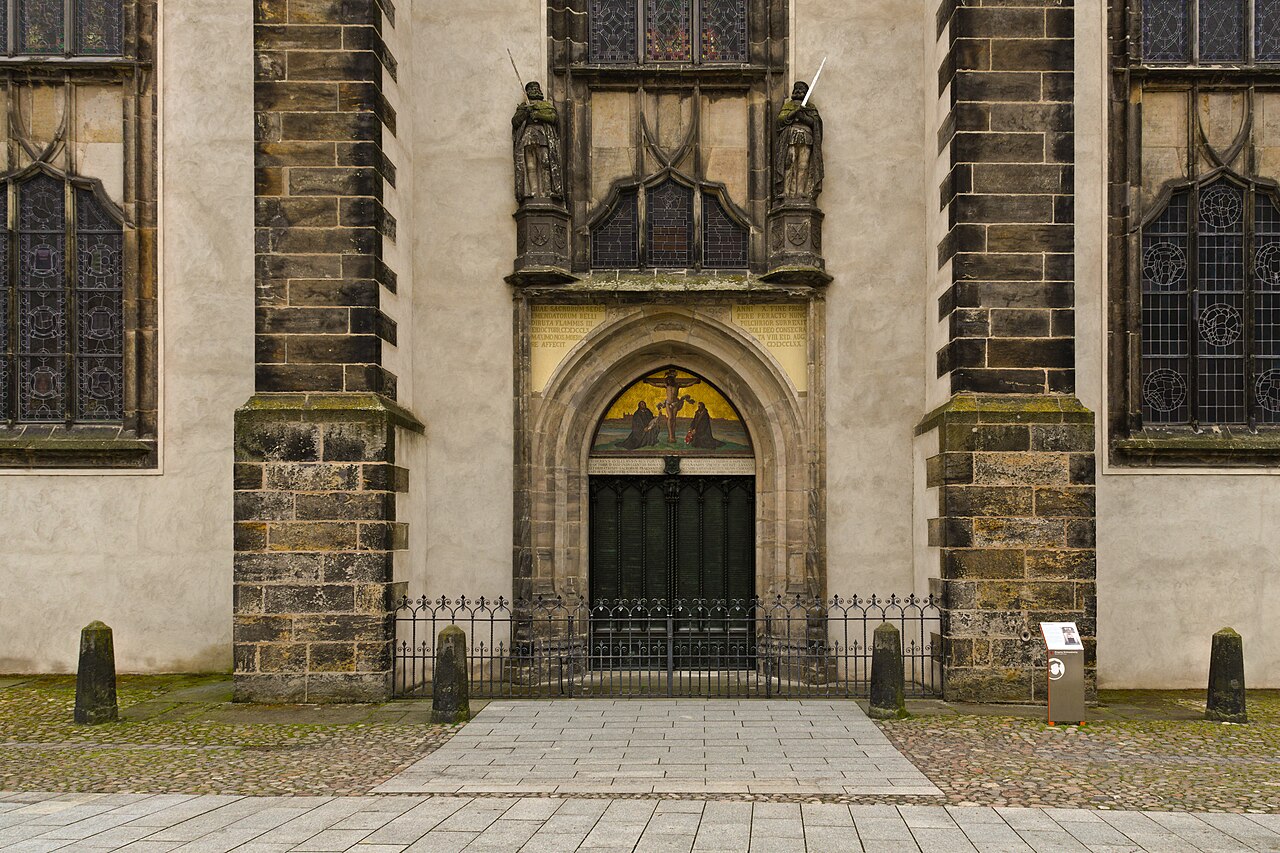
Via Wikimedia Commons: Wittenberg, Schlosskirche (Juni 2026) 1 by Romzig, CC0.
Prussia and unification
Austria was the leading German power after 1648, but in the eighteenth century Brandenburg-Prussia became a serious rival.[16] French armies occupied the Rhineland during the revolutionary wars,[17] and after the defeat of Napoleon the Congress of Vienna did not restore the Holy Roman Empire.[18] Revolutions in 1848 demanded reform and unity without achieving it.[19][20] Otto von Bismarck then harnessed German nationalism to Prussia's interests,[20] and the German Empire combined a strong, authoritarian monarchy with a weak parliament elected by all men.[21] Unification brought a single market, a common currency and a speculative building boom.[22] After 1890 an aggressive foreign policy and a large new battle fleet alarmed Europe, and by about 1907 Germany faced the alliance of Russia, France and Britain.[23]
War and the Weimar Republic
In the First World War Germany invaded France through neutral Belgium, and the war settled into years of trench fighting.[24] The Treaty of Versailles of June 1919 limited the army to 100,000 men.[25] The Weimar Republic was proclaimed on 9 November 1918, amid military defeat and revolution.[26] Many Germans never accepted it, and it struggled with war reparations, high inflation and unemployment.[25]
Dictatorship, war and genocide
Adolf Hitler led the National Socialist (Nazi) Party,[27] and after 1933 rapidly turned the republic into a dictatorship, using legal procedure, persuasion and terror. The election of March 1933 was the last free one.[28] Hitler stepped up rearmament in breach of Versailles and withdrew from the League of Nations.[29] Jews were stripped of citizenship by the Nuremberg Laws of 1935 and violently attacked in the Kristallnacht of November 1938.[28][30]
German troops invaded Poland on 1 September 1939, beginning the Second World War.[31] In the Holocaust, the Nazi regime and its allies and collaborators systematically murdered six million European Jews.[30] The war economy relied on some seven million foreigners taken from their homelands and forced to work under terrible conditions.[32] Germany surrendered unconditionally in May 1945, its cities largely rubble and its whole territory occupied.[33][34]
Two German states
The occupied country became two states: the Federal Republic in the west and the German Democratic Republic in the east.[34][35] So many people left the east that in 1961 its government built the Berlin Wall.[36] In 1970 Chancellor Willy Brandt opened talks with the eastern bloc, a policy known as Ostpolitik.[37] East Germany's economy was state-owned and centrally planned on the Soviet model;[38] Erich Honecker succeeded Walter Ulbricht as its leader.[39] In the west, Helmut Schmidt became chancellor in 1974.[40] The 1970s saw left-wing terrorism growing out of the late 1960s protest years,[41] and in 1980 environmental and other movements formed the Greens as a national party.[42]
West Germany's "social market economy" aimed to join free markets with care for workers and those who could not compete.[43] Helped by currency reform, Marshall Plan funds and hard work, it boomed from 1950.[44]
Unity
On 9 November 1989 East German border guards opened the Berlin Wall, which had divided the city for 28 years, and unification took effect on 3 October 1990.[45] Joining a centrally planned economy to a market one was without precedent.[46]
Merkel to Merz
Angela Merkel led conservative-headed governments for 16 years until December 2021, when the Social Democrat Olaf Scholz became chancellor.[47] After Russia's invasion of Ukraine in 2022, Scholz announced a special fund of 100 billion for the military.[48] His three-party coalition broke up in November 2024 and he lost a confidence vote, triggering early elections.[49] Merz's conservatives won in February 2025, and he became chancellor on 6 May, at an unprecedented second attempt in parliament.[3]
Migration
After the Berlin Wall went up, immigration, first to West Germany and later to the united country, consisted mainly of workers from southern Europe, joined later by other groups, including several million ethnic Germans from the east.[50]
Government and politics
The 1949 Basic Law was written to guard against both the fragmented politics of the Weimar Republic and Nazi dictatorship.[35] Its first article states that human dignity is inviolable, and it describes the country as a democratic and social federal state.[51] The president's role is largely ceremonial.[52] Executive power rests mainly with the chancellor, who is elected by the Bundestag.[53] The Bundesrat is the upper chamber, representing the states, and most bills need the approval of both.[4]
Economy
Output was about 5.1 trillion US dollars in 2025, or about 60,500 dollars per person.[5] Germany accounts for about 24 per cent of the European Union's output.[1] Its economy has long been built on processing and manufacturing, including vehicles, machine tools, electrical engineering and chemicals.[54]
Religion, learning and culture
West Germany had roughly equal numbers of Roman Catholics and Protestants after the war, while in the east the authorities campaigned against the churches.[55] Labour migration from the 1960s made Islam the third largest religious community.[56]
Johannes Gutenberg of Mainz developed movable metal type and the printing press in Europe.[57] The school system combines academic routes with vocational training that mixes work and classroom study.[58] Thomas Mann (1929) and Günter Grass (1999) received the Nobel Prize in Literature.[59][60]
What's unsettled
The far-right Alternative for Germany has surged. In September 2026 exit polls showed it winning Mecklenburg-Western Pomerania with 38 per cent, two weeks after its best result yet in Saxony-Anhalt, and Merz called the results a disaster.[61] In November 2026 the governing coalition passed a 2027 budget with 556 billion euros of spending, with tax and pension reforms still disputed.[62]
See also
Sources
- European Union. "Germany: EU country". european-union.europa.eu/principles-countries-history/eu-countries/…
- Library of Congress Country Studies (written in the mid-1990s). "Germany: Geography". countrystudies.us/germany/74.htm
- CNN. "Merz appointed German chancellor hours after unprecedented parliamentary defeat". 6 May 2025. cnn.com/2025/05/06/europe/merz-chancellor-german-parliament-intl
- Library of Congress Country Studies (written in the mid-1990s). "Germany: The Legislature". countrystudies.us/germany/154.htm
- World Bank. World Development Indicators: population, area, urban share, life expectancy, age and GDP for Germany. api.worldbank.org/v2/country/DEU?format=json
- Library of Congress Country Studies (written in the mid-1990s). "Germany: Drainage". countrystudies.us/germany/79.htm
- Library of Congress Country Studies (written in the mid-1990s). "Germany: Climate". countrystudies.us/germany/80.htm
- Library of Congress Country Studies (written in the mid-1990s). "Germany: Early History". countrystudies.us/germany/4.htm
- Library of Congress Country Studies (written in the mid-1990s). "Germany: The Carolingian Dynasty". countrystudies.us/germany/6.htm
- Library of Congress Country Studies (written in the mid-1990s). "Germany: The Saxon Dynasty". countrystudies.us/germany/7.htm
- Library of Congress Country Studies (written in the mid-1990s). "Germany: The Empire under the Early Habsburgs". countrystudies.us/germany/10.htm
- Library of Congress Country Studies (written in the mid-1990s). "Germany: Martin Luther". countrystudies.us/germany/12.htm
- Library of Congress Country Studies (written in the mid-1990s). "Germany: The Peace of Augsburg". countrystudies.us/germany/14.htm
- Library of Congress Country Studies (written in the mid-1990s). "Germany: The Thirty Years' War". countrystudies.us/germany/15.htm
- Library of Congress Country Studies (written in the mid-1990s). "Germany: The Peace of Westphalia". countrystudies.us/germany/18.htm
- Library of Congress Country Studies (written in the mid-1990s). "Germany: Austria and Prussia". countrystudies.us/germany/20.htm
- Library of Congress Country Studies (written in the mid-1990s). "Germany: The French Revolution and Germany". countrystudies.us/germany/22.htm
- Library of Congress Country Studies (written in the mid-1990s). "Germany: The German Confederation". countrystudies.us/germany/23.htm
- Library of Congress Country Studies (written in the mid-1990s). "Germany: The Revolutions of 1848". countrystudies.us/germany/25.htm
- Library of Congress Country Studies (written in the mid-1990s). "Germany: Bismarck and Unification". countrystudies.us/germany/27.htm
- Library of Congress Country Studies (written in the mid-1990s). "Germany: Imperial Germany". countrystudies.us/germany/28.htm
- Library of Congress Country Studies (written in the mid-1990s). "Germany: The Economy and Population Growth". countrystudies.us/germany/30.htm
- Library of Congress Country Studies (written in the mid-1990s). "Germany: Foreign Policy in the Wilhelmine Era". countrystudies.us/germany/33.htm
- Library of Congress Country Studies (written in the mid-1990s). "Germany: World War I". countrystudies.us/germany/34.htm
- Library of Congress Country Studies (written in the mid-1990s). "Germany: Problems of Parliamentary Politics". countrystudies.us/germany/36.htm
- Library of Congress Country Studies (written in the mid-1990s). "Germany: The Weimar Republic". countrystudies.us/germany/35.htm
- Library of Congress Country Studies (written in the mid-1990s). "Germany: Hitler and the Rise of National Socialism". countrystudies.us/germany/38.htm
- Library of Congress Country Studies (written in the mid-1990s). "Germany: The Third Reich". countrystudies.us/germany/39.htm
- Library of Congress Country Studies (written in the mid-1990s). "Germany: The Third Reich: Foreign Policy". countrystudies.us/germany/40.htm
- United States Holocaust Memorial Museum. "Introduction to the Holocaust: What was the Holocaust?". encyclopedia.ushmm.org/content/en/article/introduction-to-the-holoc…
- Library of Congress Country Studies (written in the mid-1990s). "Germany: The Outbreak of World War II". countrystudies.us/germany/41.htm
- Library of Congress Country Studies (written in the mid-1990s). "Germany: Total Mobilization, Resistance, and the Holocaust". countrystudies.us/germany/42.htm
- Library of Congress Country Studies (written in the mid-1990s). "Germany: Defeat". countrystudies.us/germany/43.htm
- Library of Congress Country Studies (written in the mid-1990s). "Germany: Postwar Occupation and Division". countrystudies.us/germany/44.htm
- Library of Congress Country Studies (written in the mid-1990s). "Germany: The Constitution". countrystudies.us/germany/150.htm
- Library of Congress Country Studies (written in the mid-1990s). "Germany: The Berlin Wall". countrystudies.us/germany/58.htm
- Library of Congress Country Studies (written in the mid-1990s). "Germany: Ostpolitik". countrystudies.us/germany/62.htm
- Library of Congress Country Studies (written in the mid-1990s). "Germany: Planned Economy". countrystudies.us/germany/56.htm
- Library of Congress Country Studies (written in the mid-1990s). "Germany: The Honecker Era". countrystudies.us/germany/67.htm
- Library of Congress Country Studies (written in the mid-1990s). "Germany: Helmut Schmidt". countrystudies.us/germany/63.htm
- Library of Congress Country Studies (written in the mid-1990s). "Germany: The Student Movement and Terrorism". countrystudies.us/germany/64.htm
- Library of Congress Country Studies (written in the mid-1990s). "Germany: The Greens". countrystudies.us/germany/65.htm
- Library of Congress Country Studies (written in the mid-1990s). "Germany: The Social Market Economy". countrystudies.us/germany/136.htm
- Library of Congress Country Studies (written in the mid-1990s). "Germany: The Economic Miracle and Beyond". countrystudies.us/germany/137.htm
- Library of Congress Country Studies (written in the mid-1990s). "Germany: Opening of the Berlin Wall and Unification". countrystudies.us/germany/73.htm
- Library of Congress Country Studies (written in the mid-1990s). "Germany: Unification and Its Aftermath". countrystudies.us/germany/138.htm
- Al Jazeera. "Olaf Scholz sworn in as chancellor, ending Germany's Merkel era". 8 December 2021. aljazeera.com/news/2021/12/8/olaf-scholz-elected-as-chancellor-endi…
- NPR. "Germany's chancellor said he'd boost military. How is the German army doing now?". 17 January 2023. npr.org/2023/01/17/1149646964/germanys-chancellor-said-hed-boost-mi…
- NPR. "Scholz loses Germany confidence vote, triggering new elections". 16 December 2024. npr.org/2024/12/16/g-s1-38426/germany-scholz-confidence-vote-elections
- Library of Congress Country Studies (written in the mid-1990s). "Germany: Immigration". countrystudies.us/germany/89.htm
- Federal Ministry of Justice. "Basic Law for the Federal Republic of Germany" (English). gesetze-im-internet.de/englisch_gg/englisch_gg.html
- Library of Congress Country Studies (written in the mid-1990s). "Germany: The President". countrystudies.us/germany/152.htm
- Library of Congress Country Studies (written in the mid-1990s). "Germany: The Chancellor and the Cabinet". countrystudies.us/germany/153.htm
- Library of Congress Country Studies (written in the mid-1990s). "Germany: Industry". countrystudies.us/germany/145.htm
- Library of Congress Country Studies (written in the mid-1990s). "Germany: Postwar Christianity". countrystudies.us/germany/95.htm
- Library of Congress Country Studies (written in the mid-1990s). "Germany: Islam". countrystudies.us/germany/101.htm
- HISTORY. "Printing Press". history.com/articles/printing-press
- Library of Congress Country Studies (written in the mid-1990s). "Germany: Education". countrystudies.us/germany/124.htm
- NobelPrize.org. "Thomas Mann: Facts". nobelprize.org/prizes/literature/1929/mann/facts/
- NobelPrize.org. "Günter Grass: Facts". nobelprize.org/prizes/literature/1999/grass/facts/
- CNN. "Chancellor Merz calls Germany state elections results a 'disaster', as far-right surges again". 20 September 2026. edition.cnn.com/2026/09/20/europe/berlin-mecklenburg-vorpommern-ele…
- bluewin. "German Parliament Approves Budget, But Questions Remain". November 2026. bluewin.ch/en/news/german-parliament-approves-budget-but-questions-…
