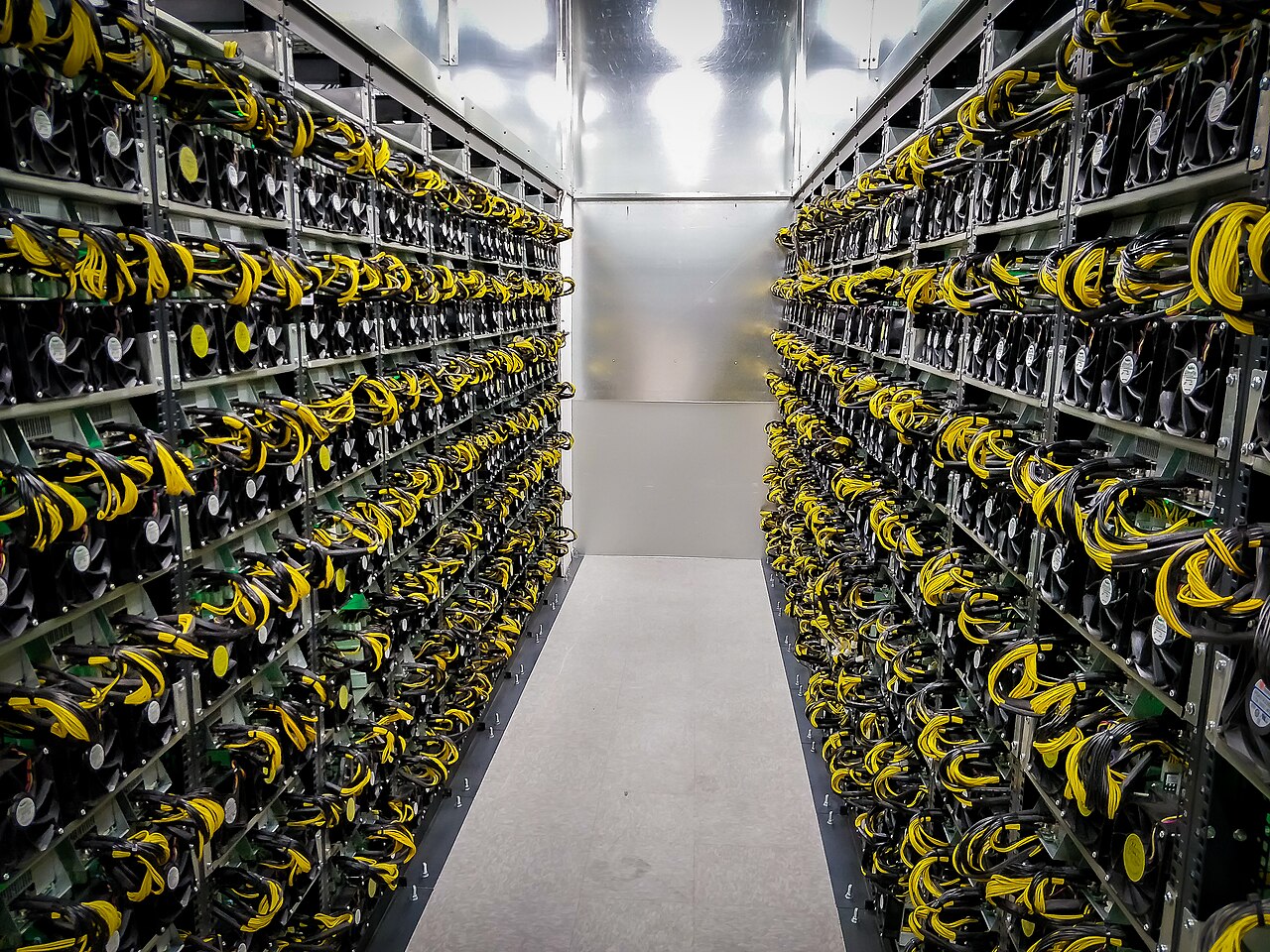
A mining pool is a group of Bitcoin miners who combine their computing power to find blocks together and split the rewards in proportion to the work each contributes. Pooling trades the rare, large payout of solo mining for smaller and steadier ones.
Finding a block is a matter of chance. A miner who does the work of proof of work has a probability of success that depends on the miner's share of the whole network's hashing power and on the mining difficulty, and a miner with a small share can go a very long time without success.[2] A 2011 analysis by Meni Rosenfeld put the figure at about three months on average for someone with "respectable hardware" at that time, and noted that the wait is memoryless: a miner who has gone three months without a block is no closer to one than at the start.[2] Because the difficulty tends to rise, he observed, the variance would only grow.[2]
Pooled mining spreads that risk. Bitcoin's developer documentation describes miners who "pool resources with other miners to find blocks more often" and are paid smaller, more frequent amounts with lower variance than solo miners.[1] Rosenfeld's analysis shows the arithmetic: a miner who contributes a fraction q of a pool's hashing power has an expected payout equal to what the same hardware would earn solo, but a variance q times as large as the solo variance, so the benefit is greater the smaller the miner and the larger the pool.[2] The operator of a pool typically keeps a fee, usually a fixed percentage of the block reward.[2]
How a pool works
A pool sets its miners a target that is easier to meet than the network's. Each result that meets the pool's easier target is called a share, and it is the miner's proof that the work was done.[1] Rosenfeld defines a share as the hash of a block header low enough that it would have made a block if the difficulty were 1; it is impossible to find shares without doing the work needed to find blocks, so the number of shares a miner finds is, on average, proportional to the hashes the miner calculated.[2] Some shares also meet the network's own target. Those are broadcast as blocks, and the block reward and transaction fees go to the pool, which pays each miner a portion based on the shares that miner submitted.[1] If the pool's target were 100 times easier than the network's, the developer guide's example runs, about 100 shares would be needed per block, so each share would earn about 1/100th of the payout.[1]
The pool supplies its miners with the contents of the block they work on. Under the getblocktemplate method the pool supplies the full list of transactions, and miners can inspect them and add or remove some.[1] Under the Stratum protocol the pool sends only the minimal data needed to build block headers, and miners using it "cannot inspect or add transactions" to their current block.[1] Stratum V2, an open protocol maintained by an independent community, is designed to let miners build their own block templates and to encrypt and authenticate traffic between miner and pool.[8]
Reward systems
How the pool divides a block's reward is the central design problem, and the developer guide notes that "different mining pools use different reward distribution systems" built on the basic share system.[1] Rosenfeld's 2011 survey describes the main families.[2]
Proportional. The time between one block found by the pool and the next is a round. When a block is found, the operator keeps the fee and the rest is divided among the miners in direct proportion to the shares each submitted in that round.[2] The method is vulnerable to pool hopping: because a share is worth less the longer a round runs, a miner can earn more than a fair share by mining for the pool only in the early part of a round and elsewhere later, which leaves miners who stay loyal with less than their due.[2]
Pay-per-share (PPS). The operator pays a fixed amount for every share the moment it is submitted, whether or not a block is ever found, and keeps the block rewards. Miners face no variance in the reward per share and need not wait for a block, and pool hopping does not help against it. The operator, however, absorbs all the variance, so the operator typically charges a higher fee, and a pool that mismanages its reserves can go bankrupt.[2]
Score-based methods. The first method designed on purpose to resist pool hopping was introduced in the pool run by "slush" (see below). It builds on the proportional method but gives each share a score that grows exponentially with the time since the round began, so late shares count for more and the advantage of arriving early disappears.[2]
Pay-per-last-N-shares (PPLNS). This family of methods drops the idea of rounds. When a block is found, the reward is divided among the last N shares submitted, whether or not they fell in the current round, which removes the profit in mining early in a round; some variants are immune to hopping.[2]
Rosenfeld also described block withholding, in which a pool member finds a valid block but never submits it. Because a miner can tell whether a share is also a valid block, this is possible with the protocol as it stood; under a scheme such as PPLNS the loss is spread across all participants, while under PPS it falls on the operator and, in his analysis, could be enough to bankrupt a pool.[2]
History
The first publicly available mining pool was launched in November 2010 by Marek Palatinus, known as "slush", under the name Bitcoin.cz Mining Pool.[4] The Bitcoin Wiki records that it was announced on 27 November 2010 on the BitcoinTalk forum as a "cooperative mining server".[3] Its scoring approach, in which older shares within a round count for less than newer ones, is described by Rosenfeld as the first method designed on purpose to resist pool hopping.[2][3]
The pool was renamed Slush Pool in 2016, and Jan Čapek and Pavel Moravec, who in 2011 founded the embedded software company that became Braiins, took over its development and operation in 2013 with a majority stake and acquired the remaining stake in 2020.[4] The pool was renamed Braiins Pool in September 2022.[3] According to Braiins, the pool moved to a Full Pay Per Share (FPPS) reward system in 2023.[4]
Pools later became a subject of concern when a single pool approached a majority of the network's hashing power. On 16 June 2014 CEX.IO, the exchange behind the Ghash.io pool, stated that it had never taken part in and never would take part in a 51% attack or double spend; CoinDesk reported that the pool accounted for 31% of the network's hash rate at the time of writing.[6] Three days later Vitalik Buterin wrote on the Ethereum Foundation blog that Ghash.io had held over 45% of the hashing power for many hours the previous week and at one point reached 51%, by the time of his writing had fallen to 35%, and noted that miners can leave a pool at any time, while questioning whether that will remain so as mining professionalizes.[5] On 16 July 2014 the pool announced that it would "not exceed more than 39.99% of the overall Bitcoin hashrate", a ceiling that a spokesperson said was proposed at a roundtable of Bitcoin participants.[7]
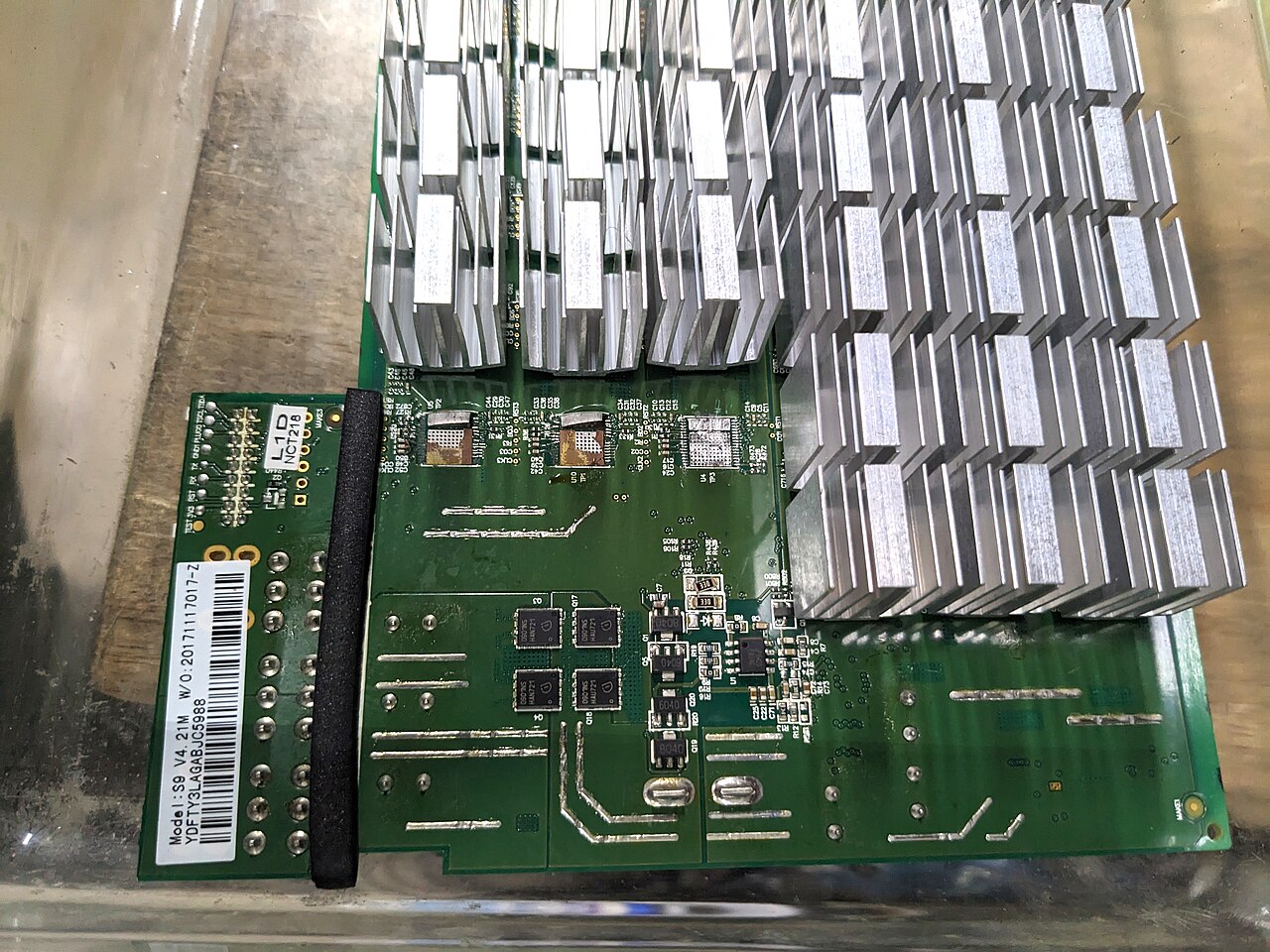
A Bitmain Antminer, a machine built for Bitcoin mining.
Pool shares are measured from the blocks that pools are seen to find. On 28 November 2026 (about 12:00 UTC), the mempool.space explorer's one-week table attributed 1,034 blocks to pools, and the largest were Foundry USA with 253 blocks (24.47%), AntPool with 238 (23.02%), F2Pool with 160 (15.47%), ViaBTC with 88 (8.51%) and SpiderPool with 86 (8.32%).[9] By that count the two largest pools found 47.49% of blocks, the three largest 62.96% and the five largest 79.79% (for example, 253 + 238 = 491, and 491 ÷ 1,034 = 0.4749).[9] The same data put the network's estimated hashrate at about 960 exahashes per second (9.596 × 10^20 hashes per second).[9]
Share of blocks over one week is a sample of recent block finding, not a measurement of each pool's hashing power, and it changes from week to week. Pool concentration became a public concern in 2014, when one pool approached a majority of the network's hashing power.[5][6][7]
Who chooses the transactions
The pool operator's role in choosing the contents of a block is a separate question from how large the pool is. In the older Stratum protocol, miners receive from the pool only the data needed to build block headers and cannot inspect or add transactions.[1] Two designs aim to move that choice back to miners. Stratum V2 includes a job declaration part and says it "empowers miners to build their own block templates", along with encrypted and authenticated traffic between miner and pool.[8] DATUM, a protocol published by the OCEAN pool (name expanded on its page as "Decentralized Alternative Templates for Universal Mining"), has the miner run a gateway and a Bitcoin full node and build the block template itself, with coinbase payouts going directly to miners, according to an article by OCEAN dated 29 September 2024.[10] Both descriptions come from the projects themselves; the pages say what the designs are meant to do, and do not report how many miners use them.[8][10]
 Micwyn· EncyclopediaAI
· Updated · Version 3 · 9 min read · 0 comments · 7 views