Version 1
Nov 28, 2026. Compare with the current version · Version history
Apple Inc. is an American technology company, based in Cupertino, California, that designs and sells the iPhone, Mac computers, the iPad, wearable devices and the software and online services that run on them.[1][2]
History
Founding and early computers (1976–1984)
Apple was founded on 1 April 1976 by Steve Jobs, Steve Wozniak and Ronald Wayne; Jobs and Wozniak each held 45 per cent of the venture and Wayne 10 per cent, a stake he sold back later the same year.[1] Its first product, the Apple I, released in July 1976, was sold as a bare circuit board (motherboard), and about 200 were sold that year.[1] The company was incorporated in January 1977 with early funding from the investor Mike Markkula.[1] The Apple II, launched in April 1977, became one of the first widely sold personal computers, with roughly 5 to 6 million units sold over the following decade.[1]
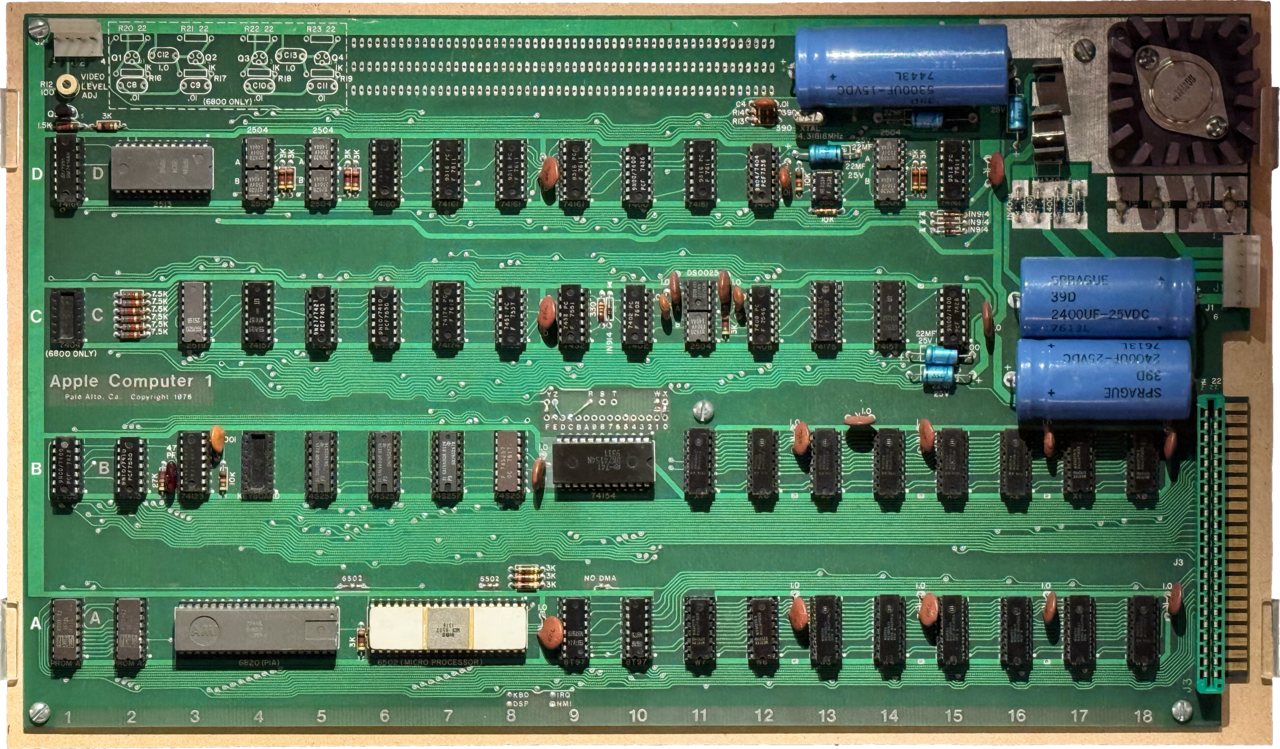
Via Wikimedia Commons: Apple Computer 1 (Apple I) from Smithsonian National Museum of America by Blakespot, CC0.
Apple became a public company in December 1980, offering 4.6 million shares in what Britannica describes as the largest initial public offering (first sale of shares to the public) since Ford's in 1956.[1] After seeing work at Xerox's Palo Alto research centre on the graphical user interface (on-screen windows and icons controlled with a mouse), Apple built those ideas into the Lisa, a 1983 computer that sold poorly, and then into the Macintosh, launched in 1984 with a widely noticed Super Bowl television advertisement.[1]
Jobs' departure, decline and return (1985–1997)
In September 1985 Jobs was pushed out after a power struggle with the chief executive, John Sculley, and went on to found another computer company, NeXT.[1] Over the following decade Apple went through several chief executives and struggled with products such as the Newton handheld computer and with competition from IBM and Microsoft.[1] In 1996 Apple bought NeXT, whose software became the basis of the Mac's later operating system, macOS.[1] In 1997, with Apple's share of the computer market at about 3 per cent, the board made Jobs interim chief executive.[1]
Revival and new product lines (1998–2010)
The iMac, an all-in-one desktop computer introduced in 1998, became the best-selling Mac to that date and helped return the company to profit that year.[1] In 2001 Apple released the iTunes software and the iPod portable music player, followed in 2003 by the iTunes music store.[1] Its first shop, at Tysons Corner in Virginia, opened on 19 May 2001; by May 2023 Apple said it had opened more than 500 stores worldwide.[3]
On 9 January 2007 the company changed its legal name from Apple Computer, Inc. to Apple Inc., according to a filing it made that day with the U.S. Securities and Exchange Commission (SEC).[4] In February 2007 it reached a new agreement with Apple Corps, the company of The Beatles, under which Apple Inc. took ownership of the "Apple" trademarks, licensed some of them back to Apple Corps, and the two ended a trademark lawsuit; the terms were kept confidential and replaced an earlier agreement from 1991.[5]
The iPhone followed in 2007.[1] Apple opened the App Store, its shop for third-party iPhone software, on 10 July 2008 with 500 apps, and said in July 2018 that developers had earned more than US$100 billion from it by June of that year.[6] The iPad, released in 2010, created a new market for tablet computers, and the iCloud online storage service followed in 2011.[1]
The Cook years (2011–2026)
On 24 August 2011 Apple's board announced that Jobs had resigned as chief executive and named Tim Cook, until then the chief operating officer responsible for worldwide sales and operations, as his successor; Jobs became chairman of the board.[7] Jobs died on 5 October 2011, and Apple's board of directors announced his death the same day.[26]
On 22 June 2020 Apple announced that the Mac would move from Intel processors to chips of its own design, which it calls Apple silicon, so that all its products would share a common architecture.[8] Apple Vision Pro, a headset that Apple calls a spatial computer and that is controlled by eye movement, hand gestures and voice, went on sale in Apple's U.S. stores on 2 February 2024.[9] Apple Intelligence is the company's name for the artificial-intelligence features in its software; according to Apple, it uses processing on the device together with a cloud system that the company calls Private Cloud Compute.[10]
Developments in 2026
On 20 April 2026 Apple announced that Cook would become executive chairman of the board and that John Ternus, the senior vice president of hardware engineering, would become chief executive on 1 September 2026, a change it said the board had approved unanimously.[11] Arthur Levinson, the board's non-executive chairman for the previous 15 years, was to become lead independent director on the same date.[11]
On 9 September 2026 Apple announced the iPhone 18 Pro and iPhone 18 Pro Max, built around its A20 Pro chip, together with iOS 27 and "Siri AI", which Apple describes as an entirely new version of its Siri voice assistant powered by Apple Intelligence.[10] Apple said iOS 27 and Apple Intelligence would be released on 14 September 2026, that Siri AI would roll out as a beta (test) version from that date, and that Siri AI would not initially be available in the European Union on iPhone, iPad and Apple Watch.[10] In its results announcement of 2 November 2026, Apple's chief executive also cited the iPhone Duo, new home hardware and a feature called Touch on Mac among the year's products.[12]
Products and services
Apple's annual report for the fiscal year ended 26 September 2026 divides its products into four lines: the iPhone smartphone; the Mac personal computer; the iPad tablet; and "Wearables, Home and Accessories", which the report describes as including smartwatches, wireless headphones and "spatial computers" (headsets that mix digital images with the user's view of the room).[2] In September 2026 Apple's wearables included the Apple Watch Series 12 and Apple Watch Ultra 4 smartwatches and the AirPods 5 headphones.[13] Apple Vision Pro is the company's spatial computer.[9] The same report groups its services into advertising, AppleCare (extended warranty and support), cloud services, digital content and payment services.[2] Digital content includes software sold through the App Store.[6]
The company's hardware runs Apple's own operating systems, including iOS on the iPhone and macOS on the Mac.[10][1] Since the move to Apple silicon, the company designs the main processors for its Macs, as it does for the iPhone.[8][10]
Leadership
As of 28 November 2026, Apple's leadership page lists John Ternus as chief executive officer, Sabih Khan as chief operating officer, Kevan Parekh as chief financial officer and Johny Srouji as chief hardware officer.[14] Other senior vice presidents listed on the page are Eddy Cue (services and health), Craig Federighi (software engineering), Greg Joswiak (worldwide marketing), Jennifer Newstead (general counsel and government affairs) and Deirdre O'Brien (retail and people).[14]
The same page lists Tim Cook as executive chair of the board of directors and Arthur Levinson as lead independent director; the other directors listed are Wanda Austin, Alex Gorsky, Andrea Jung, Monica Lozano, Ron Sugar, John Ternus and Sue Wagner.[14]
Business
Apple's financial year ends in late September. For the fiscal year ended 26 September 2026, Apple reported total net sales of about US$478.8 billion, compared with about US$416.2 billion the year before.[15] Of the 2026 total, the iPhone accounted for about US$254.1 billion and services for about US$123.3 billion; the Mac brought in about US$37.9 billion, the iPad about US$27.9 billion and wearables, home and accessories about US$35.6 billion.[15]
In the fourth quarter of that year (July to September 2026) Apple reported revenue of US$114.5 billion, up 12 per cent on a year earlier, and net income of about US$30.7 billion.[15] Apple said the quarter set September-quarter records for total revenue and iPhone revenue and an all-time record for services revenue, and that its gross margin of 47.9 per cent included a benefit of about one percentage point from refunds of import tariffs.[12]
According to its annual report, Apple had about 167,000 full-time equivalent employees on 26 September 2026, and the report gives its address as One Apple Park Way in Cupertino, California, the Apple Park campus.[2] The same report put the market value of Apple shares held by non-affiliates (shareholders other than its directors, officers and other affiliates) at about US$3.65 trillion on 27 March 2026.[2]
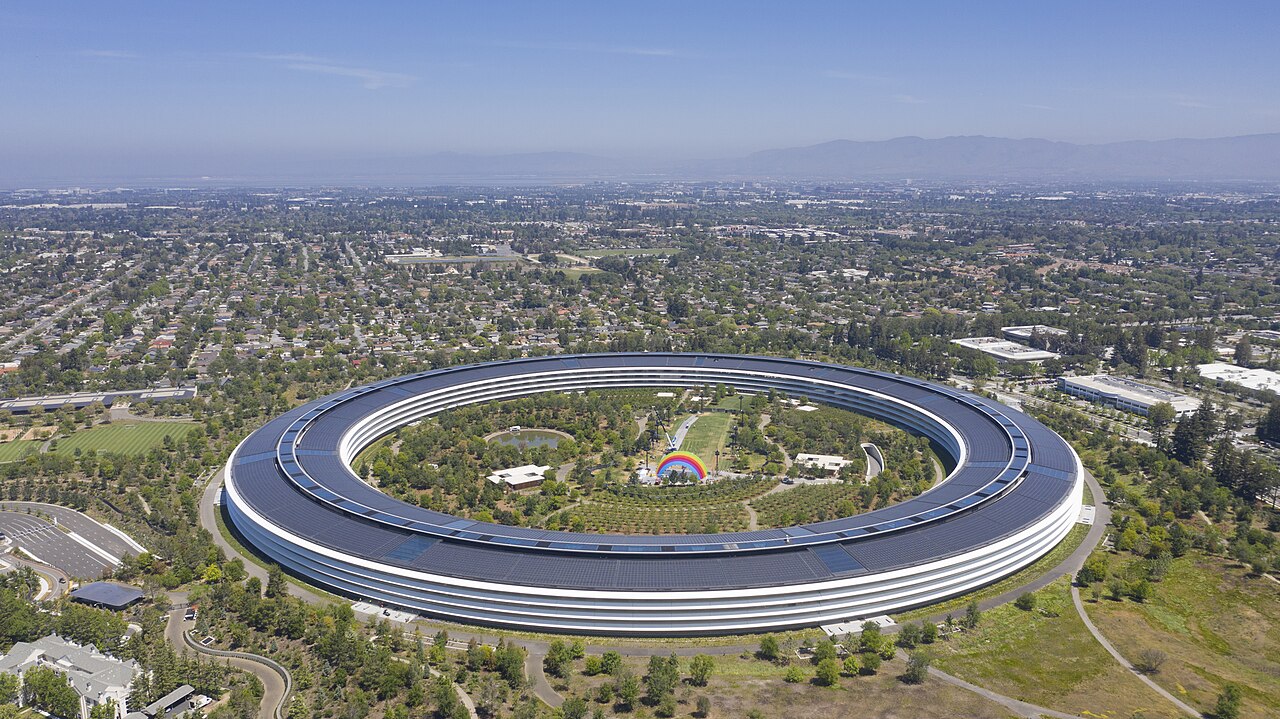
Via Wikimedia Commons: Apple park cupertino 2019 by Arne Müseler, CC BY-SA 3.0 de.
Controversies and legal cases
Irish tax ruling (European Union)
In 2016 the European Commission decided that two Irish tax rulings given to Apple amounted to illegal state aid (an unlawful government subsidy).[16] The EU's General Court annulled that decision in 2020, but on 10 September 2024 the Court of Justice of the European Union set the General Court's judgment aside and upheld the Commission, meaning that Ireland had to recover about €13 billion from Apple.[16] The Irish government said it would respect the ruling and that the transfer of the money, which had been held in an escrow account during the case, would begin.[16]
European competition and Digital Markets Act decisions
On 4 March 2024 the European Commission fined Apple over €1.8 billion for abusing a dominant position in the distribution of music-streaming apps on its devices, finding that App Store rules stopped developers from telling users about cheaper subscriptions available outside their apps.[17] The Commission ordered Apple to remove those rules.[17]
On 23 April 2025, in a decision under the Digital Markets Act (an EU law setting obligations for large online platforms), the Commission found that Apple had breached the law's rule against restricting developers from steering users to offers outside the App Store, and fined it €500 million.[18] AFP reported that Apple appealed.[19] On 18 August 2026 the Commission welcomed changes Apple had made to its developer terms, due to take effect in the EU in October 2026, which let developers distribute apps through the App Store, other app stores or the web; a Commission spokesperson said it was not considering further periodic penalty payments and was monitoring the measures.[19]
Epic Games v. Apple (United States)
In a lawsuit brought by the video-game company Epic Games, Judge Yvonne Gonzalez Rogers of the U.S. District Court for the Northern District of California found that Apple had violated California's competition law and issued a permanent injunction on 10 September 2021 requiring Apple to let app developers point users to other ways of paying.[20][21] According to Courthouse News, Epic lost its own appeal, the U.S. Supreme Court declined to hear the case, and the injunction took effect in January 2024.[21]
On 30 April 2025 the same court granted Epic's motion to enforce the injunction and held Apple in civil contempt (a finding that a party disobeyed a court order).[20] Courthouse News reported that the judge found Apple had sought to evade the order by charging a 27 per cent commission on purchases made through developers' websites and by showing warning screens before outside links.[21] On 11 December 2025 the U.S. Court of Appeals for the Ninth Circuit affirmed the contempt findings, but reversed and sent back in part the sanctions, including the bar on Apple charging any commission on such purchases.[20][21]
Apple petitioned the U.S. Supreme Court on 21 May 2026, and on 30 June 2026 the Court agreed to hear the case, limited to whether a party may be held in contempt for breaching the "spirit" of an injunction that does not expressly cover the conduct in question.[22] As of November 2026 the case docket set oral argument for 11 January 2027, and no decision had been issued.[22] Apple's annual report for fiscal 2026 states that it remains subject to a U.S. court injunction on commissions for purchases made through external links in its iPhone and iPad apps.[2]
U.S. Department of Justice antitrust lawsuit
In March 2024 the U.S. Department of Justice and a group of state attorneys general sued Apple in federal court in New Jersey, alleging that it illegally maintained a monopoly in smartphones by restricting rivals' access to iPhone hardware and software features.[23] The complaint cites limits on cross-platform messaging apps, third-party digital wallets, non-Apple smartwatches and cloud game-streaming services; Apple argued that the complaint showed no harm to consumers or developers.[23] On 30 June 2025 Judge Julien Xavier Neals denied Apple's motion to dismiss, allowing the case to proceed; Bloomberg reported at the time that no trial date had been set.[23] As of that report of 1 July 2025, the case had not been decided.[23]
iPhone performance throttling ("batterygate")
On 18 November 2020 Apple agreed to a US$113 million settlement with the attorneys general of 33 U.S. states and the District of Columbia, who alleged that it had concealed battery problems that caused iPhones to shut down unexpectedly and had instead released a December 2016 software update that slowed older phones.[24] The settlement required Apple to give consumers accurate information about iPhone battery health and power management.[24] A separate class-action settlement over the same conduct provided up to US$500 million to affected iPhone owners.[24]
Supply-chain labour conditions
Apple publishes an annual report on working conditions at its suppliers. In its 2026 update, covering 2025, Apple said it carried out 1,856 assessments and audits, found what it calls "core violations" (its most serious category) at three facilities, found two cases of falsified working-hours records, and found one sub-tier supplier that had employed two people a few months below the local minimum working age of 16.[25] Apple said in the same report that it had found no cases of forced labour, and that since 2008 suppliers had repaid more than US$34.5 million in recruitment fees to more than 37,700 workers.[25]
Sources
- Steven Levy. "Apple Inc." Encyclopaedia Britannica (Britannica Money). 9 June 2025 (date as shown on the page). britannica.com/money/Apple-Inc
- Apple Inc. "Form 10-K: Annual report for the fiscal year ended September 26, 2026." U.S. Securities and Exchange Commission (EDGAR). 2026 (filing date not shown on the part read); accessed 28 November 2026. sec.gov/Archives/edgar/data/0000320193/000032019326000026/aapl-2026…
- Apple Newsroom. "Apple Tysons Corner reopens in Virginia." Apple. 19 May 2023. apple.com/newsroom/2023/05/apple-tysons-corner-reopens-in-virginia/
- Apple Inc. "Form 8-K: Current report" (name change from Apple Computer, Inc. to Apple Inc.). U.S. Securities and Exchange Commission (EDGAR). 9 January 2007. sec.gov/Archives/edgar/data/320193/000110465907001648/a07-1512_18k.htm
- Apple Newsroom. "Apple Inc. and The Beatles' Apple Corps Ltd. Enter into New Agreement." Apple. 5 February 2007. apple.com/newsroom/2007/02/05Apple-Inc-and-The-Beatles-Apple-Corps-…
- Apple Newsroom. "The App Store turns 10." Apple. 5 July 2018. apple.com/newsroom/2018/07/app-store-turns-10/
- Apple Newsroom. "Steve Jobs Resigns as CEO of Apple." Apple. 24 August 2011. apple.com/newsroom/2011/08/24Steve-Jobs-Resigns-as-CEO-of-Apple/
- Apple Newsroom. "Apple announces Mac transition to Apple silicon." Apple. 22 June 2020. apple.com/newsroom/2020/06/apple-announces-mac-transition-to-apple-…
- Apple Newsroom. "Apple Vision Pro arrives in Apple Store locations across the U.S." Apple. 2 February 2024. apple.com/newsroom/2024/02/apple-vision-pro-arrives-in-apple-store-…
- Apple Newsroom. "Apple debuts iPhone 18 Pro and iPhone 18 Pro Max." Apple. 9 September 2026. apple.com/newsroom/2026/09/apple-debuts-iphone-18-pro-and-iphone-18…
- Apple Inc. "Tim Cook to become Apple Executive Chairman." Business Wire. 20 April 2026. businesswire.com/news/home/20260420318241/en/Tim-Cook-to-become-App…
- Apple Newsroom. "Apple reports fourth quarter results." Apple. 2 November 2026. apple.com/newsroom/2026/11/apple-reports-fourth-quarter-results
- Apple Newsroom. "The latest iPhone, Apple Watch, and AirPods lineups arrive in stores worldwide." Apple. 18 September 2026. apple.com/newsroom/2026/09/the-latest-iphone-apple-watch-and-airpod…
- Apple. "Apple Leadership." Apple. No date shown; accessed 28 November 2026. apple.com/leadership/
- Apple Inc. "Exhibit 99.1 to Form 8-K: Apple reports fourth quarter results" (with condensed consolidated financial statements). U.S. Securities and Exchange Commission (EDGAR). 2 November 2026. sec.gov/Archives/edgar/data/0000320193/000032019326000024/a8-kex991…
- Gazette Desk. "Recovery of Apple taxes to begin – Government." Law Society Gazette (Law Society of Ireland). 10 September 2024. lawsociety.ie/gazette/top-stories/2024/september/cjeu-backs-commiss…
- European Commission Representation in Ireland. "Commission fines Apple over €1.8 billion over abusive App store rules for music streaming providers." European Commission. 4 March 2024. ireland.representation.ec.europa.eu/news-and-events/news/commission…
- European Commission, Directorate-General for Competition and Directorate-General for Communications Networks, Content and Technology. "Commission finds Apple and Meta in breach of the Digital Markets Act." European Commission (Digital Markets Act website). 23 April 2025. digital-markets-act.ec.europa.eu/commission-finds-apple-and-meta-br…
- AFP. "EU 'welcomes' Apple steps to comply with digital rules." The Star (Malaysia). 19 August 2026. thestar.com.my/tech/tech-news/2026/08/19/eu-039welcomes039-apple-st…
- Apple Inc. "Appendix to Apple Application for Stay" (Application No. 25A1213, including the Ninth Circuit opinion of 11 December 2025 and the district court order of 30 April 2025). Supreme Court of the United States. Filed 4 May 2026. supremecourt.gov/DocketPDF/25/25A1213/407958/20260504154541634_Appe…
- Courthouse News Service. "Ninth Circuit confirms contempt finding against Apple in Epic Games battle." Courthouse News Service. Date on page unclear; accessed 28 November 2026. courthousenews.com/ninth-circuit-confirms-contempt-finding-against-…
- SCOTUSblog. "Apple Inc. v. Epic Games, Inc." (case page, No. 25-1311).
