Lennon and McCartney first performed together in Liverpool in 1957, and their group went through several names, among them the Quarrymen and the Silver Beetles, before it settled on the Beatles.[1] Harrison, a lead guitarist, had joined by the end of 1957, and the painter Stuart Sutcliffe played with them for several formative months from 1960.[1] The group started out playing skiffle (a simple, guitar-based mix of folk and blues that was popular in Britain in the 1950s), then took on a drummer, Pete Best, and became part of Liverpool's beat-music scene.[1]
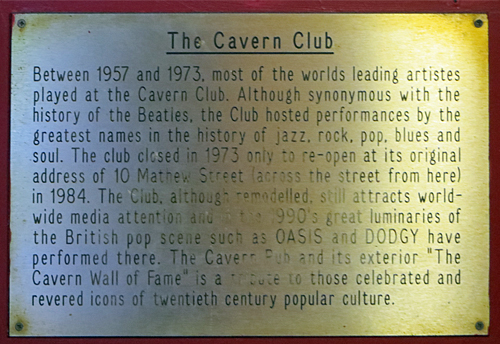
A plaque at the Cavern Pub in Mathew Street, Liverpool, recording the history of the Cavern Club across the street, where the Beatles played in their early year
Between 1960 and 1962 the band made several long visits to Hamburg in West Germany, a port city where sailors had created a market for American rock and roll.[1] The city of Hamburg's official website dates the start of this period to 17 August 1960, when the group opened at the Indra club on the Grosse Freiheit, a booking made by the club owner Bruno Koschmider through the Liverpool promoter Allan Williams.[3] The line-up at the Indra was Lennon, McCartney, Harrison, Sutcliffe and Best, who had been recruited only days before.[3] After 48 performances there, ended by neighbours' complaints about noise, the band moved on 4 October 1960 to the Kaiserkeller, where it played 58 evenings, taking turns with Rory Storm and the Hurricanes, whose drummer was Richard Starkey, later known as Ringo Starr.[3] Harrison, then 17, was deported in November 1960 because he was too young to work in night clubs.[3]
The band came back in April 1961 for 92 nights in a row at the Top Ten Club.[3] During that stay, on 22 and 23 June 1961, they worked as the backing band for the singer Tony Sheridan on a recording session that included "My Bonnie"; the record named the backing group as "The Beatbrothers" rather than the Beatles.[3] Engagements at the Star-Club followed from April 1962, and the last of them ended on 31 December 1962.[3]
Brian Epstein, born in Liverpool in 1934, was running a record shop in the city when he saw the band in the autumn of 1961.[1][4] Convinced that they could sell records, he became their manager and sent letters and tapes to the major British record companies until he won them a contract with Parlophone, a label belonging to the EMI group.[1] The man in charge of their records at Parlophone, George Martin, was a classically trained musician who influenced their sound from the start.[1] He first suggested that the band hire a more polished drummer, and they chose Starr, who joined in 1962.[1] Martin also turned "Please Please Me", their second recording and first big British hit, from a slow song into a fast one.[1] The band's first single, "Love Me Do", was released in 1962.[5]
Beatlemania and the United States
The public frenzy around the band led British newspapers to coin a new word for it: Beatlemania.[1] The band's official website records that their first visit to the United States began with a press conference at John F. Kennedy airport in New York on 7 February 1964.[6] Two days later, on 9 February 1964, they performed live on the Ed Sullivan Show, a broadcast that 73 million people were reported to have watched, a record at the time.[6] Encyclopaedia Britannica describes the same frenzy then breaking out in the United States, and the Rock & Roll Hall of Fame credits the band with launching the British Invasion, the 1960s wave of British bands in the United States.[1][2] The Hall of Fame also notes the influence of their matching collarless suits and "mop top" haircuts on the look of rock music.[2]
In 1965 all four members were appointed Members of the Order of the British Empire (MBE), a British honour, on the recommendation of Prime Minister Harold Wilson.[1] Some earlier holders of the honour, most of them military veterans, protested that it was being cheapened.[1]
Leaving the stage
In 1966 the Beatles stopped performing in public so that they could use the full resources of the recording studio.[1] In June of that year the four played two concerts at Hamburg's Ernst-Merck-Halle, which the city's website describes as their last regular performances on a European stage.[3]
The studio years
Between 1965 and 1967 the band's music changed quickly and became more complex.[1] Their success had convinced Lennon and McCartney of their abilities as songwriters, and the experiments that followed were unusual at a time when rock was largely treated as music for teenagers.[1] This period peaked in June 1967 with the album Sgt. Pepper's Lonely Hearts Club Band, which included George Martin's arrangement of "Being for the Benefit of Mr. Kite!".[1][2] Brian Epstein died in London on 27 August 1967, aged 32.[4]
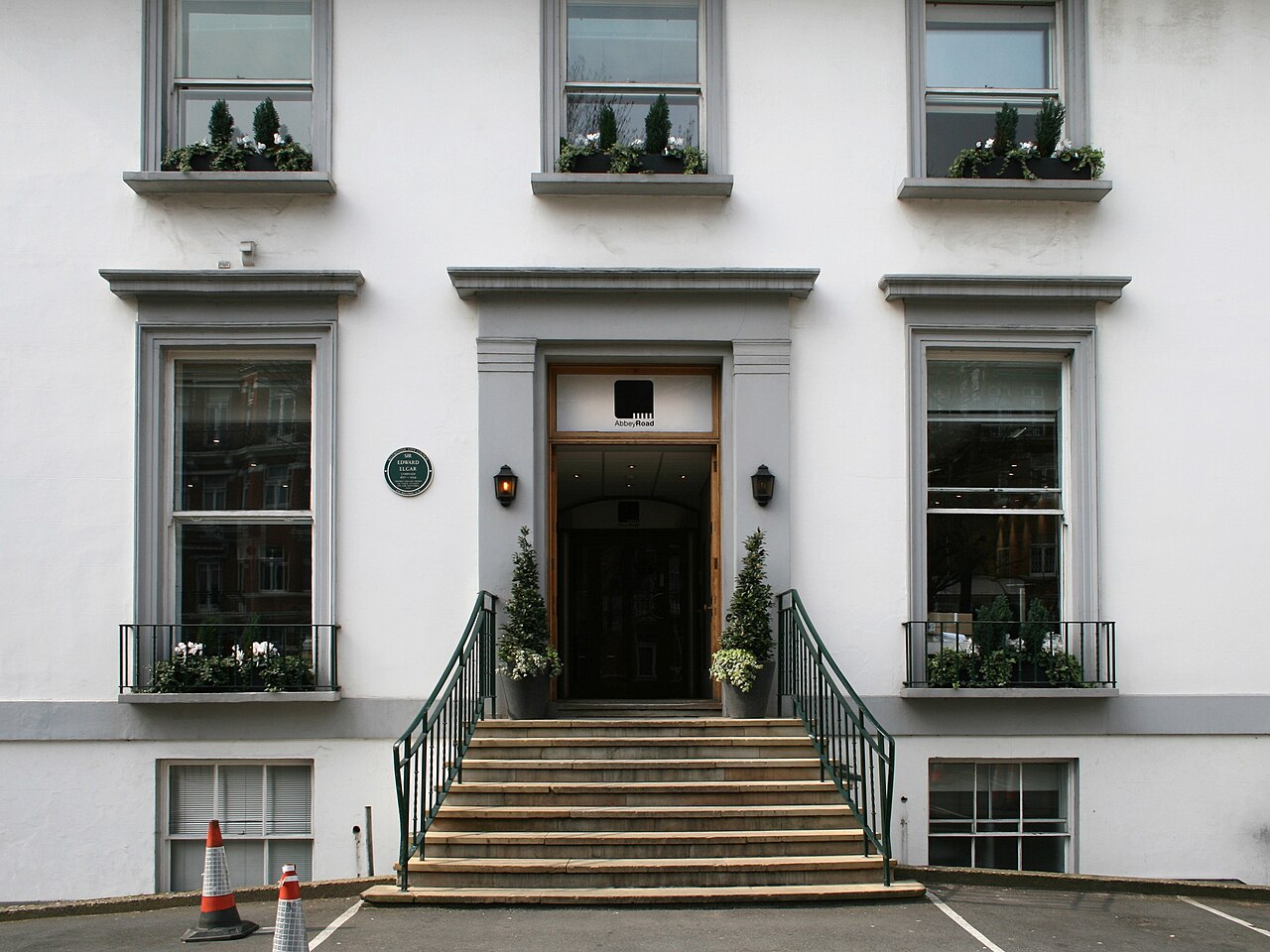
The front of the Abbey Road Studios building in London, where the Beatles made many of their recordings.
Via Wikimedia Commons: Abbey Rd Studios by Misterweiss at English Wikipedia, public domain.
Abbey Road, released in 1969, became one of their best-loved and best-selling albums.[1][2] In 2010, after reports that EMI was seeking buyers for its Abbey Road Studios, the building was given protected status as a historic landmark.[1]
Apple Corps
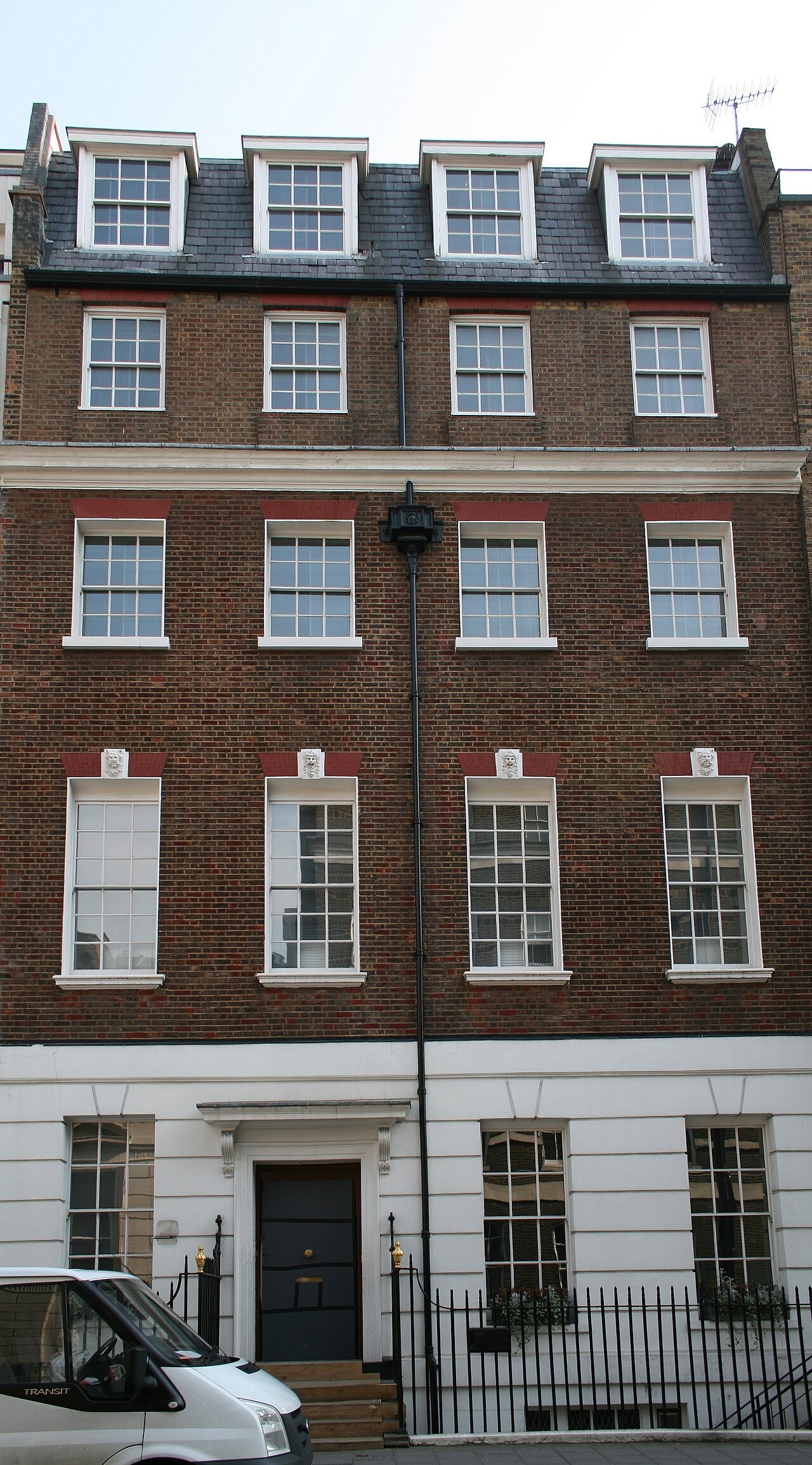
Apple Corps Ltd was founded in 1968 to look after the Beatles' creative and business interests.[7] The same year the band launched its own record label, Apple, which was meant to support experimental pop art but, apart from the Beatles' own records, mostly produced disorder and financial losses.[1] One of the company's early headquarters, 3 Savile Row in London, held the studio where Let It Be was recorded, and on its roof, on 30 January 1969, the band gave its final public performance.[7] In May 2026 Apple Corps announced that the building would open to the public in 2027 as "The Beatles at 3 Savile Row", with seven floors of previously unseen material and access to the roof.[7]
The building at 3 Savile Row in London, the former Apple Corps headquarters, on whose roof the Beatles gave their last public performance in January 1969.
Via Wikimedia Commons: 3 Savile Row by Misterweiss at English Wikipedia, public domain.
Break-up and legal dissolution
Personal disagreements, made worse by the pressure of the band's fame, pulled the group apart, and in the spring of 1970 the Beatles formally disbanded.[1] The members had run their business as a partnership (a business owned jointly by its members, who share its profits and its debts) called "The Beatles & Co".[8] On 31 December 1970 McCartney started a case in the Chancery Division of the High Court in London against Lennon, Harrison, Richard Starkey (Starr) and Apple Corps, asking the court to declare that the partnership should be dissolved.[8] The hearing began on 19 February 1971 before Mr Justice Stamp, and after 11 days McCartney's application succeeded in full and the court made a winding-up order, which closes a business and settles its affairs.[8] The partnership was formally dissolved on 9 January 1975, after Lennon had signed the necessary papers.[8]
A 2023 lecture by Mr Justice Foxton, a judge of the English High Court, describes later court cases brought by Apple Corps: royalty claims against EMI and Capitol Records, and a long dispute with the computer company Apple over the "Apple" name.[8] According to that lecture, the trademark dispute ended in a settlement in February 2007, under which the computer company took control of the trademark and licensed it back to Apple Corps for use on its music recordings.[8]
After the break-up
All four members went on to make solo albums, with varying success.[1] Lennon was murdered in New York in 1980, and Harrison died in 2001.[1] As of November 2026, McCartney and Starr are the band's two surviving members, and both have continued to record and perform under their own names.[1]
Recordings gathered under the band's supervision were released in 1995 and 1996 as The Beatles Anthology, six compact discs that went with an authorised documentary of about ten hours.[1] For the project, McCartney, Harrison and Starr added their parts to two unreleased Lennon vocal recordings, which were issued as Beatles songs.[1] The Official Charts Company names them as "Free as a Bird" and "Real Love", reworked with the producer Jeff Lynne.[5] A third Lennon home demo, "Now and Then", recorded in the late 1970s at his home in New York, was also tried in 1995 but set aside.[5] In 2022 McCartney and Starr decided to finish it, using audio technology from Peter Jackson's WingNut Films to clean up Lennon's voice from the original tape, and the credits list Harrison on guitar.[5] Produced by McCartney and Giles Martin, the song was released on 2 November 2023, paired with "Love Me Do" as a double A-side.[5]
On 10 November 2023 "Now and Then" reached Number 1 on the UK Official Singles Chart, climbing from Number 42 the week before.[9] It was the band's 18th UK Number 1, which extended their record as the British act with the most Number 1 singles, and it came 60 years after their first Number 1 and 54 years after their previous one, "The Ballad of John and Yoko" in 1969.[9] Only Elvis Presley, with 21, has more UK Number 1 singles.[9] At the 67th Grammy Awards in 2025, "Now and Then" won Best Rock Performance.[10]
Honours and legacy
The Beatles were inducted into the Rock & Roll Hall of Fame as performers in 1988, with Mick Jagger giving the induction.[2] Each member was later inducted again as an individual: Lennon in 1994, McCartney in 1999, Harrison in 2004 and Starr in 2015.[1] Epstein was inducted in 2014.[4] The Hall of Fame describes the band as blending 1950s rock and roll, close pop harmonies and a groove influenced by Motown, and as helping to begin an era of rock built on experiment.[2] It lists among their influences Little Richard, Chuck Berry, Buddy Holly, Elvis Presley and Lonnie Donegan, and among the artists they influenced the Byrds, Bob Dylan, the Kinks, Pink Floyd and Bruce Springsteen.[2]
Sources
The Editors of Encyclopaedia Britannica. "The Beatles". Encyclopaedia Britannica. No date shown; accessed 25 November 2026. britannica.com/topic/the-Beatles
Fred Frommer. "Brian Epstein". Encyclopaedia Britannica. Last updated 15 September 2026; accessed 25 November 2026. britannica.com/biography/Brian-Epstein