Version 2
Nov 28, 2026. Compare with the current version · Version history
A central bank is a public institution that manages the currency of a country or group of countries and runs its monetary policy, most often by setting an interest rate.[1][2]

Via Wikimedia Commons: London MMB »2M1 Threadneedle Street by mattbuck ( category ), CC BY-SA 4.0.
What central banks do
The European Central Bank describes a central bank as a public institution that manages a country's currency, including the money supply, the amount of money in circulation.[1] Many central banks have price stability as their main objective, and some are also legally required to support full employment.[1] Setting interest rates, which the ECB calls "the cost of money", is one of the main tools.[1]
The ECB lists further tasks. A central bank acts as banker to commercial banks, which can borrow from it for short periods by pledging collateral such as government or corporate bonds.[1] It can act as lender of last resort, stepping in when banks face liquidity problems in order to keep the financial system stable.[1] It issues banknotes and coins, supports the smooth running of payment systems, manages foreign reserves and informs the public about the economy.[1] In many countries it also supervises commercial banks to check that they are not taking excessive risks.[1]
A central bank is not a commercial bank. Individuals cannot open an account or take out a loan at one, and as a public body it is not motivated by profit.[1] The Bank of Canada calls itself "the bank for banks".[2]
The list of tasks differs from one central bank to another. The Bank of Canada names five functions: monetary policy under an inflation-targeting system, keeping the financial system safe and stable, issuing bank notes, acting as financial agent for the federal government, and overseeing payment and financial market infrastructures.[2] It states that it does not oversee or regulate financial institutions, a role assigned to the Office of the Superintendent of Financial Institutions, and that it has no mandate to protect consumers, which belongs to the Financial Consumer Agency of Canada.[2]
Origins: the Bank of England
The Bank of England dates its founding to 27 July 1694.[3] It was founded as a private bank to act as banker to the government, and was set up primarily to fund the war effort against France.[3] Its early years were dominated by the government's pressing demands for finance, and it also began to accept public deposits as a conventional bank.[3]
The Bank's own history page says the 1866 crisis around the bank Overend Gurney helped shape it as a lender of last resort for years to come; the Bank had refused Overend Gurney's request for help on 9 May 1866.[3] When the Bank was nationalised in 1946, it became owned by the government rather than by private stockholders, which gave the government the power to appoint its governors and directors and to issue directions to it.[3] The page says that this power has not been used to date.[3] For the later history of this bank, see Bank of England.
The Federal Reserve Act of 1913
President Woodrow Wilson signed the Federal Reserve Act on 23 December 1913, ending three years of discussion and debate over the development of a central bank in the United States.[4] The Act created a Federal Reserve Board, made up entirely of presidential appointees, to exercise supervisory authority over the banks, with governors serving staggered ten-year terms.[4] It also created a system of regional Reserve Banks, with the final number set at between eight and twelve, and a Federal Advisory Council of twelve bankers elected by the regional banks, who would meet occasionally with the Board.[4] See Federal Reserve for the institution as it stands today.
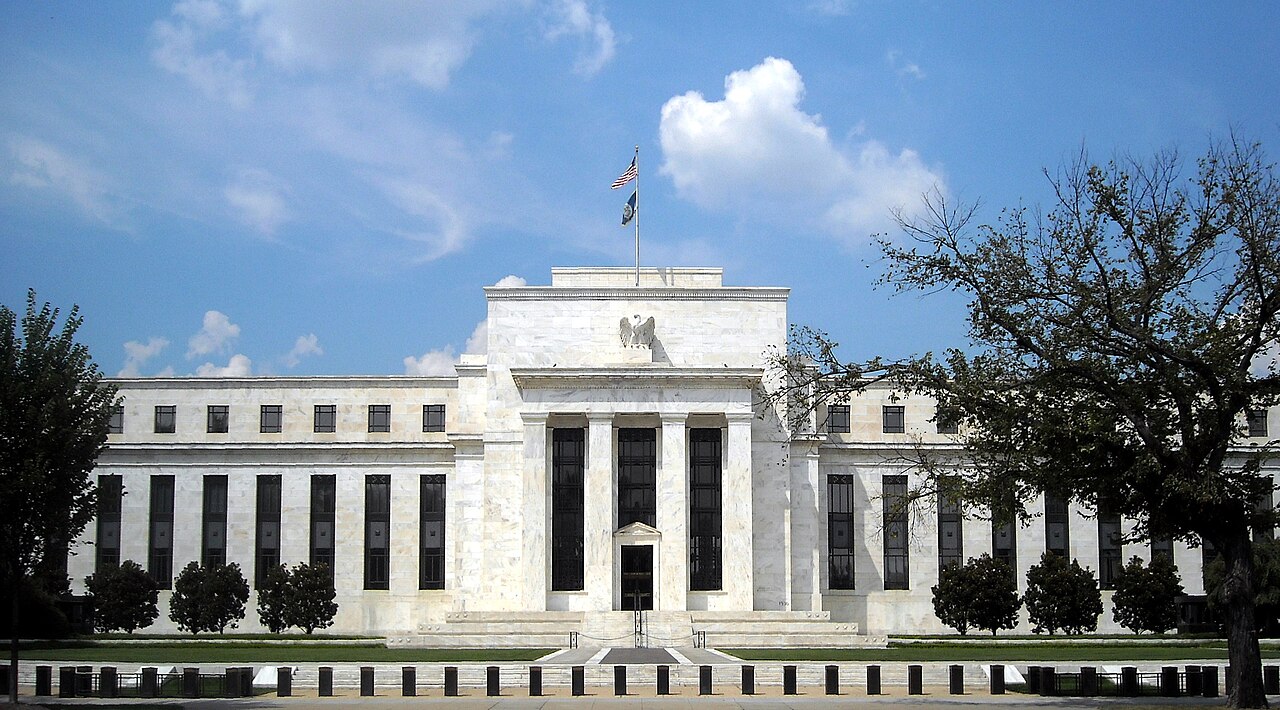
Via Wikimedia Commons: Marriner S. Eccles Federal Reserve Board Building by AgnosticPreachersKid, CC BY-SA 3.0.
Independence: the Bank of England in 1997
Whether a central bank sets its own interest rate is a matter of law and practice, and the Bank of England's 1997 change is a documented example. On 6 May 1997, four days after taking office, the Chancellor of the Exchequer announced that the Bank would have operational responsibility for setting short-term interest rates to achieve an inflation target.[5] The government would set the target and the Bank was charged with meeting it.[5] The Bank's August 1997 Quarterly Bulletin called these the most important institutional and operational changes at the Bank since nationalisation in 1946.[5]
Rate decisions were to be made by a new Monetary Policy Committee, in which each member has one vote, the Governor has a casting vote if there is no majority, and a Treasury representative may attend and speak but cannot vote.[5] On 12 June 1997 the Chancellor set a target of 2.5 percent for retail price inflation excluding mortgage interest payments (RPIX); the previous target had been "2.5% or less", which the Treasury said had caused confusion.[5] If inflation strays by more than one percentage point either side of the target, the Governor must write an open letter to the Chancellor explaining why.[5]
The independence was limited. In extreme economic circumstances, if the national interest demanded it, the government kept the power to give instructions to the Bank on interest rates for a limited period, to be exercised only through subordinate legislation approved by Parliament.[5] The Bulletin describes the Committee's meeting of 5 to 6 June 1997 as the first decision by the independent Bank to change interest rates.[5]
The European Central Bank and the euro
The Maastricht Treaty was signed on 7 February 1992 and, because of delays in ratification, took effect only on 1 November 1993.[6] The appointments of the Executive Board took effect on 1 June 1998 and marked the establishment of the European Central Bank (ECB).[6] Stage Three of economic and monetary union began on 1 January 1999, when the exchange rates of the 11 initial participating currencies were irrevocably fixed.[6] The ECB and the national central banks of the participating member states together make up the Eurosystem.[6]
The ECB describes its primary objective as maintaining price stability, that is, preserving the purchasing power of the euro.[7] It notes that the Treaty does not define price stability precisely.[7] After a strategy review concluded in July 2021, the Governing Council judged that price stability is best maintained by aiming for 2 percent inflation over the medium term, and it treats deviations below and above that target as equally undesirable.[7]
The Federal Reserve's mandate and tools
The Federal Reserve Act directs the Federal Reserve to conduct monetary policy "so as to promote effectively the goals of maximum employment, stable prices, and moderate long-term interest rates", which the Board calls the dual mandate.[8] Policy decisions are made by the Federal Open Market Committee, which includes the members of the Board of Governors, the president of the Federal Reserve Bank of New York and four of the other eleven Reserve Bank presidents, who serve rotating one-year terms.[8] The Board names as the Committee's primary tool its target for the federal funds rate, which it defines as the interest rate that banks pay to borrow reserve balances overnight.[8] It also names the interest rate paid on banks' reserve balances, forward guidance (communication about the likely future path of policy) and, during the 2007 to 2009 crisis, large-scale purchases of longer-term securities.[8]
As of its last update on 15 December 2025, the Board's list of policy tools includes open market operations, the discount window, reserve requirements, interest on reserve balances and overnight reverse repurchase agreement operations, among others.[9] On 15 March 2020 the Board announced that it was reducing reserve requirement ratios to zero percent, effective 26 March 2020, which eliminated reserve requirements for all depository institutions.[10]
Sources
- European Central Bank, "What is a central bank?", explainer, 10 July 2015. ecb.europa.eu/explainers/tell-me/html/what-is-a-central-bank.en.html
- Bank of Canada, "What is a central bank?", web page (accessed 28 November 2026). bankofcanada.ca/2026/05/what-is-a-central-bank/
- Bank of England, "History of the Bank", web page (accessed 28 November 2026). bankofengland.co.uk/about/history
- Federal Reserve History, "Federal Reserve Act Signed into Law", written as of 22 November 2013. federalreservehistory.org/essays/federal-reserve-act-signed
- Bank of England, "Changes at the Bank of England", Quarterly Bulletin, August 1997. bankofengland.co.uk/-/media/boe/files/quarterly-bulletin/1997/chang…
- European Central Bank, "A single currency: the road to the euro" history pages (Economic and Monetary Union), web page (accessed 28 November 2026). ecb.europa.eu/ecb/history/emu/html/index.en.html
- European Central Bank, "Price stability", web page (accessed 28 November 2026). ecb.europa.eu/mopo/strategy/pricestab/html/index.en.html
- Board of Governors of the Federal Reserve System, "Monetary Policy: What Are Its Goals? How Does It Work?", web page, last updated 29 July 2021. federalreserve.gov/monetarypolicy/monetary-policy-what-are-its-goal…
- Board of Governors of the Federal Reserve System, "Policy Tools", web page, last updated 15 December 2025. federalreserve.gov/monetarypolicy/policytools.htm
- Board of Governors of the Federal Reserve System, "Reserve Requirements", web page, last updated 26 November 2025. federalreserve.gov/monetarypolicy/reservereq.htm
