London is the capital city of the United Kingdom, built astride the River Thames about 50 miles (80 km) upstream from the river's estuary on the North Sea.[1]
Overview
London grew from Londinium, a town the Romans founded on the River Thames in the years after their invasion of Britain in AD 43.[7][8]
The name "London" is used in more than one sense. The City of London is a small area of 1.12 square miles at the centre, with its own ancient form of local government.[3] Greater London is the wider administrative area, made up of the City and 32 London boroughs, which was formed as a metropolitan county in 1965.[1][2]
Geography
Britannica gives the area of Greater London as 607 square miles (1,572 square km), with the city lying astride the Thames.[1] The Romans placed their town on slightly raised ground north of the river's marshes, with a bridge giving access from the land to the south.[7]
The original walled city was small. The Roman wall that enclosed it was roughly 2.5 miles long and surrounded about 134 hectares (a hectare is 10,000 square metres), according to English Heritage.[10] The City of London Corporation, which governs the City, also looks after more than 11,000 acres of green spaces, including Hampstead Heath and Epping Forest.[3]
People
Population figures for London come from the Office for National Statistics (ONS), the United Kingdom's official statistics body, and are republished by the Greater London Authority (GLA). The GLA's London Datastore states that the ONS mid-year estimate for 2023, published in July 2024, put London's population at 8.95 million.[4] In its regional economic bulletin published on 23 September 2026, the ONS listed London's population for 2024 as 9.1 million.[20]
The ONS population estimates for mid-2025, published on 29 July 2026, reported that London's population decreased by 0.29% in the year to mid-2025, the first decrease since the year to mid-2021.[5] The ONS explained that London still had more births than deaths, and more people arriving from abroad than leaving for abroad, but that these gains were more than offset by people moving from London to other parts of the United Kingdom; every other region of England grew in that year.[5]
London's population is highly international. In the 2021 census, 40.6% of London's usual residents had been born outside the United Kingdom and 23.3% held a non-UK passport, up from 36.7% and 21.0% in 2011, according to the ONS.[6] The ONS also reported that 18 of the 20 local authority areas in England and Wales with the highest share of residents born outside the UK were in London.[6]
History
Roman Londinium
Britannica dates the start of the Roman occupation of Britain to AD 43, under the Emperor Claudius, and records that the first written mention of London dates to AD 60.[7] Archaeology gives a closer date for the town's beginnings. In a 2011 excavation report on the 1 Poultry site in the City, the archaeologists Julian Hill and Peter Rowsome of Museum of London Archaeology (MOLA) describe a timber drain of AD 47/8 beneath the main Roman road as the earliest securely dated structure yet known from Londinium.[8]
The London Museum describes London in the first century as a thriving Roman town, but not yet a capital.[9] Around AD 60 it was attacked and burned in the rebellion led by Boudica, queen of the Iceni; buildings were burned and people living there were killed, and the museum notes that archaeologists have found thick layers of burned debris in central London.[9] The MOLA report dates a pottery shop destroyed in the revolt to AD 60/1.[8] Boudica and her followers were eventually defeated.[9]
From about AD 200 the Romans built a stone wall around Londinium, and between AD 250 and 270 a riverside wall about 1,700 metres long was added along the north side of the Thames, completing the circuit, according to English Heritage.[10]
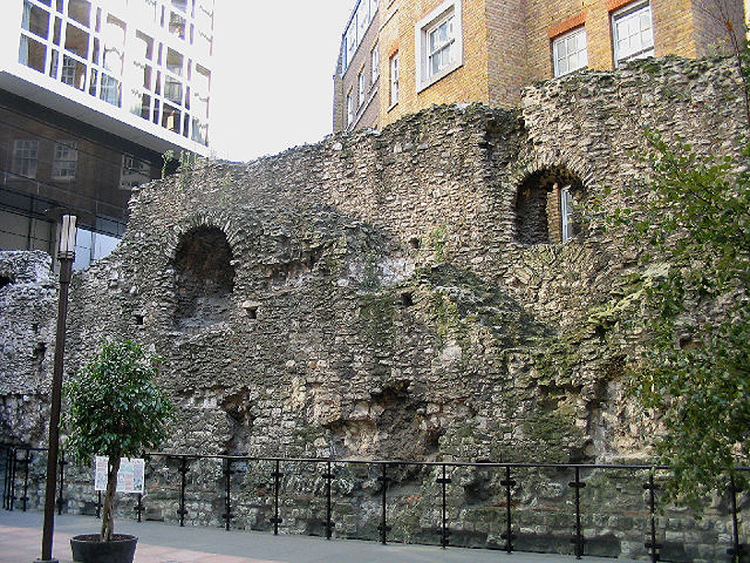
A surviving fragment of the 3rd-century Roman London Wall behind Tower Hill Station, photographed on 10 October 2005.
An earlier Saxon town, Lundenwic, stood to the west of the old Roman city.[11] The London Museum records that the Anglo-Saxons seem to have regained control of the London area from occupying Viking forces in about 880, when the West Saxon king Alfred could lay claim to it, and that in 886 Alfred re-established London by founding "Lundenburg" within the old Roman walls and abandoning Lundenwic.[11] The walls were renewed and extended in the medieval period to protect the city from attack and to control access to it.[10]
In the 11th century Edward the Confessor built a palace and a church on Thorney Island, the beginnings of the Palace of Westminster and Westminster Abbey; Historic England's World Heritage listing states that all sovereigns since the 11th century have been crowned in the Abbey, and that the buildings have symbolised monarchy, religion and power since Edward's time.[12] The White Tower at the heart of the Tower of London is described in its listing as a typical example of Norman military architecture, and the Tower as the most complete example of an 11th-century fortress palace remaining in Europe.[13]
Fire and rebuilding
The Great Fire of London, which burned from 2 to 5 September 1666, was the worst fire in the city's history.[15] It began accidentally in the house of the king's baker in Pudding Lane, near London Bridge, and destroyed a large part of the City, including old St Paul's Cathedral, 87 parish churches and about 13,000 houses, according to Britannica.[15] Plans to straighten the streets were not adopted, but Christopher Wren designed the new St Paul's Cathedral and many of the churches around it.[15] The fire is commemorated by the Monument, a column put up in the 1670s near where it began.[15]
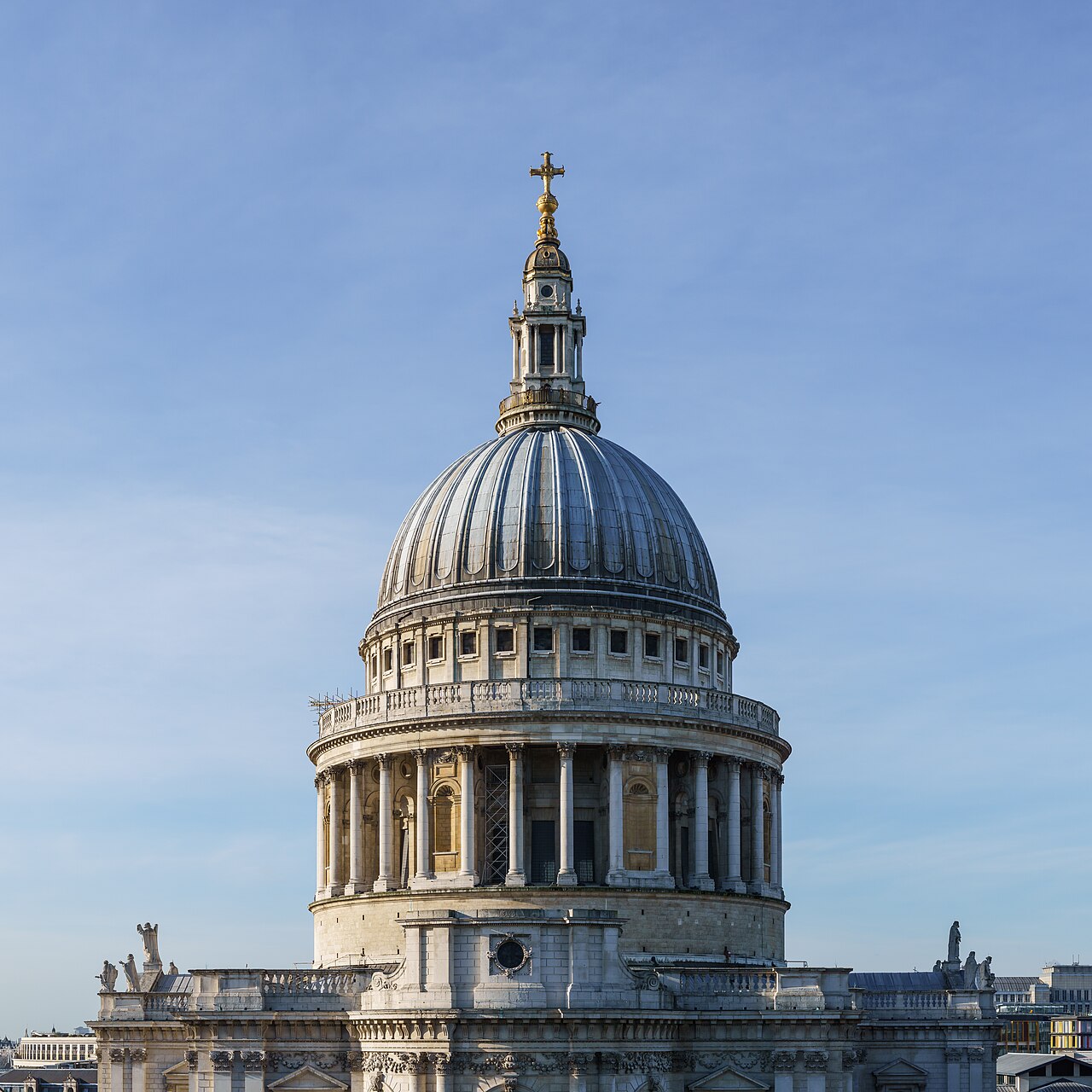
The dome of St Paul's Cathedral seen from the roof terrace of One New Change, photographed on 24 January 2015.
The Palace of Westminster was rebuilt from 1840 on the site of important medieval remains.[12] From the 1840s, railway building, and later property redevelopment and road building, destroyed large sections of the old city wall.[10]
The 20th century to the present
During the Second World War, London was bombed heavily in the Blitz, a campaign by Nazi Germany from September 1940 to May 1941.[16] Britannica estimates that 43,000 Londoners died and a further 50,000 were injured, and that more than 70,000 buildings were destroyed.[16] Greater London was created as a single administrative area in 1965.[1] After a referendum in 1998, Londoners gained a directly elected Mayor and an elected London Assembly, and the office of Mayor of London was created in 2000.[2][17]
London has hosted the Summer Olympic Games three times, in 1908, 1948 and 2012, according to Guinness World Records, which notes that the 1948 Games were known as the "Austerity Games" after the Second World War.[25]
Government
Greater London Authority
The Greater London Authority (GLA), based at City Hall, consists of one Mayor and 25 Assembly Members, all elected by Londoners.[2] Its role and powers come from the Greater London Authority Act 1999, amended by the Greater London Authority Act 2007 and further changed by the Localism Act 2011.[2] The Mayor is elected every four years, sets an overall vision for London, and must publish statutory strategies (citywide plans required by law): the London Plan for development, and strategies for transport, housing, the environment, economic development and culture.[2] The London Assembly acts as a watchdog that holds the Mayor to account, mainly through Mayor's Question Time and its committees, and the Mayor must consult it on these strategies and on the budget.[2]
The GLA group of bodies includes Transport for London (TfL), the Mayor's Office for Policing and Crime, the London Fire Commissioner and two development corporations.[2] Central government remains responsible for areas such as health care, foreign policy, defence, welfare and most taxation.[2]
Sadiq Khan of the Labour Party was elected Mayor in 2016, becoming the first Muslim mayor of the British capital, and won his third consecutive election in May 2024 with 43.8% of the vote, Reuters reported.[18] ITV News reported on 15 September 2026 that he had taken his place in the House of Lords as Lord Khan of Tooting while remaining Mayor, that he had become the longest-serving Mayor of London, and that his term ends in 2028.[17] As of November 2026, the London Elects website states that the next elections for the Mayor of London and the London Assembly are on Thursday 4 May 2028.[19]
Boroughs and the City of London Corporation
Local services are provided by 33 local authorities: the 32 London borough councils and the City of London Corporation.[2] According to the GLA, these councils handle services such as council housing, waste collection, parking, schools, collection of council tax (the local property tax), leisure, social care and public health.[2]
The City of London Corporation is headed by the Lord Mayor, and its main decision-making body is the Court of Common Council.[3] The Corporation describes its government as the oldest in the country, with origins older than Parliament, and the City has its own independent police force.[3] The Corporation also runs the Billingsgate, Smithfield and New Spitalfields wholesale food markets.[3]
Economy
In its bulletin published on 23 September 2026, the ONS reported that London's gross domestic product (GDP, the total value of goods and services produced) at current market prices was £656,291 million in 2024, against £2,884,006 million for the United Kingdom as a whole; the ONS marks the 2024 figures as provisional.[20] London had the highest GDP per head in 2024 among the United Kingdom's largest statistical regions (known as ITL1, International Territorial Level 1), at £72,201, while the North East of England had the lowest, at £29,957.[20] The ONS left the City of London and Westminster off its map of GDP per head because their values are large outliers.[20]
The City is a place of work far more than a place to live: the City of London Corporation reports that it counts 8,600 residents but 678,000 workers.[3]
Transport
Transport for London (TfL) is part of the GLA group.[2] TfL's Travel in London 2025 report, published in December 2025, gave provisional figures for the year 2024/25: about 3.6 billion journeys across London's main public transport modes, including 1,842 million bus journeys, 1.5% fewer than in 2023/24, and 1,216 million London Underground journeys, 3.0% more than the 1,181 million of 2023/24.[22] The same report estimated overall travel demand across all modes in London in 2024 at 26.6 million trips on an average day.[22]
TfL announced on 4 May 2022 that the Elizabeth line would open on 24 May 2022, with trains running between Paddington and Abbey Wood.[21] TfL later reported that the line carried an estimated 231 million passengers in 2024/25, a 10.1% increase on the year before; that it carries around 800,000 journeys a day, with more than 600 million in its first three years of operation to May 2025; and that one in every eight journeys on TfL's rail network in London involves the line.[22]
Culture and landmarks
London has four World Heritage Sites, places listed by UNESCO as being of outstanding universal value: the Palace of Westminster and Westminster Abbey, including St Margaret's Church; the Tower of London; Maritime Greenwich; and the Royal Botanic Gardens, Kew.[23] The Westminster site was inscribed in 1987 and the Tower of London in 1988.[12][13] When it inscribed the Tower, UNESCO's World Heritage Committee regretted the building of the nearby Tower Hotel and suggested that the listing be extended to Tower Bridge, which it said forms a coherent whole with the Tower.[14]
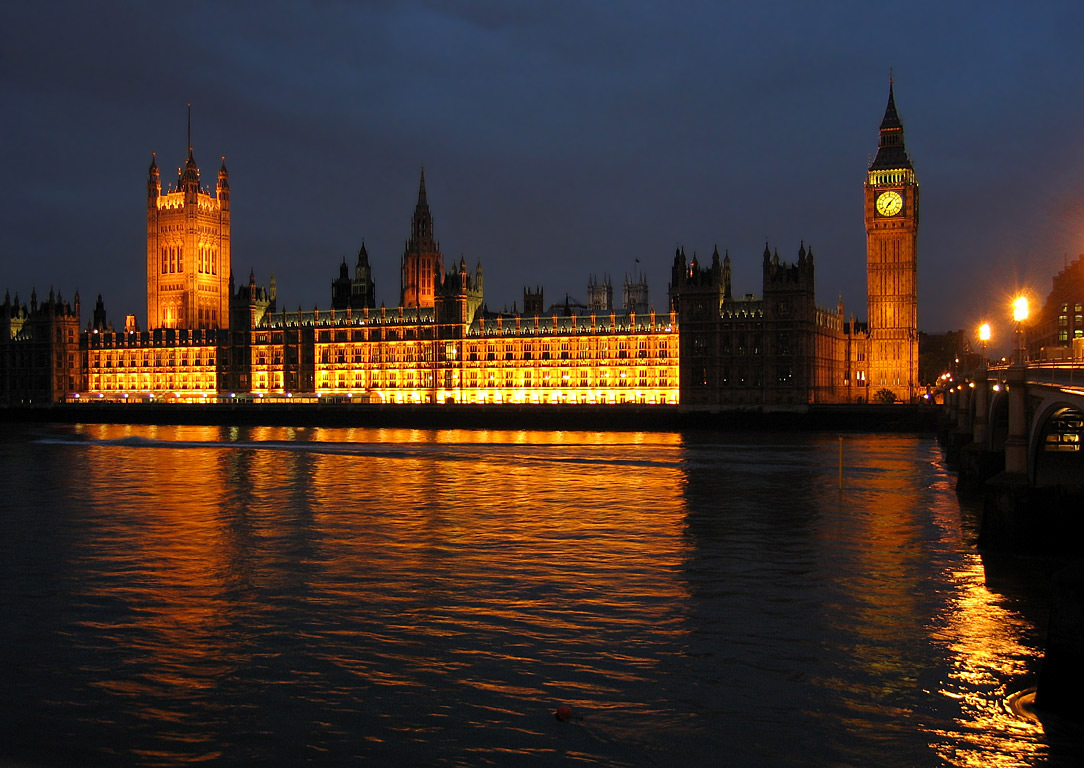
The Palace of Westminster at night, seen from the south bank of the River Thames, photographed on 29 September 2004.
Surviving sections of the Roman and medieval wall can still be seen. At Tower Hill one stretch stands 10.7 metres above present ground level, and its lower 4 metres are Roman work, marked by horizontal bands of red tiles, according to English Heritage.[10]
The Theatre in the UK 2026 report, published by the Society of London Theatre and UK Theatre, counted 17.64 million attendances at West End theatres in 2025, almost three million more than Broadway, WhatsOnStage reported on 11 March 2026.[24]
Sources
Encyclopaedia Britannica, "London". Encyclopaedia Britannica. No date shown; accessed 28 November 2026. britannica.com/place/London
Greater London Authority, "Demography" (London's Population). London Datastore. No date shown; accessed 28 November 2026. data.london.gov.uk/demography
Encyclopaedia Britannica, "London: History". Encyclopaedia Britannica. No date shown; accessed 28 November 2026. britannica.com/place/London/History
Julian Hill and Peter Rowsome, "Roman London and the Walbrook stream crossing: excavations at 1 Poultry and vicinity, City of London" (record and abstract). Museum of London Archaeology (MOLA), 2011. mola.iro.bl.uk/concern/books/d38d0c04-20f6-482f-928c-e5b39a332859
Historic England, "Palace of Westminster, Westminster Abbey and St. Margaret's Church" (World Heritage Site, list entry 1000095). Historic England. No date shown; accessed 28 November 2026. historicengland.org.uk/listing/the-list/list-entry/1000095
UNESCO World Heritage Committee, "Inscription: The Tower of London (United Kingdom)", decision 12 COM. UNESCO World Heritage Centre, 1988; accessed 28 November 2026. whc.unesco.org/en/decisions/3699
London Elects, "Results 2000" (page banner on the next elections). London Elects. No date shown; accessed 28 November 2026. londonelects.org.uk/results-2000