Respiratory syncytial virus (RSV) is a common virus that infects the nose, throat, airways and lungs, usually causing mild cold-like illness but sometimes severe disease, especially in young infants and older adults.[1][2]
The virus
The World Health Organization (WHO) describes RSV as an RNA virus (a virus whose genetic material is RNA rather than DNA) in the family Pneumoviridae, with two genotypes, A and B.[2] A Centers for Disease Control and Prevention (CDC) page updated 24 February 2026 says some laboratory tests can tell subtypes A and B apart, but that the clinical significance of the subtypes is unclear.[6]
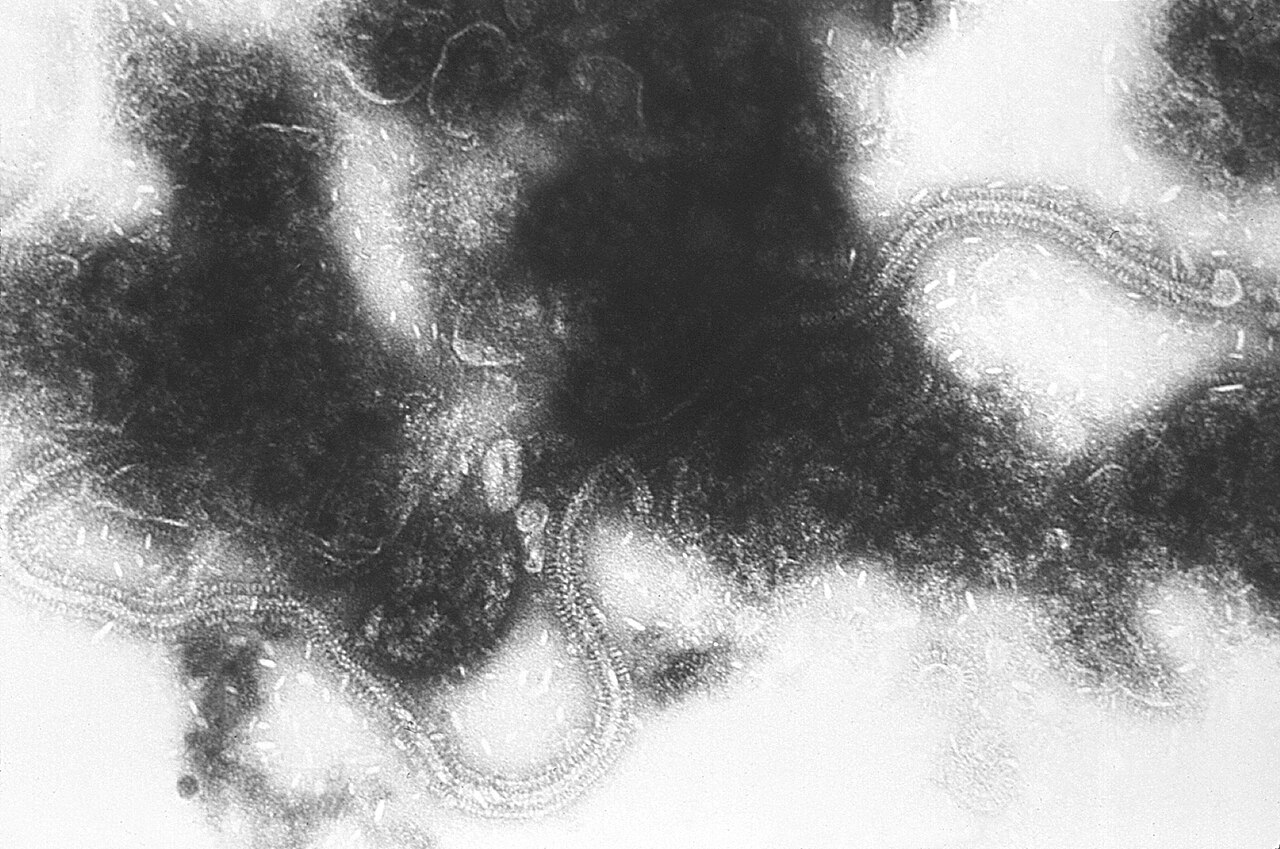
Electron micrograph of respiratory syncytial virus, 1981.
Via Wikimedia Commons: Respiratory syncytial virus 01 by Photo Credit: Content Providers(s): CDC/ Dr. Erskine Palmer, public domain.
How it spreads
According to a CDC page updated 20 February 2026, RSV spreads through droplets from coughs and sneezes, through direct contact with an infected person, and through touching contaminated surfaces.[3] The virus can survive for hours on hard surfaces and for shorter periods on soft ones.[3] The CDC says people are usually contagious for 3 to 8 days, beginning a day or two before symptoms appear, and that infants and people with weakened immune systems may spread the virus for 4 weeks or longer.[3]
Nearly all children are infected before the age of two, and people can be infected more than once during their lives.[3][2]
Seasonality
WHO states that in temperate climates RSV causes seasonal epidemics, usually in late autumn and winter, while tropical and subtropical areas see consistent months of high circulation each year without a clear seasonal pattern.[2] In the United States, the CDC says RSV usually peaks in December and January.[1] A CDC report of 19 November 2026 found that the 2025–2026 US season ran from late November 2025 to late April 2026 and peaked in the week ending 28 February 2026, later than in past seasons.[26]
Who is most at risk
WHO says infants, especially those under six months old, are at the highest risk of severe RSV disease and death, and that older adults and people with underlying illnesses are also at risk.[2] The CDC names infants under six months and adults who are older or have certain risk factors as those most likely to become seriously ill and need hospital care.[1] A CDC clinical page dated 18 August 2025 lists conditions that raise the risk for adults, among them chronic heart, lung, kidney and liver disease, moderate or severe immune compromise, nursing-home residence and frailty.[5]
The European Centre for Disease Prevention and Control (ECDC) names premature infants, infants under six months, people over 65 and people with weakened immune systems or conditions such as diabetes, heart disease or lung disease.[7] The National Health Service (NHS) in England names, among others, children born prematurely, adults over 75, and smokers and babies exposed to smoke.[8]
Signs and typical course
The CDC says symptoms usually include a runny nose, congestion, reduced appetite, coughing, sneezing, fever and wheezing, and that they tend to appear in stages rather than all at once.[4] In very young infants the only signs may be irritability, reduced activity and breathing difficulties.[4] Agencies give slightly different intervals between infection and symptoms: 4 to 6 days (CDC),[4] 4 to 7 days after exposure (WHO)[2] and two to eight days (ECDC).[7]
Most infections clear up on their own within one or two weeks, according to both the CDC and the NHS.[4][8] In more serious cases RSV can cause bronchiolitis, an inflammation of the small airways of the lungs, and pneumonia; the CDC calls it the most common cause of both conditions in children under one year old.[1] In adults, the CDC says RSV can worsen asthma, chronic obstructive pulmonary disease (COPD) and heart failure.[5]
Diagnosis
The CDC notes that RSV symptoms are not specific and overlap with those of other viral and some bacterial infections.[6] Its guidance, updated 24 February 2026, describes nucleic acid amplification tests (NAATs, which detect the virus's genetic material, such as rRT-PCR) as highly sensitive, and antigen tests (which detect viral proteins) as generally less sensitive but quicker.[6]
Burden of disease
WHO's fact sheet, dated 19 December 2025, says RSV causes over 3.6 million hospitalisations and about 100,000 deaths a year in children under five, and that 97% of these child deaths occur in low- and middle-income countries.[2] The same page says RSV causes up to 160,000 hospitalisations and 10,000 deaths a year among adults over 65 in the United States.[2]
In Europe, the ECDC estimates that RSV leads to the hospitalisation of around 250,000 children under five and roughly 156,000 adults each year across the European Union, Norway and the United Kingdom.[7] The UK Health Security Agency (UKHSA) gives approximately 33,500 hospitalisations a year in children under five and 20 to 30 deaths a year in the UK.[25] In the United States, the CDC's clinical page of 18 August 2025 says about 2 to 3% of infants under six months are hospitalised with RSV each year.[5] For the 2025–2026 season, CDC surveillance (RSV-NET) recorded cumulative hospitalisation rates of 790.2 per 100,000 infants aged 0 to 11 months and 352.1 per 100,000 adults aged 75 and older.[26]
Treatment
WHO states that there is no specific treatment for RSV and that care is supportive, such as suctioning secretions, intravenous fluids and supplemental oxygen.[2] The CDC says people with severe illness may need extra oxygen, fluids given into a vein, or intubation (a breathing tube) with mechanical ventilation, and that most such hospital stays last only a few days.[1]
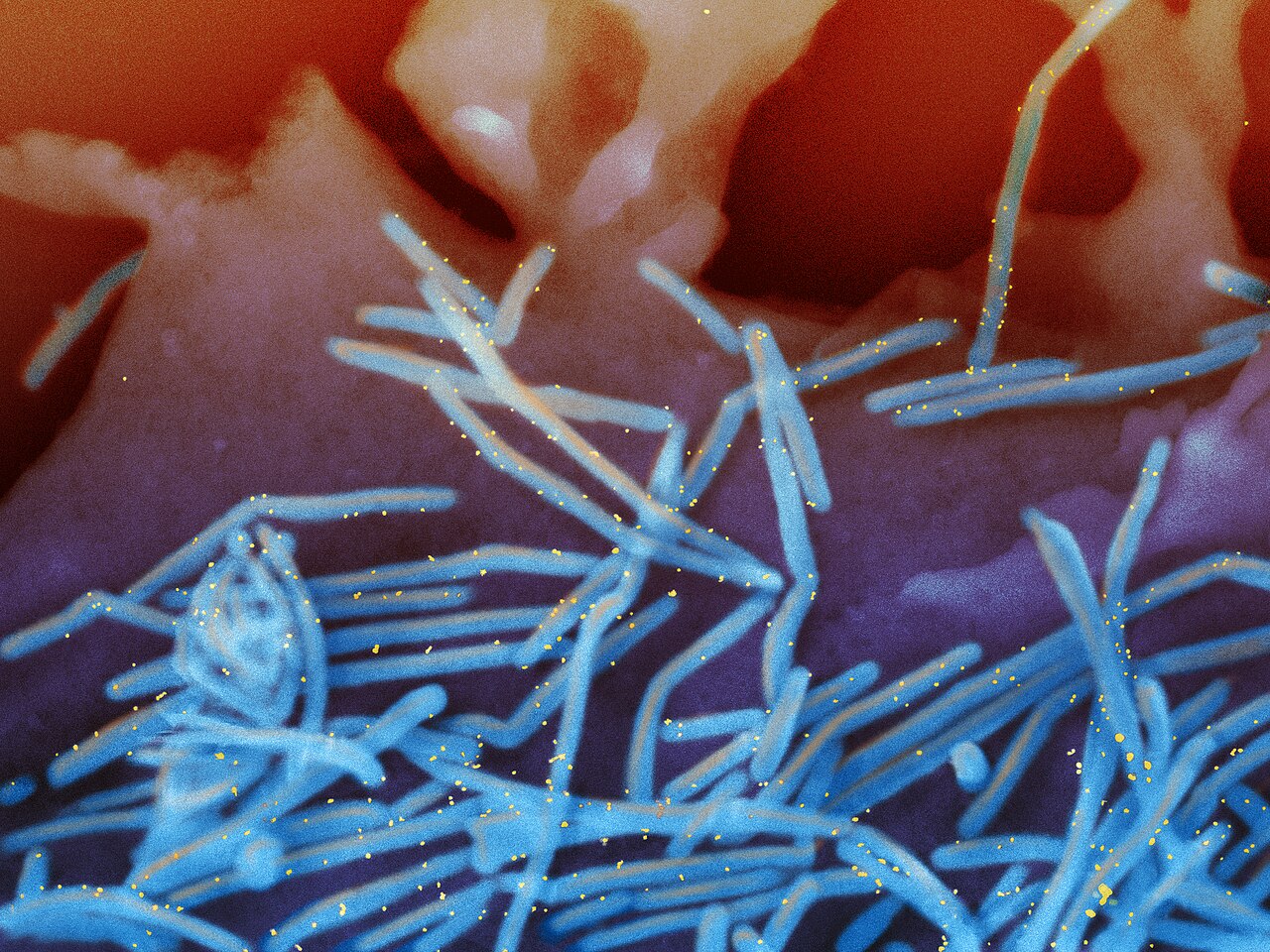
Colorized scanning electron micrograph of respiratory syncytial virus particles (blue), labelled with gold-tagged antibodies (yellow), shedding from human lung
According to a 2025 account in the journal mBio, the virus was first recovered from a chimpanzee with coryza (a runny-nose illness) by researchers at Walter Reed in the United States, who named it chimpanzee coryza agent (CCA); their report was published in 1956.[9] The collaborating laboratories of Robert Chanock and Bernard Roizman then isolated two viruses, known as "Long" and "Snyder", from children with lower respiratory illness and described them in 1957, and because the viruses formed syncytia (masses of fused cells) in tissue culture, Chanock and Laurence Finberg proposed grouping them with CCA under the name "respiratory syncytial".[9]
In the 1960s a vaccine made from virus inactivated with formalin produced antibodies but did not protect: vaccinated children who later caught RSV had worse disease than unvaccinated children, and 80% of those vaccinated needed hospital care at the time of the later infection.[9]
Vaccines and preventive antibodies
Two kinds of product are used: vaccines, which prompt the body's own immune response, and monoclonal antibodies, laboratory-made antibodies given directly.
Approvals
Palivizumab (Synagis): a monoclonal antibody for preventing serious RSV lower respiratory tract disease in children, first approved in the United States in 1998, according to its label.[15] A CDC page updated 18 August 2025 says palivizumab would no longer be available from 31 December 2025.[19]
Nirsevimab (Beyfortus): a long-acting monoclonal antibody. The European Medicines Agency (EMA) records an EU-wide marketing authorisation on 31 October 2022.[23] The US Food and Drug Administration (FDA) approved it on 17 July 2023 for newborns and infants born during or entering their first RSV season, and for children up to 24 months who remain vulnerable through a second season.[13]
Arexvy (GSK): approved by the FDA on 3 May 2023 for adults aged 60 and older, the first RSV vaccine approved in the United States.[10] As of 28 July 2026, the FDA's product page lists its use for adults 60 and older and for adults aged 18 to 59 at increased risk of RSV lower respiratory tract disease.[16]
Abrysvo (Pfizer): approved by the FDA for adults 60 and older in May 2023, and on 21 August 2023 as the first vaccine for pregnant individuals, for use at 32 through 36 weeks of pregnancy to protect infants from birth to six months of age.[11] The FDA noted more preterm births among vaccine recipients than placebo recipients (5.7% against 4.7%) and said the data were insufficient to establish or exclude a causal link.[11]
mRESVIA (Moderna): an mRNA vaccine approved by the FDA on 31 May 2024 for adults 60 and older.[12] A CDC page updated 24 February 2026 says the FDA has approved Abrysvo and mRESVIA for adults aged 18 to 49 at increased risk.[18]
Clesrovimab (Enflonsia, Merck): a monoclonal antibody approved by the FDA on 9 June 2025 for newborns and infants born during or entering their first RSV season.[14]
On 7 January 2025 the FDA required a warning about Guillain-Barré syndrome (GBS, a rare disorder in which the immune system damages nerves) in the prescribing information of Abrysvo and Arexvy, citing an increased risk in the 42 days after vaccination; it estimated 9 excess cases per million doses of Abrysvo and 7 per million of Arexvy in adults aged 65 and older, said the evidence was insufficient to establish a causal relationship, and concluded that the benefits continued to outweigh the risks.[17]
Recommendations
WHO's Strategic Advisory Group of Experts on Immunization (SAGE) issued recommendations on maternal RSV vaccines and long-acting monoclonal antibodies for infants in September 2024, and WHO published its position paper on 30 May 2025.[22] WHO's fact sheet of 19 December 2025 describes two recommended approaches for infants, maternal vaccination in the third trimester (from 28 weeks of pregnancy in most settings) and a long-acting monoclonal antibody for infants entering their first RSV season, and says WHO will issue recommendations on vaccines for older adults in the future.[2]
In the United States, a CDC page updated 24 February 2026 recommends RSV vaccination for all adults aged 75 and older and for adults aged 50 to 74 at increased risk of severe illness, and says the vaccine is not an annual vaccine.[18] For infants, a CDC page updated 18 August 2025 recommends either maternal vaccination with Abrysvo, given at 32 to 36 weeks of pregnancy, or an infant antibody (nirsevimab or clesrovimab), with nirsevimab also recommended for some children aged 8 to 19 months entering a second season.[19][5] On 5 January 2026 the US Department of Health and Human Services (HHS) announced that the acting CDC director had revised the childhood immunisation schedule, placing RSV among immunisations recommended for certain high-risk groups or populations rather than for all children.[20] On 16 March 2026 a federal district court, in American Academy of Pediatrics v. Kennedy, stayed those 5 January changes to the schedule, along with the appointments and votes of the reconstituted Advisory Committee on Immunization Practices, according to a George Washington University tracker of the case, which on 28 November 2026 showed an appeal filed in the First Circuit Court of Appeals. [21]
In the United Kingdom, UKHSA guidance updated 11 August 2026 says Abrysvo has been offered to pregnant women from week 28 of pregnancy since 1 September 2024, and that from 1 September 2026 the older-adult programme covers everyone aged 75 and over, residents of care homes for older adults, and people aged 65 to 74 who are immunosuppressed or have chronic respiratory disease.[25] In the EU/EEA, ECDC advice of 13 November 2025 reports that three countries used maternal vaccination alone and five offered it alongside long-acting antibodies.[24]
The bodies differ in several ways. WHO and UKHSA place maternal vaccination from 28 weeks of pregnancy, while the FDA label and the CDC use 32 to 36 weeks.[2][25][11][5] The CDC recommends adult vaccination from 75, or from 50 for people at increased risk, whereas the UK programme covers people from 75, or from 65 in certain groups.[18][25] WHO had not issued an older-adult recommendation as of its December 2025 fact sheet.[2]
How it differs from similar illnesses
The CDC says RSV symptoms are not specific, which makes RSV difficult to distinguish from the common cold, flu or COVID-19,[1] and the NHS calls RSV a common cause of coughs and colds.[8] A CDC page updated 27 April 2026 says influenza viruses, SARS-CoV-2 (the virus that causes COVID-19) and RSV can cause acute respiratory illnesses with similar signs and symptoms, and that multiplex tests, which check for several viruses at once, can identify these infections and help inform antiviral treatment decisions.[28]
In a CDC study of adults aged 60 and older hospitalised between February 2022 and May 2023, RSV hospitalisations were less frequent than those for COVID-19 or influenza but were associated with more severe disease, including more frequent oxygen therapy and intensive care admission.[27] WHO states that there is no specific treatment for RSV.[2] Separate entries cover Influenza (flu) and COVID-19.
European Centre for Disease Prevention and Control. "Respiratory syncytial virus (RSV)". ECDC, published 24 October 2023, last updated 3 September 2025. ecdc.europa.eu/en/respiratory-syncytial-virus-rsv
Casadevall, Arturo; Roane, Philip R.; Shenk, Thomas; Roizman, Bernard. "The Story behind the Science: On the discovery of respiratory syncytial virus". mBio 16(3): e03074-24, American Society for Microbiology, 21 January 2025. pmc.ncbi.nlm.nih.gov/articles/PMC11898631/
U.S. Food and Drug Administration, Center for Drug Evaluation and Research. "Approval Package for: Application Number 761432Orig1s000" (Enflonsia, clesrovimab-cfor; approval letter dated 9 June 2025). FDA, 2025. accessdata.fda.gov/drugsatfda_docs/nda/2025/761432Orig1s000Approv.pdf
European Centre for Disease Prevention and Control. "Rapid scientific advice on protecting infants against respiratory syncytial virus disease for the European 2025/26 winter season". ECDC, 13 November 2025. ecdc.europa.eu/en/publications-data/rapid-scientific-advice-protect…
Winn, Amber K., et al. "Respiratory Virus Activity — United States, July 2025–June 2026". MMWR Morbidity and Mortality Weekly Report 75(45): 662–668, CDC, 19 November 2026. cdc.gov/mmwr/volumes/75/wr/mm7545a2.htm
Centers for Disease Control and Prevention. "Disease Severity of Respiratory Syncytial Virus Compared with COVID-19 and Influenza Among Hospitalized Adults Aged ≥60 Years — IVY Network, 20 U.S. States, February 2022–May 2023". MMWR 72(40): 1083–1088, 6 October 2023. cdc.gov/mmwr/volumes/72/wr/mm7240a2.htm