COVID-19 (coronavirus disease 2019) is an infectious disease caused by the coronavirus SARS-CoV-2, which spreads mainly through the air and caused a global pandemic from 2020.[1][19]
The virus
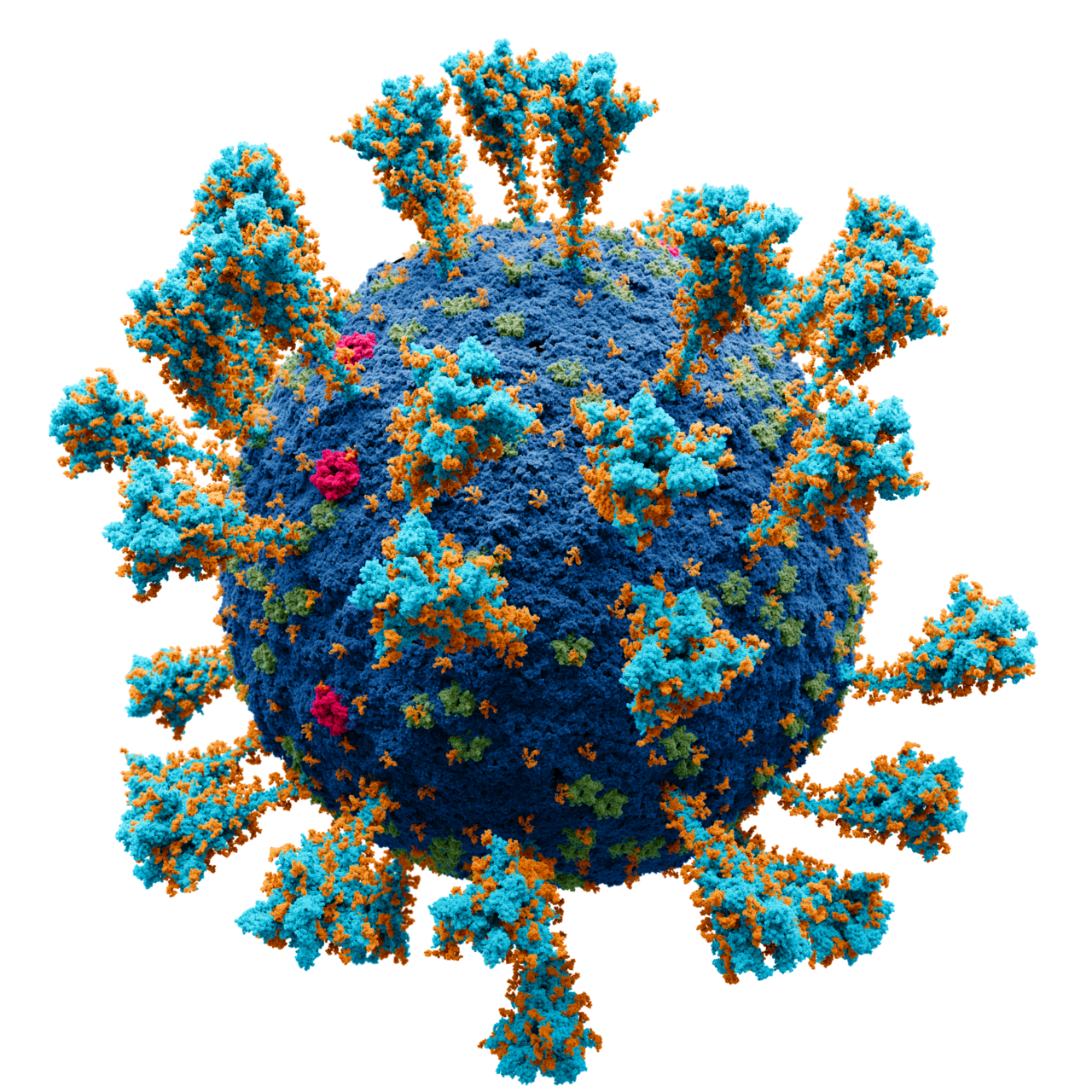
SARS-CoV-2 (severe acute respiratory syndrome coronavirus 2) is a coronavirus first identified in 2019.[3] A 2022 review in Nature Reviews Microbiology places it in the genus Sarbecovirus and gives its sequence similarity to SARS-CoV, the coronavirus that causes SARS, as 79%.[2] Its genome is a single strand of positive-sense RNA, meaning RNA that a cell can read directly to make viral proteins, and its particle is built from four structural proteins (membrane, nucleocapsid, envelope and spike) inside a fatty envelope taken from the host cell.[2] To enter a cell, the spike binds to a receptor called angiotensin-converting enzyme 2 (ACE2), and a host enzyme, TMPRSS2, then cuts the spike so that the virus can fuse with the cell.[2]
Computer-generated atomic model of the outer structure of a SARS-CoV-2 particle, 2021.
The World Health Organization (WHO) states in a fact sheet dated 27 November 2025 that the virus spreads through the air in infectious particles released when an infected person breathes, talks, coughs or sneezes, more readily in close contact or shared indoor spaces, and also through contaminated surfaces.[1] The fact sheet says that people can pass the virus on without having symptoms and that it circulates throughout the year without an established seasonal pattern.[1]
Symptoms and course
According to the same fact sheet, symptoms usually begin 3–6 days after exposure and last up to 10 days, though some people have symptoms for longer.[1] WHO lists fever, chills and sore throat as the most common symptoms with the variants then circulating; less common ones include muscle aches, tiredness, headache, a new persistent cough, shortness of breath and loss of taste or smell.[1] WHO states that most people recover fully without treatment, that older adults, people with underlying conditions and unvaccinated people are at higher risk of severe illness, and that children rarely develop a severe inflammatory syndrome a few weeks after infection.[1] A CDC page dated 17 September 2024 states that people are on average considered contagious for about eight days after symptoms begin.[3]
Longer-term effects
WHO calls lasting illness after infection post COVID-19 condition, widely known as long COVID.[4] Its fact sheet dated 26 February 2025 describes symptoms that usually start within 3 months of the initial illness and last at least 2 months, such as fatigue, muscle or joint aches, breathlessness, headaches and difficulty concentrating, and gives global estimates that 6 in 100 people with COVID-19 develop the condition.[4]
The US Centers for Disease Control and Prevention (CDC) uses a different time frame: its page dated 6 May 2026 defines Long COVID as a chronic condition that occurs after SARS-CoV-2 infection and is present for at least 3 months, and states that no approved laboratory test can determine whether symptoms are due to it.[5]
Testing
A CDC overview for health professionals, dated 29 August 2024, describes two main kinds of test for current infection.[6] Nucleic acid amplification tests (NAATs), which detect the virus's genetic material and of which PCR (polymerase chain reaction) tests are the most common, are described as highly sensitive and highly specific; antigen tests, which detect viral proteins, are described as similarly specific but less sensitive than most NAATs, and able to give results in minutes.[6] The page states that antibody testing does not diagnose current infection.[6]
The US Food and Drug Administration (FDA) allowed emergency use of the Pfizer-BioNTech vaccine from 11 December 2020 and on 23 August 2021 approved it as the first COVID-19 vaccine, marketed as Comirnaty, for people aged 16 and over.[7] The FDA said at the time that safety data showed increased risks of myocarditis and pericarditis (inflammation of the heart muscle and of the sac around the heart), particularly within seven days after the second dose.[7] As of November 2026, FDA product pages list approval letters for Moderna's Spikevax from 31 January 2022 to 27 August 2026, for Nuvaxovid from 16 May 2025 to 27 August 2026, and for mNEXSPIKE from 30 May 2025 to 27 August 2026.[8][9][10] The pages describe all three as approved for people aged 65 and over and for younger people with at least one condition that puts them at high risk of severe COVID-19, from age 6 months for Spikevax and from 12 years for the other two.[8][9][10] On 29 May 2026 the FDA advised manufacturers that 2026–2027 vaccines should target the XFG variant of the JN.1 lineage.[11]
Recommendations, and how agencies differ
WHO advises countries through its Strategic Advisory Group of Experts on Immunization (SAGE).[1] Its fact sheet of 27 November 2025 states that the vaccines have saved millions of lives but have limited impact on reducing transmission and that people at high risk of severe COVID-19 may need revaccination 6–12 months after their most recent dose.[1]
A CDC page for clinicians, updated 23 September 2026, states that a 2026–2027 COVID-19 vaccine is recommended for all adults aged 18 and over and for children aged 6 months to 17 years with moderate to severe immunocompromise, and that for other children it is recommended through shared clinical decision-making (a decision taken together with a clinician).[12] The page says that, because of legal uncertainties and inquiries, the recommendations of the July 2025 immunization schedule remain in effect for the 2026–2027 season.[12]
In the United Kingdom, the government announced on 23 March 2026 that it had accepted the advice of the Joint Committee on Vaccination and Immunisation (JCVI) for the autumn 2026 programme in England, covering adults aged 75 and over, residents of care homes for older adults, and people aged 6 months and over who are immunosuppressed.[13] The agencies thus differ in scope: WHO's advice centres on people at high risk, the UK programme is defined by age, care-home residence and immune status, and the CDC's 2026–2027 recommendation covers all adults.[1][12][13]
Treatment
WHO states that medical treatment exists, although most people recover from mild illness without it, and that health professionals choose treatment according to severity, the risk of worsening, and the person's age, symptoms, other conditions and individual factors.[1] On 25 May 2023 the FDA approved the oral antiviral Paxlovid (nirmatrelvir tablets and ritonavir tablets, co-packaged) for mild-to-moderate COVID-19 in adults at high risk of progression to severe disease, calling it the fourth drug, and first oral antiviral pill, that it had approved to treat COVID-19 in adults.[14]
Variants
Versions of the virus that carry distinct sets of mutations are called variants. On 31 May 2021 WHO introduced Greek-letter labels for key variants, saying that naming variants after the places where they were detected was stigmatizing and discriminatory; the labels did not replace scientific names such as those of GISAID, Nextstrain and Pango.[15] On 26 November 2021 WHO designated the variant B.1.1.529, first reported to it from South Africa two days earlier, a variant of concern named Omicron.[16]
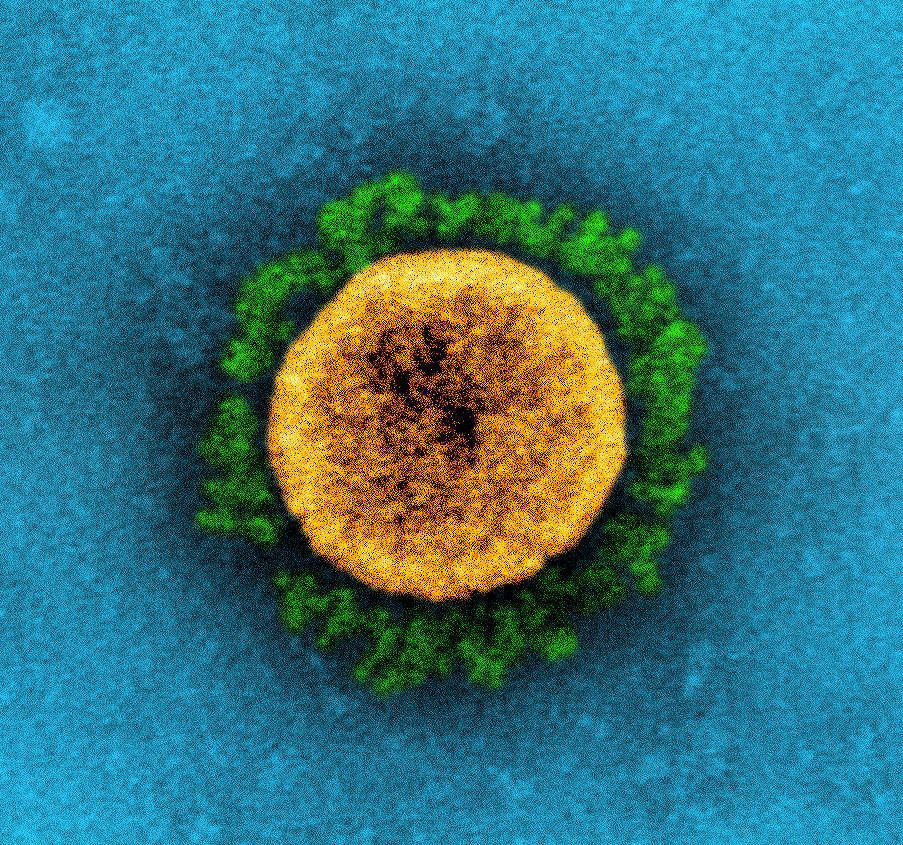
Transmission electron micrograph of a SARS-CoV-2 particle of the B.1.1.7 variant, with spike proteins shown in green, taken at the NIAID Integrated Research Fac
WHO's tracking page lists JN.1 as a variant of interest (as of 2 December 2024) and, as of 19 November 2026, five variants under monitoring: PQ.16.1.1, NB.1.8.1, XFG, BA.3.2 and PJ.2.1.[17] WHO's dashboard reported that XFG, the most prevalent, made up 52% of sequences submitted worldwide in the week ending 18 October 2026, and stated that available evidence suggests these variants do not pose additional public health risks compared with other circulating variants.[18]
The pandemic
On 11 March 2020, WHO Director-General Tedros Adhanom Ghebreyesus said that COVID-19 could be characterized as a pandemic, when there were more than 118,000 cases in 114 countries and 4,291 people had died.[19] On 5 May 2023, after WHO's Emergency Committee met for the 15th time and advised it, he declared COVID-19 over as a global health emergency, saying that almost 7 million deaths had been reported to WHO but that the true toll was several times higher, at least 20 million.[20]
WHO's fact sheet of 27 November 2025 reports nearly 780 million cases and more than 7.1 million deaths reported worldwide since December 2019, and over 13.64 billion vaccine doses given by the end of 2024.[1] For the 28 days from 12 October to 8 November 2026, WHO's dashboard reported 52,768 new cases from 61 countries and 849 new deaths from 33 countries.[18]
Origin
The origin of SARS-CoV-2 is disputed between two main positions, a natural spillover from animals to humans and an incident connected with research, set out below as their holders state them.
Natural spillover
A 2022 study in Science by Michael Worobey and colleagues reported that the earliest known cases, from December 2019, were geographically centred on the Huanan Seafood Wholesale Market in Wuhan, where live mammals susceptible to the virus were sold in late 2019 and virus-positive environmental samples were associated with stalls selling them; the authors concluded that the virus emerged through the live wildlife trade, while stating that the evidence was insufficient to define earlier events.[23] A 2024 study in Cell by Alexander Crits-Christoph and colleagues reported higher virus positivity near and within a wildlife stall and named animals including raccoon dogs as potential intermediate hosts, while stating that it was not possible to conclude which species may have been infected.[24]
On 27 June 2025, WHO's Scientific Advisory Group for the Origins of Novel Pathogens (SAGO), a panel of 27 independent experts, reported that the weight of available evidence suggests zoonotic spillover, either directly from bats or through an intermediate host, while stating that much of the information needed to evaluate all hypotheses fully had not been provided.[21] NPR reported in April 2025 that many scientists consider a natural origin, with spillover at a Wuhan wildlife market, more likely.[26]
Research-related incident
In January 2025 the US Central Intelligence Agency (CIA) said it assessed with low confidence that a research-related origin was more likely than a natural one, while saying both remained plausible; CBS News and the Associated Press reported that the finding did not rest on new intelligence, that the FBI under its then-director Christopher Wray had judged a laboratory escape most likely, and that the Department of Energy had earlier reached the same conclusion with low confidence.[25] NPR reported that a US House of Representatives investigation concluded in December 2024 that a lab leak was the most likely scenario, and that on 18 April 2025 the White House replaced government COVID-19 information websites with a page titled "Lab Leak: The True Origins of COVID-19".[26]
WHO's position
At a member-state briefing on 27 June 2025, the WHO Director-General said that all hypotheses must remain on the table, including zoonotic spillover and a lab leak.[22] He said that China had shared some, but not all, of the information WHO had requested, that neither WHO nor SAGO had had access to other governments' intelligence reports on the origin, and that one SAGO member had resigned and three others had asked for their names to be removed from the report.[22]
The Chinese government's position
A white paper issued by China's State Council Information Office on 30 April 2025 states that studies including the WHO-China joint study ruled out Wuhan as the natural origin and concluded that a laboratory leak in Wuhan is extremely unlikely, and calls for a thorough investigation of the virus's origins in the United States.[27] Responding to the CIA assessment in January 2025, foreign ministry spokeswoman Mao Ning cited the China-WHO joint expert team's conclusion that a laboratory leak was extremely unlikely, and a Chinese embassy spokesperson said China firmly opposed the politicization of the question.[25]
How it differs from similar illnesses
Flu and RSV are described in the entries Influenza (flu) and Respiratory syncytial virus (RSV). The CDC states that COVID-19 is caused by SARS-CoV-2 and flu by influenza viruses, and that COVID-19 spreads more easily than flu.[3] It gives the usual time from infection to symptoms as one to four days for flu and two to five days, and up to 14, for COVID-19, states that flu seems to cause more severe illness in young children, and states that because the two share many symptoms, testing is needed to confirm a diagnosis.[3]
The UK Health Security Agency (UKHSA), in a blog post of 8 October 2025, describes the common cold as caused by rhinovirus, with symptoms that come on gradually over 2 to 3 days and usually without the fever or body aches typical of flu, whose symptoms develop very rapidly.[28] It says that many people with COVID-19 have cold-like symptoms, some with fever or chills, and lists RSV symptoms as cough, wheezing, shortness of breath, tiredness and fever, with RSV circulating mainly from about November to February.[28]
Lamers, Mart M., and Bart L. Haagmans. "SARS-CoV-2 pathogenesis." Nature Reviews Microbiology 20, 270–284. Published 30 March 2022. nature.com/articles/s41579-022-00713-0
Centers for Disease Control and Prevention. "Similarities and Differences between Flu and COVID-19." CDC, 17 September 2024. cdc.gov/flu/about/flu-vs-covid19.html
Centers for Disease Control and Prevention. "Interim Clinical Considerations for Use of COVID-19 Vaccines in the United States." CDC, updated 23 September 2026. cdc.gov/covid/hcp/vaccine-considerations/index.html
World Health Organization. "Tracking SARS-CoV-2 variants." WHO, variants under monitoring listed as of 19 November 2026; accessed 28 November 2026. who.int/activities/tracking-SARS-CoV-2-variants
World Health Organization. "WHO COVID-19 dashboard: Summary." WHO Data, reporting period to 8 November 2026; accessed 28 November 2026. data.who.int/dashboards/covid19/summary
World Health Organization. "WHO Director-General's opening remarks at the Member State Briefing on the report of the Scientific Advisory Group for the Origins of Novel Pathogens - 27 June 2025." WHO, 27 June 2025. who.int/news-room/speeches/item/who-director-general-s-opening-rema…
Worobey, Michael, et al. "The Huanan Seafood Wholesale Market in Wuhan was the early epicenter of the COVID-19 pandemic." Science 377 (6609), 951–959. Published online 26 July 2022 (issue of 26 August 2022). doi.org/10.1126/science.abp8715
Crits-Christoph, Alexander, et al. "Genetic tracing of market wildlife and viruses at the epicenter of the COVID-19 pandemic." Cell 187 (19), 5468–5482.e11, 19 September 2024. pmc.ncbi.nlm.nih.gov/articles/PMC11427129/
National Health Commission of the People's Republic of China. "China releases white paper on Covid-19 prevention, control and origins tracing." 30 April 2025. en.nhc.gov.cn/2025-04/30/c_86425.htm