The 2026 FIFA World Cup was the 23rd edition of the men's international football championship, the first with 48 teams and 104 matches and the first shared by three host countries, Canada, Mexico and the United States; Spain won it.[1]
Choosing the hosts
The tournament was awarded at the FIFA Congress in Moscow on 13 June 2018, when member federations chose a joint bid from the United States, Mexico and Canada, known as the "United" bid, over Morocco, the only other candidate.[2] ESPN reported that the joint bid received 134 votes to Morocco's 65, that Iran chose neither option and that Cuba, Slovenia and Spain abstained.[2] Under a hosting process that FIFA had overhauled, each eligible member federation cast a public vote.[2] At the time of the vote, the bid planned for 60 of 80 matches to be played in the United States and 10 each in Canada and Mexico.[2]
Format
By the time of the vote, the 2026 tournament was already planned to have an expanded field of 48 teams.[2] The original plan for 2026 was 16 groups of three teams and 80 matches.[3] On 14 March 2023 the FIFA Council replaced this with 12 groups of four, from which the top two teams in each group and the eight best third-placed teams advanced to a new knockout round of 32.[3] The change raised the total from the 64 matches of recent tournaments to 104, and meant that the two finalists each played eight matches.[3] FIFA said the four-team groups reduced the risk of collusion (teams arranging a result that suits both), guaranteed every team at least three matches and gave competing teams balanced rest time.[3]
Under the schedule announced by FIFA in February 2024, 78 of the 104 matches were allotted to the United States and 13 each to Mexico and Canada, over 39 days.[5]
Qualification
The three host nations qualified automatically.[7] The other 45 places were decided through regional qualifying competitions and play-offs.[6][7] Sports Illustrated reported on 1 April 2026 that the field of 48 was complete after a final night on which Sweden, Bosnia and Herzegovina, Czechia and Türkiye won European play-off places, and Iraq and DR Congo won the inter-confederation play-offs.[6] Italy, the four-time champions, lost on penalties to Bosnia and Herzegovina and missed a third consecutive World Cup.[6] Türkiye qualified for the first time since 2002.[6] A Reuters list of the qualified teams published the same day identified four countries that had never qualified before: Uzbekistan, Jordan, Cape Verde and Curaçao.[7]
Host cities and stadiums
FIFA announced the 16 host cities in New York on 26 May 2022: 11 in the United States, three in Mexico and two in Canada.[4] Edmonton was the Canadian candidate left out.[4]
Country
City
Stadium (usual name)
United States
New York/New Jersey (East Rutherford)
MetLife Stadium
United States
Los Angeles (Inglewood)
SoFi Stadium
United States
Dallas (Arlington)
AT&T Stadium
United States
Atlanta
Mercedes-Benz Stadium
United States
Miami (Miami Gardens)
Hard Rock Stadium
United States
Houston
NRG Stadium
United States
Kansas City
Arrowhead Stadium
United States
Philadelphia
Lincoln Financial Field
United States
Boston (Foxborough)
Gillette Stadium
United States
Seattle
Lumen Field
United States
San Francisco Bay Area (Santa Clara)
Levi's Stadium
Mexico
Mexico City
Estadio Azteca
Mexico
Guadalajara (Zapopan)
Estadio Akron
Mexico
Monterrey (Guadalupe)
Estadio BBVA
Canada
Toronto
BMO Field
Canada
Vancouver
BC Place
Source for the table:[4]
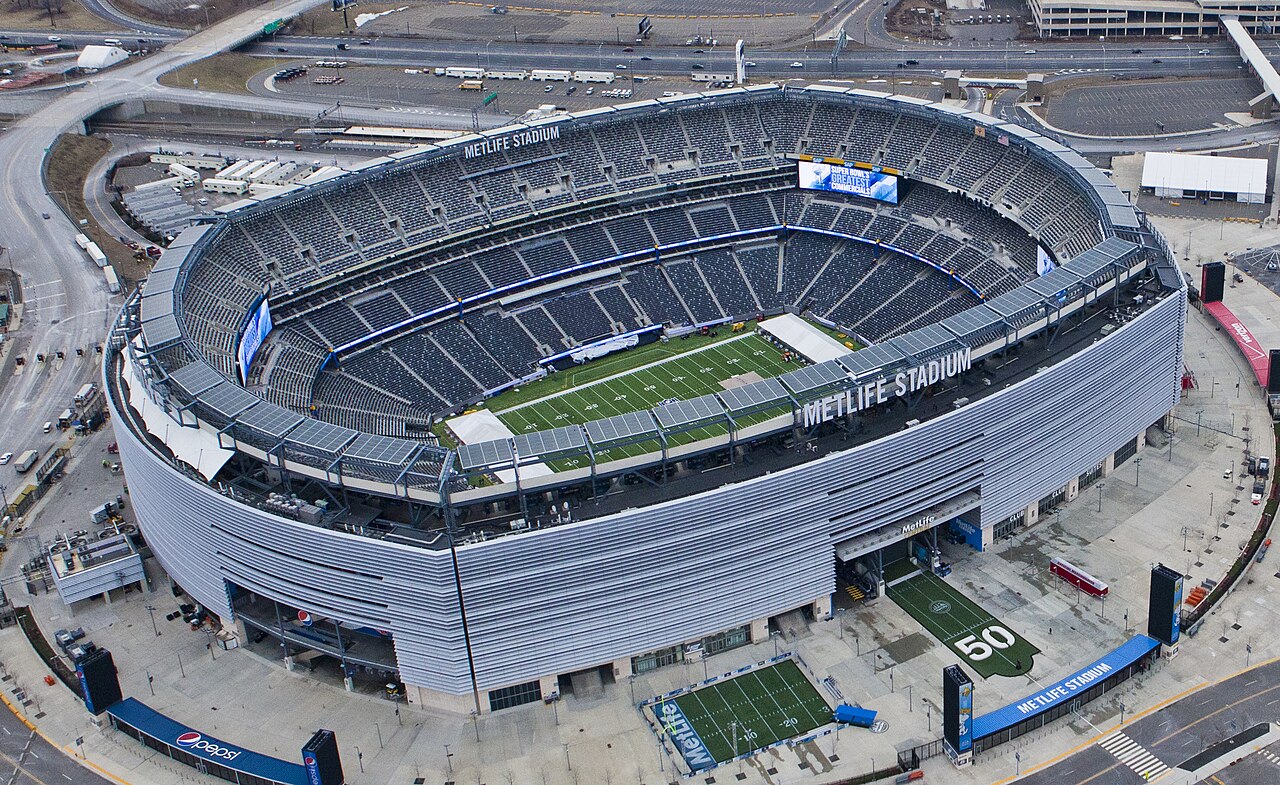
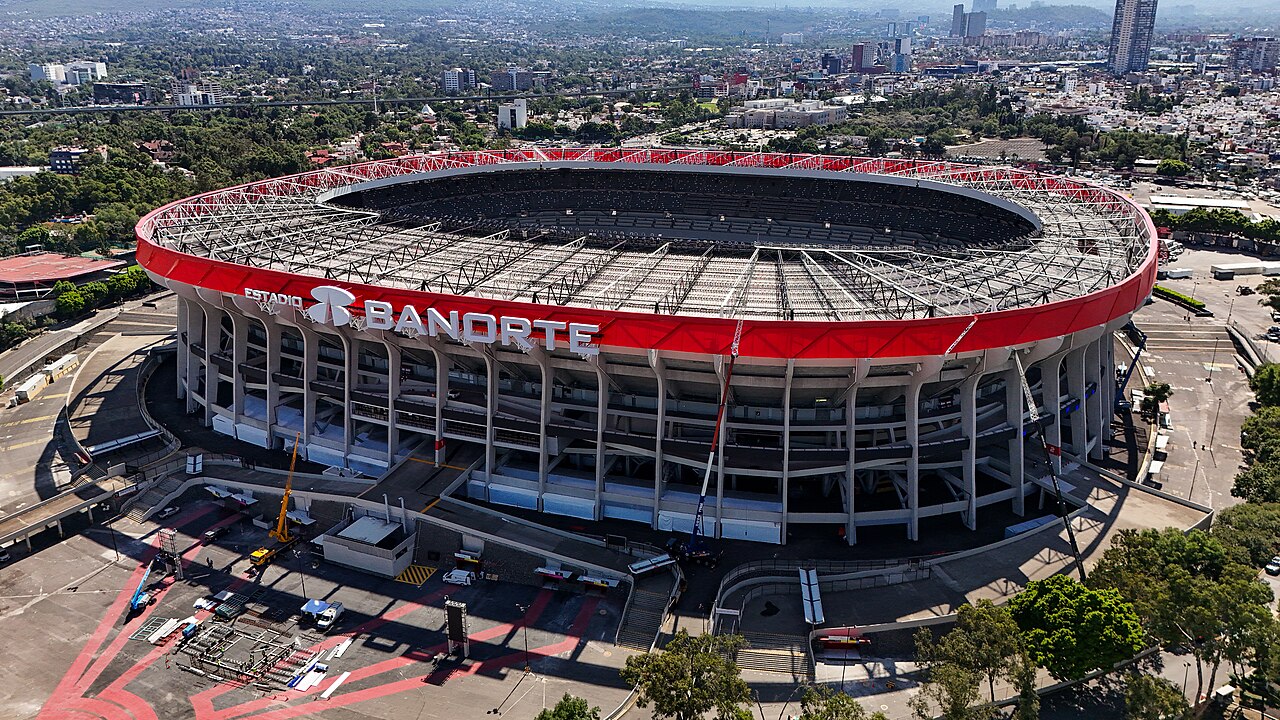
In February 2024 FIFA gave the opening match to Estadio Azteca in Mexico City on 11 June, the semi-finals to AT&T Stadium near Dallas and Mercedes-Benz Stadium in Atlanta, the third-place match to Hard Rock Stadium near Miami, and the final on 19 July to MetLife Stadium, which opened in 2010.[5] During the tournament FIFA and its media partners used non-commercial, city-based names for the venues, such as "New York New Jersey Stadium" and "Boston Stadium".[1][10]
An aerial view of MetLife Stadium in East Rutherford, New Jersey, on 20 January 2014.
Mexico opened the tournament on 11 June 2026 by beating South Africa 2–0 at Estadio Azteca, with goals from Julián Quiñones in the ninth minute and a header by Raúl Jiménez in the 66th, before what the Associated Press reported was a capacity crowd of 80,824.[8] In France's group match against Iraq on 22 June, Kylian Mbappé scored twice to reach 16 World Cup goals, equalling the career record held by Germany's Miroslav Klose, Fox Sports reported.[13]
Round of 32 and round of 16
All three hosts reached the knockout rounds.[29][30] The United States beat Bosnia and Herzegovina 2–0 in the round of 32 and then lost 4–1 to Belgium at the Seattle venue on 6 July in the round of 16, Fox Sports reported.[29] In the other round-of-16 matches involving the hosts, England beat Mexico 3–2 at Estadio Azteca and Morocco beat Canada 3–0, while Norway beat Brazil 2–1, AFP reported.[30]
Quarter-finals
France beat Morocco 2–0 at the Boston venue, with goals from Mbappé and Ousmane Dembélé, and Spain beat Belgium 2–1 in Los Angeles, with Mikel Merino scoring the winner in the 88th minute.[10] England needed a stoppage-time equaliser and an extra-time winner from Jude Bellingham to beat Norway, and Argentina beat Switzerland 3–1 after extra time.[9][10]
Semi-finals and third-place match
In the semi-finals, Spain beat France 2–0 near Dallas on 14 July, and Argentina came from behind to beat England 2–1 in Atlanta on 15 July.[9][11] In Atlanta, Anthony Gordon gave England the lead in the second half, Enzo Fernández equalised in the 85th minute and Lautaro Martínez scored the winner in the 90th.[12] England then beat France 6–4 in the third-place match on 18 July, the highest-scoring third-place play-off in World Cup history according to NBC.[9][11]
Final
The final was played on 19 July 2026 at MetLife Stadium in East Rutherford, New Jersey.[1][5] The score was 0–0 after 90 minutes, and Spain's Ferran Torres scored the only goal in the 106th minute of extra time to give Spain a 1–0 win over Argentina.[1] It was Spain's second World Cup title, and FIFA said Spain became the first nation to hold the men's and women's World Cup titles at the same time.[1] The final included a half-time show, curated by the musician Chris Martin and produced by the advocacy organisation Global Citizen.[1]
Awards and records
FIFA announced the individual awards after the final.[1] Spain's Rodri won the Golden Ball for the tournament's best player, Spain's Unai Simón won the Golden Glove for the best goalkeeper, and Spain's Pau Cubarsí won the Young Player Award.[1]
Fox Sports reported after the third-place match that Mbappé had scored 10 goals at the tournament, taking him past Lionel Messi in the race for the Golden Boot (the award for the top scorer), and 22 World Cup goals in his career, which it described as the most in the competition's history.[13] NBC Sports reported on 20 July 2026 that Mbappé won the Golden Boot with 10 goals, ahead of Messi with eight, and that Messi received the Silver Ball and Mbappé the Bronze Ball.[31]
According to FIFA, the tournament set an attendance record of 6,810,966 spectators across its 16 stadiums, and 308 goals were scored.[1] Other firsts included the 48-team format, the 104-match schedule and the three-country hosting arrangement.[1]
Money
As of 29 October 2026, FIFA had not published audited financial figures for the tournament.[14] Insider Sport reported on 29 October 2026, citing unnamed sources quoted by The Times, that ticket and hospitality sales had brought FIFA about $5 billion, against the $3.3 billion it had budgeted for that income.[14] The same report said that this was about a third of the roughly $15 billion that FIFA's president, Gianni Infantino, told member associations on the eve of the final that the tournament had generated, according to The Guardian, compared with FIFA's original projection of $11 billion.[14] For comparison, the 2022 World Cup in Qatar earned $929 million from tickets and hospitality.[14] FIFA declined to confirm the figures and said its financial results would appear in its next annual report after an audit.[14]
Disputes
Ticket prices
FIFA sold tickets under a pricing system in which prices were set by demand; Euronews described it on 15 June 2026 as the first dynamic pricing system used at a World Cup.[15] Euronews reported that tickets started at $140 for group matches, according to the Associated Press, and that the starting price of category 1 tickets for the final rose from $8,680 to $10,990 in April 2026 and to $32,970 in May.[15] FIFA also ran its own resale platform; Sports Illustrated reported in December 2025 that it charged a 15% fee to both buyer and seller.[17]
Football Supporters Europe (FSE), a fans' network, and the consumer group Euroconsumers wrote to FIFA saying that dynamic pricing "has no place in football" and that "the fact that scalping is legal doesn't mean FIFA must become the scalper", Sports Illustrated reported on 3 December 2025.[17] In response, FIFA said its model reflected existing market practice for major entertainment and sporting events in the host countries.[17] The same report said FIFA had promised not to use dynamic or variable pricing for its next batch of tickets.[17] Infantino defended the prices in May 2026, saying the United States was "the market in which entertainment is the most developed in the world" and that tickets sold too cheaply would be resold at much higher prices, according to Euronews.[15] Following criticism, FIFA offered 130,000 tickets at $60 to national federations for their regular supporters, and Fortune reported that $60 tickets were made available for every match.[15][16]
On 27 May 2026 the attorneys general of New Jersey, Jennifer Davenport, and New York, Letitia James, announced an investigation into FIFA's ticketing practices and sent subpoenas covering the eight matches played in New Jersey, including the final.[18] They cited reports that fans may have been misled about the location of the seats they bought, and asked why prices far exceeded those of any earlier World Cup; FIFA declined to comment.[18] As of the latest report found (May 2026), no outcome had been announced; this may have changed.
Visas and entry
Entry to the United States was a concern for several qualified countries.[19] ESPN reported in February 2026 that, under Presidential Proclamation 10998, the US government had expanded its suspension of visa issuance to nationals of 39 countries as of 1 January 2026, and that four of them, Haiti, Senegal, Ivory Coast and Iran, had qualified.[19] Players, team officials and their immediate families from those countries were to be granted visas, but ordinary fans faced an almost complete ban; a State Department spokesperson said that "a visa is a privilege" and that national-interest exceptions would be "quite rare".[19] FIFA pointed to a faster visa-interview process it had arranged with the US government for ticket holders, and said it was "not involved in host country immigration processes".[19]
Iran's participation was uncertain before the tournament.[20] ABC News reported on 6 June 2026 that Iran's sports minister had said in March that the team would not take part, during what ABC called the "U.S.-Israeli war on Iran", and that a ceasefire had been in place since 7 April.[20] A US official confirmed that the players had received visas; Iran's embassy in Turkey said a "large portion" of the support staff had been refused, which ABC did not independently confirm.[20] Secretary of State Marco Rubio said the government had "no problem" giving visas to the team but would not let other people be embedded in its delegation.[20] The team was expected to stay in Mexico, in part because of complications caused by US sanctions, and was scheduled to play its first match against New Zealand in Los Angeles on 15 June.[20]
Iran did play. The Associated Press (AP) reported on 28 June 2026 that it drew all three of its Group G matches, against New Zealand, Belgium and Egypt, finished third in the group with three points and missed the round of 32 by one place.[32] The team had to return to Mexico immediately after each of its first two matches, near Los Angeles, a restriction the United States later eased; coach Amir Ghalenoei said: "We were treated very, very badly."[32]
Politics
In October 2025, President Donald Trump said that World Cup matches could be taken away from Boston, criticising the city's mayor, Michelle Wu, the Associated Press reported.[21] FIFA's vice-president Victor Montagliani responded that "it's FIFA's tournament, FIFA's jurisdiction, FIFA makes those decisions", and the mayor's office said Boston was "honored and excited" to host.[21] The Boston venue went on to host France's quarter-final against Morocco.[10]
Immigration enforcement around matches was also disputed.[22] On 21 May 2026, Homeland Security Secretary Markwayne Mullin said in a video posted by Immigration and Customs Enforcement (ICE) that ICE and Homeland Security Investigations would "be out there every day" during the tournament against counterfeit tickets, human trafficking and drug smuggling; he did not rule out immigration arrests but said officers were not there to "round up" non-citizens.[22] A San Francisco Bay Area immigrant advocacy group, SIREN, said mixed federal messages had caused anxiety in immigrant communities.[22]
At the tournament draw at the Kennedy Center in Washington in December 2025, Infantino presented Trump with the first FIFA Peace Prize.[23] The London-based human rights group FairSquare filed a complaint with FIFA's ethics committee arguing that giving such a prize to a sitting political leader breached FIFA's duty of political neutrality, and Human Rights Watch also criticised the award; FIFA said it did not comment on potential cases.[23] Reuters reported on 8 September 2026 that more than 100,000 people had signed a further FairSquare complaint against Infantino alleging abuse of power and breaches of political neutrality, citing among other things the creation of the Peace Prize without FIFA Council approval and a request from Trump during the tournament to review a red card shown to US striker Folarin Balogun, which was later suspended.[24] According to FairSquare, the ethics committee had acknowledged the first complaint on 12 December 2025 but given no update since; as of that report no decision had been announced, and this may have changed.[24]
Player welfare and the schedule
The players' union FIFPRO raised concerns about workload and heat before the tournament.[27][28] Its September 2025 report on the 2024–25 season, "Overworked and Under-Protected", examined workload and rest, including the 2025 FIFA Club World Cup held in the United States, and its general secretary, Alex Phillips, said FIFPRO had had only "informal discussions" with FIFA about the 2026 World Cup.[28] Phillips said in July 2025 that FIFA was likely to be "more flexible" with kick-off times but that the union had "absolutely no power to force them to".[27]
Heat and weather
Heat at the 2025 Club World Cup, where some matches were played in temperatures above 38 °C (100 °F), prompted concern for 2026.[25][26] FIFPRO said the risk posed by kick-offs in very high temperatures was "real and growing" and urged football bodies to review kick-off times, while a sports ecologist, Madeleine Orr, said high-risk cities such as Miami, Monterrey, Philadelphia, Kansas City, Boston and New York should avoid the hottest afternoon hours, Reuters reported in June 2025.[26] FIFPRO wanted matches rescheduled or postponed when the wet-bulb globe temperature (a heat-stress measure that combines temperature, humidity, sun and wind) exceeded 32 °C, and compulsory cooling breaks between 28 °C and 32 °C.[27] On 8 December 2025 FIFA announced that every match, whatever the weather, would stop for a three-minute hydration break at the 22-minute mark of each half, saying the aim was to prioritise player welfare.[25]
A drone view of the Azteca Stadium in Mexico City, carrying the name Estadio Banorte, on 14 May 2026.