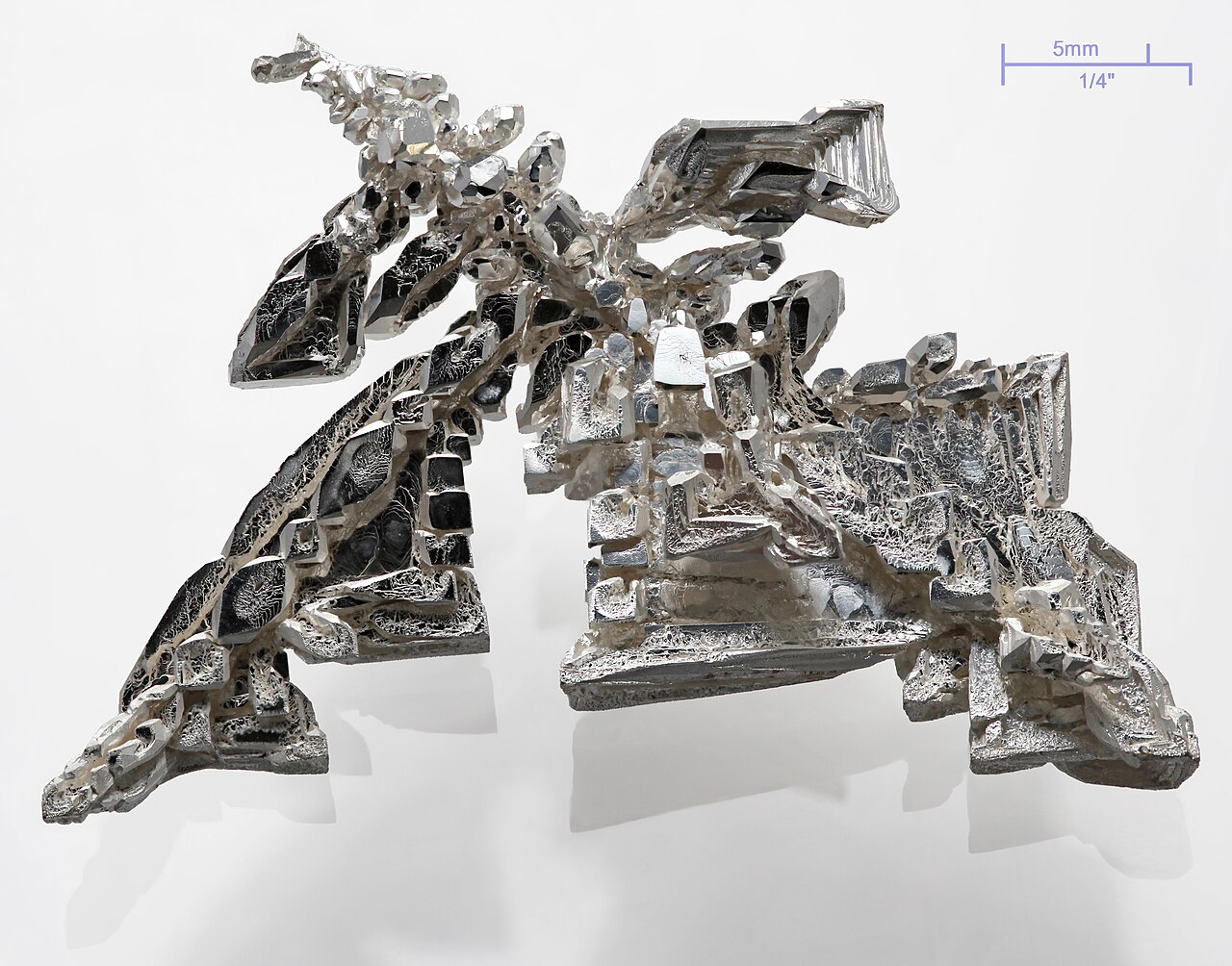
Silver is the chemical element with atomic number 47 and the symbol Ag, a metal in group 11 of the periodic table that has been known since prehistoric times and is used in jewellery, tableware, mirrors and electrical contacts.[1][3]
This entry is about the element. Its relative atomic mass is 107.868, it is in group 11 of the periodic table, and it is a solid at room temperature.[1] For its place in the table and its basic facts, see the [periodic table page for Silver](/element/Q1090/silver).
Properties
The Royal Society of Chemistry lists silver's melting point as 961.78 °C (1234.93 K), its boiling point as 2162 °C (2435 K), and its density as 10.5 g/cm³.[1] Its standard atomic weight is 107.8682(2), unchanged since 1985 according to the atomic weights commission of the International Union of Pure and Applied Chemistry; NIST gives the same value.[3][2]
Isotopes
Silver has two stable isotopes. The Royal Society of Chemistry gives their natural proportions as 51.839 percent for silver-107 and 48.161 percent for silver-109, and NIST gives 0.51839(8) and 0.48161(8).[1][2]
History and name
The Royal Society of Chemistry says slag heaps at ancient mines in Turkey and Greece show that silver was mined from about 3000 BC, and that the Laurium mines near Athens were operating from 600 BC. The atomic weights commission says silver was known in prehistoric times.[1][3] The name comes from the Anglo-Saxon siolfur, which the commission says is of unknown origin; the symbol Ag comes from the Latin argentum.[1][3]
Where it comes from
The Royal Society of Chemistry gives silver's crustal abundance as 0.055 parts per million. Most is extracted as a by-product from lead-zinc, copper, gold and copper-nickel ores, and in the electrolytic refining of copper. World production is about 20,000 tonnes a year according to the page, and Mexico, Peru and China are listed as the top three producers, without a date.[1]
Uses
The Royal Society of Chemistry lists jewellery and tableware (sterling silver is 92.5 percent silver), mirrors, dental alloys, solder, electrical contacts, batteries, silver salts in photography and antibacterial coatings. It says silver has no known biological role.[1]