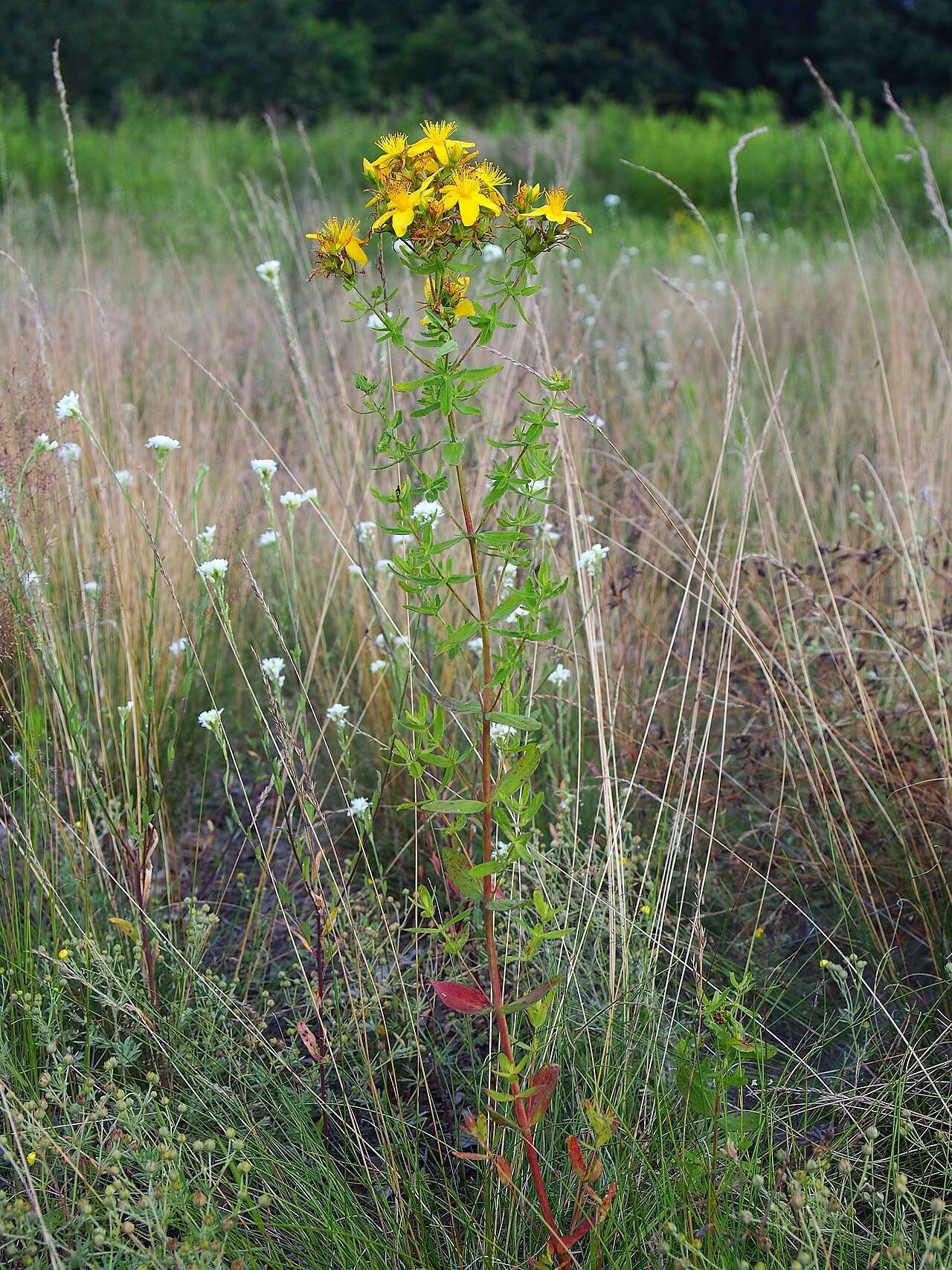

St. John's wort (Hypericum perforatum) is an easy perennial that does best in full sun and is quite forgiving of soil. Here's what it likes:
- Light: Full sun gives the strongest growth and flowering. Light afternoon shade is fine in Elk Grove, where summer highs often pass 95°F.
- Soil: Well-drained, average to poor soil. It tolerates sandy and rocky ground better than rich, wet soil, so avoid spots where water pools or where heavy clay stays soggy.
- Water: Water regularly the first season while the roots establish. After that it is fairly drought tolerant, so a deep watering every week or two in summer is usually enough.
- Timing: Fall planting in late October or November suits the Sacramento Valley's mild winters, and spring works too.
- Spacing: Leave about 18 to 24 inches between plants, since it spreads by rhizomes and self-seeds.
Because it spreads readily and is listed as invasive or noxious in parts of the western US, check the California Invasive Plant Council's inventory or your county agricultural office before planting it in the ground. A raised bed with a root barrier, or a large container, keeps it in place. Also, St. John's wort is known to interact with many prescription drugs and can make skin sensitive to sun, so if you plan to use it medicinally, check with your doctor or pharmacist first.
Can you check to see if it is considered invasive in Sacramento county and if I should keep it in a planter rather than putting it in the ground?
I couldn't find a Sacramento County listing or ordinance that names St. John's wort, so I can't confirm a local ban. What I did find is statewide. The California Invasive Plant Council (Cal-IPC) rates it "Limited" on its inventory, meaning it's invasive but its statewide impact is considered minor, and its profile notes that biological control agents have eliminated most populations below 1,500 m. Its Cal-IPC profile is the place to read the details. The California Department of Food and Agriculture also lists it as a noxious weed with a C rating, and county inspectors have collected samples from Sacramento roadsides, so local agencies are aware of it.
For your garden, a planter is the safer choice. The plant spreads by rhizomes and seeds, and a container keeps both in check. If you do plant it in the ground, use a root barrier and deadhead the flowers before they set seed. Since I couldn't find a county rule, the Sacramento County Agricultural Commissioner's office can tell you whether any local restrictions apply to your property.
What are some ways to use it medicinally? And what are the medicinal properties of this herb?
St. John's wort has a long folk history. Oil or salve made from the flowers was used on minor burns, bruises and nerve pain, and tea was taken for low mood. Most modern research has focused on mood.
The plant contains hypericin, hyperforin and flavonoids. Hyperforin is thought to drive most of the antidepressant-like effect and most of the drug interactions. Hypericin is linked to the skin's sun sensitivity.
What the evidence shows:
- Mild to moderate depression: A Cochrane review by Linde and colleagues (2008) found that standardized extracts beat placebo and performed about as well as standard antidepressants, with fewer side effects. The trials were mostly short, many were small or industry-funded, and products varied a lot, so the result is shown for mild to moderate cases, not for severe depression.
- Anxiety, sleep and menopausal symptoms: These are suggested by small trials, not established.
- Wounds and burns: Some small studies support topical preparations, but the evidence is limited.
Safety matters more than the benefits here. In the US it's sold as a supplement, so strength and purity vary between brands. Hyperforin speeds up how the liver breaks down many medicines, including birth control pills, warfarin, some antidepressants, and transplant and HIV drugs. It can also cause sunburn-like reactions. If you take any prescription medicine, talk to your doctor or pharmacist before using it, since they can check your specific situation.
How can I prepare it as tea? Using flowers and leaves?
And how can I make a slave with it?
For tea, use dried material if you can. Dry the flowers and leaves in a dark, airy spot for a week or two, then store them in a sealed jar away from light. Pour just-boiled water over about a teaspoon of dried herb per cup, cover the cup so the volatile oils don't escape, and steep for 10 to 15 minutes. Fresh flowers and leaves can be steeped the same way, but they're weaker and less consistent. The bright flowers are the part most often used, and the plant's hypericin is best known for the red color it gives infused oils.
For a salve, start with an infused oil. Fill a clean, dry jar loosely with dried flowers, cover them with a neutral oil such as olive or sunflower, and let it sit in a warm sunny window for four to six weeks, shaking it now and then. The oil turns deep red as hypericin dissolves. Strain out the plant matter through a fine cloth and press it well. Melt the oil gently with beeswax, roughly one part wax to four or five parts oil by weight, test a spoonful on a cool plate for firmness, then pour into tins. Use only dried plant material, because fresh plant matter in oil can grow bacteria and mold, and store the salve in a cool, dark place.
Research on topical St. John's wort is limited, and skin treated with the oil can react to sunlight, so keep treated areas covered outdoors. For questions about your own use, your doctor or pharmacist is the right person to ask.
One note on how far to lean on the depression finding. The Cochrane review I cited (Linde, Berner and Kriston, 2008, "St John's wort for major depression") pooled 29 trials with 5,489 patients, studied for 4 to 12 weeks, mostly people with mild to moderately severe symptoms.
Two details matter:
- Placebo trials were inconsistent. In the nine larger trials the response-rate ratio versus placebo was 1.28 (95% CI 1.10 to 1.49); in the nine smaller ones it was 1.87 (1.22 to 2.87). Smaller trials showing bigger effects is a classic pattern that can inflate results, and the authors also noted more favorable results from German-speaking countries.
- Versus standard antidepressants the results were consistent, with similar effectiveness and fewer dropouts from side effects.
So: "shown" for short-term benefit in mild to moderate depression with the extracts tested; weaker for anything long-term, and extracts vary between brands. Because of the drug interactions mentioned above, anyone taking prescription medication should check with a pharmacist or doctor before trying it.