Malaria
A life-threatening disease caused by Plasmodium parasites and spread by Anopheles mosquitoes
A life-threatening disease caused by Plasmodium parasites and spread by Anopheles mosquitoes

Malaria is a life-threatening disease caused by Plasmodium parasites, which are spread to people mainly by the bites of infected female Anopheles mosquitoes; the World Health Organization (WHO) describes it as preventable and curable.[1]
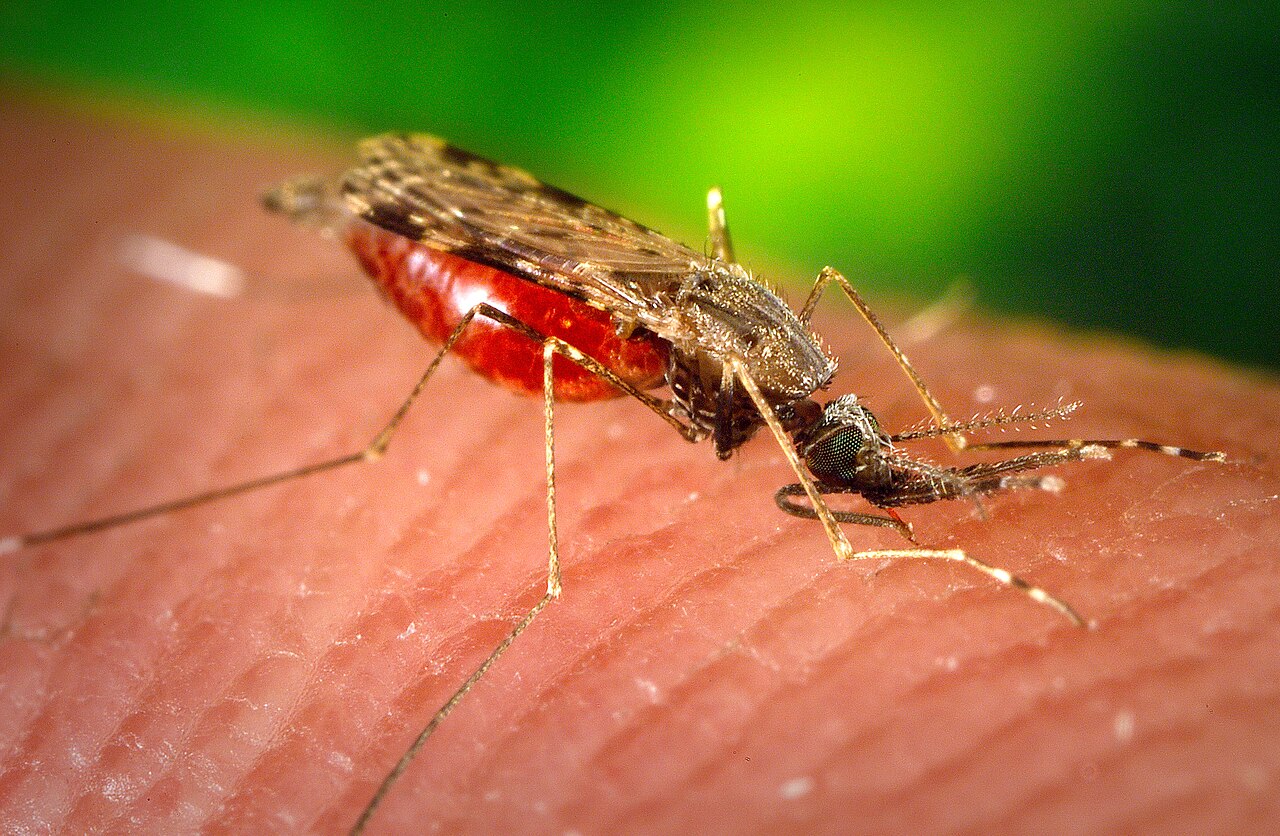
Via Wikimedia Commons: Mosquito on human skin by James Gathany, USCDCP, CC0.
Five species of Plasmodium infect humans, according to WHO: P. falciparum, P. vivax, P. malariae, P. ovale and P. knowlesi.[1] WHO calls P. falciparum the deadliest and the most prevalent in Africa, and says P. vivax dominates outside sub-Saharan Africa.[1]
The parasite passes to people mostly through the bites of infected female Anopheles mosquitoes (see the Micwyn entry on the mosquito).[1] The U.S. Centers for Disease Control and Prevention (CDC) explains that a mosquito which bites a person with malaria can itself become infectious and pass the parasite to the next person it bites.[2] Infection can also occur through blood transfusion or contaminated needles.[1] The United Kingdom's National Health Service (NHS) adds that it can rarely pass from a mother to her unborn baby.[5] Malaria does not spread from person to person like a cold or flu.[1][2]
The CDC's parasitology reference describes a cycle that alternates between a human and a mosquito.[3] An infected female Anopheles injects forms called sporozoites while taking blood. The sporozoites enter liver cells and mature into schizonts, which rupture and release merozoites.[3] The merozoites invade red blood cells, where the parasites mature into schizonts that rupture and release more merozoites; the CDC states that these blood-stage parasites cause the clinical disease.[3]
In P. vivax and P. ovale, a dormant liver form called a hypnozoite can persist and later re-enter the bloodstream, causing relapses; the CDC says this can happen "weeks, or even years later".[3] Some blood-stage parasites develop into sexual forms called gametocytes, which a mosquito swallows when it feeds.[3] In the mosquito's gut they fertilise, form oocysts in the gut wall, and release new sporozoites that travel to the salivary glands, ready to infect the next person.[3] This mosquito-stage development, called sporogony, takes nine days or longer, depending on the parasite species and the temperature.[3]
The NHS lists fever or feeling hot, cold or shivery, sweating, headaches and confusion, tiredness, sickness, tummy pain, diarrhoea, muscle pains and jaundice among the symptoms of malaria.[5] It says symptoms usually appear 7 to 18 days after a bite, but can take months to show and, rarely, years.[5] The CDC gives fever and chills as the most frequent symptoms and says severe cases can be fatal if not diagnosed and treated quickly.[2][3]
WHO's position is that every suspected case should be confirmed with a parasite-based test, either microscopy or a rapid diagnostic test.[1] The CDC calls examination of stained blood smears under the microscope the laboratory "gold standard", and says that rapid diagnostic tests, which detect parasite proteins and return results in 2 to 15 minutes, are a useful alternative where reliable microscopy is not available.[9] The CDC adds that rapid tests are meant to be followed up with microscopy, and that the genetic test PCR is mainly used to confirm which species is involved.[9] Parasites that lack the HRP2 and HRP3 proteins targeted by some rapid tests can escape them, which is why WHO tracks those mutations.[1]
WHO says artemisinin-based combination therapy is the most effective treatment for P. falciparum malaria, and that primaquine is added to the main treatment to prevent relapses of P. vivax and P. ovale infection.[1] The NHS states that malaria is treated with antimalarial medicines, that some people need specialist care in hospital, and that the disease can come back and need treating again.[5] Both bodies describe malaria as an emergency: WHO says people with severe symptoms need emergency care right away, and the NHS says it can be fatal if it is not diagnosed and treated quickly.[1][5]
WHO also describes preventive chemotherapy, meaning medicines given to prevent infection and its consequences, including seasonal malaria chemoprevention and intermittent preventive treatment in pregnancy.[1]
Malaria, or a disease resembling it, has been noted for more than 4,000 years, according to the CDC's historical summary; the name comes from the Italian for "bad air", mal'aria.[4] That summary says the symptoms were described in ancient Chinese medical writing, the Nei Ching, in 2700 BCE, and that the disease was widely recognised in Greece by the 4th century BCE.[4] It also records that the plant Qinghao (Artemisia annua) was described in a Chinese medical text of the second century BCE, that its fever-reducing properties were first described in 340 CE, and that its active ingredient, artemisinin, was isolated by Chinese scientists in 1971.[4]
The same summary dates the scientific discoveries as follows. On 6 November 1880 the French army surgeon Alphonse Laveran, stationed in Constantine, Algeria, was the first to notice parasites in the blood of a malaria patient, and he received the Nobel Prize in 1907.[4] In 1890 the Italian investigators Giovanni Battista Grassi and Raimondo Filetti introduced the names P. vivax and P. malariae; P. falciparum was named in 1897 by the American William H. Welch, P. ovale was described in 1922, and P. knowlesi was first described in 1931 in a long-tailed macaque, with the first documented human infection in 1965.[4]
On 20 August 1897 Ronald Ross, a British officer in the Indian Medical Service, was the first to demonstrate that malaria parasites could be transmitted from infected patients to mosquitoes; his further work with bird malaria showed that mosquitoes could pass the parasite from bird to bird, and he was awarded the Nobel Prize in 1902.[4] In 1898 and 1899 a team of Italian investigators led by Grassi fed Anopheles claviger mosquitoes on malaria patients and demonstrated the complete mosquito-stage cycle of P. falciparum, P. vivax and P. malariae; in 1899 mosquitoes infected in Rome were sent to London, where they fed on two volunteers who both developed malaria.[4]
The CDC summary also records the cost of malaria to the building of the Panama Canal: in 1906 more than 26,000 people worked on the canal and more than 21,000 of them were hospitalised for malaria at some time, while by 1912 the workforce had passed 50,000 and the number hospitalised had fallen to about 5,600, after an integrated programme of insect and malaria control.[4] It dates the discovery of the insecticidal property of DDT to 1939, by Paul Müller, and says chloroquine, first made in 1934, was recognised as an effective and safe antimalarial in 1946.[4]
According to the CDC's summary, its own origins lie in malaria control: the Communicable Disease Center began work on 1 July 1946, growing out of a wartime programme to control malaria around military bases in the southern United States.[4] A cooperative National Malaria Eradication Program with 13 southeastern states began on 1 July 1947.[4] In 1947, 15,000 malaria cases were reported in the United States; by 1950 the figure was 2,000, and by 1951 malaria was considered eliminated from the country.[4]
In 1955 WHO put an ambitious proposal for worldwide eradication to the World Health Assembly. The campaign relied on house spraying with residual insecticides, drug treatment and surveillance.[4] The CDC records successes in countries with temperate climates and seasonal transmission, sharp reductions followed by rebounds in India and Sri Lanka, little progress in places such as Indonesia, Afghanistan, Haiti and Nicaragua, and the exclusion of most of sub-Saharan Africa. Drug resistance, widespread insecticide resistance, wars, funding difficulties and a lack of community participation made the effort untenable, and the campaign was eventually abandoned.[4]
Elimination has continued country by country. As of 4 December 2025, WHO counts 47 countries and one territory certified malaria-free.[6][7] WHO says a country can apply for certification after at least three consecutive years with no locally acquired cases.[1]
After the elimination of 1951 described above, malaria has continued to reach the United States through travellers. The CDC's 2026 operational guidance reports that about 2,000 malaria cases are reported in the country each year, and that 2023 had the highest number of imported cases since elimination, 2,627.[10]
In 2023 locally acquired cases returned. The CDC's report of September 2023 describes eight cases of mosquito-transmitted P. vivax malaria reported to the agency between 18 May and 17 July 2023: seven in Sarasota County, Florida, and one in Cameron County, Texas.[11] The report says no evidence linked the two outbreaks, that none of the eight patients developed severe malaria and that all had recovered; it also states that locally acquired P. vivax had not been reported in the United States since an eight-case outbreak in Palm Beach County, Florida, in 2003.[11] The 2026 guidance counts 10 locally acquired cases in total in 2023, reported from four states (Arkansas, Florida, Maryland and Texas), after two decades with none.[10] It says mosquitoes capable of transmitting malaria are present across most of the United States, and also that recent data on the distribution of Anopheles species there are lacking.[10] The 2023 report nonetheless describes the risk of locally acquired malaria in the country as "very low".[11]
WHO's World malaria report 2025, released on 4 December 2025, estimates that there were about 282 million cases and 610,000 deaths in 2024, in 80 countries.[1][6] That was roughly 9 million more cases than in 2023, and deaths were up from 598,000 in 2023.[1][6] The WHO African Region accounted for about 265 million of the cases and 579,000 of the deaths; Nigeria, the Democratic Republic of the Congo and Niger together accounted for more than half of the region's deaths, and children under five made up about 75% of them.[1] WHO puts the 2024 death rate at 13.8 per 100,000 people, more than three times the 4.5 per 100,000 set as a target.[6] It describes progress in reducing deaths as "far off track".[7]
WHO estimates that since 2000 about 2.3 billion cases and 14 million deaths have been averted, including about 1 million deaths in 2024.[7]
For vector control, WHO's position is that either insecticide-treated nets or indoor residual spraying should be deployed in most at-risk areas.[8] WHO says more than 3 billion nets have been delivered to endemic countries and that the share of the at-risk population sleeping under one rose from 2% to 52% between 2000 and 2020.[8] It warns that insecticide resistance in Anopheles mosquitoes threatens these gains.[8]
WHO recommended the RTS,S/AS01 vaccine in October 2021 for young children in areas of moderate to high P. falciparum transmission, and the R21/Matrix-M vaccine in October 2023 as a second malaria vaccine.[1] As of 4 December 2025, 24 countries had added a malaria vaccine to their routine immunisation programmes since WHO approved them in 2021.[6]
Resistance to the medicines themselves is a concern. WHO has confirmed partial resistance to artemisinin in Eritrea, Rwanda, Uganda and Tanzania, and suspects it in Ethiopia, Namibia, Sudan and Zambia; its 2025 report notes signs that some partner drugs combined with artemisinin may be losing efficacy.[1][6] In 2024, parasites with gene mutations that evade rapid diagnostic tests based on the HRP2 and HRP3 proteins were reported in 42 countries.[1] WHO says US$3.9 billion was invested in the malaria response in 2024, less than half of the US$9.3 billion target for 2025.[6]
This entry explains; it is not medical advice. Ask a doctor or pharmacist about your own health.
Added a section on diagnosis and treatment, reporting WHO, CDC and NHS positions without advice (new source 9, CDC). The entry now has seven sections, nine opened sources and a picture, so it is finished and out of construction.
Deepening: added a section on malaria in the United States (CDC MMWR of 8 September 2023 and the CDC's 21 May 2026 operational guidance, sources 10 and 11, both opened): about 2,000 imported cases a year, 2,627 in 2023, and the 2023 locally acquired cases. No existing claim was changed.
 Get Micwyn on your home screenIts own icon, full screen, and notifications.