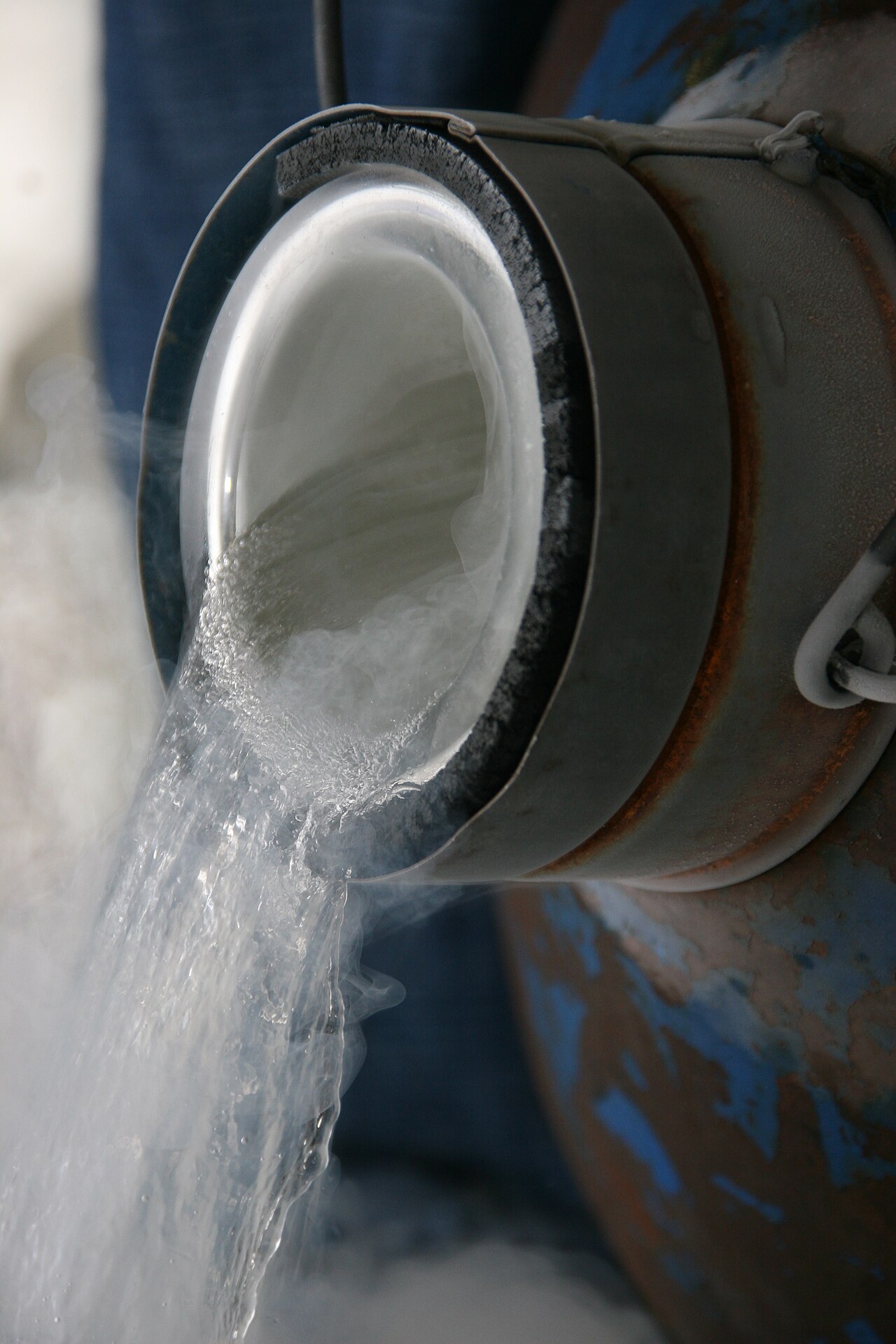
This entry is about the element. Its relative atomic mass is 14.007, it is in group 15 of the periodic table, and it is a gas at room temperature.[1]
Properties
The Royal Society of Chemistry lists nitrogen's melting point as −210.0 °C (63.2 K), its boiling point as −195.795 °C (77.355 K), and its density as 0.001145 g/cm³.[1] The atomic weights commission of the International Union of Pure and Applied Chemistry gives its standard atomic weight as an interval, 14.00643 to 14.00728, since 2009.[3]
Isotopes
Nitrogen has two stable isotopes. The Royal Society of Chemistry gives the natural proportions as 99.636 percent for nitrogen-14 and 0.364 percent for nitrogen-15, and NIST gives them as 0.99636(20) and 0.00364(20).[1][2]
Discovery and name
The Scottish physician and chemist Daniel Rutherford discovered nitrogen in 1772. The Royal Society of Chemistry says his doctoral thesis at Edinburgh, in September 1772, was the first to suggest that the gas was an element.[1][3] The name comes from the Greek nitron, "nitre," and genes, "forming," meaning nitre-forming; the atomic weights commission traces it to the Latin nitrum and Greek nitron for "native soda."[1][3]
Nitrogen in the air
NOAA's table of the composition of dry air gives nitrogen (N₂) as 78.084 percent by volume, against 20.946 percent for oxygen, 0.934 percent for argon and 0.042 percent for carbon dioxide.[4] The Royal Society of Chemistry says nitrogen is obtained by the distillation of liquid air and that around 45 million tonnes are extracted each year.[1]
Uses and the nitrogen cycle
The Royal Society of Chemistry says nitrogen is used to make fertilisers, nitric acid, nylon, dyes and explosives, starting from ammonia made by the Haber process, of which it says 150 million tonnes are produced every year. Nitrogen is also used as an inert atmosphere to preserve foods and in annealing steel.[1] The same page says living things cycle nitrogen through the nitrogen cycle, and that chemical fertilisers manufactured from ammonia can greatly increase crop yields.[1] These production figures are undated on the page.