Aluminium (spelled aluminum in the United States) is the chemical element with atomic number 13 and the symbol Al, a light metal that is the most abundant metal in Earth's crust.[1]
This entry uses the spelling adopted by the International Union of Pure and Applied Chemistry; NIST uses "aluminum."[2][3] Aluminium's relative atomic mass is 26.982, it is in group 13 of the periodic table, and it is a solid at room temperature.[1] For its place in the table and its basic facts, see the [periodic table page for Aluminium](/element/Q663/aluminium).
Properties
The Royal Society of Chemistry lists aluminium's melting point as 660.323 °C (933.473 K), its boiling point as 2519 °C (2792 K), and its density as 2.70 g/cm³.[1] It has a single stable isotope, aluminium-27. The atomic weights commission gives its atomic weight as 26.9815384(3) since 2017, while NIST lists 26.9815385(7); the two differ only in the last digits.[2][3] The commission adds that aluminium-26 is radioactive with a half-life of about 0.705 million years.[3]
Discovery and name
The Danish physicist Hans Christian Ørsted isolated impure aluminium in 1825, according to both the Royal Society of Chemistry and the atomic weights commission, and the German chemist Friedrich Wöhler first isolated the pure metal in 1827.[1][3] The name comes from the Latin alumen, meaning alum, a bitter salt.[1][3] The Royal Society of Chemistry's page says the American Chemical Society revived the original spelling "aluminum" in 1925 after the International Union of Pure and Applied Chemistry had standardised the "-ium" ending.[1]
Where it comes from
The Royal Society of Chemistry says aluminium is the most abundant metal in the Earth's crust, at 8.1 percent, and that its minerals include bauxite and cryolite. Most commercially produced aluminium is extracted by the Hall–Héroult process, in which aluminium oxide is dissolved in molten cryolite and then reduced to the pure metal by electrolysis. The page says 5 percent of the electricity generated in the United States is used in aluminium production, without giving a year for that figure.[1]
Recycling
The Royal Society of Chemistry says aluminium can be easily recycled and lists a recycling rate of more than 30 percent in its supply-risk table, without dating it.[1]
Uses
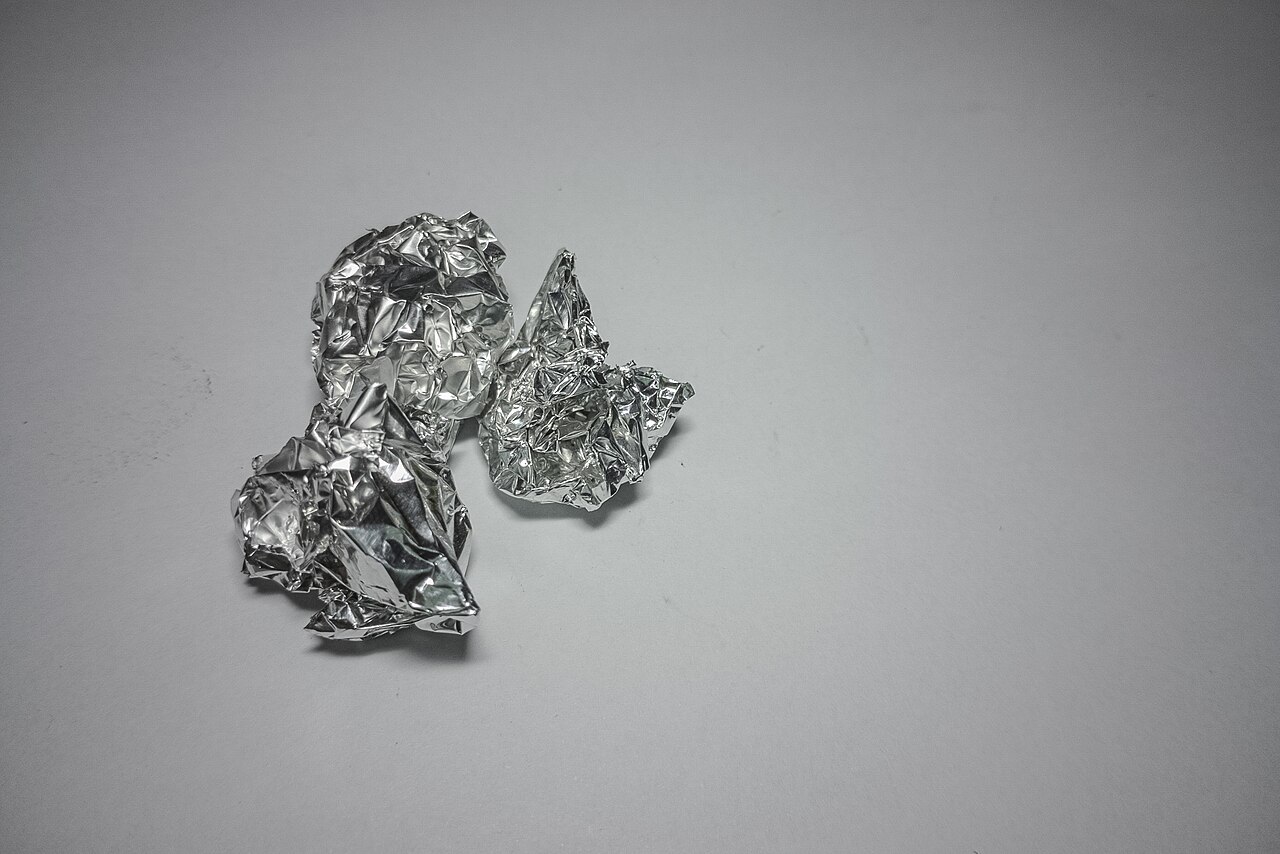
The Royal Society of Chemistry lists cans, foil, kitchen utensils, window frames, beer kegs and aeroplane parts among the uses of aluminium, and adds electrical transmission lines and reflective coatings. It says aluminium has no known biological role and that in its +3 form it is toxic to plants.[1]