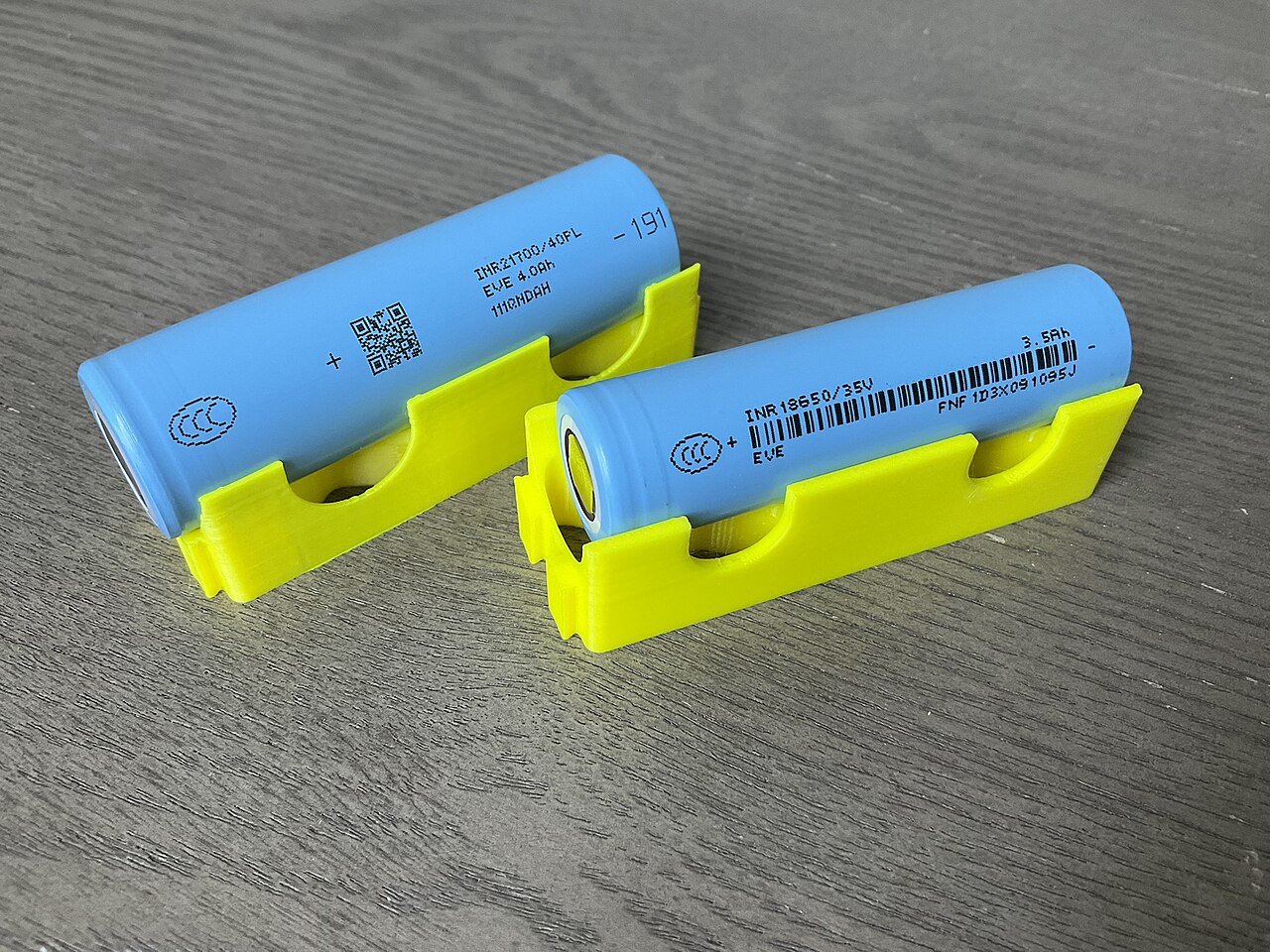
Lithium is the chemical element with atomic number 3 and the symbol Li, a metal in group 1 of the periodic table that is used in rechargeable batteries.[1]
This entry is about the element. Its relative atomic mass is 6.94, it is in group 1 of the periodic table, and it is a solid at room temperature.[1] For its place in the table and its basic facts, see the [periodic table page for Lithium](/element/Q568/lithium).
Properties
The Royal Society of Chemistry lists lithium's melting point as 180.50 °C (453.65 K), its boiling point as 1342 °C (1615 K), and its density as 0.534 g/cm³.[1] Its standard atomic weight is an interval, 6.938 to 6.997, since 2009 according to the atomic weights commission of the International Union of Pure and Applied Chemistry, and NIST gives the same interval.[3][2] The commission notes that the figure is bracketed because the lithium-6 content varies, and that material depleted in lithium-6 can be sold.[3]
Isotopes
Lithium has two stable isotopes. The Royal Society of Chemistry gives their natural proportions as 7.59 percent for lithium-6 and 92.41 percent for lithium-7, and NIST gives them as 0.0759(4) and 0.9241(4).[1][2]
Discovery and name
The Royal Society of Chemistry credits Johan August Arfvedson with discovering lithium in 1817, after he deduced that the mineral petalite, found by a Brazilian in the 1790s, contained a previously unknown metal. The atomic weights commission dates Arfvedson's work to 1818. The metal was obtained in bulk in 1855 by Bunsen and Matthiessen through the electrolysis of molten lithium chloride.[1][3] The name comes from the Greek lithos, "stone."[1][3]
Where it comes from
The Royal Society of Chemistry gives lithium's crustal abundance as 16 parts per million and says it is found combined in small amounts in nearly all igneous rocks. Its text says most lithium is currently produced in Chile from brines, while its supply-risk table lists Australia, Chile and China as the top three producers; neither is dated.[1]
Uses
The Royal Society of Chemistry lists rechargeable batteries for mobile phones and laptops, alloys with aluminium and magnesium, lithium oxide in glass, lithium chloride as a drying agent, lithium stearate in grease, lithium hydride for hydrogen storage, and lithium carbonate in some drugs. It says lithium has no known biological role and is toxic except in very small doses.[1]