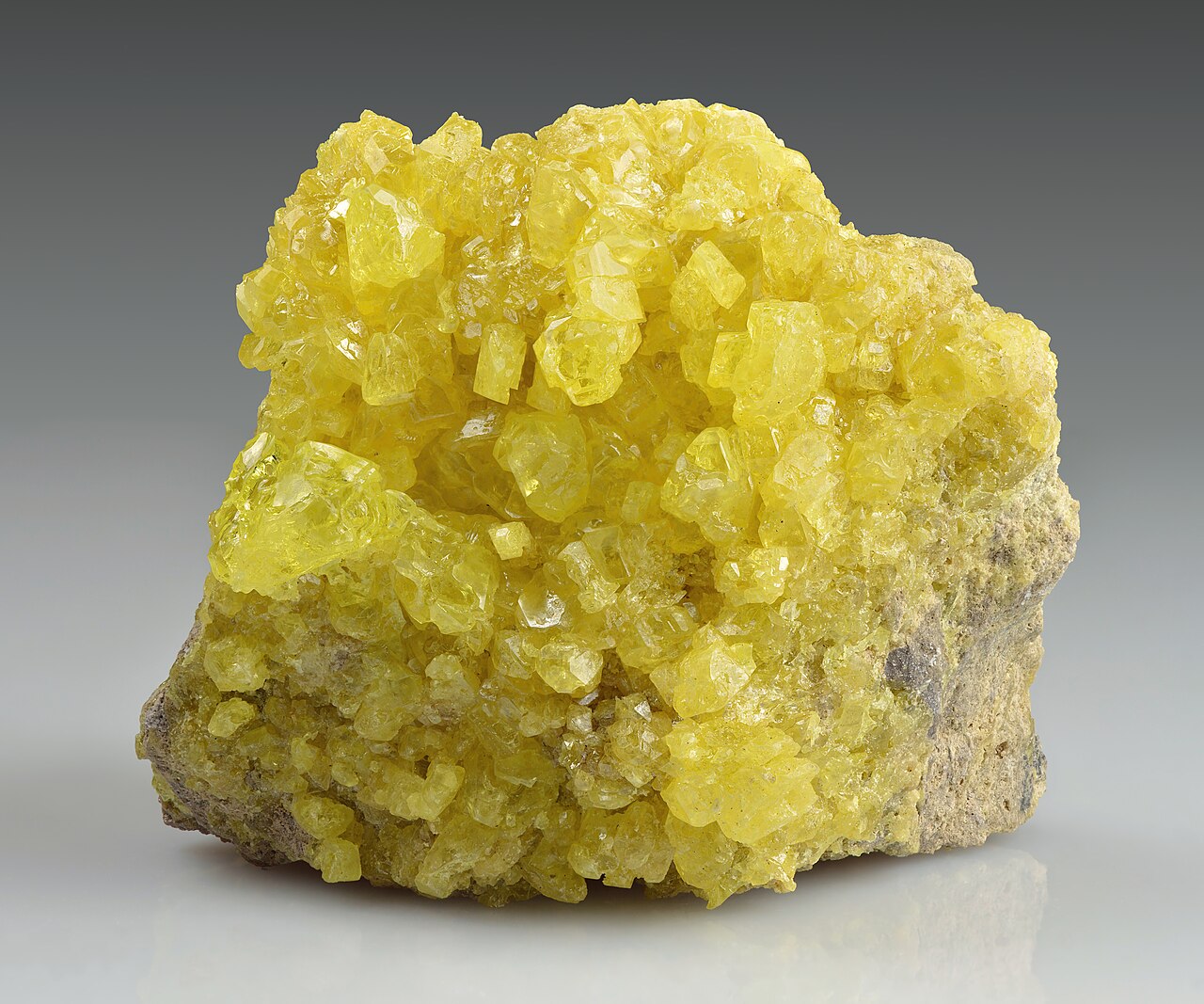
Sulfur is the chemical element with atomic number 16 and the symbol S, a solid in group 16 of the periodic table that has been known since prehistory and is mostly made into sulfuric acid.[1]
This entry is about the element. Its relative atomic mass is 32.06, it is in group 16 of the periodic table, and it is a solid at room temperature.[1] For its place in the table and its basic facts, see the [periodic table page for Sulfur](/element/Q682/sulfur).
Properties
The Royal Society of Chemistry lists sulfur's melting point as 115.21 °C (388.36 K), its boiling point as 444.61 °C (717.76 K), and its density as 2.07 g/cm³.[1] Its standard atomic weight is an interval, 32.059 to 32.076, since 2009 according to the atomic weights commission of the International Union of Pure and Applied Chemistry; NIST gives the same interval. The commission says sulfur's isotopes are fractionated by chemical, physical and biological processes, with microbial reactions the main cause.[3][2]
Isotopes
Sulfur has four stable isotopes. The Royal Society of Chemistry gives their natural proportions as 94.99 percent for sulfur-32, 0.75 percent for sulfur-33, 4.25 percent for sulfur-34 and 0.01 percent for sulfur-36, and NIST gives 0.9499(26), 0.0075(2), 0.0425(24) and 0.0001(1).[1][2]
History and name
Sulfur was known from prehistoric times, and the Royal Society of Chemistry notes that it is mentioned 15 times in the Bible. Humphry Davy suggested in 1808 that it contained hydrogen, but Gay-Lussac and Thénard proved in 1809 that it is an element, and Davy agreed.[1][3] The commission traces the name to the Latin sulphurium and the Sanskrit sulveri.[3]
Where it comes from
The Royal Society of Chemistry gives sulfur's crustal abundance as 404 parts per million. It says sulfur is now obtained almost entirely from the purification processes that remove it from natural gas, oil and tar sands, and its supply-risk table lists China, the United States and Canada as the top three producers, without a date.[1]
Uses
The Royal Society of Chemistry says most sulfur is made into sulfuric acid, and lists vulcanising rubber, a fungicide, black gunpowder, mercaptans, sulfites and gypsum (calcium sulfate). It says sulfur is essential to all living things and that sulfur and sulfate are non-toxic, while carbon disulfide, hydrogen sulfide and sulfur dioxide are toxic.[1]