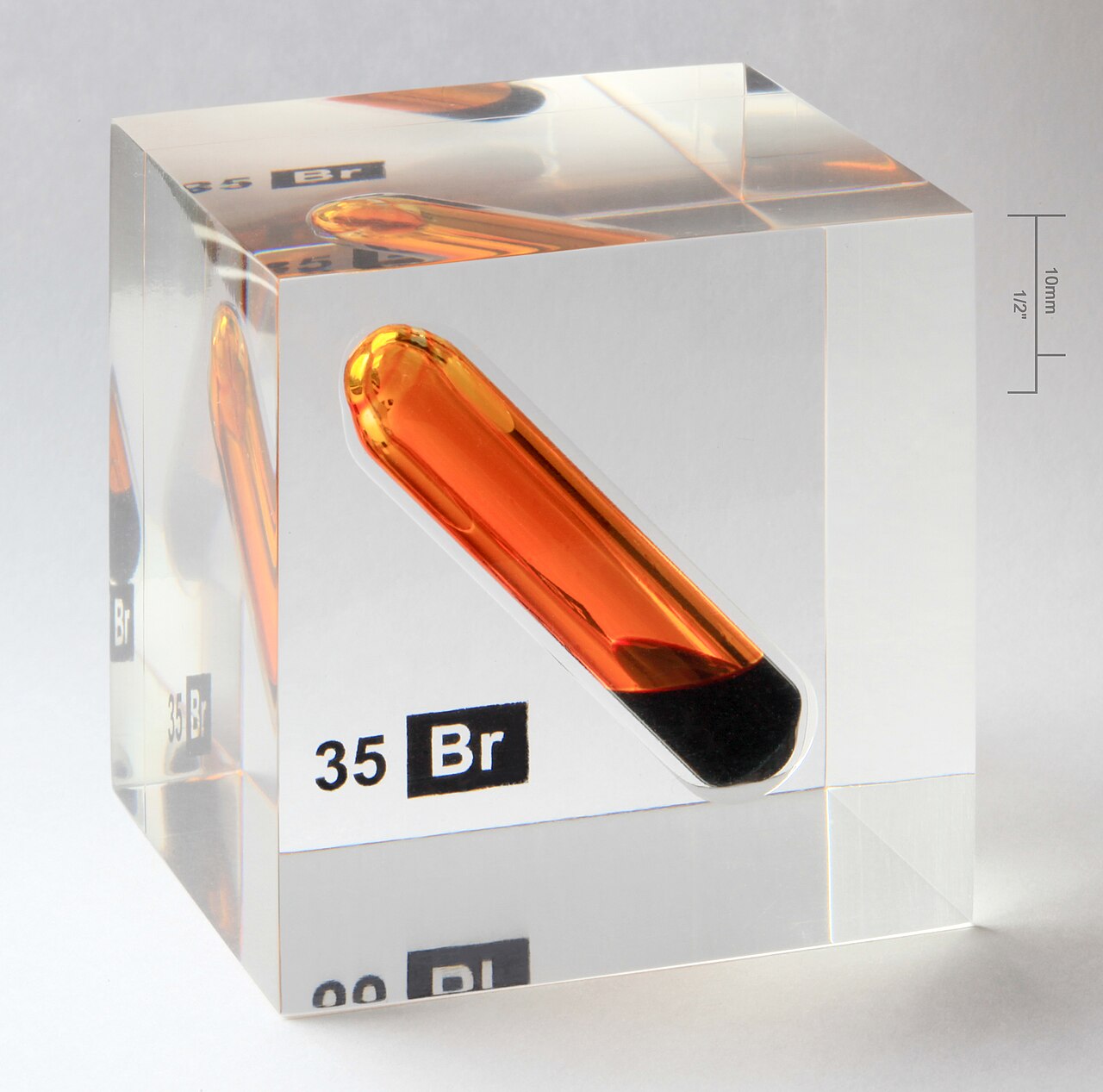
Bromine is the chemical element with atomic number 35 and the symbol Br, a reddish liquid in group 17 of the periodic table whose name comes from the Greek word for stench.[1]
This entry is about the element. Its relative atomic mass is 79.904, it is in group 17 of the periodic table, and it is a liquid at room temperature.[1] For its place in the table and its basic facts, see the [periodic table page for Bromine](/element/Q879/bromine).
Properties
The Royal Society of Chemistry lists bromine's melting point as −7.2 °C (266 K), its boiling point as 58.8 °C (332 K), and its density as 3.1028 g/cm³.[1] Its standard atomic weight is an interval, 79.901 to 79.907, since 2011 according to the atomic weights commission of the International Union of Pure and Applied Chemistry, which says the interval was set to better reflect natural variations; NIST gives the same interval.[3][2] The Royal Society of Chemistry's table gives the single value 79.904.[1]
Isotopes
Bromine has two stable isotopes. The Royal Society of Chemistry gives their natural proportions as 50.69 percent for bromine-79 and 49.31 percent for bromine-81, and NIST gives 0.5069(7) and 0.4931(7).[1][2]
Discovery and name
The Royal Society of Chemistry credits Antoine-Jérôme Balard in Montpellier, France, and Carl Löwig in Heidelberg, Germany, with discovering bromine in 1826. It says Balard liberated an orange-red liquid from the brine residue at Montpellier, that Löwig had a sample from a spring at Kreuznach a year earlier, and that Balard published first and is credited as discoverer.[1] The atomic weights commission says the element was first prepared by the German chemist Carl Löwig in 1825 and first publicly announced in 1826 by the French chemist and pharmacist Balard.[3] The name comes from the Greek bromos, "stench."[1][3]
Where it comes from
The Royal Society of Chemistry gives bromine's crustal abundance as 0.88 parts per million and says the Dead Sea contains up to 0.5 percent bromide. It is made by electrolysis of natural bromine-rich brine, and the United States, China and Israel are listed as the top three producers, without a date.[1]
Uses
The Royal Society of Chemistry lists agricultural chemicals, dyestuffs, insecticides, pharmaceuticals, flame retardants, halon fire extinguishers and silver bromide in photography. It says bromine has no known biological role in humans and an irritating effect on the eyes and throat.[1]