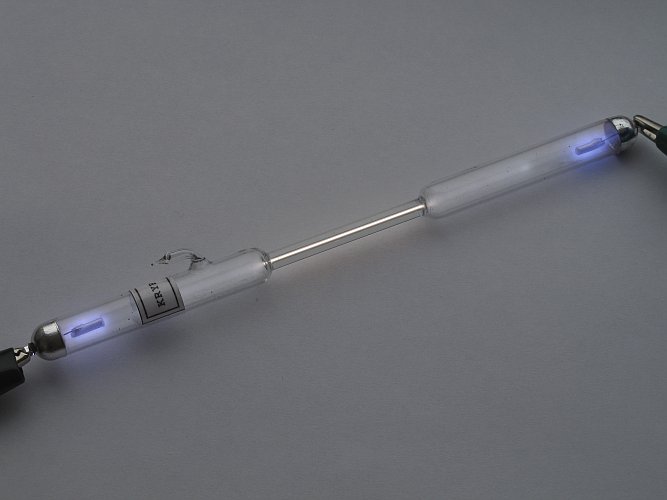
This entry is about the element. Its relative atomic mass is 83.798, it is in group 18 of the periodic table, and it is a gas at room temperature.[1] For its place in the table and its basic facts, see the [periodic table page for Krypton](/element/Q888/krypton).
Properties
The Royal Society of Chemistry lists krypton's melting point as −157.37 °C (115.78 K), its boiling point as −153.415 °C (119.735 K), and its density as 0.003425 g/cm³.[1] Its standard atomic weight is 83.798(2), unchanged since 2001 according to the atomic weights commission of the International Union of Pure and Applied Chemistry, which says nearly all krypton on Earth is isotopically indistinguishable from atmospheric krypton; NIST gives the same value.[3][2]
Isotopes
Krypton has six naturally occurring isotopes. The Royal Society of Chemistry gives their proportions as 0.355 percent for krypton-78, 2.286 percent for krypton-80, 11.593 percent for krypton-82, 11.5 percent for krypton-83, 56.987 percent for krypton-84 and 17.279 percent for krypton-86, and NIST gives the same figures as fractions.[1][2]
Discovery and name
William Ramsay, described by the atomic weights commission as Scottish, and Morris William Travers, whom it calls English, discovered krypton in liquefied air in 1898. The Royal Society of Chemistry says that having discovered argon, they isolated about 25 cm³ of krypton on 30 May 1898 and that its spectrum showed it was new.[1][3] The name comes from the Greek kryptos, "hidden."[1][3]
Where it comes from
The Royal Society of Chemistry says krypton makes up about 1 part per million of the atmosphere by volume and is obtained by distillation of liquefied air.[1]
Uses
The Royal Society of Chemistry lists krypton as a filling gas for energy-saving fluorescent lights, in flash lamps and in krypton fluoride lasers, and notes that radioactive krypton was used in monitoring nuclear activity during the Cold War. It says that krypton-86 was used to define the metre from 1960 to 1983, and that krypton has no known biological role.[1]