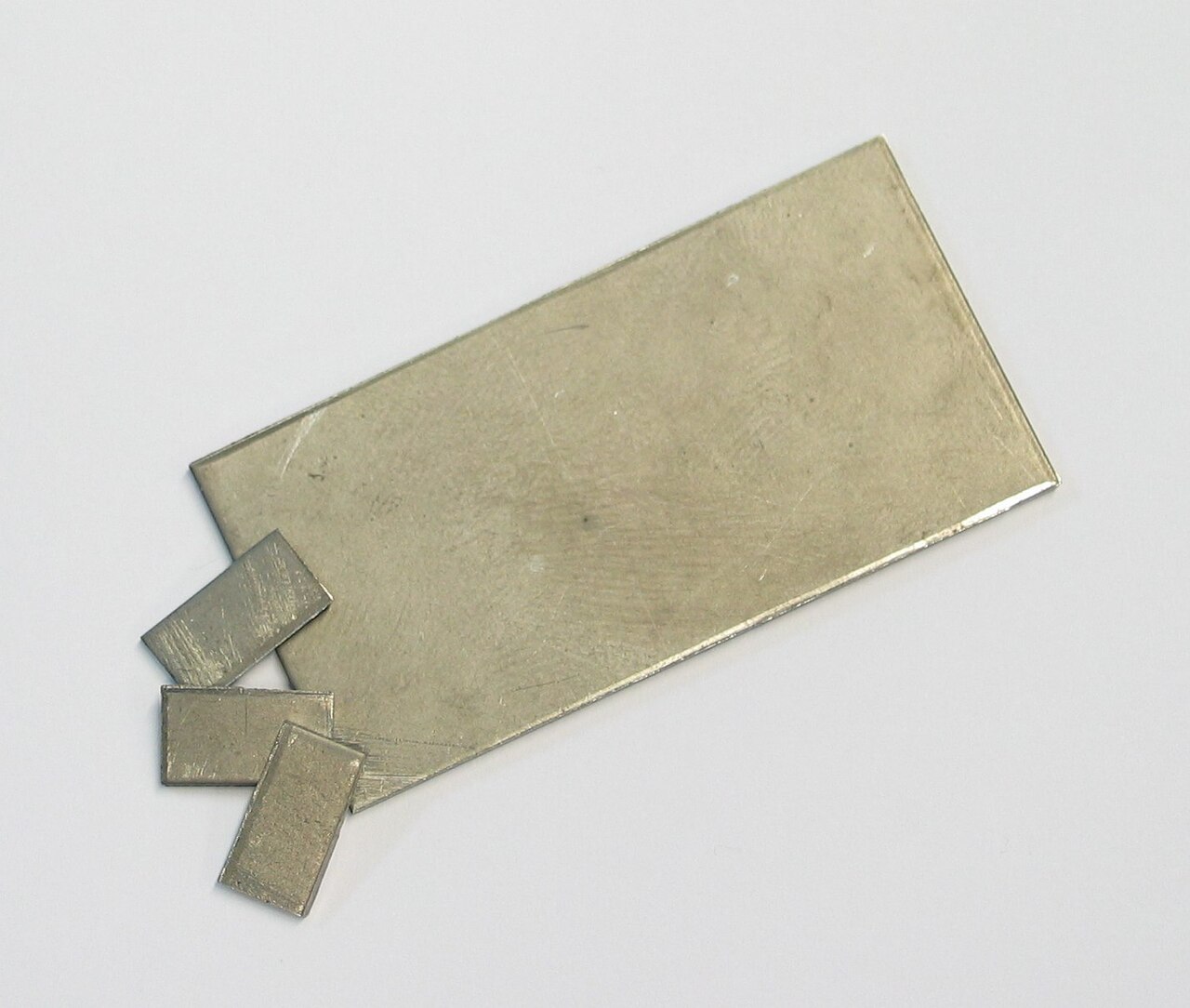
Niobium is the chemical element with atomic number 41 and the symbol Nb, a metal in group 5 of the periodic table that is used in steel alloys, jet engines and superconducting magnets.[1]
This entry is about the element. Its relative atomic mass is 92.906, it is in group 5 of the periodic table, and it is a solid at room temperature.[1] For its place in the table and its basic facts, see the [periodic table page for Niobium](/element/Q1046/niobium).
Properties
The Royal Society of Chemistry lists niobium's melting point as 2477 °C (2750 K), its boiling point as 4741 °C (5014 K), and its density as 8.57 g/cm³.[1] It has a single stable isotope, niobium-93, so its atomic weight is a single value, 92.90637(1) since 2017 according to the atomic weights commission of the International Union of Pure and Applied Chemistry; NIST gives 92.90637(2).[3][2]
Discovery and name
The British chemist and manufacturer Charles Hatchett discovered niobium in 1801 in a black mineral called columbite, and named it columbium, according to the atomic weights commission. Heinrich Rose determined that it differed from tantalum and renamed it niobium, which the Royal Society of Chemistry dates to 1844 and the commission to 1846.[1][3] The name comes from Niobe, the daughter of Tantalus in Greek mythology, because of the element's similarity to tantalum, and the commission says the International Union of Pure and Applied Chemistry adopted the name niobium in 1949.[1][3] The Royal Society of Chemistry says Christian Blomstrand made the pure metal in 1864, while the commission dates its first isolation to 1846.[1][3]
Where it comes from
The Royal Society of Chemistry gives niobium's crustal abundance as 8 parts per million. Columbite is the main source and niobium is mined alongside tantalum, and some comes as a by-product of tin extraction. Brazil and Canada are the leading producers listed, without a date.[1]
Uses
The Royal Society of Chemistry lists stainless steel alloys, jet engines and rockets, building beams, pipelines, superconducting magnets and niobium oxide in glass. It says niobium has no known biological role.[1]