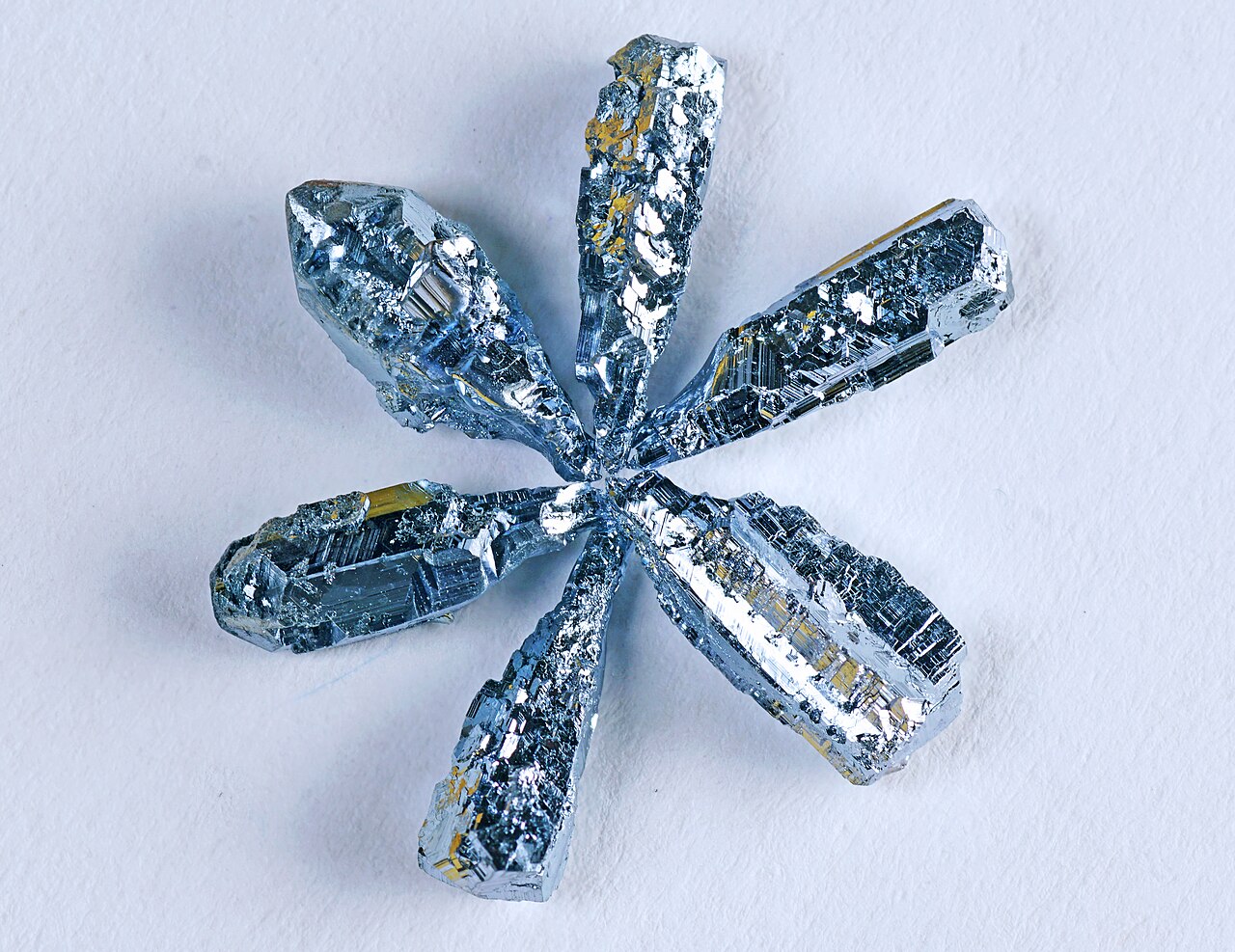
Osmium is the chemical element with atomic number 76 and the symbol Os, a metal in group 8 of the periodic table that the Royal Society of Chemistry lists with a density of 22.5872 g/cm³.[1]
This entry is about the element. Its relative atomic mass is 190.23, it is in group 8 of the periodic table, and it is a solid at room temperature.[1] For its place in the table and its basic facts, see the [periodic table page for Osmium](/element/Q751/osmium).
Properties
The Royal Society of Chemistry lists osmium's melting point as 3033 °C, its boiling point as 5008 °C, and its density as 22.5872 g/cm³.[1] Its standard atomic weight is 190.23(3), unchanged since 1991 according to the atomic weights commission of the International Union of Pure and Applied Chemistry; NIST gives the same value.[3][2]
Isotopes
Osmium has seven naturally occurring isotopes. The Royal Society of Chemistry gives their proportions as 0.02 percent for osmium-184, 1.59 percent for osmium-186, 1.96 percent for osmium-187, 13.24 percent for osmium-188, 16.15 percent for osmium-189, 26.26 percent for osmium-190 and 40.78 percent for osmium-192, and NIST gives the same figures as fractions. Osmium-186 is radioactive with a half-life of about 2 quadrillion years.[1][2][3]
Discovery and name
The English chemist Smithson Tennant discovered osmium in 1803 in a crude platinum ore, according to the atomic weights commission, simultaneously with iridium. The Royal Society of Chemistry says he dissolved platinum residue in aqua regia, separated two metals by alkali and acid treatment, and named osmium for its odour.[1][3] The name comes from the Greek osme, "smell."[1][3]
Where it comes from
The Royal Society of Chemistry says osmium occurs uncombined and in osmiridium, an alloy with iridium, and that most is obtained from the wastes of nickel refining.[1]
Uses
The Royal Society of Chemistry lists very hard alloys for fountain-pen tips, instrument pivots, needles and electrical contacts, and a catalyst in the chemical industry. It says the metal itself is not toxic but its oxide is volatile and very toxic to the lungs, skin and eyes.[1]
This entry explains; it is not medical advice. Ask a doctor or pharmacist about your own health.