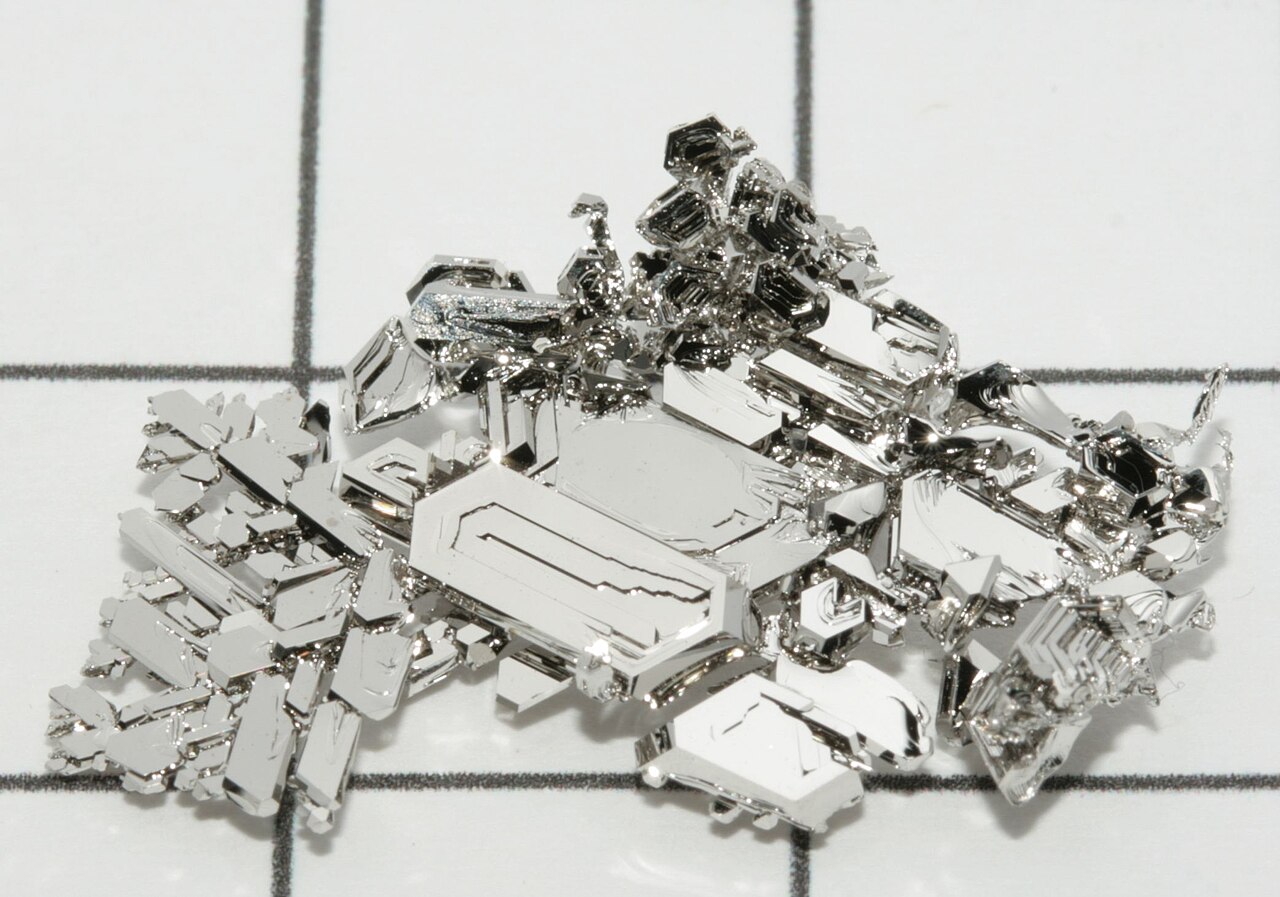
Platinum is the chemical element with atomic number 78 and the symbol Pt, a precious metal in group 10 of the periodic table that is used in jewellery and in catalytic converters.[1]
This entry is about the element. Its relative atomic mass is 195.084, it is in group 10 of the periodic table, and it is a solid at room temperature.[1] For its place in the table and its basic facts, see the [periodic table page for Platinum](/element/Q880/platinum).
Properties
The Royal Society of Chemistry lists platinum's melting point as 1768.2 °C, its boiling point as 3825 °C, and its density as 21.5 g/cm³.[1] Its standard atomic weight is 195.084(9), unchanged since 2005 according to the atomic weights commission of the International Union of Pure and Applied Chemistry; NIST gives the same value.[3][2]
Isotopes
Platinum has six naturally occurring isotopes. The Royal Society of Chemistry gives their proportions as 0.012 percent for platinum-190, 0.782 percent for platinum-192, 32.86 percent for platinum-194, 33.78 percent for platinum-195, 25.21 percent for platinum-196 and 7.356 percent for platinum-198, and NIST gives the same figures as fractions. Platinum-190 is radioactive with a half-life of hundreds of billions of years.[1][2][3]
History and name
The Royal Society of Chemistry says platinum was known to native South Americans before Columbus and was taken to Europe around 1750, and that the oldest worked specimen is from an Egyptian casket of the 7th century BC. The atomic weights commission says the Spanish astronomer Antonio de Ulloa found it in Peru in 1735, Charles Wood found it in Colombia in 1741, and William Brownrigg prepared purified platinum in 1750.[1][3] The name comes from the Spanish platina, "little silver."[1][3]
Where it comes from
The Royal Society of Chemistry says platinum is found uncombined in alluvial deposits, that most comes from South Africa, from the mineral cooperite, and that it is also a by-product of copper and nickel refining.[1]
Uses
The Royal Society of Chemistry lists jewellery, catalytic converters for vehicles, which it says account for about half of annual demand, catalysts for nitric acid, silicone and benzene production, fuel-cell catalysts, computer hard disks, thermocouples, spark plugs, pacemakers and dental fillings, and some compounds used as chemotherapy drugs. It says platinum has no known biological role and is non-toxic.[1]