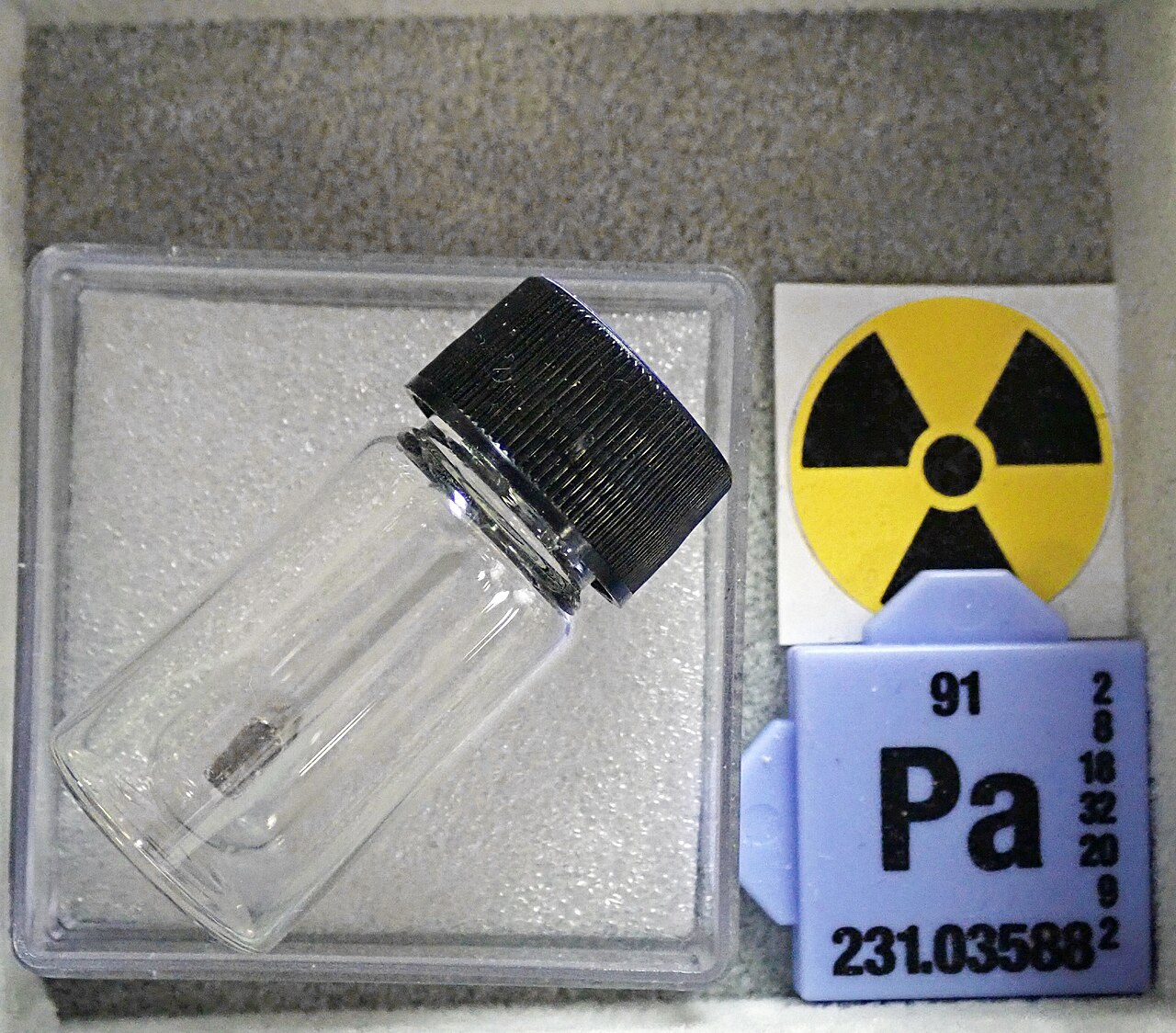
Protactinium is the chemical element with atomic number 91 and the symbol Pa, a rare radioactive metal in the actinide series whose name means "first actinium."[1]
This entry is about the element. Its relative atomic mass is 231.036, it is one of the actinides in the periodic table, and it is a solid at room temperature.[1] For its place in the table and its basic facts, see the [periodic table page for Protactinium](/element/Q1109/protactinium).
Properties
The Royal Society of Chemistry lists protactinium's melting point as 1572 °C, its boiling point as 4000 °C, and its density as 15.4 g/cm³.[1] Its standard atomic weight is 231.03588(1) since 2017 according to the atomic weights commission of the International Union of Pure and Applied Chemistry; NIST gives 231.03588(2).[3][2]
Isotopes
Protactinium-231 is the only isotope found in nature in any amount. The Royal Society of Chemistry lists it with a half-life of 32,500 years, and the commission gives 32,500 years too.[1][2][3]
Discovery and name
Kasimir Fajans and Otto Göhring showed in 1913 that a new element existed, which the atomic weights commission describes as identified by the German chemists K. Fajans and O. H. Göhring in 1913 as an isotope with a half-life of 6.7 hours, protactinium-234. The commission says the longer-lived protactinium-231 was identified in 1918 by the German chemist O. Hahn and the Austrian physicist L. Meitner, and independently by F. Soddy and J. A. Cranston in Britain; the Royal Society of Chemistry credits Lise Meitner with separating it from pitchblende at the Kaiser Wilhelm Institute in Berlin in 1918.[1][3] The name comes from the Greek protos, "first," as a prefix to actinium, into which it decays.[1]
Where it comes from
The Royal Society of Chemistry says protactinium occurs in small amounts in uranium ores and is also extracted from spent fuel rods.[1]
Uses
The Royal Society of Chemistry says protactinium is little used outside research. It says it has no known biological role and is toxic because of its radioactivity.[1]
This entry explains; it is not medical advice. Ask a doctor or pharmacist about your own health.