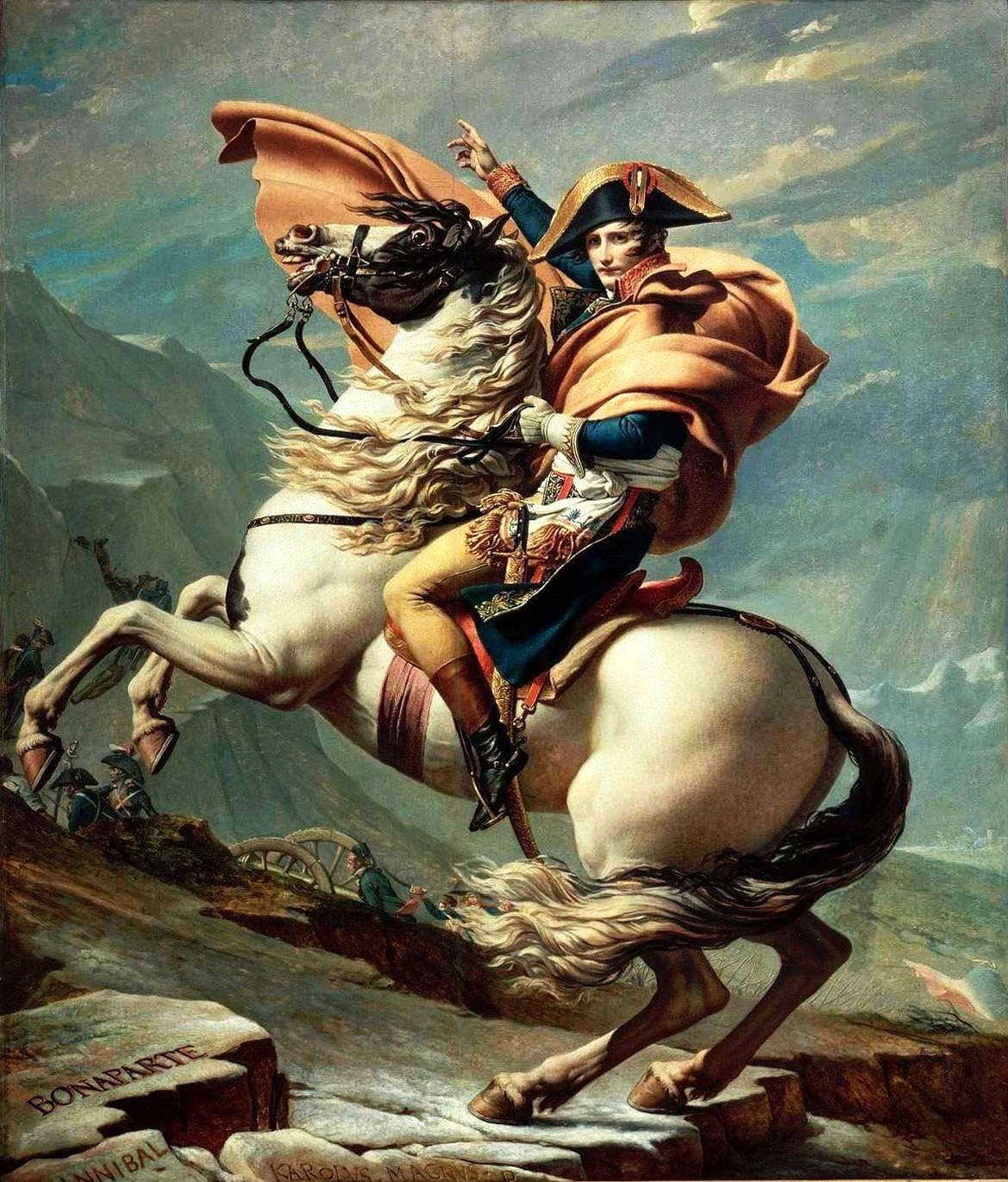
Napoleon Bonaparte (1769-1821) was the Corsican-born French general who seized power in 1799, ruled France as First Consul and then as Emperor, fought most of Europe, and died in exile on St Helena on 5 May 1821.[1][2]
Napoleon Crossing the Alps, a painting by Jacques-Louis David
Dates below follow the McGill University Napoleon timeline unless another source is named. Where sources disagree, this entry says so.
Rise
Napoleon was born on 15 August 1769 in Ajaccio, Corsica.[1][3] McGill dates his entry to the military school at Brienne to 15 May 1779; Brown University's timeline says April 1779.[1][3] He drove the British fleet out of Toulon in December 1793, and on 5 October 1795 (13 Vendemiaire) put down a royalist insurrection in Paris.[1][3] On 2 March 1796 he was made commander in chief of the Army of Italy, and he married Josephine on 9 March. He won at Arcola in November 1796, and the Treaty of Campo-Formio followed on 17 October 1797.[1] He fought the Battle of the Pyramids in Egypt on 21 July 1798.[1][3]
On 9-10 November 1799 (18-19 Brumaire) a coup made him provisional consul.[1] The Concordat was signed on 15 July 1801 and the Treaty of Amiens on 25 March 1802.[1][4] In 1803, Brown's timeline says, he sold the Louisiana Territory to the United States for 80 million francs.[4]
Egypt and the Rosetta Stone
During the Egyptian campaign, soldiers in Napoleon's army found a black slab near the town of Rosetta (Rashid), about 35 miles east of Alexandria, "on what was likely July 15, 1799"; History.com notes there is some debate about the exact date, and British Online Archives dates it 15 July 1799 and names the officer in charge as Pierre-Francois Bouchard.[15][16] The stone carries one decree in three scripts: Greek, Egyptian hieroglyphs and Egyptian demotic.[15][17] Google Arts and Culture, in a story from the British Museum, says the decree was passed by a council of priests honouring the 13-year-old Ptolemy V.[17]
After Napoleon's defeat, the stone became British property under the Treaty of Alexandria in 1801, reached England in February 1802, and has been in the British Museum since 1802, with one break.[16][17] Both History.com and Google Arts and Culture name Jean-Francois Champollion and Thomas Young among those who worked on reading it; none of the pages read gives the year of decipherment.[15][17]
Emperor
The Civil Code was published on 21 March 1804. He was proclaimed Emperor on 18 May 1804 and crowned with Josephine at Notre-Dame on 2 December 1804; Brown adds that he placed the crown on his own head.[1][4]
The wars that followed: - Trafalgar, 21 October 1805: a French naval defeat.[1] - Austerlitz, 2 December 1805: a French victory.[1][5] - Jena and Auerstadt, 14 October 1806: a French victory.[1] - The Berlin decrees of 21 November 1806 began the Continental System, which Brown says led to the Peninsular War, lasting until June 1813.[5][6] - Wagram, 5-6 July 1809 (McGill gives 6 July): a French victory.[1][6]
He divorced Josephine on 15 December 1809, married Marie-Louise of Austria on 2 April 1810, and their son, called the King of Rome, was born on 20 March 1811.[1] The son later died in Austria at the age of 21.[7]
Saint-Domingue, slavery and Haiti
The Fondation Napoleon says an expedition of 20,000 soldiers under General Leclerc, Pauline Bonaparte's husband, left Brest on 14 December 1801 and reached Cap-Francais on 29 January 1802.[18] The Bibliotheque nationale's heritage site, writing about the whole group of expeditions, says the largest involved about 40,000 sailors and soldiers, and National Geographic cites more than 60,000 soldiers sent to the island, so the figures differ.[19][20] Toussaint Louverture submitted on 6 May 1802 according to the Fondation (the BnF says a ceasefire in April), and was taken to France, where he died at the fort of Joux in April 1803.[18][19] Leclerc died of yellow fever in November 1802, and the French garrison evacuated Cap-Francais after the battle of Vertieres in November 1803.[18][19]
Haiti's independence was proclaimed on 1 January 1804.[18][19] The BnF adds that France recognised it only in 1825, in exchange for 150 million francs, and that the failure of the expedition contributed to the Louisiana Purchase.[19]
On slavery, the sources differ. The BnF says the law of 20 May 1802 maintained slavery where it had not been effectively abolished, namely Martinique and Reunion, while leaving open a future restoration in other colonies such as Saint-Domingue, and that Napoleon said he did not intend to restore it there.[19] National Geographic quotes a historian saying that Napoleon reinstated slavery in 1802 and describes the restoration of bondage in Guadeloupe that year as a turning point.[20] The Fondation Napoleon says news reached the island in early August 1802 that slavery had been re-established in the colonies, and quotes Napoleon on St Helena calling the Saint-Domingue affair "a great folly on my part".[18]
Russia, 1812
The Grande Armee crossed the Niemen on 24 June 1812.[1] Counts of its size differ: History.com says at least 450,000 and perhaps as many as 650,000 crossed, Brown says roughly 700,000.[8][9] The only major battle, at Borodino on 7 September, cost at least 70,000 casualties according to History.com.[8][9] Napoleon entered Moscow on 14 September, and the city burned on 15-16 September.[1][8] The army left Moscow on 19 October, fought the Battle of the Berezina on 26-28 November, and Napoleon left the army on 5 December.[1][8] History.com says an estimated 100,000 made it out of Russia, and Brown gives the same figure.[8][9]
Defeat and exile
The Battle of Leipzig, 16-19 October 1813, was a French defeat.[1] McGill dates his unconditional abdication to 6 April 1814; Brown and the treaty text date the renunciation to 11 April 1814, when the Treaty of Fontainebleau gave him the island of Elba "as a separate principality" for life.[1][9][10] He arrived on Elba on 4 May.[1][9]
He left Elba on 25 or 26 February 1815, landed near Cannes on 1 March and reached Paris on 20 March.[1][9] The National Army Museum says Waterloo, fought on 18 June 1815 against Wellington and Blucher, was a defeat in which Napoleon lost nearly 40,000 men killed, wounded or captured against 22,000 Allied casualties; it counts 72,000 French soldiers and 246 guns.[11] He abdicated again on 22 June according to McGill and Brown, though the museum says he abdicated when the Allies entered Paris on 7 July.[1][9][11] The British took him to St Helena, where he arrived in mid-October 1815.[1][12][13]
Death
Napoleon died on St Helena on 5 May 1821; McGill records his last words as "A la tete de l'armee."[1] The Fondation Napoleon gives the time as 5:49 p.m.[12] The autopsy on 6 May concluded stomach cancer, worsened by bleeding gastric ulcers, and PBS says he had been given a large dose of calomel the day before he died.[12][14]
A 1961 paper in Nature suggested arsenic poisoning.[12][14] The Fondation Napoleon author rejects it, writing that the clinical symptoms of chronic arsenic poisoning were absent, while a history site notes that arsenic in his hair was no higher than expected for the time.[12][13] PBS concludes that the original autopsy result still seems most likely.[14]
In 1840 his remains were returned to France. The Fondation Napoleon says they were exhumed at 11 a.m. on 16 October; History Hit says his body was buried in the crypt at Les Invalides in July of that year, so those two accounts do not agree.[12][13]
Still needs a source
These points have not been checked against a page we could read, so the entry makes no claims about them:
Wellington's own dispatch on Waterloo.
The date of the Battle of the Nile (1798) and the year Champollion deciphered the hieroglyphs.
The full text of the law of 20 May 1802, which this entry knows only from a summary.