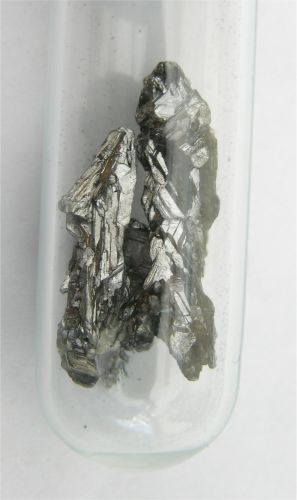
Arsenic is the chemical element with atomic number 33 and the symbol As, a solid in group 15 of the periodic table that is known for its toxic compounds.[1]
A sample of arsenic.
Via Wikimedia Commons: Arsen 1 by The original uploader was Tomihahndorf at German Wikipedia ., CC BY-SA 3.0.
This entry is about the element. Its relative atomic mass is 74.922, it is in group 15 of the periodic table, and it is a solid at room temperature.[1] For its place in the table and its basic facts, see the [periodic table page for Arsenic](/element/Q871/arsenic).
Properties
The Royal Society of Chemistry lists arsenic as subliming at 616 °C (889 K), that is, turning directly from solid to gas rather than melting, and gives its density as 5.75 g/cm³.[1] It has a single stable isotope, arsenic-75, so its atomic weight is a single value, 74.921595(6) since 2013 according to the atomic weights commission of the International Union of Pure and Applied Chemistry; NIST gives the same value.[3][2]
History and name
The Royal Society of Chemistry says the ancient Egyptians knew arsenic and that the discovery of the element is attributed to Albertus Magnus in the 1200s, dating it to about 1250. The atomic weights commission says the German scientist and philosopher Albert von Bollstädt, Albertus Magnus, is thought to have obtained the metal around 1250, and that its poisonous sulfides were known in prehistoric times.[1][3] The Royal Society of Chemistry says the name is thought to come from the Greek arsenikon, the name for the yellow pigment orpiment; the commission traces it to the Greek arsenikos, "masculine."[1][3]
Where it comes from
The Royal Society of Chemistry gives arsenic's crustal abundance as 2.5 parts per million. It says most arsenic is produced as a by-product of copper and lead refining, and that it can be obtained by heating the mineral arsenopyrite. The top three producers listed are China, Chile and Kazakhstan, without a date.[1]
Uses
The Royal Society of Chemistry lists strictly controlled rat poisons and insecticides, arsenic as a doping agent in gallium arsenide, bronzing, pyrotechnics, hardening shot, special glass and wood preservation. It says arsenic in small doses is toxic and a suspected carcinogen.[1]
This entry explains; it is not medical advice. Ask a doctor or pharmacist about your own health.