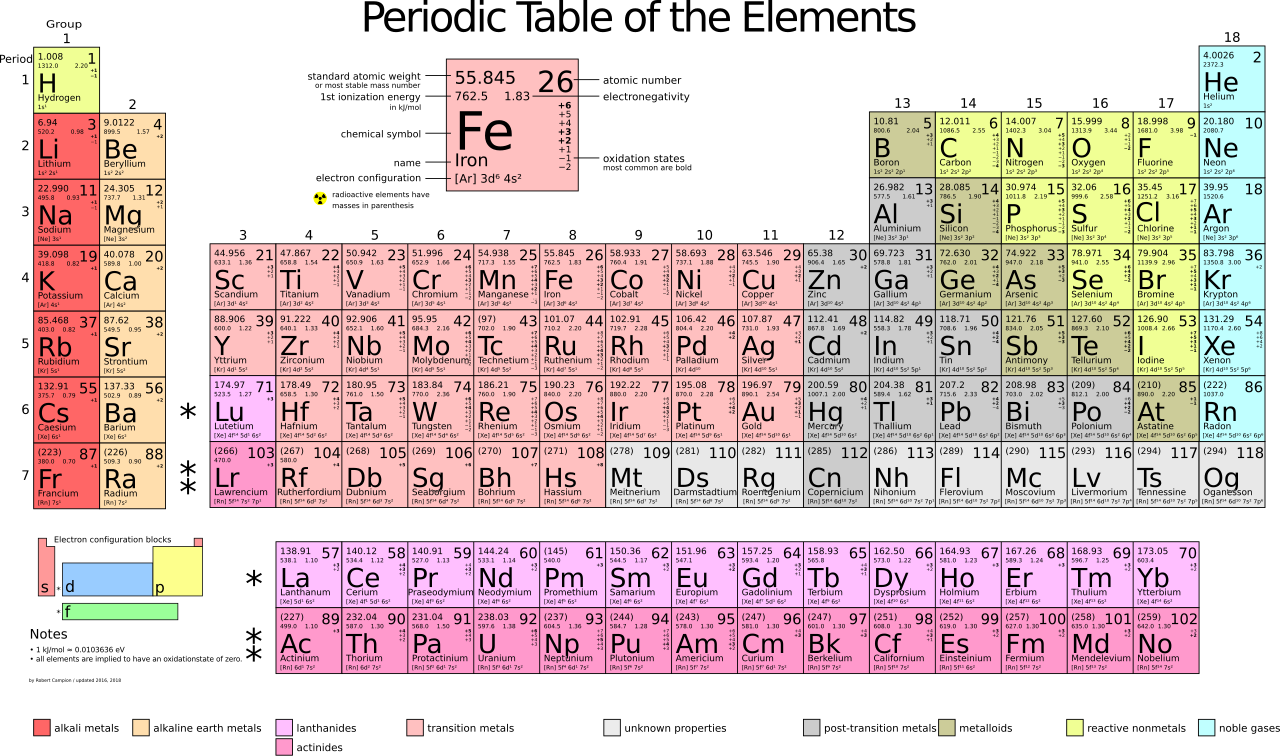
The periodic table is the chart that arranges the chemical elements by atomic number so that elements with similar properties fall in the same column; Dmitri Mendeleev completed the first widely used version in 1869, and the table now runs to element 118.[1][3][6]
The Royal Society of Chemistry says Antoine Lavoisier grouped the elements by properties into gases, non-metals, metals and earths in 1789, and Scientific American says he drew up a list of 33 known elements.[1][3] Johann Dobereiner noticed groups of three similar elements, called triads; the Royal Society of Chemistry and LibreTexts date this to 1829, while Scientific American gives 1817.[1][3][5] A conference at Karlsruhe in 1860 produced a more accurate list of atomic masses, which, the Royal Society says, made orderly arrangement possible.[1] Alexandre-Emile Beguyer de Chancourtois published a spiral arrangement in 1862, John Newlands set out his "law of octaves" in the 1860s, and Lothar Meyer produced tables between 1864 and 1870.[1][3] LibreTexts says Mendeleev and Meyer developed the periodic law independently in 1869, whereas the Royal Society and Scientific American place Meyer's published table in 1870.[1][3][5]
Mendeleev's table, 1869
Scientific American says that on 17 February 1869 the Russian chemistry professor Dmitri Mendeleev completed the first of his many periodic charts, which included 63 known elements; that is a Julian-calendar date, and the page does not give the Gregorian equivalent.[3] The American Institute of Physics notes that his 1869 table had many gaps and uncertainties and that "the properties of elements are in periodic dependence upon their atomic weights", in Mendeleev's own words.[2]
He left gaps for elements not yet found. The Royal Society of Chemistry describes gallium, discovered by Paul-Emile Lecoq in 1875, as the element he had called eka-aluminium; his predicted atomic mass was "About 68" against a measured 69.72.[1] The American Institute of Physics dates the discoveries that confirmed his predictions to gallium 1875, scandium 1879 and germanium 1886.[2]
Atomic number
Henry Moseley used X-rays in 1913 to show that each element has a characteristic number, and elements have been arranged by atomic number ever since.[2][4] NIST says Moseley measured the X-ray spectra of 12 elements, from calcium to zinc, that his result also pointed to missing elements at numbers 43, 61, 72 and 75, and that technetium (1937) and promethium (1945) were later found.[4] Moseley was killed at Gallipoli at the age of 27; NIST dates his death to 10 August 1915, while the Royal Society of Chemistry says August 15.[1][4]
The noble gases and the shape of the table
William Ramsay's discovery of the noble gases in the 1890s added a new group; the Royal Society of Chemistry says Mendeleev had not predicted them, and Scientific American dates argon to 1894.[1][3][5] IUPAC has recommended since 1988 that groups be numbered simply from 1 to 18, with Group 18 holding the noble gases.[5][6] LibreTexts adds that the 15 elements after barium are the lanthanides and the 14 after radium are the actinides.[5]
New elements, 2016
IUPAC says that on 8 June 2016 it released provisional names for the four newest elements, numbers 113, 115, 117 and 118, and on 28 November 2016 it announced the approved names and symbols.[6] In November 2018 IUPAC and the International Union of Pure and Applied Physics released a provisional report on the discovery of new elements.[6] You can browse each element in this encyclopedia's element pages at micwyn.com/element.
Still needs a source
These points have not been checked against a page we could read, so the entry makes no claims about them:
Which laboratories discovered elements 113, 115, 117 and 118, and the date IUPAC first recognised them.
How many elements occur naturally and how many are made only in laboratories.
Glenn Seaborg and the placement of the actinides.
The 2019 International Year of the Periodic Table, and any search for elements 119 and 120.