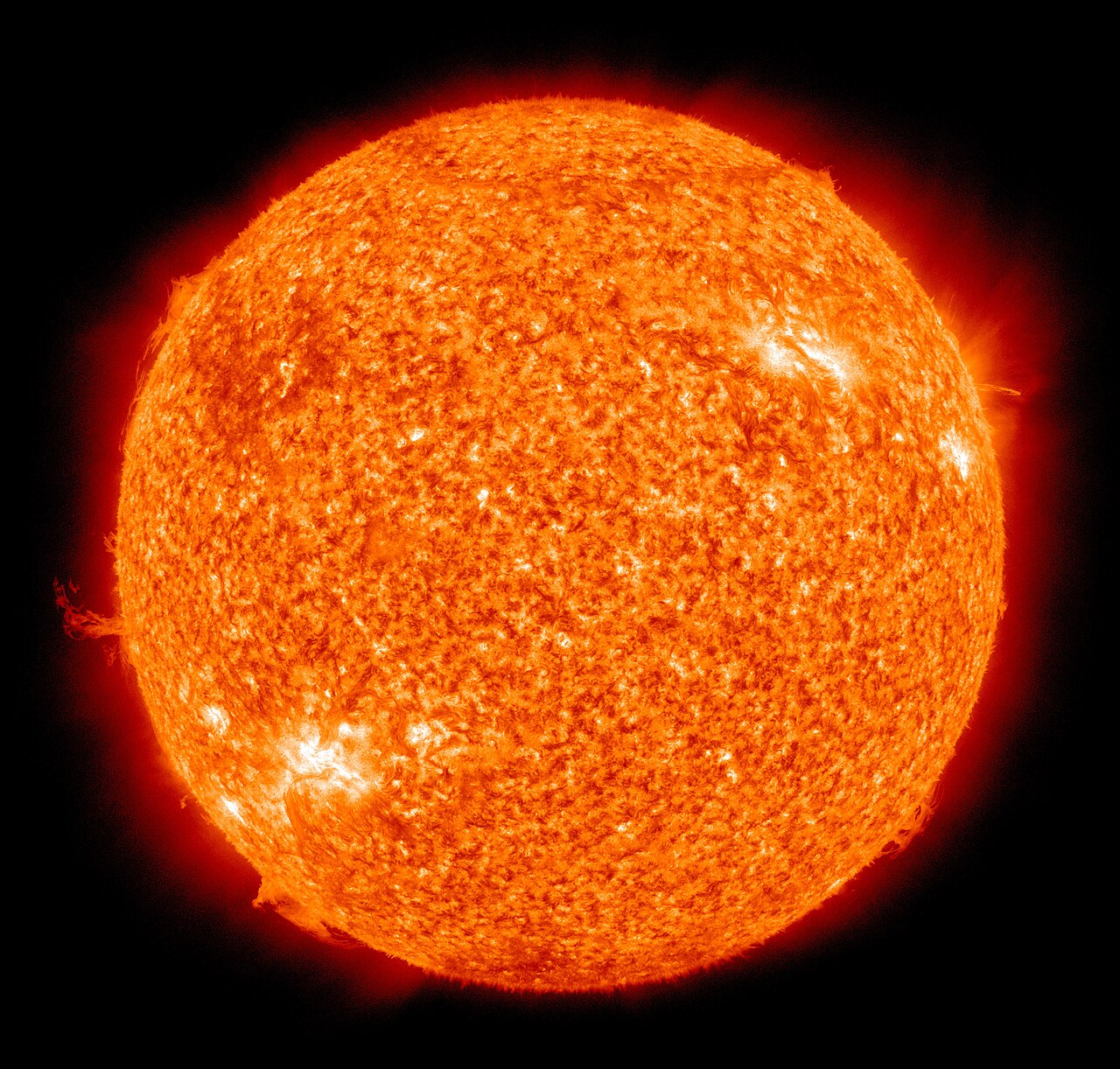
The Sun is the star at the center of the Solar System: a ball of hot plasma, mostly hydrogen and helium, whose gravity holds the planets and other bodies in orbit and whose energy makes life on Earth possible.[1]
The Sun in extreme ultraviolet light as imaged by NASA's Solar Dynamics Observatory.
NASA describes the Sun as an average star in size: its diameter is about 1.4 million kilometres, roughly 100 times Earth's, and it would take more than 330,000 Earths to match its mass and about 1.3 million to fill its volume.[1] It holds 99.8% of the Solar System's mass.[1] Earth is about 150 million kilometres (93 million miles) from it.[1] The nearest other star system is Alpha Centauri, 4.37 light-years away; the red dwarf Proxima Centauri is slightly closer, at 4.24 light-years.[1]
The Sun sits in the Milky Way in a spiral arm called the Orion Spur. NASA says the Solar System moves at an average of about 720,000 kilometres per hour and needs about 230 million years to circle the galaxy once.[1]
Structure
The Sun has no solid surface. Its interior has three regions: the core, the radiative zone and the convection zone.[1]
Core. Hydrogen is fused into helium here, which powers the Sun's heat and light. Temperatures top 15 million °C, the core is about 138,000 kilometres thick, and its density is about 150 grams per cubic centimetre, roughly eight times that of gold.[1]
Radiative zone. Energy moves outward as radiation, which NASA says takes about 170,000 years to reach the top of the next layer.[1]
Convection zone. Here large bubbles of hot plasma rise toward the visible surface.[1]
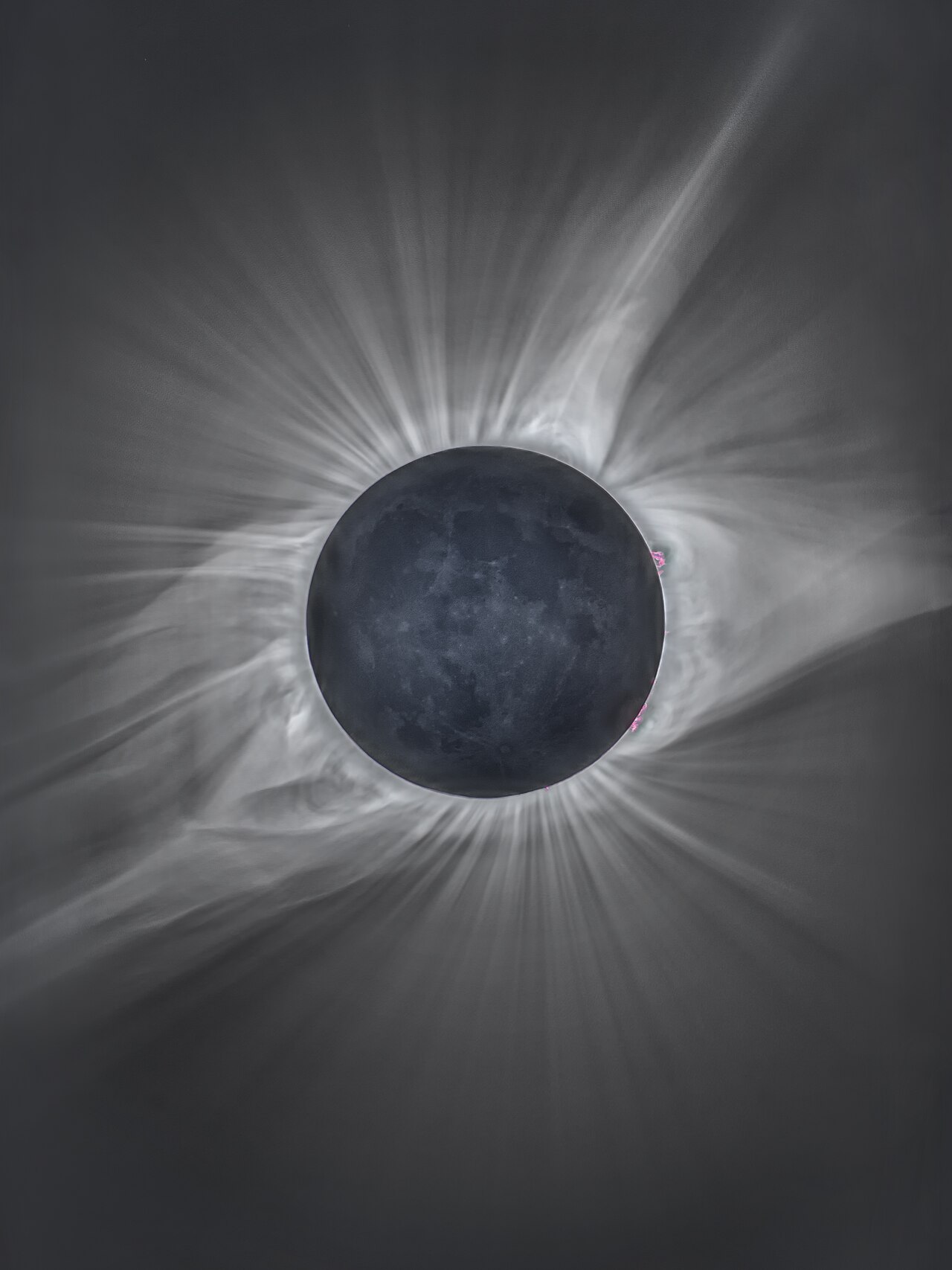
The layer commonly called the surface is the photosphere, about 250 miles thick, with temperatures near 5,500 °C. It emits most of the visible light.[1] Above it lie the chromosphere, a thin transition zone and the corona, the upper atmosphere.[1] The corona reaches up to about 2 million °C, much hotter than the photosphere. NASA calls the source of this coronal heating a major unsolved puzzle in solar physics.[1] During a total solar eclipse the chromosphere appears as a fine red rim and the corona as a white crown, whose name means "crown" in Latin and Spanish.[1]
The Sun's corona as a white crown around the Moon's dark disk during a total solar eclipse.
Because the Sun is a ball of gas, different parts spin at different rates: about once every 25 Earth days at the equator and once every 36 days at the poles. Its axis is tilted 7.25 degrees to the plane of the planets' orbits.[1]
Magnetism, sunspots and the solar cycle
Sunspots are cooler regions of the photosphere caused by concentrations of magnetic field lines, which prevent heat from reaching the surface there. They are often around 6,000 °F (about 3,300 °C), against about 10,000 °F (5,500 °C) for the rest of the photosphere.[2] They last from days to months and typically stretch 1,000 to 100,000 miles across.[2] Sunspots are the visible part of active regions, areas of intense magnetic fields that are the source of solar eruptions.[2]
The number of sunspots rises and falls over a cycle of roughly 11 years, and NASA and NOAA track it to follow the solar cycle.[2] Near the height of the cycle the Sun's magnetic poles flip, and the Sun moves from a calm state to an active one.[4] Astronomers have tracked solar cycles since Galileo first observed sunspots in the 1600s.[4] Solar Cycle 25 began in December 2019.[1] On 15 October 2024, NASA, NOAA and the international Solar Cycle Prediction Panel announced that the Sun had reached its solar maximum period. NOAA's Elsayed Talaat said the month of peak activity would not be identified for months or years, because a peak can only be recognised after activity has consistently declined.[4]
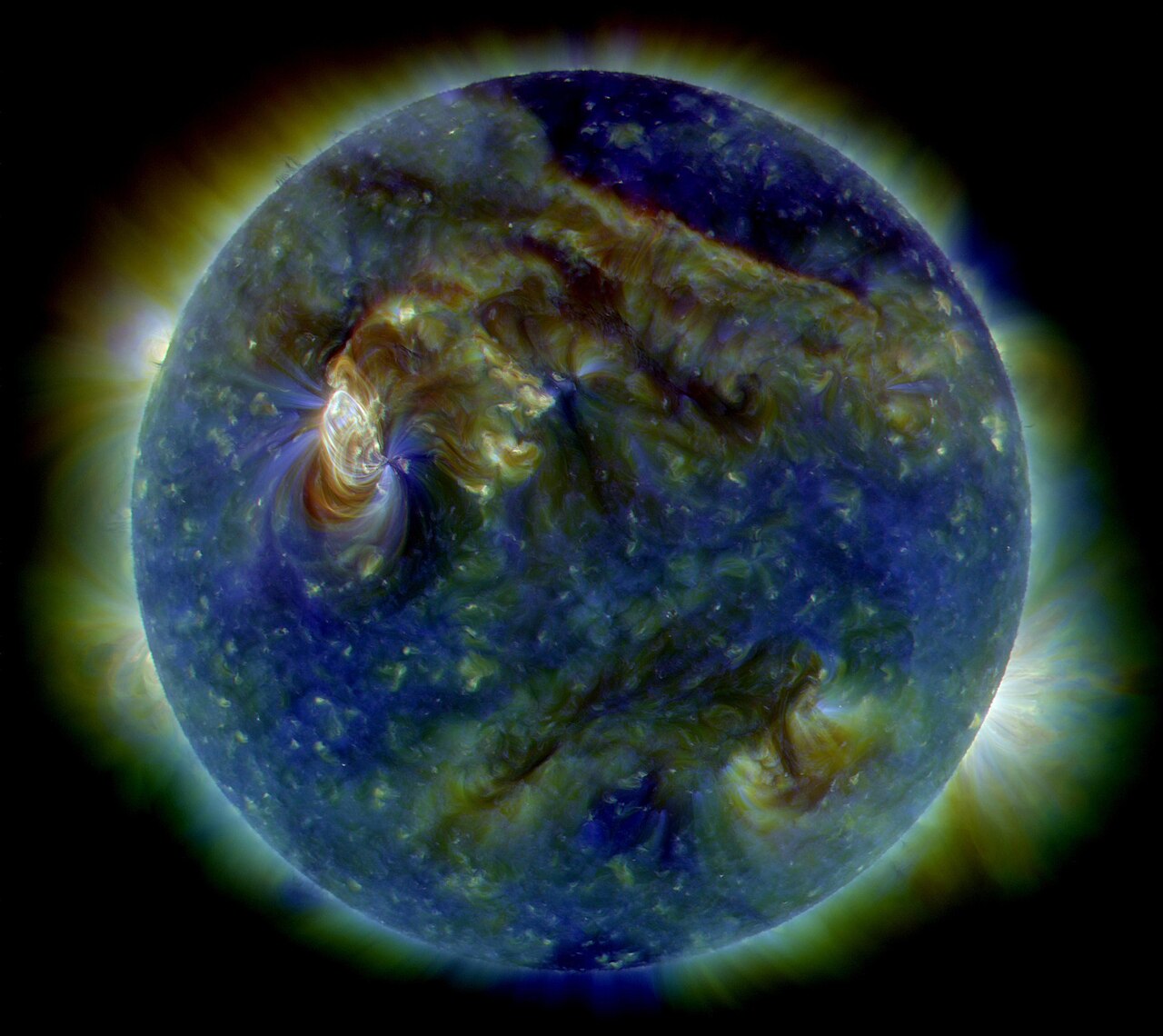
The Sun in extreme ultraviolet light on 1 August 2010, with bright active regions and glowing arches of magnetic structure across its disk.
The Sun's magnetic fields twist as it rotates, and NASA says solar storms typically begin when these fields snap and reconnect, releasing large amounts of energy.[3] A solar flare is an intense burst of radiation across the electromagnetic spectrum.[3] NOAA classifies flares by their peak soft X-ray output as A, B, C, M and X, each class ten times stronger than the one before; X-class flares reach 10⁻⁴ watts per square metre.[6] A coronal mass ejection (CME) is an immense cloud of solar material, often millions of miles across, thrown into space at over a million miles per hour, often after a flare.[3]
When a storm is aimed at Earth it can disturb Earth's magnetic field in what is called a geomagnetic storm, producing radio blackouts, power outages and auroras. NASA says these events do not directly harm people on the ground, because Earth's magnetic field and atmosphere protect us.[3] Because flare radiation travels at the speed of light, its effects on the sunlit side of Earth's upper atmosphere arrive at the same moment the flare is seen.[6]
NASA's historical examples include:
1 September 1859 (the Carrington Event): A flare observed by British astronomer Richard Carrington triggered the strongest geomagnetic storm on record, according to NASA. Telegraph systems failed, and auroras were seen as far south as Cuba and Hawaii.[1]
13 March 1989: A geomagnetic storm interrupted power from Hydro-Québec, leaving 6 million people without electricity for 9 hours, and power surges melted transformers in New Jersey.[1]
May 2024: A series of large flares and CMEs produced the strongest geomagnetic storm at Earth in two decades, according to NASA and NOAA.[4]
NASA and NOAA said in October 2024 that the most powerful flare of Solar Cycle 25 up to that point was an X9.0 on 3 October 2024.[4]
Solar wind and the heliosphere
The Sun continuously blows a stream of charged gas, the solar wind. Material leaves the corona at supersonic speeds and forms a vast magnetic bubble, the heliosphere, that extends beyond the planets' orbits, so Earth lies inside the Sun's atmosphere.[1] NASA describes coronal holes as patches where the Sun's magnetic field lines connect directly to interplanetary space.[1] NOAA reports that they produce fast wind at 500 to 800 kilometres per second, while the most common wind in the plane of the planets is slow, around 400 kilometres per second.[5] Because the Sun rotates, its magnetic field is carried into a spiral called the Parker spiral.[1] NOAA notes that fast wind brings geomagnetic storms and slow wind brings calm space weather.[5]
Formation and future
The Sun formed about 4.6 billion years ago from a spinning cloud of gas and dust called the solar nebula, which collapsed under its own gravity and flattened into a disk.[1] NASA's page gives the Sun's age as 4.5 billion years in its overview and 4.6 billion years for its formation, so the two figures are not reconciled there.[1] NASA says the Sun is a little less than halfway through its lifetime and will last another 5 billion years or so. It will then expand into a red giant large enough to engulf Mercury and Venus, and possibly Earth, before becoming a white dwarf.[1]
Exploration
NASA's Parker Solar Probe, launched on 12 August 2018, became in 2021 the first spacecraft to fly through the corona. It is built to come within about 3.9 million miles of the Sun, moving at about 430,000 miles per hour at closest approach, protected by a carbon-composite shield 11.43 centimetres thick.[7] NASA lists other spacecraft currently studying the Sun, among them STEREO, Solar Orbiter, SOHO, the Solar Dynamics Observatory, Hinode, IRIS and Wind.[1]
Name
The Latin word for the Sun is sol, the root of "solar". The Greek sun god Helios gave his name to terms such as heliosphere and helioseismology.[1]