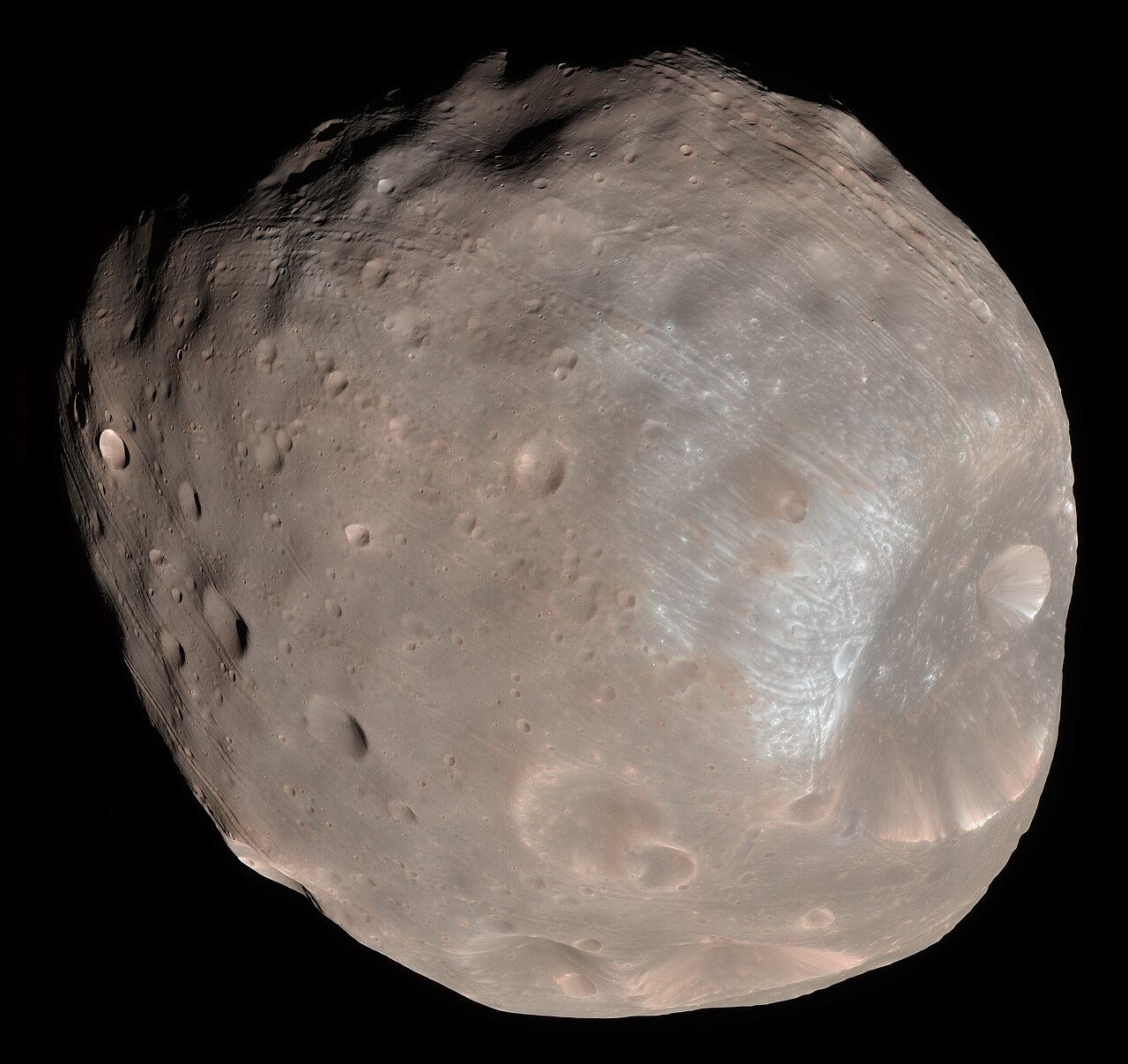
Phobos is the larger and inner of Mars's two moons, an irregular, heavily cratered body about 27 by 22 by 18 kilometres across that circles Mars three times a day.[1]
Phobos, the larger moon of Mars, photographed by the HiRISE camera on NASA's Mars Reconnaissance Orbiter.
Via Wikimedia Commons: Phobos colour 2008 by NASA / JPL-Caltech / University of Arizona, public domain.
Orbit and fate
Phobos orbits so close to Mars that from some places on the planet it cannot always be seen.[1] NASA says it is approaching Mars at about 1.8 metres every hundred years, and at that rate it will either crash into Mars in about 50 million years or break up into a ring.[1]
Surface and composition
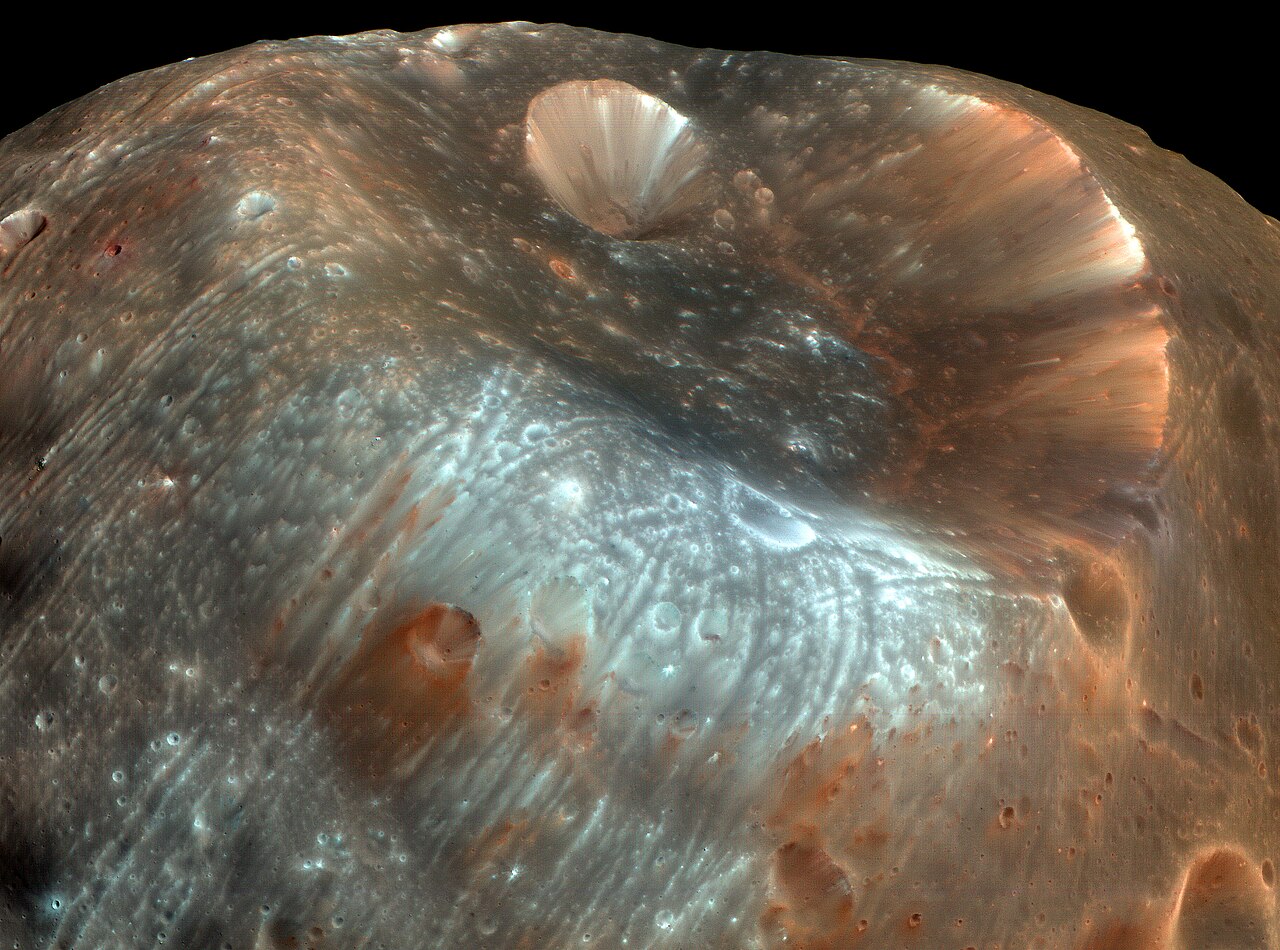
NASA says Phobos was nearly shattered by a giant impact and carries gouges from thousands of meteorite impacts.[1] Its most prominent feature is Stickney Crater, named for Chloe Angeline Stickney Hall, a mathematician and the wife of the astronomer Asaph Hall, who discovered both of Mars's moons. NASA's page gives its diameter as 9 kilometres in one place and 9.7 kilometres in another.[1] Images from Mars Global Surveyor show the crater appears filled with fine dust, with evidence of boulders sliding down its slopes.[1]
Stickney Crater, the largest impact crater on Phobos.
NASA says Phobos and Deimos appear to be made of C-type rock, similar to dark carbonaceous chondrite asteroids, and that Phobos's surface has been pounded into powder by meteoroid impacts, some of which started landslides that left dark trails on steep slopes.[1] Phobos has no atmosphere. Temperatures measured on its day and night sides range from about −4 °C to −112 °C, an extreme difference NASA attributes to fine surface dust that cannot hold heat.[1]
Discovery and name
Asaph Hall discovered Phobos on 17 August 1877 and Deimos on 11 August 1877.[1][2] He named them for the mythological sons of Ares, the Greek counterpart of the Roman god Mars: Phobos means "fear" and Deimos "dread".[1][2]
Compared with Deimos
Deimos is the smaller moon, 15 by 12 by 11 kilometres, and orbits Mars every 30 hours. Both moons are heavily cratered, but Deimos looks smoother because loose debris partly fills its craters, and it lacks the grooves and ridges seen on Phobos. Its largest crater, about 2.3 kilometres across, is about a fifth the size of the largest on Phobos.[2]
Where did Phobos come from?
NASA says Phobos may be a captured asteroid, though some scientists have evidence that contradicts this.[1] Scientists have long debated the origin of the Martian moons. NASA describes two leading ideas: that they are ancient asteroids captured by Mars's gravity, or that they formed from material thrown into orbit by a massive impact on Mars.[3] A NASA-led study published in the journal Icarus in November 2024 proposed another route: an asteroid passing near Mars could have been torn apart by the planet's gravity, with surviving fragments colliding in orbit, spreading into a disk and clumping into the two moons.[6] The same article notes that the giant-impact idea better explains the moons' near-circular orbits aligned with Mars's equator, but that a giant impact leaves material mostly close to the planet, whereas Deimos in particular sits far out.[6]
The Martian Moons eXploration mission
The Japan Aerospace Exploration Agency (JAXA) launched its Martian Moons eXploration (MMX) spacecraft from the Tanegashima Space Center at 4:41:03 a.m. Japan time on 20 October 2026, aboard H3 rocket flight number 10, and reported on 26 October that the spacecraft's first transmission after launch had been received.[4] MMX will focus on Phobos, which JAXA describes as never having been explored, and aims to return at least 10 grams of regolith to Earth.[4][5] JAXA's plan is to arrive in the Mars system about a year after launch, enter an orbit similar to Phobos's, land a rover and then the main spacecraft, and observe Deimos from a distance. The sample capsule is to return to Earth, with recovery planned in Australia, in 2031.[5] NASA says the spacecraft will arrive at Mars in 2027 and collect its sample no earlier than 2028.[3]
NASA contributes the MEGANE instrument, which measures neutrons and gamma rays to determine the moon's chemical makeup, and the P-Sampler, a device that collects surface material with bursts of nitrogen gas. NASA will curate about 15% of the returned sample.[3] As of 22 November 2026 the spacecraft is on its way; none of these later milestones has yet occurred.