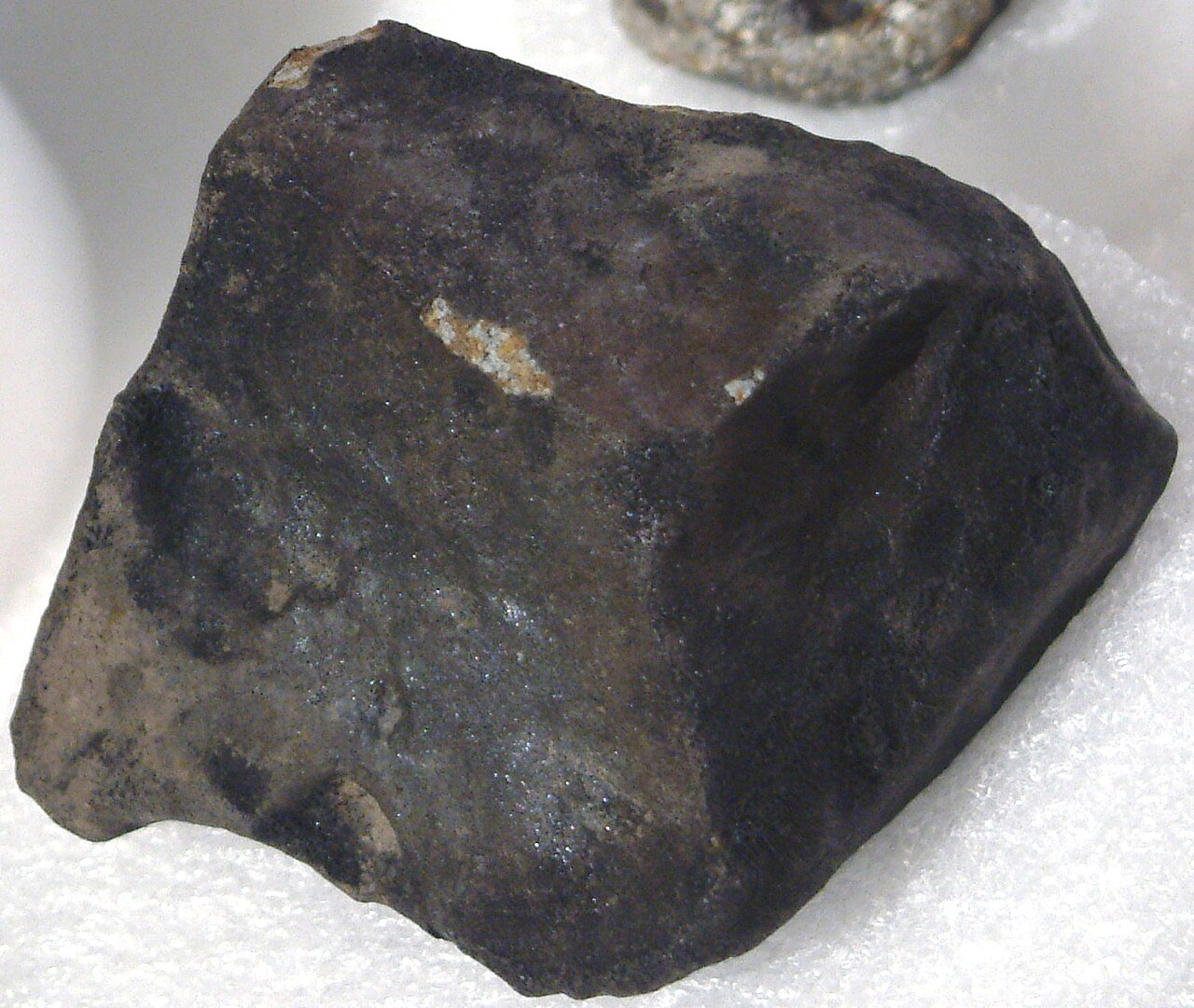
A meteorite is a natural solid object from space that has survived a meteor's passage through an atmosphere without being completely vaporized and reaches the ground.[1][2] NASA says meteorites typically range from the size of a pebble to a fist.[1]
A dark, angular stony rock with a thin dark outer crust and a few small pale patches where it has chipped, resting on white foam; the image carries no label saying which meteorite it is or its credit
The International Astronomical Union's Commission F1 (2017 definitions) says a meteorite is any natural solid object that survived the meteor phase in a gaseous atmosphere without being completely vaporized, and that a meteoroid in the atmosphere becomes one after ablation stops and it continues on "dark flight" to the ground. A meteorite smaller than 1 millimetre can be called a micrometeorite. Foreign objects on the surface of an airless body are not meteorites, because "there is no meteorite without a meteor"; they can be called impact debris.[2]
How to recognize one
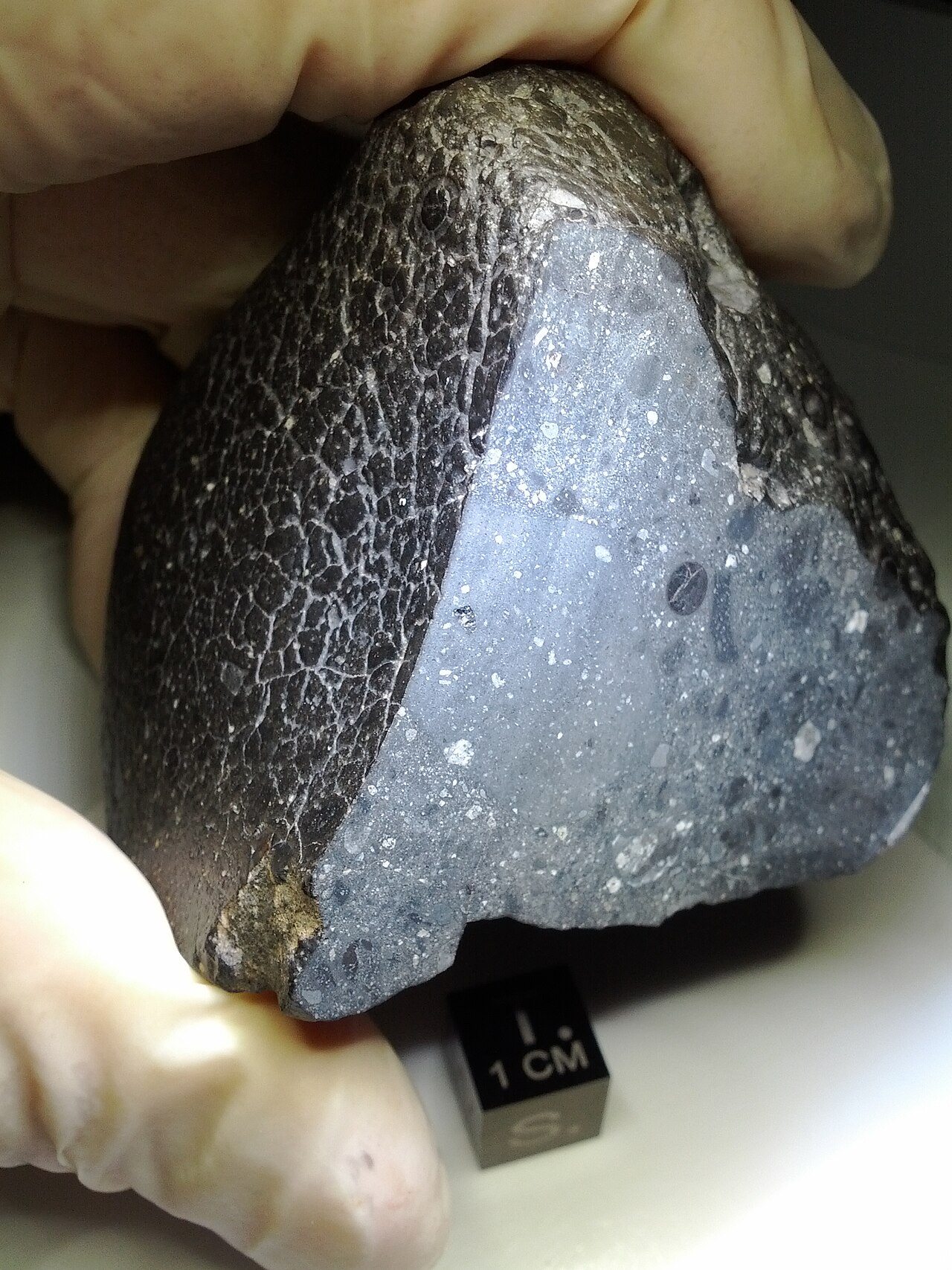
NASA says meteorites may resemble Earth rocks but usually have a burned exterior, a "fusion crust" that can look shiny and forms as the outer surface melts passing through the atmosphere.[1] NASA's Antarctic collection shows an 8 kilogram Martian meteorite with a dark fusion crust covering most of its exterior and a light basaltic interior visible where the crust has broken off.[3] NASA says deserts, both sandy and icy, are the best places to find them, because dark rocks stand out on pale sand or on Antarctic ice.[1]
Types
NASA says there are three major types: "irons", "stonys" and "stony-irons". Most meteorites that fall to Earth are stony, but most of those discovered long after they fall are irons, which are heavier and easier to tell from Earth rocks.[1]
Where they come from
NASA says most meteorites found on Earth come from shattered asteroids, and that scientists can tell by calculating orbits from photographs of falls, comparing composition with classes of asteroids, and measuring ages. It gives these breakdowns:[1]
99.8% come from asteroids, and the remaining 0.2% is split roughly equally between meteorites from Mars and from the Moon.
Over 60 known Martian meteorites were blasted off Mars by impacts and are igneous rocks, and Martian origin shows in pockets of trapped gas matching what spacecraft measured there.
Nearly 80 lunar meteorites resemble Apollo samples but come from other parts of the Moon.
A class called howardite-eucrite-diogenite (HED) came from the asteroid Vesta, which NASA says its Dawn mission established.
Pieces of Mercury or Venus could in theory have reached Earth, but none has been conclusively identified.
NASA also says that after a meteor shower you should not expect to find meteorites, because most showers come from fragile comet debris; no remnants have been traced definitively to the Taurids or Geminids.[1] See the Comet and Asteroid entries.
What they tell us
NASA says meteorites preserve diverse materials from when planets formed and let scientists learn the age and composition of planetary building blocks, the temperatures reached inside asteroids and how much material was shocked by impacts.[1] NASA says meteorites can be up to 4.6 billion years old.[1] A 2026 press release about organic molecules in the Murchison meteorite, which fell in Australia in 1969, quotes a researcher saying it is "at least 5.5 billion years old, one billion years older than Earth".[5] The two figures differ, and the release does not say why; the older number may refer to dust grains older than the solar system inside the rock, but the sources do not say so, so that is not claimed here.
Antarctic meteorites
The US Antarctic meteorite programme is a cooperation among NASA, the National Science Foundation and the Smithsonian Institution. NASA's page says that as of 2016 about 22,000 samples had been recovered, that curators had sent over 19,000 samples to roughly 600 scientists, and that the collection includes samples from the Moon, Mars and asteroids.[3] I read only this 2016 summary, so the count is likely to be higher now.
Newer research
Hillsborough, New Jersey. A meteorite crashed through a home's roof in Hillsborough on 16 July 2024. A team led by Peter Jenniskens of NASA Ames and the SETI Institute reported in July 2026 in Science Advances, according to a press summary, that it holds carbon compounds, amino acids and other prebiotic molecules, and shows more alteration by briny water than most meteorites of its type. It is classified CM1/2, a carbonaceous chondrite thought to come from the inner asteroid belt. The summary says these are building blocks of life, "but not necessarily from life itself".[4] I read a news summary of the paper, not the paper.
Murchison and Aguas Zarcas. Researchers at the National High Magnetic Field Laboratory and Brookhaven National Laboratory report in The Planetary Science Journal tens of thousands of carbon-based molecules in a small sample of each meteorite, and that the two share only a small fraction of them. The release says this suggests different asteroids experienced very different environments as they formed.[5] I read the press release, not the paper.
International Astronomical Union Commission F1, as published by the International Meteor Organization. "Definitions of terms in meteor astronomy." Approved by electronic vote, 30 April 2017. imo.net/definitions-of-terms-in-meteor-astronomy-iau (read 23 November 2026)
NASA Johnson Space Center Astromaterials Curation. "Antarctic Meteorites." curator.jsc.nasa.gov/antmet/ (read 23 November 2026)
Brookhaven National Laboratory (issued by the National High Magnetic Field Laboratory). "A Glimpse of the Solar System's Origins: Striking Details on the Molecules Inside a Meteorite." bnl.gov/newsroom/news.php?a=123172 (read 23 November 2026)