Daphnis is a tiny moon of Saturn that orbits inside the Keeler Gap of the A ring and raises waves along the gap's edges.[1][3] NASA calls it "the wavemaker moon".[3]
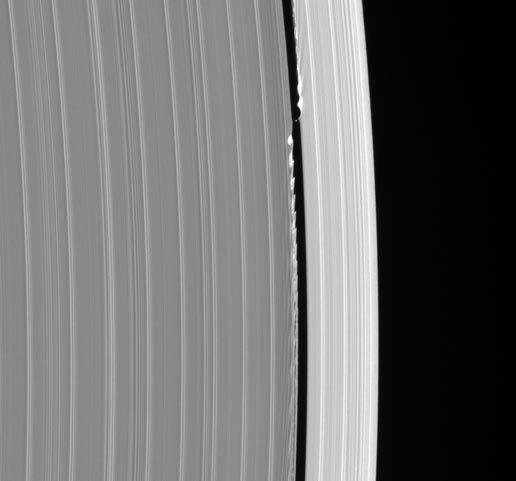
Via Wikimedia Commons: Shepherd Moon Daphnis by NASA/JPL/Space Science Institute, public domain.
Orbit and size
NASA gives Daphnis a mean radius of 3.8 kilometres (2.4 miles) and an orbit 136,500 kilometres (85,000 miles) from Saturn, completed in about 14 hours.[1] The NASA Saturnian Satellite Fact Sheet lists the same distance and a period of 0.594 days, which is about 14.3 hours, with an eccentricity of 0.000 and an inclination of 0.0 degrees. It also gives radii along three axes of 4.3, 4.1 and 3.2 kilometres, a mass of about 0.000001 × 10²⁰ kilograms and a mean density of 340 kilograms per cubic metre.[2] A NASA image page describes the moon as 8 kilometres (5 miles) across, which is consistent with the mean radius above.[3]
The Keeler Gap and its waves
Daphnis lies within the Keeler Gap, which NASA's image page gives as 42 kilometres (26 miles) wide.[3] NASA's moon page explains that the moon's gravity perturbs the orbits of particles in the A ring and sculpts the edge of the gap into waves. Material on the inner edge of the gap orbits faster than the moon, so the waves there lead Daphnis in its orbit; material on the outer edge moves slower, so the waves there trail it.[1] Daphnis raises waves in both the horizontal and vertical directions, and Cassini observed the vertical structures in 2009, around the time of Saturn's equinox.[3] NASA also reports that the waves cast shadows on Saturn when the Sun is in line with the plane of the rings, which happens at the planet's equinox.[1]
Surface
NASA's January 2017 description of Cassini's closest view says that, like Atlas and Pan, Daphnis appears to have a narrow ridge around its equator and a fairly smooth mantle of material that is likely an accumulation of fine particles from the rings. A few craters were obvious at that resolution, and a second ridge runs parallel to the equatorial band further north.[3] The same page notes a faint, narrow tendril of ring material just behind the moon, which may be a packet of material Daphnis drew out of the ring.[3] The wave peak on one side of the gap looked softer than the otherwise sharp gap edges, possibly because fine ring particles spread into the gap after Daphnis's last close approach to that edge on an earlier orbit.[3]
Discovery and name
NASA says the Cassini mission team discovered Daphnis on 1 May 2005. Before that, scientists had proposed a moon at this position because of the ripples seen along the edge of the Keeler Gap.[1] It was first designated S/2005 S1.[1][2] The moon is named for Daphnis, a shepherd and pipes player who was a pastoral poet in Greek mythology, a son of Hermes and a brother of Pan.[1]
Cassini's closest view
On 16 January 2017, during one of its ring-grazing passes over the outer edges of Saturn's rings, Cassini took what NASA called the closest view of Daphnis yet obtained. The picture was taken with the narrow-angle camera from about 28,000 kilometres (17,000 miles), at a scale of 168 metres per pixel.[3]
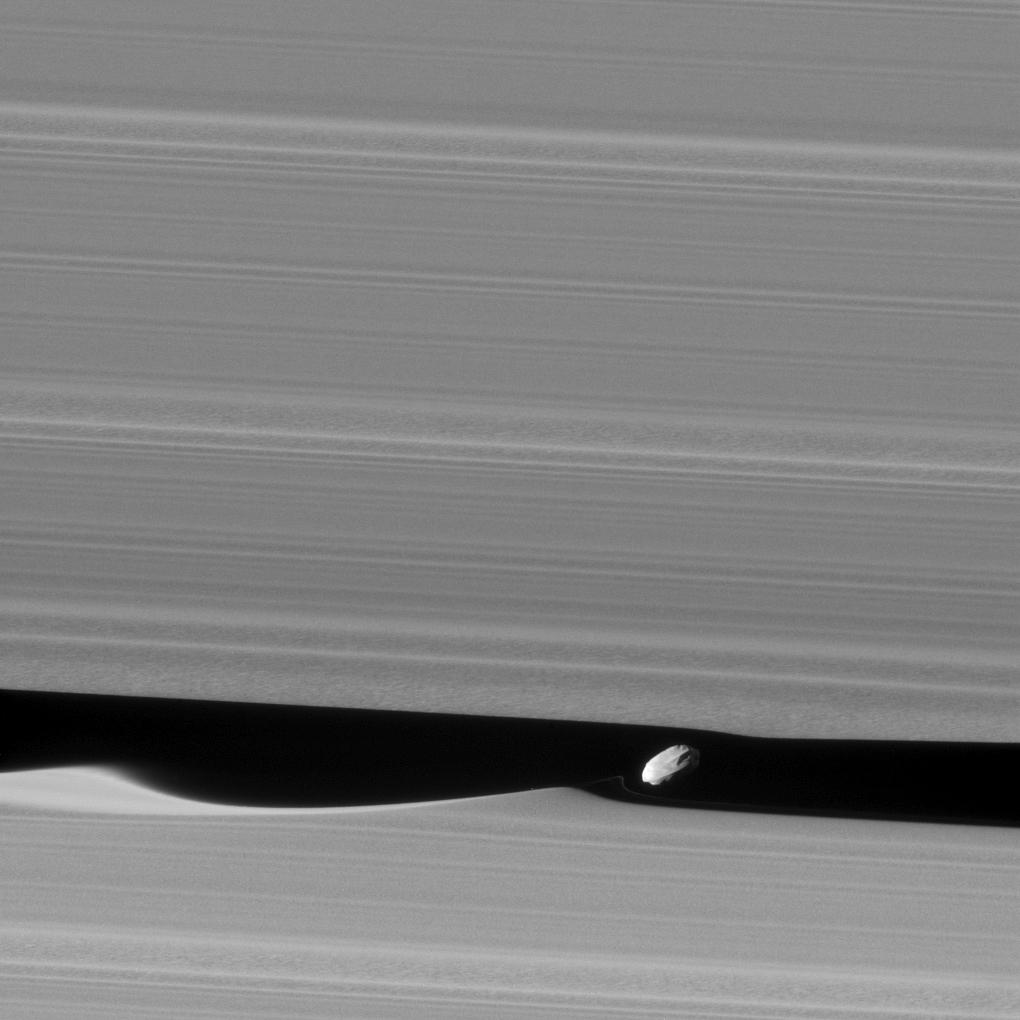
Via Wikimedia Commons: PIA21056 - Daphnis Up Close by NASA/JPL-Caltech/Space Science Institute, public domain.
See also
Saturn describes the planet; other small moons near its rings include Prometheus and Pandora.
Sources
- NASA Science. "Daphnis," Saturn Moons. science.nasa.gov/saturn/moons/daphnis/ (read 22 November 2026)
- NASA Space Science Data Coordinated Archive. "Saturnian Satellite Fact Sheet." nssdc.gsfc.nasa.gov/planetary/factsheet/saturniansatfact.html (read 22 November 2026)
- NASA. "Daphnis Up Close" (PIA21056). 19 January 2017. nasa.gov/image-article/daphnis-up-close/ (read 22 November 2026)
