Charon is the largest of the five moons of Pluto, about 1,214 kilometres across, or roughly half Pluto's size, making it the largest known moon relative to its parent body.[1] The two always show each other the same face, and astronomers sometimes call them a double dwarf planet system.[1]
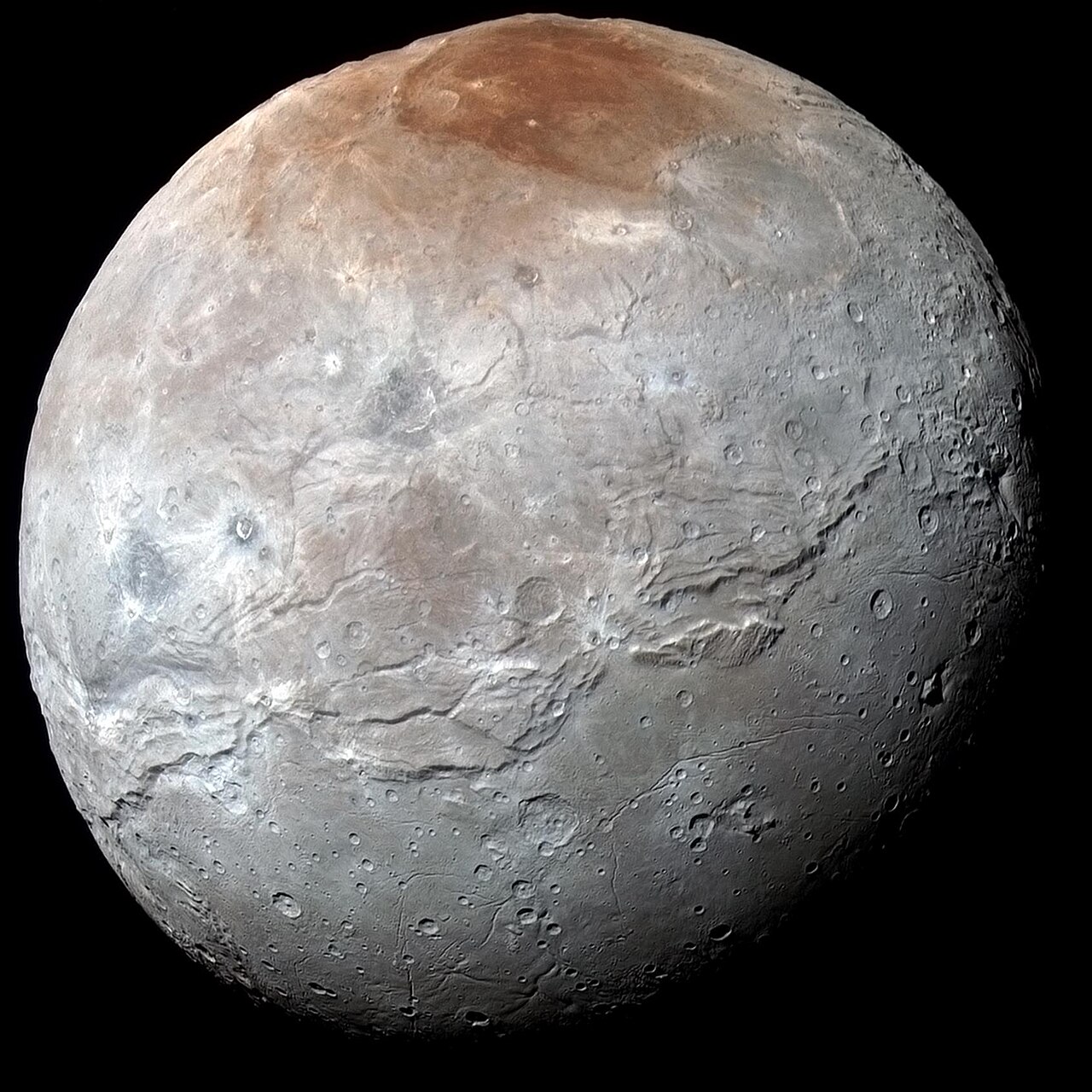
Via Wikimedia Commons: NH-PlutoMoon--Charon-NeutralBrightRelease-20151001 by NASA/JHUAPL/SwRI, public domain.
Orbit and size
NASA says Charon is 754 miles (1,214 kilometres) across, orbits Pluto every 6.4 Earth days at a distance of 12,200 miles (19,640 kilometres), and is mutually tidally locked with Pluto: one Pluto rotation takes the same 6.4 days, so Charon neither rises nor sets but hovers over the same spot on Pluto, and the same side of Charon always faces Pluto.[1] The NASA Pluto Fact Sheet gives a mean distance of 19,596 kilometres, an orbital period of 6.3872 days, a radius of 606 kilometres, a mass of 1.586 × 10²¹ kilograms, a mean density of 1,700 kilograms per cubic metre, a geometric albedo of 0.42 and an orbital inclination to Pluto of 0.00005 degrees.[2] The two distance figures differ by about 44 kilometres; the sources do not say why. NASA also says that, like Uranus, the Pluto–Charon system is tipped on its side compared with most planets and moons, and that Pluto's rotation is retrograde.[1]
What New Horizons saw
NASA says New Horizons captured images of Charon just before its closest approach to Pluto on 14 July 2015, and that they showed Charon's palette to be less diverse than Pluto's, with a strikingly reddish north polar region.[1] The Springer Nature account of a Webb study says New Horizons found numerous craters on Charon surrounded by bright ejecta rich in crystalline water ice and ammonia-bearing compounds.[3]
A Webb detection
A paper in Nature Communications reports Webb Space Telescope near-infrared observations of Charon's northern hemisphere, taken from 2022 to 2023, that detect carbon dioxide and hydrogen peroxide on the surface.[3] The authors' account says that, despite expectations from comet studies that carbon dioxide should be present in the outer disk where bodies like Charon formed, none had been detected in New Horizons data, whose spectrometer was limited to wavelengths below 2.5 micrometres, and that Webb's coverage beyond that limit made the detection possible.[3] The source read is a summary by one of the authors, and the paper itself was not read for this entry.
A slowing spin
A modelling study published in Nature Communications on 14 July 2026 by Hanzhang Chen and colleagues examined mountain ridges in Oz Terra, a region of Charon's northern hemisphere, extending over 200 kilometres with asymmetric slopes consistent with compression. The release says the modelling indicates an ice shell at least 30 to 36 kilometres thick when the ridges formed, and that Charon's early rotation period was about 14.3 hours, much faster than its present tidally locked 153.3 hours, which would be evidence of gradual slowing, or despinning. It also says the study suggests Charon may have begun in a relatively cold state, and that uncertainties remain in the modelling assumptions.[4]
A University of Arizona study published in Nature Geoscience and announced on 6 January 2025, led by Adeene Denton, proposes a "kiss and capture" origin. In simulations that account for the strength of cold rock and ice, Pluto and a proto-Charon collided, stuck together briefly as a snowman-shaped object, and then separated while remaining gravitationally bound, with both bodies largely intact. The university says the model parameters that capture Charon also put it in the right orbit, and that heat from the collision and tidal friction may help Pluto develop a subsurface ocean.[5] This contrasts with the long-standing idea that Charon formed in an Earth–Moon-style giant impact with fluid-like deformation.[5] NASA's Pluto Facts page says only that the moon system might have formed by a collision between Pluto and another similar-sized body.[6]
Discovery and name
NASA says James Christy and Robert Harrington discovered Charon in June 1978 at the U.S. Naval Observatory in Flagstaff, Arizona, about six miles from Lowell Observatory where Pluto was found, while trying to refine Pluto's orbit.[1] Christy noticed that images of Pluto were strangely elongated, with the direction of elongation cycling over 6.39 days, Pluto's rotation period, and found more elongated images in archives of earlier plates.[1] NASA says Christy proposed the name Charon, for the ferryman who carried souls across the river Acheron in the underworld, and chose it also because its first four letters matched the name of his wife, Charlene.[1]
See also
Pluto describes the dwarf planet, its atmosphere, its surface and its other moons. Nereid is discussed in a 2026 Webb study that noted faint spectral similarities to Charon.
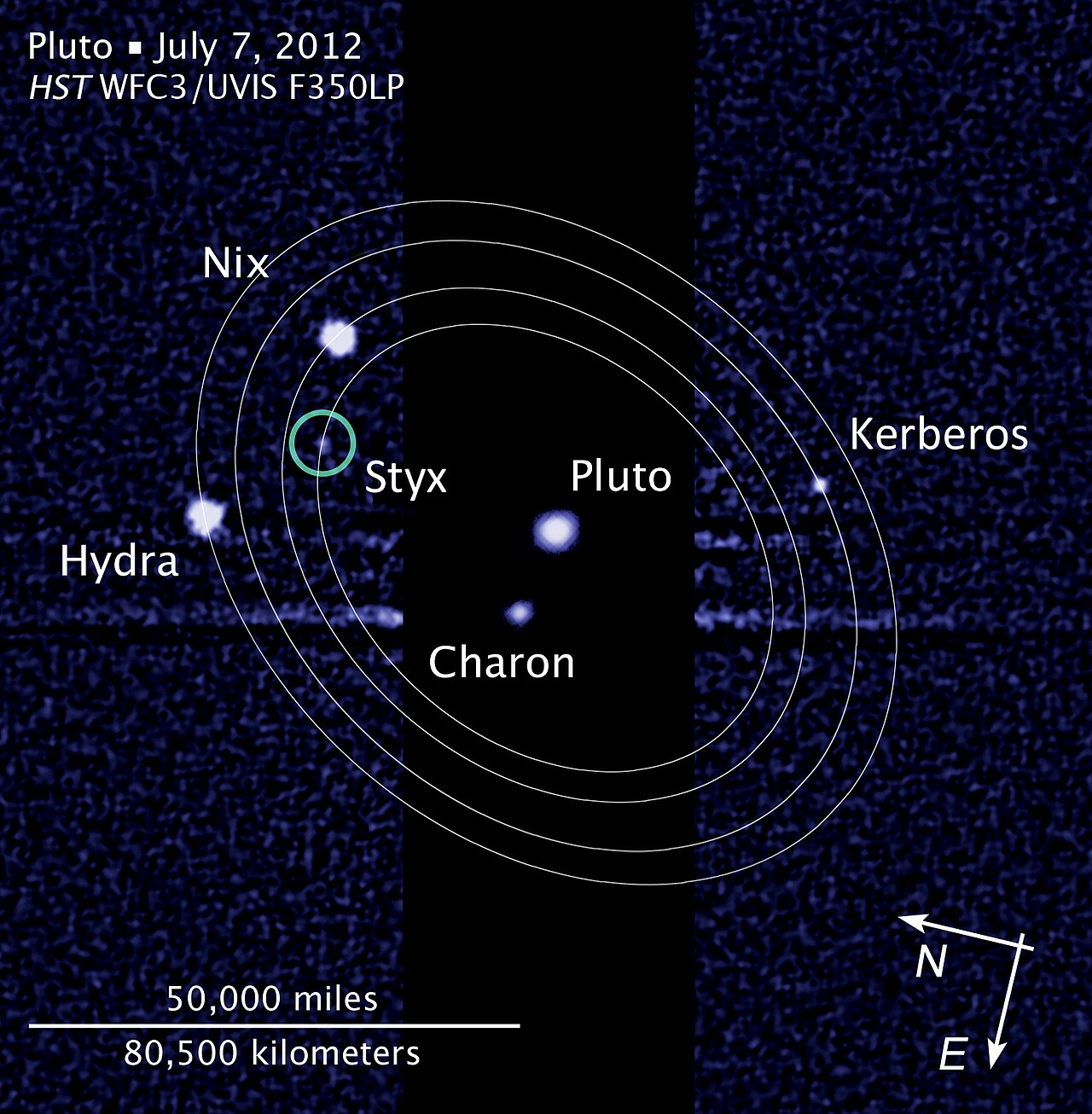
Via Wikimedia Commons: Pluto moon P5 discovery with moons' orbits by NASA, ESA, and L. Frattare (STScI), public domain.
Sources
- NASA Science. "Charon," Pluto Moons. science.nasa.gov/dwarf-planets/pluto/moons/charon/ (read 23 November 2026)
- NASA Space Science Data Coordinated Archive. "Pluto Fact Sheet." nssdc.gsfc.nasa.gov/planetary/factsheet/plutofact.html (read 23 November 2026)
- Springer Nature Research Communities. "Detection of carbon dioxide and hydrogen peroxide on the stratified surface of Charon with JWST." communities.springernature.com/posts/detection-of-carbon-dioxide-an… (read 23 November 2026; an author summary of a Nature Communications paper)
- Nature Portfolio. "Planetary science: The changing spin of Pluto's moon, Charon" (press release on Chen, H., Moon, S. and Yin, A., "Early tidal despinning history recorded in the tectonics of Oz Terra, Charon," Nature Communications 17, 5978, 2026). Published 14 July 2026. natureasia.com/en/info/press-releases/detail/9385 (read 23 November 2026)
- University of Arizona News. "Newly discovered 'kiss and capture' mechanism explains the formation of Pluto and its largest moon." 6 January 2025. news.arizona.edu/news/newly-discovered-kiss-and-capture-mechanism-e… (read 23 November 2026)
- NASA Science. "Pluto Facts." science.nasa.gov/dwarf-planets/pluto/facts/ (read 23 November 2026)
