A dwarf planet is, in the International Astronomical Union's 2006 definition, a body that orbits the Sun, is massive enough to be nearly round, has not cleared the neighbourhood around its orbit, and is not a satellite.[1][2] The union recognises five: Ceres, Pluto, Haumea, Makemake and Eris.[1]
The definition
NASA says Pluto and other dwarf planets are a lot like regular planets, and that the difference comes from the union's 2006 definition of a planet, under which a planet must orbit its host star, be mostly round, and be big enough for its gravity to have cleared other objects of similar size from its orbit. Dwarf planets were defined as objects that orbit the Sun and are nearly round but have not cleared their orbits of debris.[1] NASA quotes the resolution's wording: a dwarf planet orbits the Sun, has enough mass for its self-gravity to give it a nearly round, hydrostatic-equilibrium shape, has not cleared its neighbourhood, and is not a satellite.[2] See the Planet entry for the full definition and its history.
The five recognised dwarf planets
NASA says the union has so far recognised only five, which in order of distance from the Sun are Ceres, Pluto, Haumea, Makemake and Eris, and that the union says there may be many more, perhaps more than a hundred, waiting to be discovered.[1] From the NASA pages used for the individual entries:
- Ceres is the only dwarf planet in the inner solar system, in the main asteroid belt between Mars and Jupiter, about 2.8 astronomical units from the Sun, with a radius of about 476 kilometres and no moons.[3] It was first classed as a planet and was the first dwarf planet visited by a spacecraft, NASA's Dawn, which went into orbit in 2015.[1][3]
- Pluto is about 39 astronomical units from the Sun and about 2,377 kilometres across, with five moons, and was visited by NASA's New Horizons on 14 July 2015.[1][4]
- Haumea is about 43 astronomical units from the Sun, with an equatorial diameter of about 1,740 kilometres, a football shape from its roughly four-hour rotation, two moons and a ring.[1][5]
- Makemake is about 45.8 astronomical units from the Sun, about 1,430 kilometres across, with one known moon, and is the second-brightest object in the Kuiper Belt as seen from Earth after Pluto.[1][6]
- Eris is about 68 astronomical units from the Sun on a path that reaches well beyond the Kuiper Belt, about 2,400 kilometres across, nearly the same size as Pluto, with one known moon, Dysnomia.[1][7]
NASA's pages call Makemake "slightly smaller than Pluto" and give a diameter of 1,430 kilometres against Pluto's 2,377; the Makemake entry notes the mismatch.[1][6]
The famous demotion
NASA says Pluto, discovered by Clyde Tombaugh in 1930, was long considered the ninth planet, but that after astronomers found similar worlds deeper in the Kuiper Belt the union reclassified it as a dwarf planet in 2006, with widespread outrage over the "demoted planet", textbooks being updated and the internet spawning memes of Pluto going through a range of emotions.[1] NASA's account of the discovery of Eris, in 2005, says it helped trigger the debate that led to the reclassification, and that Ceres, discovered in 1801, was once classified as a planet and considered an asteroid for many years.[1][7]
Where they are
NASA says Haumea and Makemake are in the Kuiper Belt, a doughnut-shaped region of icy bodies beyond Neptune, and its pages for Makemake and Eris describe the Kuiper Belt as a disc-like zone beyond Neptune populated by thousands of miniature icy worlds that formed about 4.5 billion years ago.[1][6][7] The Solar System entry describes the belt and other regions.
See also
The Solar System entry puts the five dwarf planets in context, and the Planet entry explains the definition that separates them from the eight planets.
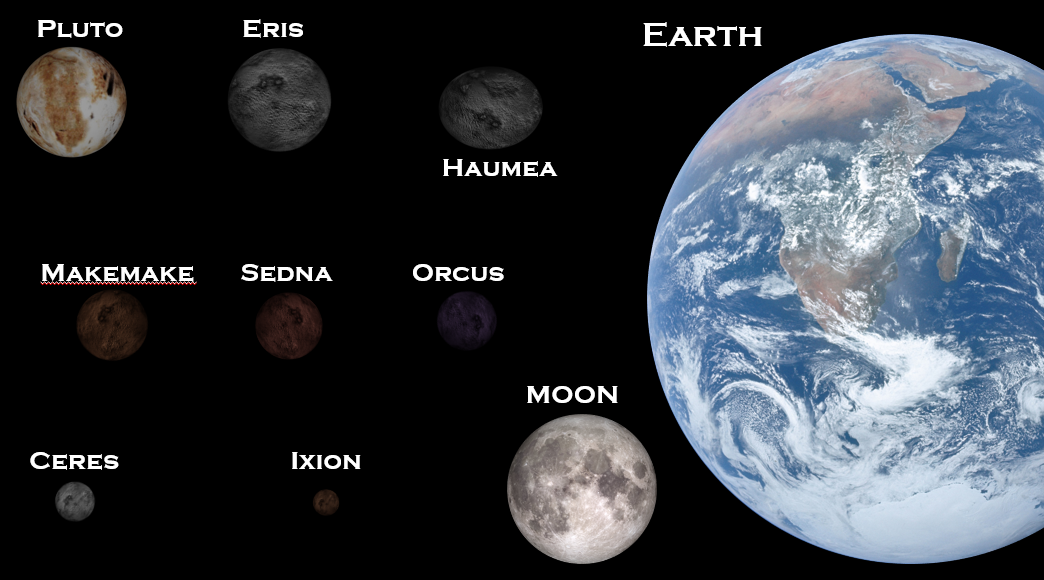
Via Wikimedia Commons: Dwarf Planets compared to the Earth and Moon by SpaceSize, CC BY-SA 4.0.
Sources
- NASA Science. "Dwarf Planets Overview." science.nasa.gov/dwarf-planets/ (read 23 November 2026)
- NASA Science. "What is a Planet?" science.nasa.gov/solar-system/planets/what-is-a-planet/ (read 23 November 2026)
- NASA Science. "Ceres Facts." science.nasa.gov/dwarf-planets/ceres/facts/ (read 23 November 2026)
- NASA Science. "Pluto Facts." science.nasa.gov/dwarf-planets/pluto/facts/ (read 23 November 2026)
- NASA Science. "Haumea." science.nasa.gov/dwarf-planets/haumea/ (read 23 November 2026)
- NASA Science. "Makemake." science.nasa.gov/dwarf-planets/makemake/ (read 23 November 2026)
- NASA Science. "Eris." science.nasa.gov/dwarf-planets/eris/ (read 23 November 2026)
