A planetary ring is a flat band of countless small particles of dust, ice and rock that orbits a planet or other body. All four giant planets have rings, and Saturn's are by far the most spectacular.[1][2][3][4] In 2014 astronomers found rings around a small body, the Centaur Chariklo.[5]
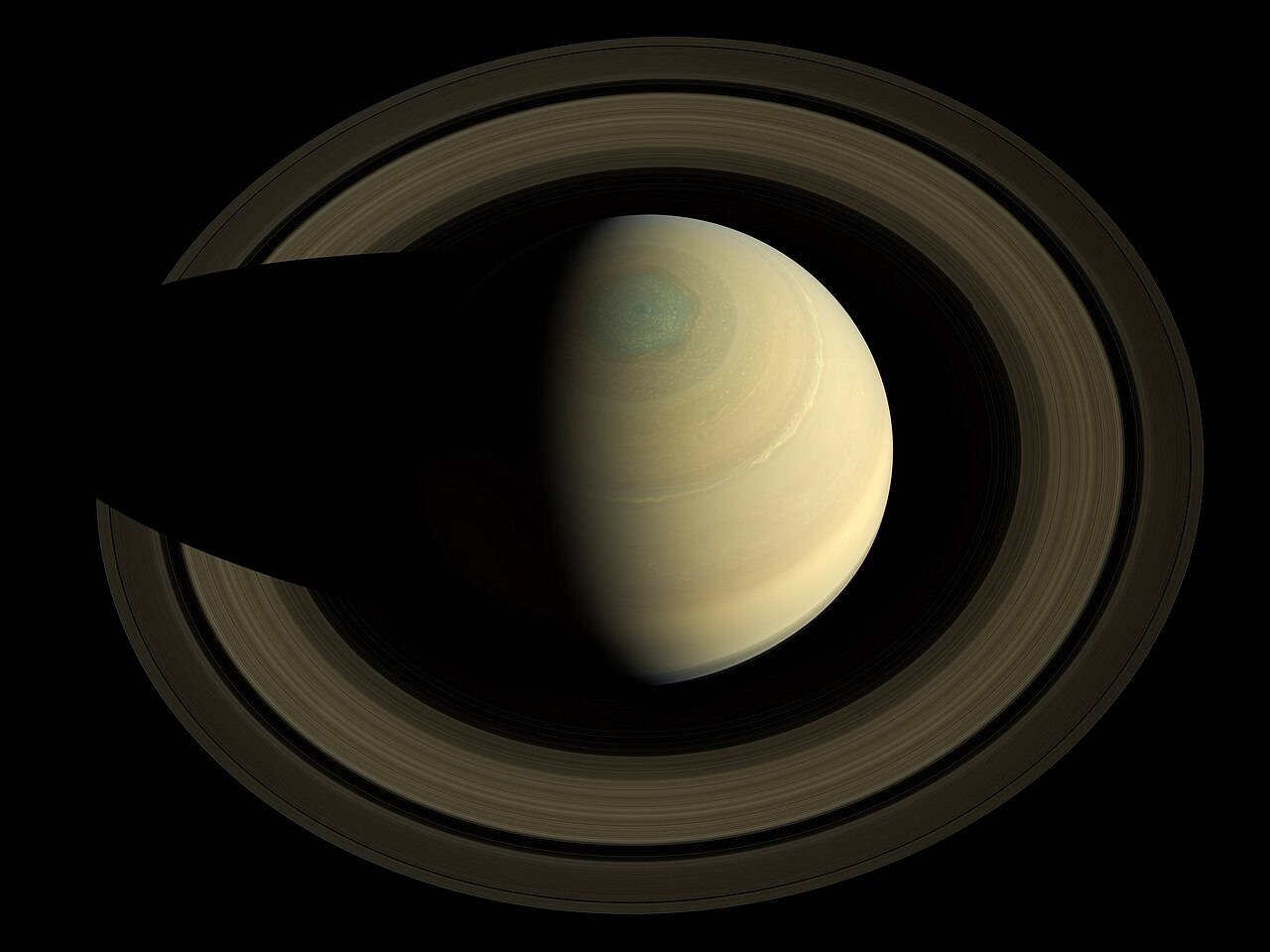
Via Wikimedia Commons: Top view of the rings of Saturn by Cassini - October 10, 2013 by NASA / JPL-Caltech / SSI / Cornell, public domain.
Saturn
Saturn is "not the only planet to have rings", NASA says, but none are as spectacular or as complex.[1] NASA says Saturn's rings are thought to be pieces of comets, asteroids or shattered moons that broke up before reaching the planet, torn apart by its gravity, and are made of billions of small chunks of ice and rock coated with other materials such as dust. Particles mostly range from tiny, dust-sized icy grains to chunks as big as a house, with a few as large as mountains.[1] NASA says the system extends up to 175,000 miles (282,000 kilometres) from the planet while the main rings are typically only about 30 feet (10 metres) thick.[1] The rings are named alphabetically in the order discovered. The main ones are A, B and C, separated by the Cassini Division, a gap 2,920 miles (4,700 kilometres) wide between the A and B rings, and the fainter D, E, F and G rings were discovered more recently. NASA lists the order outward as D, C, B, Cassini Division, A, F, G and E, with the very faint Phoebe ring far out in the orbit of the moon Phoebe.[1]
- Jupiter. NASA says Voyager 1 discovered its rings in 1979, that they are small, dark particles that are hard to see except when backlit by the Sun, and that Galileo data indicate dust kicked up as meteoroids smash into the small inner moons may form them.[2]
- Uranus. NASA says it has 13 faint rings in two sets: an inner system of nine mostly narrow, dark grey rings, and two outer rings, the innermost reddish and the outer blue like Saturn's E ring.[3]
- Neptune. NASA says it has at least five main rings, named Galle, Leverrier, Lassell, Arago and Adams, plus four prominent arcs, clumps of dust in the outermost ring. NASA says scientists now think the gravity of the moon Galatea stabilizes the arcs, and that the rings are thought to be relatively young and short-lived.[4]
Rings around a small body
In 2014 observers at many South American sites, including ESO's La Silla Observatory, used a star's disappearance behind the Centaur (10199) Chariklo to discover two dense, narrow rings, 7 and 3 kilometres wide with a 9-kilometre gap, around a body about 250 kilometres across. ESO called it the smallest object by far found to have rings and only the fifth body in the solar system with them, and said the rings' origin is a mystery, possibly a collision that made a disc of debris.[5] See the Centaur entry.
How old are Saturn's rings?
This is an active debate, and the sources read present both sides. A 2026 conference abstract by Gregorio Ricerchi and Aurélien Crida summarizes it: arguments based on the rings' almost pure water-ice composition favour young rings, 100 to 400 million years old, while arguments based on dynamics favour old, primordial rings of about 4.5 billion years.[6] The Institut de physique du globe de Paris reports that Cassini showed the rings are more than 99% water ice, which studies in the 2010s and 2020s read as an age of no more than about 400 million years, from the time dusty micrometeoroid material would take to darken them.[7] A paper published in Nature Geoscience on 16 December 2024 by Ryuki Hyodo, Gustavo Madeira and Hidenori Genda argues this may be an illusion: it proposes that micrometeoroids hitting at about 20 kilometres per second vaporize into hot plasma that Saturn's magnetic field removes, so the rings could stay clean and be as old as the solar system.[7] The 2026 abstract argues that earlier calculations over-estimated gravitational focusing of dust by a factor of 5 and that, with uncertain dust parameters, "any exposure age is virtually possible", so composition cannot settle the question. It adds that the A ring's present shape appears hard to maintain over hundreds of millions of years.[6] I read the institute's press release and the conference abstract, not the papers themselves, and neither side is settled.
See also
Solar System, Gas giant, Ice giant and Natural satellite.
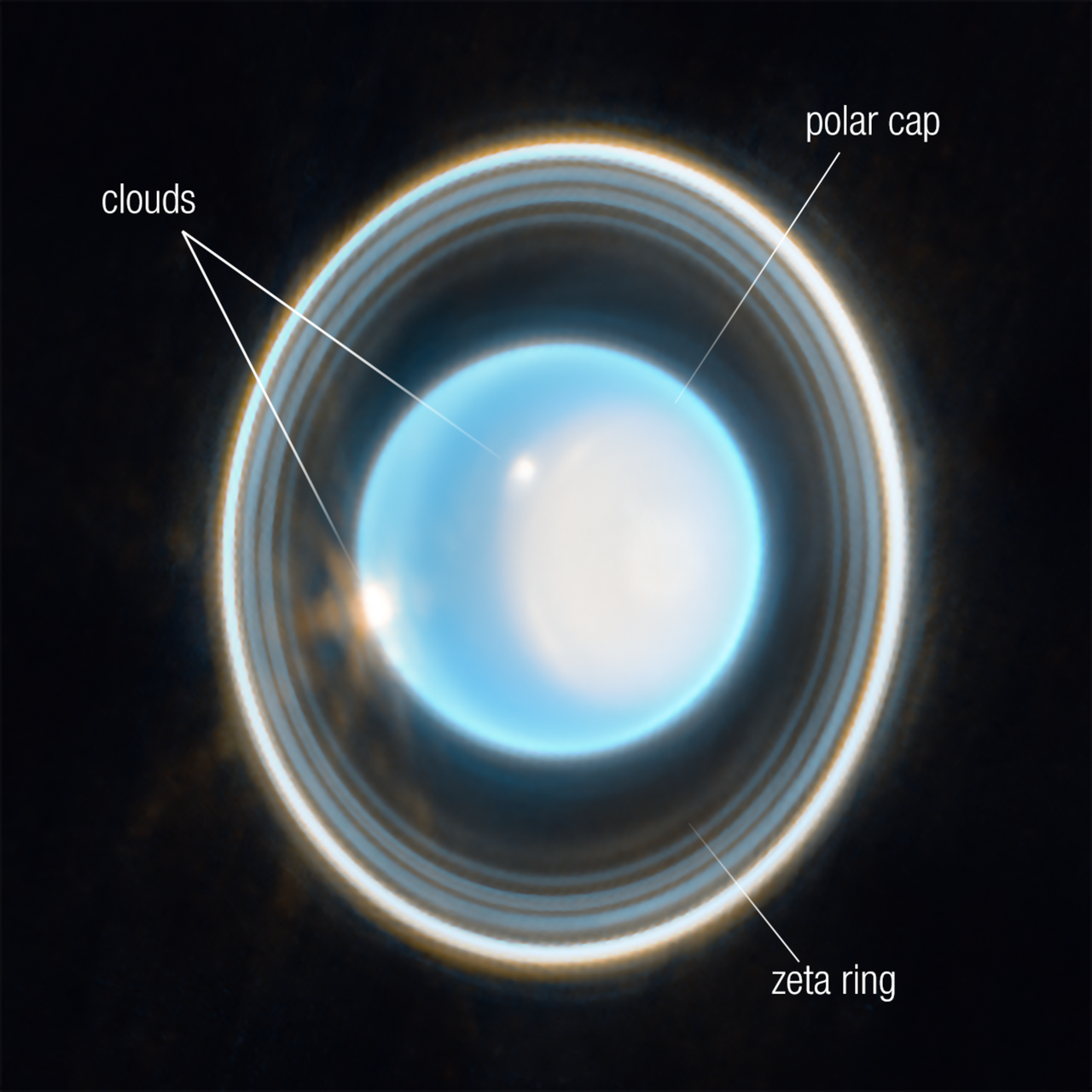
Via Wikimedia Commons: STScI-Uranus-NIRCam by NASA, ESA, CSA, STScI, public domain.
Sources
- NASA Science. "Saturn Facts." science.nasa.gov/saturn/facts/ (read 23 November 2026)
- NASA Science. "Jupiter Facts." science.nasa.gov/jupiter/facts/ (read 23 November 2026)
- NASA Science. "Uranus Facts." science.nasa.gov/uranus/facts/ (read 23 November 2026)
- NASA Science. "Neptune Facts." science.nasa.gov/neptune/facts/ (read 23 November 2026)
- European Southern Observatory. ESO press release eso1410 on the rings of Chariklo. 26 March 2014. eso.org/public/news/eso1410/ (read 23 November 2026)
- Ricerchi, G., Crida, A. "Saturn's rings: compositional and dynamical evolutions as markers of their young or old age." Europlanet Science Congress 2026, abstract EPSC2026-876 (7–11 September 2026). meetingorganizer.copernicus.org/EPSC2026/EPSC2026-876.html (read 23 November 2026)
- Institut de physique du globe de Paris. "A new perspective on the age of Saturn's rings." Press release on Hyodo, Madeira, Genda, Nature Geoscience (16 December 2024). ipgp.fr/en/news-and-agenda/news/a-new-perspective-on-the-age-of-sat… (read 23 November 2026)
