An aurora is a glow in the upper atmosphere of a planet, produced when energetic charged particles from space collide with atoms and molecules there.[1][2] On Earth the displays are called the northern lights (aurora borealis) and southern lights (aurora australis).[1][2]
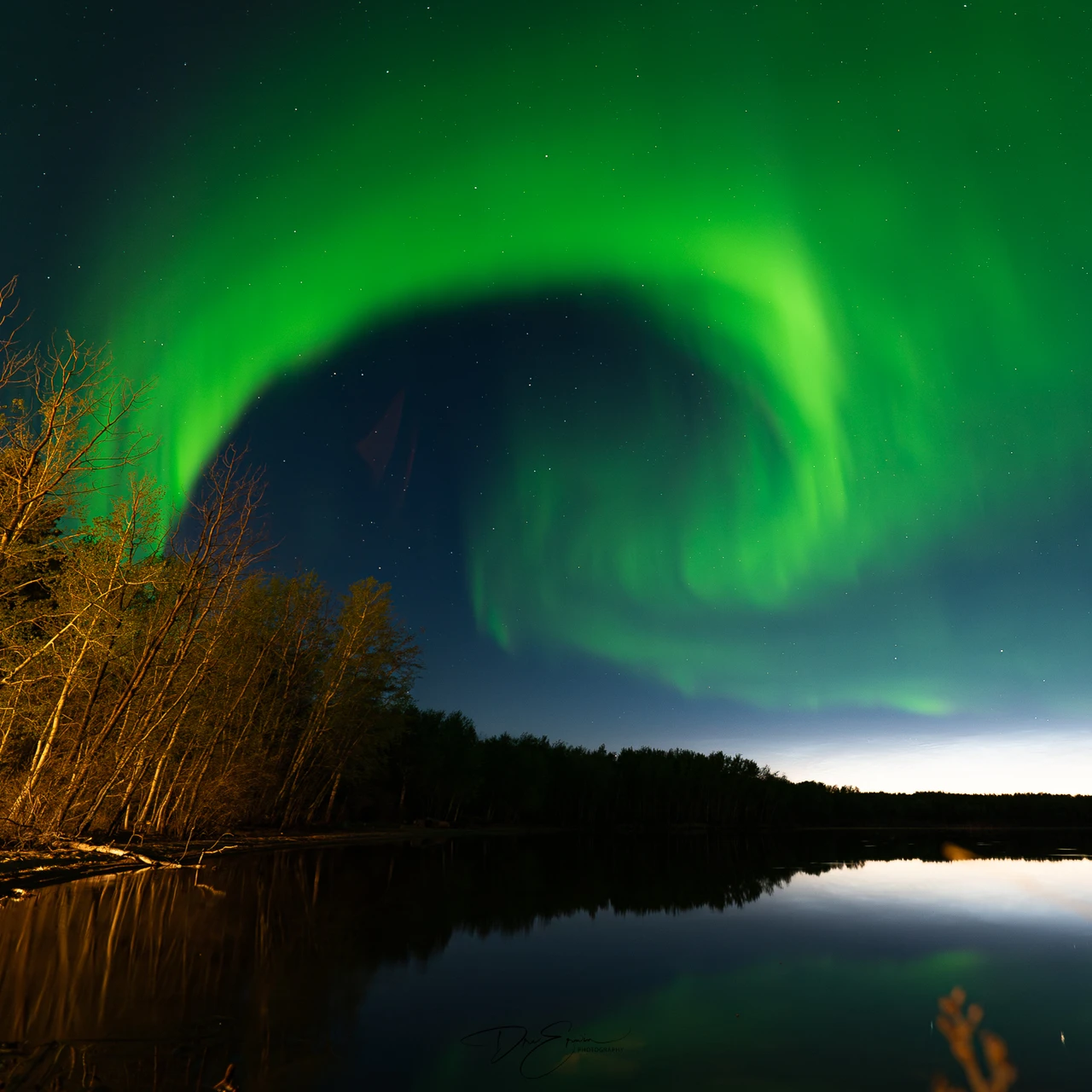
Via Wikimedia Commons: Aurora Borealis over Pinehouse Lake, Saskatchewan by Dre Erwin Photo, CC BY 4.0.
How it works
NOAA's Space Weather Prediction Center says Earth's auroras are the result of electrons colliding with the upper reaches of the atmosphere. The electrons are energized in the night-side tail of the magnetosphere and at lower altitudes along auroral field lines, then follow Earth's magnetic field down to the polar regions where they strike oxygen and nitrogen atoms and molecules. The collisions excite the atoms and molecules, and when they relax they release light, much as a neon light works. NOAA says protons cause faint, diffuse aurora that is usually not easily visible to the eye, and that the aurora typically forms 80 to 500 kilometres above the surface.[1] NASA adds that the solar wind continuously flows toward Earth, can deposit and accumulate energy in Earth's magnetic shield, and that when this energy is released much of it rains down on the atmosphere, causing auroras.[2]
Colors
NASA says the most common aurora color is green, produced when oxygen is excited by electrons about 60 miles (100 kilometres) above the surface. It lists the following:[2]
- Green: oxygen at roughly 60 to 120 miles (100 to 200 kilometres) altitude.
- Red: oxygen above about 120 miles (200 kilometres).
- Blue: excited nitrogen at about 60 to 120 miles (100 to 200 kilometres).
- Pink and reddish-purple: nitrogen, with the lower edge of an aurora glowing reddish-purple to pink if it is below about 60 miles (100 kilometres), depending on the type and energy of the particle.
- Purple, pink or white: when light from the different gases appears to mix.
Shapes and where to see them
NOAA says Earth's field guides the electrons so that auroras form two ovals centred roughly on the magnetic poles. Common forms are tall rays like a curtain of folded cloth and arcs from horizon to horizon in the evening. Near midnight the arcs often twist and sway, and at the peak of what is called an auroral substorm they may expand to fill the whole sky and become very bright, before taking a cloud-like, blinking form in the early morning. NOAA says the best place to see them is under an oval between about 60 and 75 degrees north and south latitude, where they appear on more than half the nights of a year.[1] During large geomagnetic storms the ovals expand away from the poles so that aurora can be seen over most of the United States, and in very large events even farther from the poles.[1] A strong coronal mass ejection striking Earth's magnetosphere is one cause of such storms; NOAA's page does not say which storms it has in mind. NASA's announcement of the solar maximum says the May 2024 storm was possibly among the strongest displays of auroras in the past 500 years.[3] Skies must be dark and clear, and NOAA notes that the midnight sun in summer at high latitudes prevents seeing them.[1]
Name and history
NASA says "aurora" is the Latin word for dawn and the name of the Roman goddess of the dawn. Europeans living far from the Arctic Circle usually saw a faint red glow to the north, like the reddish glow of dawn in the east, and aurora borealis translates as "northern dawn". It says communities around the world have documented auroras for thousands of years, and that the Iñupiat people of northern Alaska call them kiuġuyat or kiuġiyaq.[2]
On other worlds
NASA says auroras can occur on other planets and moons with atmospheres, usually where a magnetic field meets the atmosphere. It lists Voyager 1 seeing aurora on the dark side of Jupiter in 1979, later views by Hubble, Galileo and Juno, observations at Saturn by Cassini and others, MAVEN finding them on Mars, and Pioneer discovering them on Venus, with signs of aurora on some moons and beyond the solar system.[2] NASA's Jupiter page says its magnetic field causes some of the solar system's most spectacular auroras at the poles.[4]
Newer research
- What powers auroral arcs. A study led by Sheng Tian at UCLA, published in Nature Communications, combined archived data from the Van Allen Probes, a US Air Force satellite and NASA's ground-based THEMIS imagers to examine an arc seen in both hemispheres. It reports that Alfvén waves, low-frequency plasma waves, deliver the energy that sustains the electric field that accelerates the electrons, solving a long-standing puzzle of how that field persists.[5] I read the university's release, not the paper.
- Rocket "CT scans," February 2026. NASA launched sounding rockets from Alaska on 9 and 10 February 2026 to study the electrical circuit behind the aurora: one mission targeted dark patches called black auroras and the twin GNEISS rockets built a 3D scan of auroral currents. The release says all reached their planned altitudes and returned good data, and I found no published results.[6]
See also
Solar System, Sun and Earth.
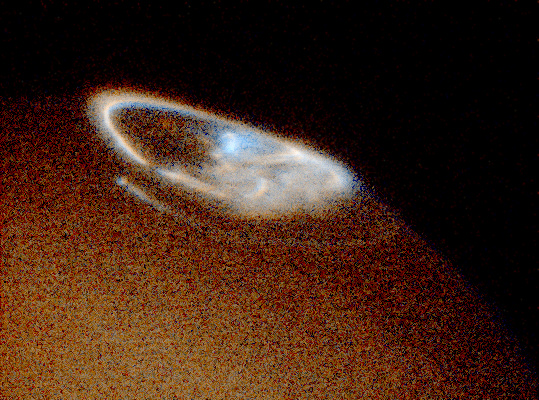
Via Wikimedia Commons: Ultraviolet Aurora borealis on Jupiter from Hubble 1998 by J. Clarke (Univ. Michigan), NASA, public domain.
Sources
- NOAA Space Weather Prediction Center. "Aurora." swpc.noaa.gov/phenomena/aurora (read 23 November 2026)
- NASA Science. "Auroras." science.nasa.gov/sun/auroras/ (read 23 November 2026)
- NASA Science. "NASA, NOAA: Sun Reaches Maximum Phase in 11-Year Solar Cycle." 15 October 2024. science.nasa.gov/?p=428304 (read 23 November 2026)
- NASA Science. "Jupiter Facts." science.nasa.gov/jupiter/facts/ (read 23 November 2026)
- UCLA Physical Sciences. "UCLA-led discovery reveals processes behind planetary auroras." physicalsciences.ucla.edu/ucla-led-discovery-reveals-processes-behi… (read 23 November 2026)
- ScienceDaily, reporting a NASA release on the February 2026 Alaska rocket launches. sciencedaily.com/releases/2026/02/260217005738.htm (read 23 November 2026)
