A lunar eclipse happens when Earth's shadow falls on the full Moon, dimming it and sometimes turning it a striking red over a few hours.[1][2] NASA says each lunar eclipse is visible from half of Earth.[2]
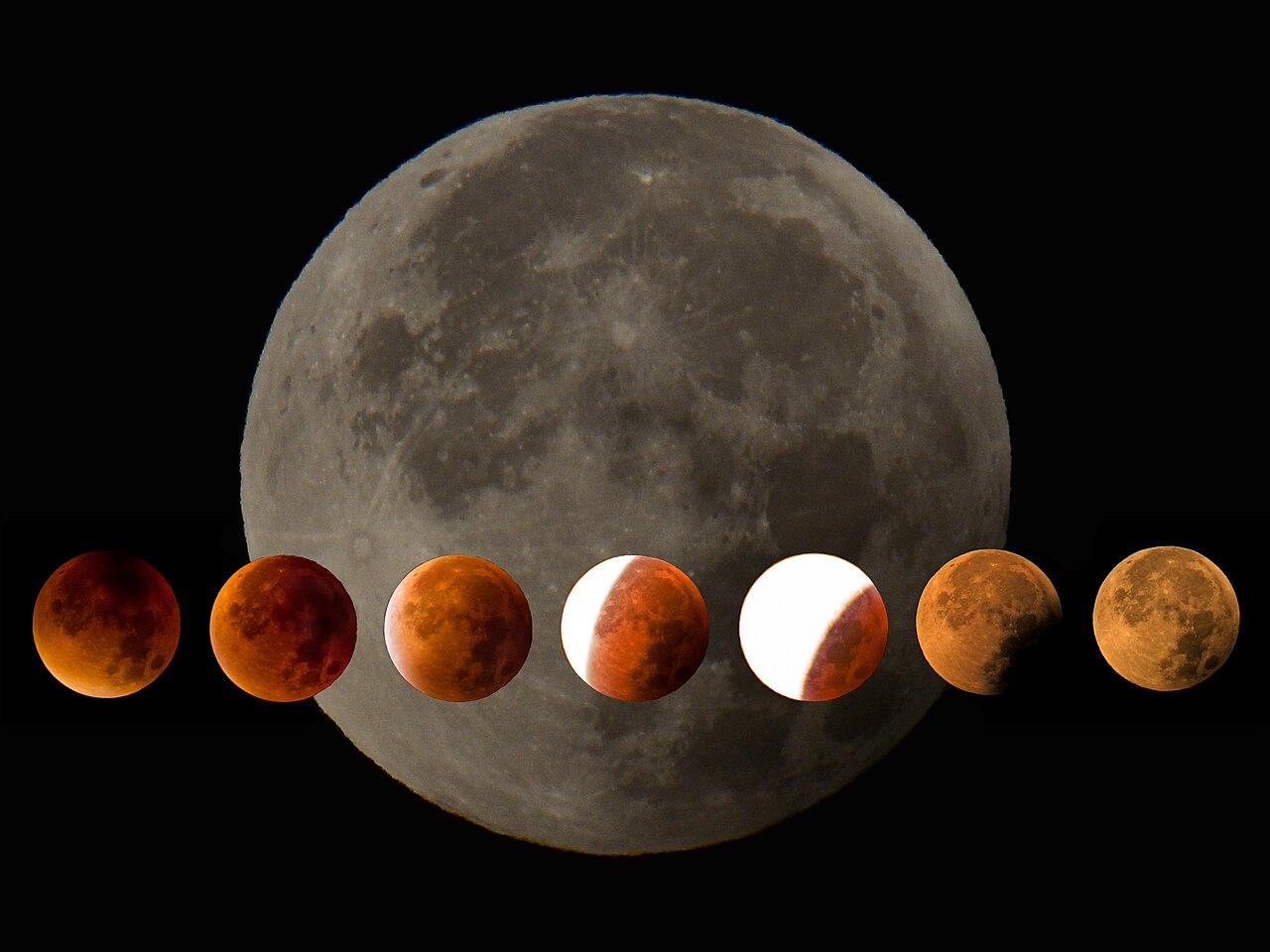
Via Wikimedia Commons: Total Lunar Eclipse 28 09 2015 by Feel free to use my photos, but please mention me as the aut, CC BY-SA 3.0 at.
What happens
NASA says lunar eclipses occur at the full Moon phase, when Earth is positioned precisely between the Moon and the Sun and its shadow falls on the Moon's surface.[1][2] NASA's Moon eclipse page says that anywhere from four to seven times a year Earth, the Moon and the Sun line up to create an eclipse of one kind or another, and that the tilt of the Moon's orbit relative to Earth's orbit is the reason eclipses are occasional instead of monthly.[2] The Solar eclipse entry covers the other kind, in which the Moon blocks the Sun.
Three types
NASA's Moon page lists three kinds of lunar eclipse, depending on how the Moon lines up with Earth's shadow:[2]
- Total. The Moon moves into the inner part of Earth's shadow, the umbra. Some sunlight passing through Earth's atmosphere still reaches the Moon, lighting it dimly.
- Partial. An imperfect alignment means the Moon passes through only part of the umbra, and the shadow grows and recedes without entirely covering the Moon.
- Penumbral. The Moon travels through the penumbra, the faint outer part of Earth's shadow, and dims so slightly that it can be hard to notice, so, NASA says, "if you don't know this one is happening, you might miss it".
NASA's eclipse overview also says that at least two partial lunar eclipses happen every year, but total lunar eclipses are rare.[1]
Why the Moon turns red
NASA explains that colours with shorter wavelengths, the blues and violets, scatter more easily than colours with longer wavelengths such as red and orange. The longer wavelengths make it through Earth's atmosphere, and the shorter ones are scattered away, so the Moon looks orangish or reddish during a total eclipse. NASA says the more dust or cloud in Earth's atmosphere during the eclipse, the redder the Moon appears.[2] It says the same effect makes the sky blue and sunsets red: at sunrise and sunset light takes a longer, low-angle path through the air and the blue part scatters away, and in an eclipse any sunlight not blocked by Earth is filtered through a thick slice of atmosphere on the way to the Moon, "as if all the world's sunrises and sunsets are projected onto the Moon".[2] NASA's 2014 video summary says a total eclipse colours the Moon "a fiery red", while most eclipses are partial.[3]
Seeing one
NASA says it is always safe to look at a lunar eclipse with the naked eye, and safe to look at the Moon unprotected or through a telescope in all types and stages, unlike a solar eclipse.[1] It notes that although solar eclipses happen as often as lunar ones, they are visible from such a small area of Earth each time that they are far rarer to encounter.[2]
Examples and what is next
NASA's visualization page for April 2014 describes the first of four consecutive total lunar eclipses, a "tetrad", on 15 April 2014, followed by 8 October 2014, 4 April 2015 and 28 September 2015, which it says were visible across North America. It adds that while a tetrad itself is not rare, its visibility across the whole United States was unusual.[3] NASA's list of upcoming eclipses shows two penumbral lunar eclipses in 2027, on 20 to 21 February and 16 to 17 August.[4] I did not read sources on lunar eclipses between 2015 and 2027, so none are described here.
See also
Moon, Earth and Solar System.
Sources
- NASA Science. "Eclipses." science.nasa.gov/eclipses/ (read 23 November 2026)
- NASA Science. "Eclipses" (Moon pages). science.nasa.gov/moon/eclipses/ (read 23 November 2026)
- NASA Scientific Visualization Studio. "Red Moon Rising" (April 2014). svs.gsfc.nasa.gov/11472 (read 23 November 2026)
- NASA Science. "Future Eclipses." science.nasa.gov/eclipses/future-eclipses/ (read 23 November 2026)
