An insect is any member of the class Insecta, the largest class of arthropods, whose adults typically have a three-part body of head, thorax and abdomen, six jointed legs, one pair of antennae and, in many species, wings.[1][2]
Definition and body plan
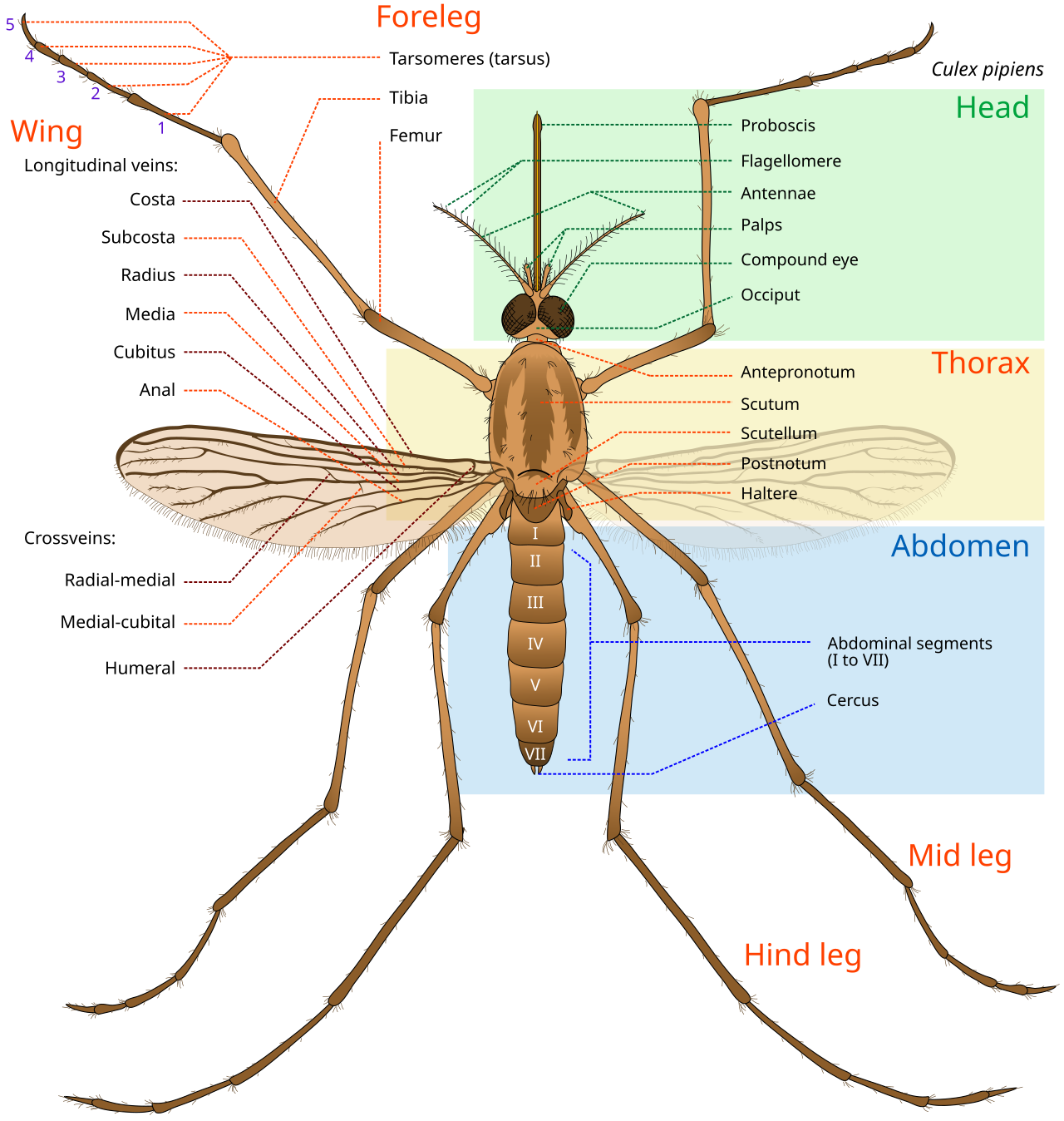
Insects belong to the phylum Arthropoda, the largest phylum in the animal kingdom.[1] They have segmented bodies, jointed legs and an external skeleton, or exoskeleton.[1] Insects are invertebrates, meaning animals without a backbone.[2] The insect body is divided into three main regions: the head, the thorax and the abdomen.[1][2]
A labelled diagram showing the head, thorax and abdomen of an insect, with its six legs, antennae and wings.
Via Wikimedia Commons: Culex pipiens diagram en by Mariana Ruiz Villarreal LadyofHats, public domain.
The head carries the mouthparts, the eyes and a single pair of antennae, the feelers that project from the head.[1] The thorax, the middle region, is made up of three segments; in adult insects it usually bears three pairs of legs, giving six legs in all, and one or two pairs of wings.[1] The abdomen, the rear region, is divided into many segments and holds most of the digestive, excretory and reproductive organs.[1]
Many insects have wings, but not all.[2] In beetles, for example, the front pair of wings has been hardened into protective shells called elytra.[2] In flies the hind wings are modified into structures called halteres, which act as sensors that help with balance in flight.[3]
Exoskeleton and breathing
The outer skeleton of an insect contains chitin, a tough, white, horny substance that is also found in the shells of crabs and lobsters.[4] Chemically, chitin is a polysaccharide, a large molecule built from units of an amino sugar called glucosamine.[4]
Insects do not have lungs. Air reaches their tissues through a network of air-filled tubes called tracheae, which open to the outside through paired holes called spiracles on the thorax and abdomen.[5] The spiracles have muscular valves that stay closed most of the time and open to let oxygen in.[5] The tracheae are continuous with the cuticle, the outer layer of the body surface.[6] Insect blood, called hemolymph, is driven through the wings, antennae and legs by accessory pumps.[6]
Insects grow by molting, the replacement of the old exoskeleton by newly formed cuticle, a process controlled by hormones.[3] Molting begins when sense receptors in the body wall detect that the soft internal tissues have filled the old exoskeleton; a hormone from the brain then signals the prothoracic gland to release the molting hormone, a steroid called ecdysone, which acts on the epidermis, the insect's outer layer of living cells, stimulating growth and the formation of new cuticle.[3]
During the young larval stages a second hormone, juvenile hormone, secreted by a small gland behind the brain called the corpus allatum, causes the molting epidermis to keep producing larval cuticle.[3] When it stops being produced in the last larval stage, the insect undergoes metamorphosis, the change in body form into an adult.[3] In holometabolous insects, which pass through a pupal stage between larva and adult, the pupa develops in the presence of only a very small amount of juvenile hormone.[3]
Number of species
Insects are the most species-rich group of animals, and estimates of how many kinds exist have varied widely.[7] As of November 2026, Encyclopaedia Britannica's article on insects stated that about 1 million insect species had been described, roughly three-fourths of all described animal species, and that entomologists estimate the true number of living species could be as high as 5 million to 10 million.[1]
A 1996 information sheet from the Smithsonian Institution's National Museum of Natural History gave about 900,000 known species of living insects.[8] The same sheet stated that most authorities expected undescribed species to outnumber the named ones, with conservative estimates of about 2 million undescribed species and other estimates reaching 30 million.[8] It linked the 30 million figure to studies of tropical forest canopies in Latin America by Smithsonian entomologist Terry Erwin.[8] The 1996 sheet also estimated that about 10 quintillion (10,000,000,000,000,000,000) individual insects are alive at any one time.[8]
A 2018 review in the Annual Review of Entomology by Nigel E. Stork of Griffith University, Australia, examined newer methods of estimating global species richness.[9] Taking the mean of most recent estimates, Stork put the number of species at about 1.5 million for beetles, 5.5 million for insects and 7 million for all terrestrial (land-dwelling) arthropods.[9] The review concluded that earlier estimates of 30 million species or more, which had been based on assumptions about how specialised insects are to particular host plants, now seemed extremely unlikely.[9] With about 1 million insect species named, Stork's figures imply that roughly 80 percent of insect species have yet to be discovered.[9] The review recommended more attention to less-studied groups, including many families of beetles (Coleoptera), flies (Diptera) and wasps, bees and ants (Hymenoptera), and to poorly sampled parts of the world.[9] It also noted that DNA-based methods have revealed many new species in groups that are hard to tell apart by appearance, but that studies of well-researched faunas suggest only 1 to 2 percent of species are truly cryptic, meaning indistinguishable by their outward form.[9]
Place among the arthropods
Insects are one of several major lineages of arthropods, alongside the crustaceans, the myriapods (centipedes and millipedes) and the chelicerates.[10] Molecular studies, which compare genetic sequences rather than body form, found that the six-legged arthropods, grouped together as Hexapoda, are more closely related to the aquatic crustaceans than to the land-dwelling centipedes and millipedes.[10]
A 2010 study in Nature by Jerome C. Regier and colleagues, based on 62 nuclear protein-coding genes from 75 arthropod species, strongly supported a group named Pancrustacea, made up of the hexapods together with the crustaceans.[10] The study identified a crustacean group it named Xenocarida, consisting of the cephalocarids and remipedes, as the closest relatives of the hexapods.[10] Because the hexapods sit inside the crustacean family tree, the authors concluded that "crustaceans" as traditionally defined are not monophyletic, meaning they do not form a group made up of one common ancestor and all of its descendants.[10] The same study supported a larger group, Mandibulata, uniting the myriapods with the Pancrustacea.[10]
Not every six-legged arthropod is an insect.[11] Three small groups, the springtails (Collembola), the Protura and the Diplura, are treated as non-insect hexapods.[11] Their mouthparts are entognathous, meaning they are enclosed within folds of the head rather than exposed.[11] Some reference works use Hexapoda as another name for the class Insecta itself.[1]
Evolutionary origin
A 2014 study in Science led by Bernhard Misof, which reconstructed insect relationships from 1,478 protein-coding genes, dated the origin of insects to the Early Ordovician period, about 479 million years ago.[7] The same study placed the origin of insect flight in the Early Devonian, about 406 million years ago, and the origin of the major living insect lineages in the Mississippian, about 345 million years ago.[7] It dated the major diversification of holometabolous insects to the Early Cretaceous.[7]
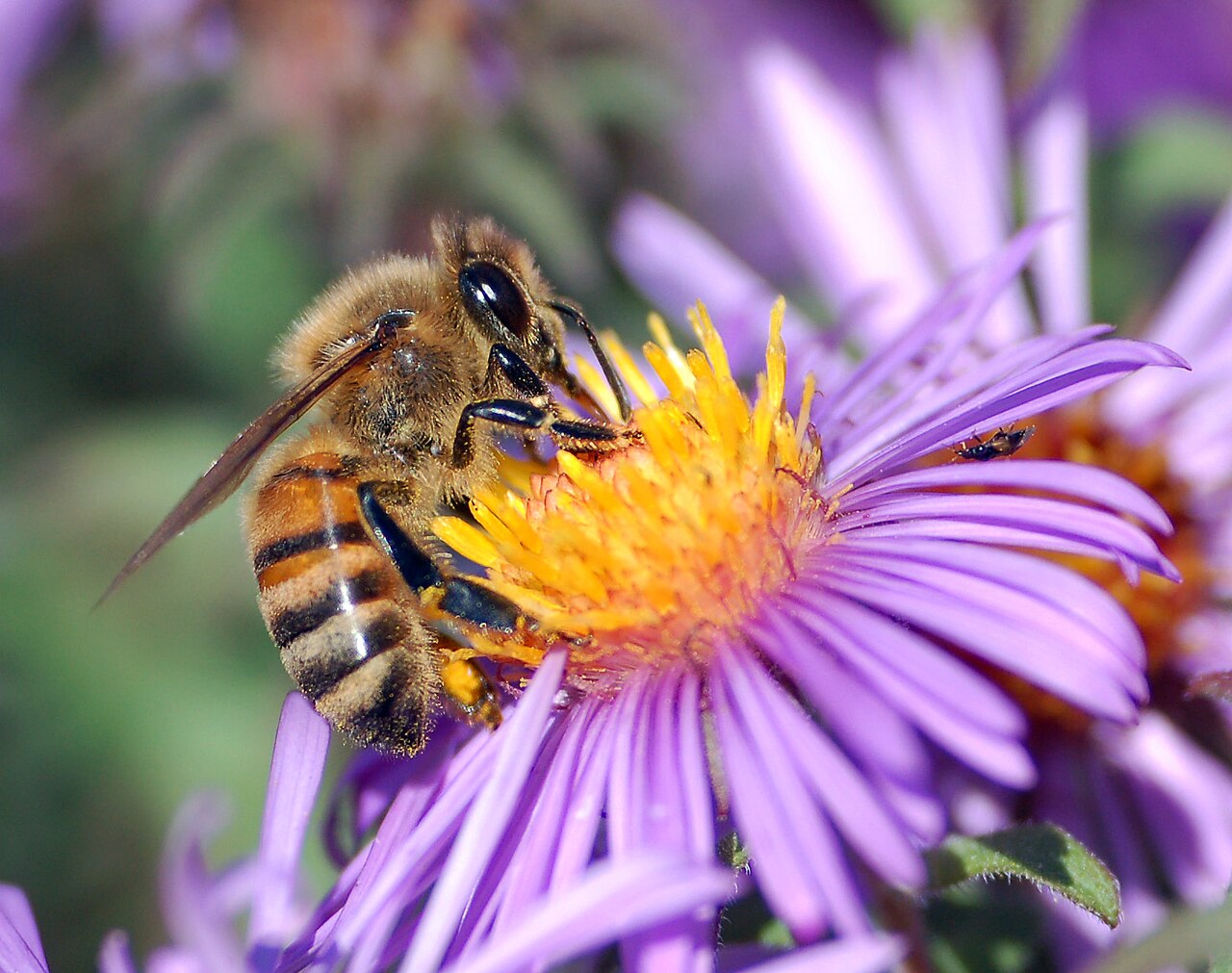
Many insects pollinate plants, meaning they transfer pollen between flowers.[1] A 2016 assessment by the Intergovernmental Science-Policy Platform on Biodiversity and Ecosystem Services (IPBES) reported that more than three-quarters of the world's food crops rely at least in part on pollination by insects and other animals.[12] The assessment stated that nearly 90 percent of all wild flowering plants depend at least to some extent on animal pollination.[12] It put the annual value of global crops directly affected by pollinators at between US$235 billion and US$577 billion.[12] Among pollinators it counted more than 20,000 species of wild bees, along with many species of butterflies, flies, moths, wasps and beetles, as well as birds, bats and other animals.[12]
Decomposition and food webs
Insects make up much of the animal biomass, the total mass of living animals, that connects plants and other primary producers with the animals that eat them.[13] Insects that feed on dead material break down leaves, wood, dung and carrion, which contributes to nutrient cycling and soil formation.[13] Britannica describes many insects as scavengers and as food for other animals, and notes that some insects feed on other insects that are pests, a service known as biological control.[1][13] Insects also produce substances useful to people, are used in research in genetics, population biology and physiology, and serve as indicators of water and soil quality.[1]
Pests and disease vectors
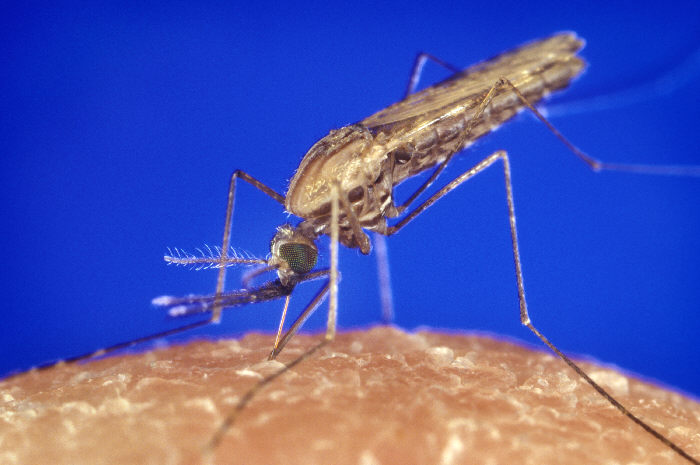
An Anopheles mosquito, the type of insect that spreads malaria parasites, feeding on human skin.
In everyday speech the word "insect" often refers to familiar pests or carriers of disease.[1] Some insects are vectors, animals that carry disease-causing organisms from one host to another.[14] A World Health Organization fact sheet dated 26 September 2024 stated that vector-borne diseases account for more than 17 percent of all infectious diseases and cause more than 700,000 deaths each year.[14]
According to that fact sheet, malaria, caused by a parasite spread by Anopheles mosquitoes, was estimated to cause 249 million cases and more than 608,000 deaths a year, mostly among children under five.[14] Dengue, the most prevalent viral infection transmitted by Aedes mosquitoes, put about 3.9 billion people in more than 130 countries at risk.[14] The WHO listed other insect vectors and the diseases they spread, including sandflies (leishmaniasis), triatome bugs (Chagas disease), tsetse flies (African sleeping sickness), fleas (plague) and lice (typhus and louse-borne relapsing fever).[14]
Declines debate
Whether, and how fast, insect populations are falling worldwide has been the subject of active research and debate.[13][15] A 2020 meta-analysis in Science led by Roel van Klink combined 166 long-term surveys of insect communities at 1,676 sites.[15] It found considerable variation in trends, even between neighbouring sites, but an average decline in the abundance of land-dwelling insects of about 9 percent per decade and an average increase in freshwater insect abundance of about 11 percent per decade.[15] Both patterns were driven largely by strong trends in North America and some European regions, and trends in protected areas tended to be weaker.[15] Other researchers, Desquilbet and colleagues, challenged the study's criteria for including data and other aspects of its analysis; the original authors published a reply maintaining that their synthesis was sound.[16]
A 2021 introduction to a special collection of papers in the Proceedings of the National Academy of Sciences, by David L. Wagner and colleagues, described insect decline as "death by a thousand cuts," the result of many stressors acting together.[13] It named land-use change (especially deforestation), climate change, agriculture, introduced species, nitrification (the build-up of nitrogen compounds in the environment) and pollution as the principal stressors, with insecticides, herbicides, urbanisation and light pollution as further local or regional pressures.[13] The authors also stressed that not all insects are declining: they attributed increases in freshwater insects in parts of Europe and North America to clean-water laws, and noted range or abundance increases in many temperate insects, including many British moths.[13] They pointed out that most long-term data come from Europe and the United States and called for trend data from tropical regions of the Americas, Africa and Asia.[13]
The 2016 IPBES assessment reported that regional and national assessments often find more than 40 percent of invertebrate pollinator species, especially bees and butterflies, threatened locally.[12] It attributed pollinator decline mainly to changes in land use, intensive agricultural practices and pesticide use, along with invasive species, diseases and pests, and climate change.[12]
Sources
Encyclopaedia Britannica, "Insect". Encyclopaedia Britannica. No date shown; accessed 24 November 2026. britannica.com/animal/insect
Encyclopaedia Britannica, "Chitin". Encyclopaedia Britannica. No date shown; accessed 24 November 2026. britannica.com/science/chitin
Encyclopaedia Britannica, "Tracheal tube" (excerpt from the article "Insect", section "Respiratory system"). Encyclopaedia Britannica. No date shown; accessed 24 November 2026. britannica.com/science/tracheal-tube
Bernhard Misof and colleagues, "Phylogenomics resolves the timing and pattern of insect evolution". Science, vol. 346, no. 6210, pp. 763-767, 7 November 2014. pubmed.ncbi.nlm.nih.gov/25378627/
Entomology Section, Department of Systematic Biology, National Museum of Natural History, with Public Inquiry Services, "Numbers of Insects (Species and Individuals)", Information Sheet Number 18. Smithsonian Institution, 1996; accessed 24 November 2026. si.edu/spotlight/buginfo/bugnos
Nigel E. Stork, "How Many Species of Insects and Other Terrestrial Arthropods Are There on Earth?". Annual Review of Entomology, vol. 63, pp. 31-45, January 2018 (online 22 September 2017). pubmed.gov/28938083/
Jerome C. Regier, Jeffrey W. Shultz, Andreas Zwick, April Hussey, Bernard Ball, Regina Wetzer, Joel W. Martin and Clifford W. Cunningham, "Arthropod relationships revealed by phylogenomic analysis of nuclear protein-coding sequences". Nature, vol. 463, pp. 1079-1083, 25 February 2010. pubmed.ncbi.nlm.nih.gov/20147900/
David L. Wagner, Eliza M. Grames, Matthew L. Forister, May R. Berenbaum and David Stopak, "Insect decline in the Anthropocene: Death by a thousand cuts". Proceedings of the National Academy of Sciences, vol. 118, no. 2, January 2021. pmc.ncbi.nlm.nih.gov/articles/PMC7812858
Roel van Klink, Diana E. Bowler, Konstantin B. Gongalsky, Ann B. Swengel, Alessandro Gentile and Jonathan M. Chase, "Meta-analysis reveals declines in terrestrial but increases in freshwater insect abundances". Science, vol. 368, no. 6489, pp. 417-420, 24 April 2020. pubmed.ncbi.nlm.nih.gov/32327596/
Roel van Klink, Diana E. Bowler, Konstantin B. Gongalsky, Ann B. Swengel and Jonathan M. Chase, "Response to Comment on 'Meta-analysis reveals declines in terrestrial but increases in freshwater insect abundances'". Science, vol. 370, no. 6523, 18 December 2020. pubmed.ncbi.nlm.nih.gov/33335031/