Metamorphosis, in insects, is the process of growth and development that carries an insect from the egg to its adult form, either through gradually changing nymphs or through a larva and a pupa.[1][2]
Overview
Insects can grow only by a series of moults (ecdyses), in which the old outer skeleton is shed, and these moults make large changes in body form possible.[1] Biologists recognise three broad patterns of development: ametabolous, with almost no change in form; hemimetabolous, or incomplete metamorphosis; and holometabolous, or complete metamorphosis.[1] Each stage between two moults is called an instar.[2] Metamorphosis is not limited to insects: in amphibians, for example, hormones from the thyroid gland drive the change from tadpole to adult.[3]
Ametabolous development
The most primitive wingless insects, such as silverfish, show almost no change in form as they grow to adulthood and are called ametabolous.[1] A 2019 review by James Truman and Lynn Riddiford describes this simple, direct development as the ancestral strategy of insects, seen today in the silverfish (order Zygentoma) and the jumping bristletails (order Archaeognatha).[4]
Incomplete metamorphosis
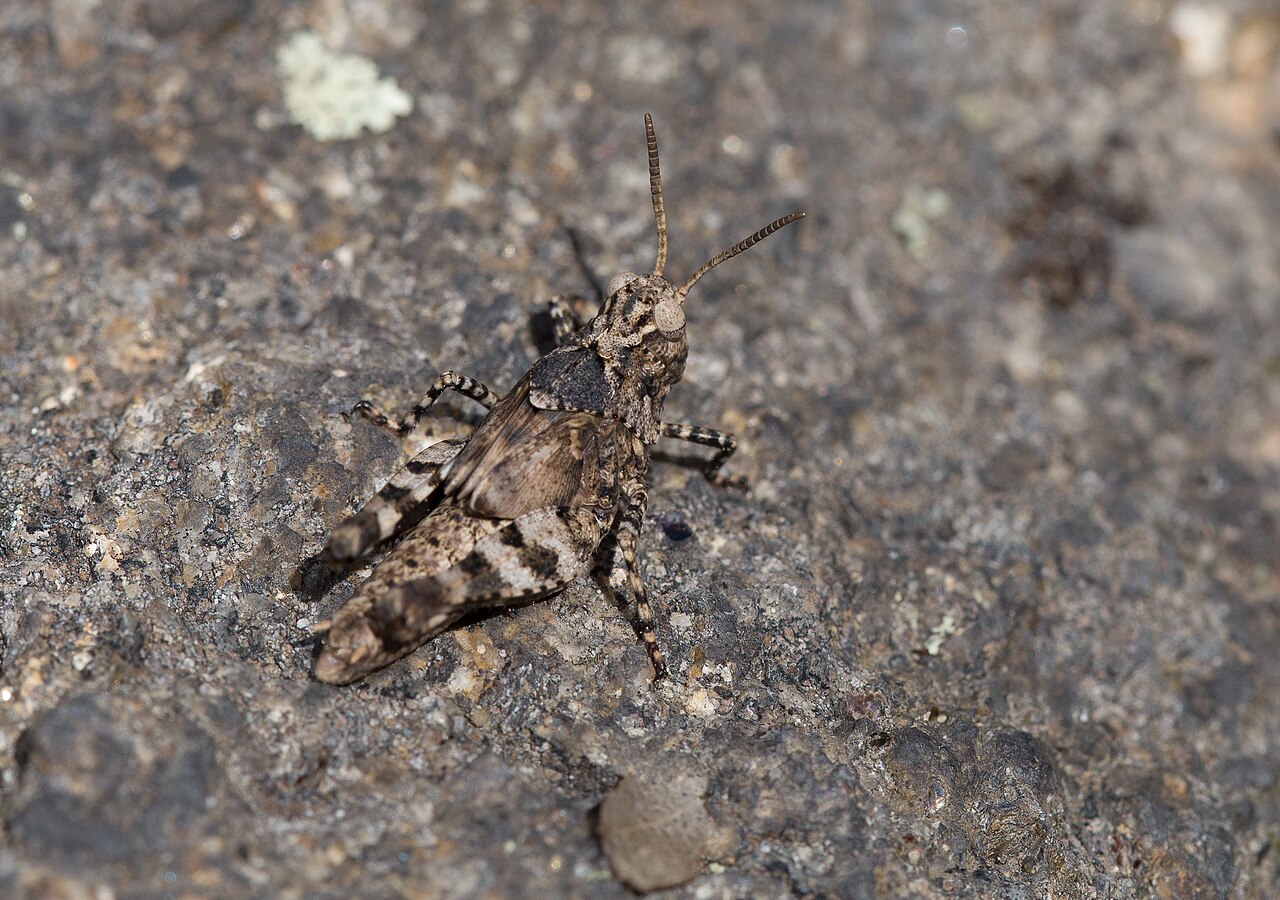
Insects with incomplete (hemimetabolous) metamorphosis have three life stages: egg, nymph and adult.[2] The young insect hatches as a first-instar nymph and sheds its exoskeleton several times as it grows; small wing buds on its back grow larger with each moult, and only the adult has fully formed wings.[2] The nymph usually resembles the adult but lacks wings and genitalia, and in later instars it carries immobile wing pads that become working, jointed wings at the moult to the adult.[4] Grasshoppers, true bugs and aphids keep a broadly constant body form until this final moult.[1] Other examples include dragonflies, cicadas, praying mantises and cockroaches.[2]
A grasshopper nymph showing the small wing pads that enlarge with each moult until the adult stage.
Insects with complete (holometabolous) metamorphosis pass through four stages: egg, larva, pupa and adult.[5][2] The larva looks very different from the adult, has no wings and is built for growing; it moults several times with little change in form before moulting into a pupa and finally into a winged adult.[5] Larvae have common names in several groups: those of moths and butterflies are caterpillars, those of beetles are grubs and those of flies are maggots.[2] Unlike nymphs, larvae show no external wing buds, because the wings develop internally.[2]
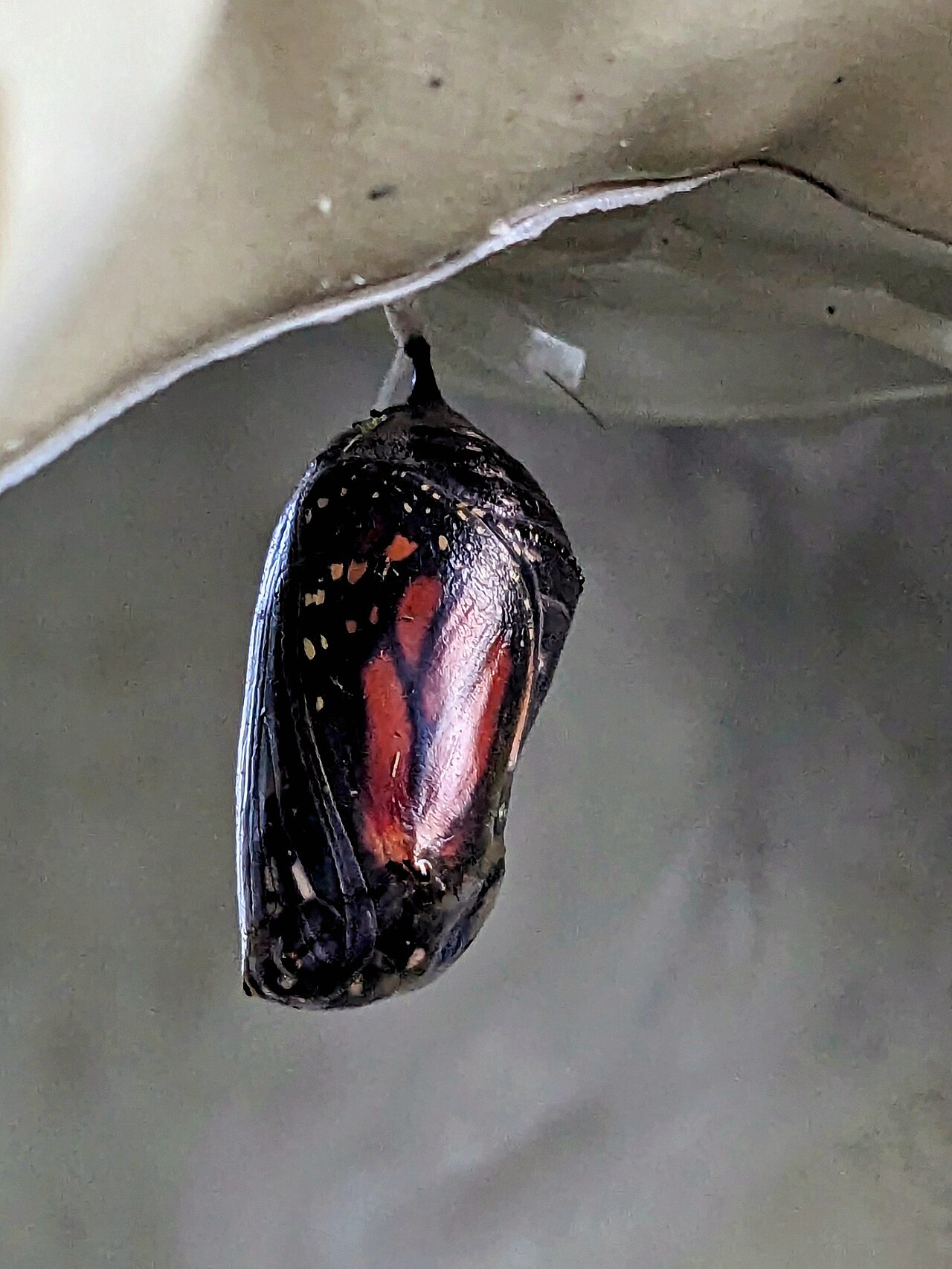
The pupa is an inactive stage placed between the larva and the adult.[6] It barely eats or moves while the adult body forms inside it; a butterfly pupa is called a chrysalis, and many moths spin a protective silk covering before pupating.[2] Adult tissues develop from groups of reserve cells, called imaginal discs, that are present in the larva all along.[3] Truman and Riddiford describe these as embryonic regions that persist within larval organs, with a primordium becoming a true imaginal disc once it permanently loses contact with the larval cuticle.[4] Beetles, butterflies and moths, flies, and bees and wasps develop this way.[1][5]
A monarch butterfly pupa, or chrysalis, hanging from a leaf, the stage in which the caterpillar's body is rebuilt into the adult.
Moulting and metamorphosis are coordinated by a small set of hormones. Prothoracicotropic hormone (PTTH) is secreted from the brain and stimulates the prothoracic glands to make steroid hormones called ecdysteroids; during larval life these glands are the main site of ecdysteroid production.[7] The glands release ecdysone into the blood (haemolymph), and peripheral tissues convert it into the active form, 20-hydroxyecdysone, using a cytochrome P450 enzyme called Shade.[8] 20-hydroxyecdysone acts through the ecdysone receptor (EcR), which pairs with a partner protein called Ultraspiracle.[8] A short-lived rise in ecdysteroid levels starts each moult.[6] PTTH is not strictly essential: a 2011 review by Yoshiaki Tanaka notes that removing the brain from larvae does not halt development, although it is considerably delayed in species such as the hawkmoth and silkworm, and concludes that PTTH serves mainly to regulate ecdysteroid production precisely.[7]
Juvenile hormone (JH), produced by glands called the corpora allata, keeps the insect in its immature form; as its level falls, metamorphosis to the adult can proceed.[3] The action of JH depends on 20-hydroxyecdysone being present at the same time.[6] According to Xavier Belles, JH represses metamorphosis in both hemimetabolous and holometabolous insects until they reach a critical size.[9] The hormone was discovered through the entomologist Wigglesworth's experiments on the kissing bug Rhodnius prolixus, which first showed that a hormone circulating in nymphs prevented metamorphosis; in 1940 Wigglesworth concluded that it came from the corpus allatum and named it juvenile hormone.[10] Its receptor is a protein called Methoprene-tolerant (Met), first identified in the fruit fly Drosophila; in 2007 Konopova and Jindra showed that Met is needed in the beetle Tribolium castaneum to prevent premature metamorphosis.[10]
At the gene level, three transcription factors (proteins that switch other genes on or off) mark the stages. Krüppel homolog 1 (Kr-h1) is the main effector of JH acting through Met and maintains the larval or nymphal state; Broad specifies the pupal stage in holometabolous insects; and E93 specifies the adult.[4] Kr-h1 represses E93, which triggers metamorphosis, and Belles describes this Met–Kr-h1–E93 pathway (known as MEKRE93) as the essential axis that regulates metamorphosis in all insects.[9]
Evolution
Complete metamorphosis is the most common insect life cycle. A 2019 review by Jens Rolff, Paul Johnston and Stuart Reynolds states that more than 80% of insect species undergo it, possibly around 60% of all animals.[6] Truman and Riddiford note that the Holometabola, the group of insects with complete metamorphosis, includes 11 orders, of which four have been especially successful: beetles (Coleoptera), ants, wasps and sawflies (Hymenoptera), butterflies and moths (Lepidoptera), and flies and mosquitoes (Diptera).[4]
Estimates of when complete metamorphosis appeared differ by method. Rolff and colleagues report that DNA sequence analysis supports hemimetabolous insects as the ancestral group and places their split from the Holometabola at almost 400 million years ago.[6] Truman and Riddiford write that the holometabolous life cycle arose in the early Carboniferous period, about 350 million years ago.[4] In the fossil record, a 2015 study by Joachim Haug, Conrad Labandeira and colleagues described Srokalarva berthei, a larva about 311 million years old from the Mazon Creek deposits of Illinois, United States, as the oldest known holometabolous larva.[11] It had a caterpillar-like body plan and head structures suggesting it fed on plants, and the authors placed it in an extinct lineage closer to the neuropteroid insects than to other holometabolous groups.[11]
How the larva and pupa arose remains debated. In a 1999 paper in Nature, Truman and Riddiford argued that changes in developmental hormones were central to the evolution of metamorphosis and proposed that the three ancestral life stages, pronymph, nymph and adult, correspond to the larva, pupa and adult of insects with complete metamorphosis.[12] Their 2019 review restated this view: hemimetabolous insects have a hidden embryonic stage, the pronymph, which shares features with the holometabolous larva, and the larva is seen as arising by "de-embryonisation", an idea first proposed by Berlese in 1913.[4] Rolff and colleagues regard the origin of the larval stage, and whether the pupa derives from a modified final nymphal stage, as still unresolved.[6] Later work has pushed the hormonal story further back: Belles notes that JH has been found in the last quarter of embryonic development in the ametabolous firebrat Thermobia domestica, which also makes Broad, Kr-h1 and E93, suggesting that the evolution of metamorphosis mainly required these existing proteins to take on new functions.[9]
Several explanations have been offered for the success of complete metamorphosis. Charles Darwin suggested that successive life stages may be adapted to different niches, and Hinton proposed that a pupal stage lets a winged insect have a larva without external wing pads.[6] Rolff and colleagues argue instead that its main benefit is decoupling growth, which happens in the larva, from differentiation into the adult form, while noting that the pupa carries costs because it is exposed to predators, parasites and disease-causing organisms.[6]
Truman, James W. and Riddiford, Lynn M. "The evolution of insect metamorphosis: a developmental and endocrine view". Philosophical Transactions of the Royal Society B, vol. 374, article 20190070, 26 August 2019. pmc.ncbi.nlm.nih.gov/articles/PMC6711285
Rolff, Jens; Johnston, Paul R.; Reynolds, Stuart. "Complete metamorphosis of insects". Philosophical Transactions of the Royal Society B, vol. 374, no. 1783, article 20190063, 2019. pmc.ncbi.nlm.nih.gov/articles/PMC6711294
Tanaka, Yoshiaki. "Recent topics on the regulatory mechanism of ecdysteroidogenesis by the prothoracic glands in insects". Frontiers in Endocrinology, 2011. frontiersin.org/articles/10.3389/fendo.2011.00107
Kamiyama, Takumi and Niwa, Ryusuke. "Transcriptional Regulators of Ecdysteroid Biosynthetic Enzymes and Their Roles in Insect Development". Frontiers in Physiology, vol. 13, 8 February 2022. frontiersin.org/articles/10.3389/fphys.2022.823418/full
Belles, Xavier. "Investigating the origin of insect metamorphosis". eLife, vol. 12, e94410 (Insight), 21 December 2023. elifesciences.org/articles/94410.pdf
Haug, Joachim T.; Labandeira, Conrad C.; Santiago-Blay, Jorge A.; Haug, Carolin; Brown, Susan. "Life habits, hox genes, and affinities of a 311 million-year-old holometabolan larva". BMC Evolutionary Biology, vol. 15, article 208, 2015 (record in the Smithsonian Research Online repository). repository.si.edu/handle/10088/27434
Truman, James W. and Riddiford, Lynn M. "The Origins of Insect Metamorphosis". Nature, vol. 401, pp. 447–452, 1999 (summary page, Riddiford Lab, University of Washington). faculty.washington.edu/lmr/lmrjtnature.html