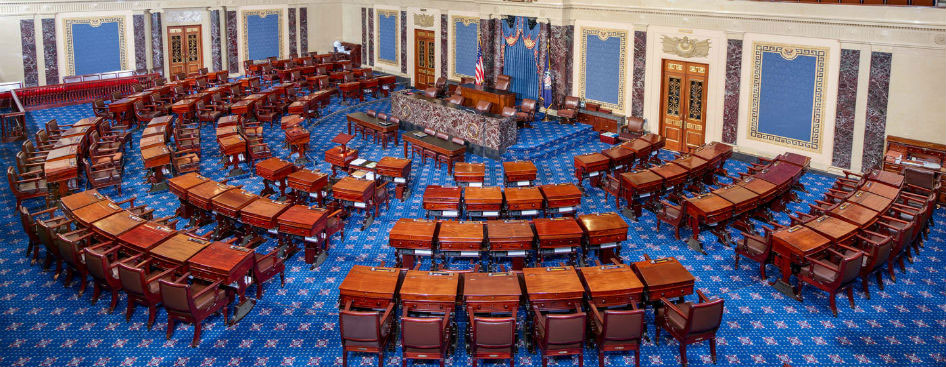
The United States Senate is one of the two houses of the United States Congress, established in 1789 under the Constitution, in which each state is represented by two senators serving six-year terms.[1]
Origins
The Constitutional Convention
How the states should be represented in the new national legislature was one of the hardest questions facing the Constitutional Convention, which met in Philadelphia in the summer of 1787.[3] On 29 May 1787 Edmund Randolph introduced the Virginia Plan, drafted by James Madison, which proposed a bicameral (two-chamber) legislature in which representation in both houses would be proportional to the size of each state.[3] Delegates from the large states argued that because their states contributed more to the nation's financial and defensive resources, they deserved more representation in the Senate as well as in the House.[4] Delegates from the small states demanded that every state be represented equally in both houses, as each state had an equal vote under the Articles of Confederation; William Paterson of New Jersey argued that sovereignty implied equality.[3][4]
On 11 June the convention adopted proportional representation for the House, counting free citizens plus "three fifths of all other persons", meaning enslaved African Americans.[3] Roger Sherman of Connecticut, supported by his fellow delegate Oliver Ellsworth, then moved that each state have an equal vote in the Senate; the motion failed by one vote.[3] Paterson's New Jersey Plan, presented on 15 June, proposed a single-chamber legislature with one vote per state; the convention rejected it on 19 June and affirmed a two-chamber legislature on 21 June.[3] A second vote on equal representation in the Senate, on 2 July, ended in a tie.[3] A committee appointed to resolve the dispute reported Sherman's proposal with an added provision, suggested by Benjamin Franklin, that bills for raising and spending money must start in the House.[3]
On 16 July 1787 the convention adopted this mixed plan by a margin of one vote: representation in the House would follow population, while every state would have the same number of seats in the Senate.[4] The agreement is known as the Great Compromise or, after Sherman and Ellsworth, the Connecticut Compromise.[4] According to the Senate Historical Office, without that vote there would probably have been no Constitution.[4]
The convention shaped the Senate as a smaller and more deliberate body than the House. Delegates rejected a plan for the House to elect senators from lists submitted by the states and agreed instead that state legislatures would choose them.[4] They set the minimum age for senators at 30 and the term at six years, against 25 years and two-year terms for representatives; Madison explained the differences by the "nature of the senatorial trust", which called for more coolness, system and wisdom than the popular branch.[4] The six-year term was adopted on 26 June 1787 by a vote of 7 states to 4.[5] Senators vote as individuals rather than as state delegations.[5] Article V of the Constitution, which governs amendments, provides that no state may be deprived of its equal vote in the Senate without its own consent.[2]
Election by state legislatures and the Seventeenth Amendment
As ratified, the Constitution provided that each state's two senators would be "chosen by the Legislature thereof".[2] Supporters of this method argued that it would strengthen the ties between the states and the national government and protect senators from shifting public opinion.[6] In the late nineteenth century, however, some legislatures deadlocked when different parties controlled their two houses, leaving Senate seats vacant for months or even years, and special interests and political machines sometimes gained control of state legislatures.[7] Progressive reformers called the Senate a "millionaires' club" serving private interests.[7] More than half of the states adopted the "Oregon system", in which primary elections showed voters' preferences and legislative candidates pledged to follow the result.[7] A 1912 Senate investigation of bribery in the election of Senator William Lorimer of Illinois suggested that only a constitutional amendment would satisfy the demand for reform.[7]
The House passed proposals for direct election in 1910 and 1911, but they contained a "race rider" barring federal intervention against racial discrimination among voters; Senator Joseph L. Bristow of Kansas offered a substitute without it, which the Senate adopted on a close vote in May 1911.[7] Congress passed the amendment on 13 May 1912 and it was ratified as the Seventeenth Amendment on 8 April 1913.[7] It provides that senators are "elected by the people" of each state, with voters meeting the same qualifications as voters for the larger house of the state legislature.[7] The first popular elections for the Senate were held in 1914.[6] The amendment also changed how vacancies are filled: the governor must call an election, and the state legislature may allow the governor to make a temporary appointment until it is held.[7][6]
The first Senate
The First Congress was due to meet in New York City on 4 March 1789, but only eight of the 22 senators from the 11 states that had ratified the Constitution were present, short of the quorum of 12.[23] The Senate reached its first quorum on 6 April 1789, when Richard Henry Lee of Virginia arrived; after reading the members' credentials, it elected a president pro tempore for the sole purpose of opening and counting the electoral votes for president.[23] The Senate met in Federal Hall in New York from 1789 to 1790 and in Congress Hall in Philadelphia from 1790 to 1800, before moving to the new Capitol in Washington in November 1800.[24] It used the chamber now called the Old Senate Chamber from 1819 to 1859 and moved into its present chamber in 1859.[24]
How it works
Membership and terms
The Constitution gives each state two senators, each with one vote.[2] Senators serve six-year terms, and the Senate is divided into three classes so that one third of the seats are filled every two years.[2][5] In 1789 the first senators were assigned to classes by lot, with the two senators from each state placed in different classes; the first class served two years, the second four and the third six.[5] Because two thirds of its members carry over from one Congress to the next, the Senate is regarded as a "continuing body" and, unlike the House, does not adopt new rules at the start of each Congress.[5] Encyclopaedia Britannica notes that this rotation has earned it the nickname "the house that never dies".[1]
Qualifications and discipline
A senator must be at least 30 years old, must have been a citizen of the United States for nine years, and must be an inhabitant of the state he or she represents when elected.[2] The framers chose the word "inhabitant" rather than "resident" and set no minimum period of residence.[5] The Senate judges the elections, returns and qualifications of its own members, sets its own rules, may punish members for disorderly behaviour and may expel a member by a two-thirds vote.[2] It may also censure a member, a formal statement of disapproval adopted by majority vote; censure is not mentioned in the Constitution and does not remove a senator from office.[27] According to the Senate, it has censured nine of its members since 1789.[27]
Presiding officers
The Vice President of the United States is President of the Senate but may vote only when the Senate is equally divided.[2] At the convention Elbridge Gerry objected that this breached the separation of powers, saying the delegates "might as well put the President himself as head of the legislature".[31] Over time vice presidents came to preside only on occasion, such as the swearing-in of new senators or to break a tie.[31]
The Constitution also provides for a president pro tempore (from the Latin for "for the time being"), chosen by the Senate to preside when the Vice President is absent or serving as President.[2] By tradition the office goes to the senior member of the majority party, and the president pro tempore is third in the line of presidential succession, after the Vice President and the Speaker of the House.[9] In the absence of the president pro tempore, another senator of the majority party presides.[13] The Senate also elects other officers, including the Secretary of the Senate, who oversees the clerks, historians, reporters of debate and public records, and the Sergeant at Arms, its chief law-enforcement and protocol officer; it elected its first chaplain on 25 April 1789.[9]
Party leaders
Floor leaders are not mentioned in the Constitution.[10] The posts developed gradually in the late nineteenth and early twentieth centuries, as the chairs of each party's conference (the organisation of all its senators) took on the work of leading their party on the floor; by the 1920s the leaders exercised the full range of modern duties.[10] A 1969 study by the Senate parliamentarian Floyd Riddick held that the Democratic Conference made its chair the official leader in 1921 and the Republican Conference in 1925, although historians differ on when the first leaders emerged.[10] Senators of third parties and independents generally join one of the two major conferences in order to receive committee assignments.[11]
The majority leader and minority leader speak for their parties, coordinate legislative strategy and open and close each day's proceedings.[10] When several senators seek to speak at once, the presiding officer recognises the majority leader first and then the minority leader, which allows the majority leader to offer amendments and motions before other senators.[10] The majority leader schedules bills for the floor and, with the minority leader, arranges unanimous consent agreements, which set aside the normal rules to limit and divide the time for debate.[10][13]
Committees
For about its first 27 years the Senate relied mainly on temporary committees formed for a single task and dissolved when it was done.[12] On 10 December 1816 it approved a resolution by Senator James Barbour of Virginia creating 11 permanent standing committees, among them Foreign Relations, Finance, Military Affairs and the Judiciary.[12] According to the Senate, these have grown into 16 standing committees, four special or select committees and four joint committees shared with the House.[12] Standing committees are organised mainly by subject, each chaired by a member of the majority party; they hold hearings, take testimony and, in "mark-up" sessions, settle the wording of bills, though they consider only a fraction of the thousands of bills referred to them.[1] Select and special committees study particular questions or conduct investigations, for example on ageing, ethics, Indian affairs and intelligence.[1]
Powers
Legislation
The Senate shares the power to make law with the House of Representatives, and a bill becomes an act of Congress only when both houses approve an identical text.[1] Bills for raising revenue must begin in the House, but the Senate may propose or agree to amendments to them as with other bills.[2]
Advice and consent
The President makes treaties "by and with the Advice and Consent of the Senate", provided that two thirds of the senators present agree.[2] The Senate votes on a resolution of ratification; the treaty is ratified when the parties formally exchange the documents.[14] On 22 August 1789 President George Washington came to the Senate chamber in person to seek advice on a treaty with Native American nations; when the Senate referred his questions to a committee instead of debating them in his presence, he decided to send future treaty business in writing, a practice his successors have followed.[14] In its first 200 years the Senate approved more than 1,500 treaties and rejected 21.[14] The best-known rejection was of the Treaty of Versailles: the Senate voted it down on 19 November 1919 and again on 19 March 1920, and the United States never ratified it or joined the League of Nations.[14] Presidents also make many international agreements, known as executive agreements, without submitting them to the Senate.[14]
The President likewise nominates ambassadors, Supreme Court justices and other officers, who take office only with the Senate's advice and consent.[2] A Senate historical overview reports that each two-year Congress typically receives about 4,000 civilian and 65,000 military nominations, most of which are confirmed.[15] On 5 August 1789 the Senate rejected its first nominee, Benjamin Fishbourn of Georgia, whose only apparent shortcoming was to have offended one of Georgia's new senators; the episode helped establish "senatorial courtesy", the custom of deferring to senators of the President's party from a nominee's home state.[15] Nearly a quarter of all Supreme Court nominations have failed through rejection, withdrawal or lack of action.[15] Before the 1860s the Senate usually acted on nominations without sending them to committee; Harlan Fiske Stone, in 1925, was the first Supreme Court nominee to appear before the Judiciary Committee, and every Supreme Court appointee since John Marshall Harlan in 1955 has done so.[15] Treaties and nominations available for action on the floor are listed on the Executive Calendar.[13]
Trial of impeachments
The House of Representatives brings impeachment charges, and the Senate has "the sole Power to try all Impeachments".[2] Senators take a special oath for a trial; when the President is tried, the Chief Justice of the United States presides; and conviction requires two thirds of the senators present.[2] The penalty is limited to removal from office and disqualification from holding federal office in future, though the person convicted may still be prosecuted in the ordinary courts.[2] Alexander Hamilton defended the choice of the Senate as the trial court in The Federalist No. 65.[5] Since 1934 a Senate rule has allowed a committee of senators to receive evidence and take testimony, and in Nixon v. United States (1993) the Supreme Court upheld the Senate's right to set its own trial procedures.[32]
The Senate's list of impeachment cases begins with Senator William Blount, whose case ended in January 1799 with his expulsion recorded and the charges dismissed, and runs to a Secretary of Homeland Security in 2024, whose articles the Senate dismissed as unconstitutional.[16] Eight cases ended in conviction, all of them of federal judges.[16][17] Every president tried by the Senate has been acquitted: Andrew Johnson in 1868, a president in 1999, and another president who was tried twice, in 2020 and 2021.[16]
The filibuster and cloture
A filibuster is an attempt to block or delay action on a bill or other matter by debating it at length; cloture is the procedure for ending that debate and forcing a vote.[13][18] Filibusters are possible because of the Senate's tradition of unlimited debate.[18] Senator William Maclay recorded tactics to "talk away the time" during the Senate's first session in 1789, and the word "filibuster" came into common use in the mid-nineteenth century.[19][20] Until 1917 the Senate's rules offered no way for a majority to end debate.[18]
In 1917, at the urging of President Woodrow Wilson, the Senate adopted Rule 22, which allowed two thirds of the senators voting to close debate.[20][18] Cloture was first invoked in 1919, against a filibuster of the Treaty of Versailles, but in the following four decades it succeeded only five times, and filibusters were used against civil rights measures, including bills against lynching.[19] Senator Strom Thurmond of South Carolina spoke for 24 hours and 18 minutes against the Civil Rights Act of 1957.[20] In 1964 the Senate invoked cloture after a 60-day filibuster against the Civil Rights Act, the first time it had overcome a filibuster of civil rights legislation.[20][19] In April 2025 a senator spoke for 25 hours and 5 minutes, which the Senate Historical Office records as the longest individual speech.[19]
In 1975 the Senate lowered the threshold for cloture to three fifths of all senators "duly chosen and sworn", or 60 of 100.[18] Ending debate on a proposal to change the Senate's standing rules still requires two thirds of those present.[1] On 21 November 2013 the Senate voted 52 to 48 to establish, by precedent, that debate on most nominations could be closed by a simple majority, leaving the 60-vote threshold for Supreme Court nominations and for legislation.[21] On 6 April 2017 it extended the simple-majority threshold to Supreme Court nominations by another 52 to 48 vote, while leaving the legislative filibuster in place.[22]
Notable history
The Senate has been the scene of several turning points in national history beyond those already described. In 1868 it tried President Andrew Johnson, the first impeachment trial of a president, and acquitted him.[16][1] On 25 February 1870 Hiram Revels of Mississippi took the oath as the first African American senator, after the Senate voted 48 to 8 to seat him over objections that he had not been a citizen for nine years.[25] Rebecca Latimer Felton of Georgia, appointed to a vacancy, took the oath on 21 November 1922 and served for about 24 hours while the Senate was in session, the start of what the Senate Historical Office marks as a century of women senators; Hattie Caraway of Arkansas became the first woman elected to the Senate in 1932.[26] The Senate Historical Office counted 59 women who had been elected or appointed to the Senate as of November 2022.[26]
On 2 December 1954 the Senate voted 67 to 22 to condemn Senator Joseph R. McCarthy of Wisconsin for his conduct towards Senate committees.[27] Television coverage of the Senate floor began on 2 June 1986, seven years after the House began broadcasting its proceedings, and on 29 July 1986 the Senate voted 78 to 21 to keep the cameras on permanently.[28]
The Senate chamber in the north wing of the United States Capitol, used by the Senate since 1859.
The Senate has 100 members, two from each of the 50 states.[2][29] As of November 2026, the Senate's website gave the party division of the 119th Congress as 53 Republicans, forming the majority, 45 Democrats and 2 independents.[29] According to the Senate's Democratic press gallery, the two independents caucus with the Democrats for organisational purposes.[30] These figures describe the 119th Congress, which ends on 3 January 2027, and do not reflect the elections of November 2026: the terms of the 33 Class II senators, whose seats were contested in 2026, run until that date.[8][30]
National Archives. "17th Amendment to the U.S. Constitution: Direct Election of U.S. Senators (1913)." National Archives, Milestone Documents, 15 September 2021 (last reviewed 8 February 2022). archives.gov/milestone-documents/17th-amendment
United States Senate. "Class II - Senators Whose Terms of Service Expire in 2027." United States Senate. No date shown; accessed 24 November 2026. senate.gov/senators/Class_II.htm
United States Senate. "Officers and Staff." United States Senate. No date shown; accessed 24 November 2026. senate.gov/about/officers-staff.htm
United States Senate. "Senators" (Party Division, 119th Congress). United States Senate. No date shown; accessed 24 November 2026. senate.gov/senators/
Senate Democratic Press Gallery (U.S. Senate Daily Press). "119th Congress: Senate Party Lineup" (Senate Facts). United States Senate. No date shown; accessed 24 November 2026. dailypress.senate.gov/on-the-floor/senate-facts/