Diana, Princess of Wales (1961–1997), born Diana Frances Spencer, was the first wife of Charles, Prince of Wales (later King Charles III), a member of the British royal family known for her charity work, who died after a car crash in Paris in 1997.[1][2]
Early life
Diana was born on 1 July 1961 at Park House, a house her parents rented on the Sandringham estate in Norfolk, which belonged to Queen Elizabeth II.[1][2][3] She was the youngest daughter of Viscount and Viscountess Althorp.[1] Her father, Edward John Spencer, Viscount Althorp, was heir to the 7th Earl Spencer, and her mother, Frances Ruth Burke Roche, was a daughter of the 4th Baron Fermoy.[2] Her parents separated in 1967 and divorced in 1969, and she lived with her father, who succeeded to the earldom in 1975.[1][2]
She went to school at Riddlesworth Hall and then at West Heath in Kent, and afterwards attended a finishing school (a private school teaching social skills and accomplishments to young women) in Switzerland.[1][2] Before her marriage she worked in London as a kindergarten assistant at the Young England school in Pimlico.[1][2]
Marriage
Her engagement to Charles, Prince of Wales, was announced in February 1981.[1][2] They married at St Paul's Cathedral in London on 29 July 1981, in a ceremony televised around the world.[1][2][3] The couple had two sons: Prince William, born in 1982, and Prince Henry, known as Prince Harry, born in 1984.[1][2]
Public role and charity work
As Princess of Wales she carried out many royal engagements and overseas visits, both with her husband and on her own.[1] The Royal Family's official website notes that she was known for her sense of style and for helping younger British fashion designers, but that she was best known for her charity work.[1] During her marriage she was president or patron of more than 100 charities, and she drew attention to causes including homelessness, disability, the welfare of children and HIV/AIDS.[1] Britannica lists the arts, children's issues and AIDS patients among the causes she supported, and records that her compassion earned her the nickname "the People's Princess".[2]
In April 1987 the Middlesex Hospital in London invited her to open the first ward in the United Kingdom devoted to treating people with HIV/AIDS.[7] She shook hands with patients there without wearing gloves; the journalist Tina Brown, writing in TIME in 2020, described the moment as "a broken taboo" that was reported around the world, and wrote that Diana went on visiting hospitals and patients' bedsides for the next decade.[7]
Separation and divorce
The Prince and Princess of Wales separated in December 1992, and their divorce became final on 28 August 1996.[1][2] Britannica states that she received a substantial financial settlement.[2] After the divorce she was known as Diana, Princess of Wales, without the style "Her Royal Highness", but she continued to be regarded as a member of the Royal Family.[1][2]
After the divorce she gave up most of her patronages, keeping her links with six organisations: Centrepoint (a charity for homeless young people), the English National Ballet, the Leprosy Mission, the National AIDS Trust, Great Ormond Street Hospital and the Royal Marsden Hospital.[1]
Campaign against landmines
In the last year of her life Diana campaigned against anti-personnel landmines (explosive devices buried in the ground that kill or maim people who step on them, often long after a conflict ends).[1][5] In January 1997 she travelled to Angola, where she visited the work of the HALO Trust, a charity that clears mines.[1][6] On 15 January 1997 she was photographed walking through a minefield that the HALO Trust was clearing in Huambo, Angola's second city.[4][6] The HALO Trust states that this visit drew worldwide attention to the humanitarian crisis caused by landmines.[4] In August 1997 she also visited Bosnia as part of the same campaign.[1][5]
A treaty banning anti-personnel mines followed later in 1997.[4][6] The HALO Trust, writing in 2017, credited her work, "much of it behind the scenes", with helping to make the Ottawa Treaty (formally the Anti-Personnel Mine Ban Treaty) a reality, and said that 162 states were then signatories.[5] A 2025 CBS News report said that her advocacy and the pictures of her in the minefield helped build support for the treaty.[6]
Death
Diana died on 31 August 1997, aged 36, following a car crash in a road tunnel in Paris.[1][2][3] Her companion, Dodi Fayed, and the driver of their car, Henri Paul, were also killed.[2] The car, a Mercedes, was being followed by photographers, and it struck a pillar in the Alma Tunnel.[12][13]
Her death was followed by what Britannica calls "unprecedented expressions of public mourning".[2] On 5 September 1997 Queen Elizabeth II made a televised broadcast in which she described Diana as "an exceptional and gifted human being".[16]
Funeral
Before the funeral her body lay in the chapel at St James's Palace in London.[3] The funeral took place at Westminster Abbey on 6 September 1997.[1][3] Britannica notes that the royal family broke with tradition by arranging a funeral that was televised internationally, and Westminster Abbey records that the service was watched by millions of people around the world.[2][3] Representatives of the charities she had worked with walked behind her coffin.[1] Flowers and toys were left at the Abbey's west gates, and wreaths sent by foreign heads of state were laid on the green outside.[3]
After the service her coffin was taken by road to Althorp, the Spencer family home, where she was buried privately on an island in an ornamental lake.[1][3]
Official investigations
French investigation
Because the crash happened in France, it was first investigated by the French authorities.[15][21] Nine photographers and a press motorcyclist were placed under formal investigation (a French legal step short of charges being brought at trial) for manslaughter and for failing to help people in danger.[21] In 1999 the investigating judge, Hervé Stéphan, cleared the photographers, finding that the driver's consumption of alcohol and drugs, together with excessive speed, had caused the deaths.[2][11] France's highest court, the Court of Cassation, upheld the dismissal of the manslaughter charges in April 2002.[11] In 2006 three photographers were convicted of invasion of privacy for photographing the scene, and each was fined one euro.[13]
Operation Paget
In 2004, at the request of Michael Burgess, the Royal Coroner, the Metropolitan Police began an inquiry led by its former commissioner, Lord Stevens.[9] Known as Operation Paget, it examined claims that the crash had been a deliberate killing; its 871-page report, "The Operation Paget Inquiry Report into the Allegation of Conspiracy to Murder", was published in December 2006.[9][10] Announcing the findings on 14 December 2006, Stevens said that "on the evidence available now, there was no conspiracy to murder any of the occupants of that car".[8] According to a Reuters report of the findings, the inquiry concluded, as the French investigation had, that Henri Paul was intoxicated, with a blood alcohol level about twice the British drink-drive limit, and was driving too fast.[8][10] Britannica summarises the report's conclusion as finding that the driver was at fault.[2]
Inquest (2007–2008)
An inquest (an official inquiry before a coroner into the cause of a death) into the deaths of Diana and Dodi Fayed was held before Lord Justice Scott Baker, sitting with a jury of six women and five men.[10][12][15] It heard evidence for about six months from 278 witnesses.[12][14] The coroner told the jury that claims that the crash had been staged should be rejected and described Mohamed Al Fayed's allegation of a conspiracy as "without substance".[15]
On 7 April 2008 the jury returned a verdict by a majority of nine to two.[12][13] Its verdict was "unlawful killing, grossly negligent driving of the following vehicles and of the Mercedes".[13] The jury found that the crash was caused or contributed to by the speed and manner of driving of the Mercedes, by the speed and manner of driving of the following vehicles, and by the impairment of the judgment of the driver of the Mercedes through alcohol.[12][15] It also found that the deaths were caused or contributed to by the fact that Diana and Dodi Fayed were not wearing seatbelts, and by the fact that the Mercedes struck the pillar in the Alma Tunnel rather than colliding with something else.[12] TIME reported that all eleven jurors agreed on the seatbelt and pillar findings.[14] No British charges could be brought against the photographers because the crash took place in France.[13]
In December 2013 the Metropolitan Police said that, after examining further allegations about the deaths, it had found "no credible evidence" to support them and no basis for reopening a criminal investigation.[9]
Commemoration and legacy
On 31 August 2007, the tenth anniversary of her death, a service of thanksgiving for her life was held at the Guards' Chapel, Wellington Barracks, in London, with arrangements overseen by her sons and by members of the Spencer family.[20]
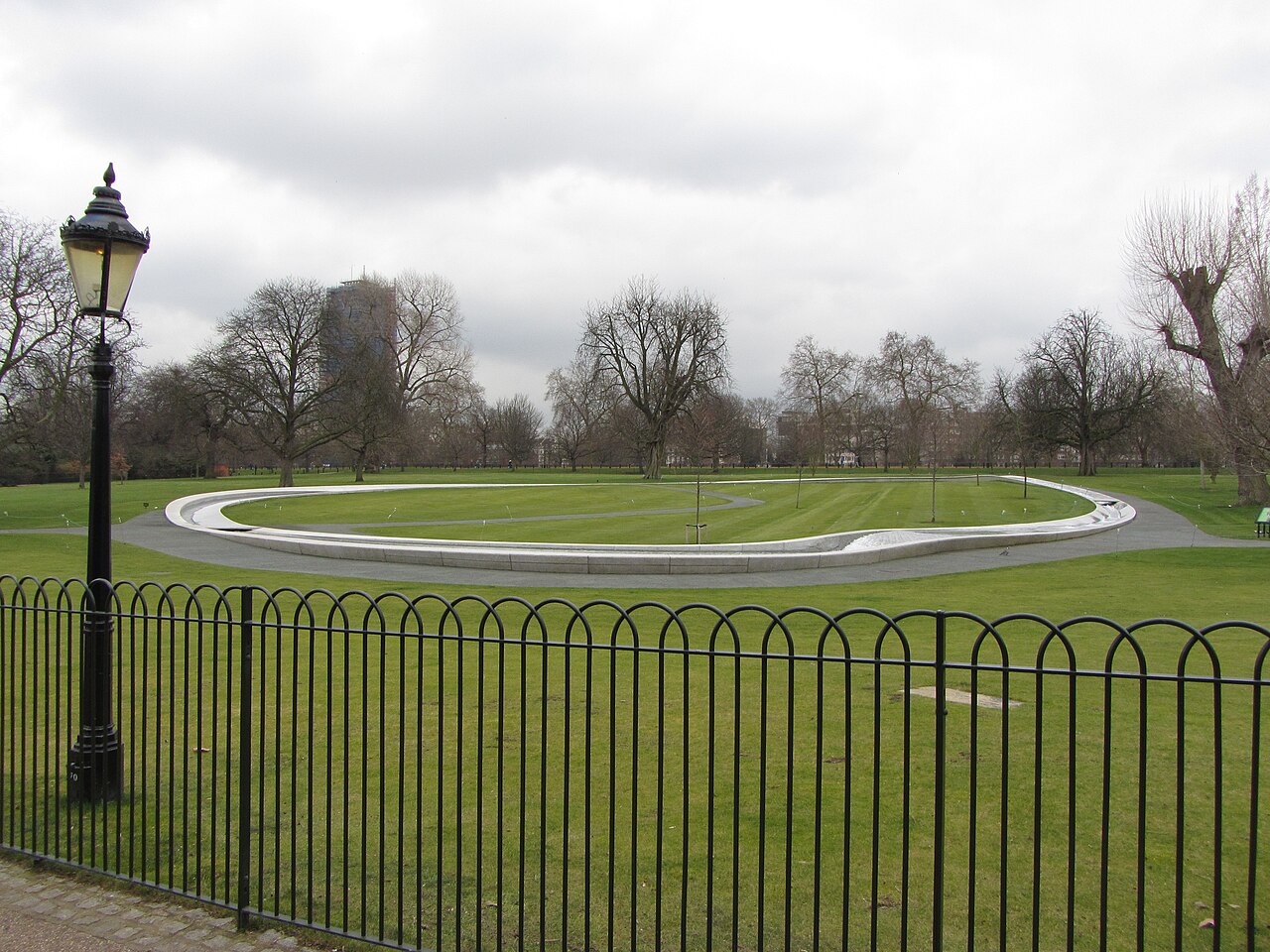
The Diana, Princess of Wales Memorial Fountain in Hyde Park, London, was opened by Queen Elizabeth II on 6 July 2004.[17][18] It is made of 545 pieces of Cornish granite, and water flows from its highest point in two directions to meet in a calm pool at the bottom.[17] At its opening the Queen called it "a highly original memorial which captures something of the essence of a remarkable human being".[18]
The Diana Award, a registered charity, describes itself as the only charity set up in memory of Diana, Princess of Wales, and was founded on her belief that young people have the power to change the world.[19] It states that it exists to empower young people to make positive change, and its 2026 virtual awards ceremony honoured 198 young people from 44 countries.[19]
Britannica writes that her life and death polarised national feeling about the monarchy, which many people saw as old-fashioned and unfeeling in an age of popular media.[2] The Royal Family's website states that her work continues through charities and projects set up in her memory to help people in need.[1]
The Diana, Princess of Wales Memorial Fountain in Hyde Park, London, an oval granite water channel opened in 2004.
The Royal Family. "Diana, Princess of Wales." royal.uk. No date shown; accessed 24 November 2026. royal.uk/diana-princess-wales
The Editors of Encyclopaedia Britannica. "Diana, princess of Wales." Encyclopaedia Britannica. No date shown; accessed 24 November 2026. britannica.com/topic/Diana-Princess-of-Wales
NBC News. "10 years later, inquest opens into Diana's death." NBC News, 2007 (exact date not shown; accessed 24 November 2026). nbcnews.com/id/wbna21095031
NBC News. "Paparazzi, Diana's driver ruled at fault." NBC News, April 2008 (exact date not shown; accessed 24 November 2026). nbcnews.com/news/amp/wbna23996067