Prince Philip, Duke of Edinburgh (1921–2021), born a prince of Greece and Denmark, was the husband of Queen Elizabeth II and her consort from her accession in 1952 until his death at Windsor Castle in 2021.[1][5][11]
Birth and family
Philip was born on 10 June 1921 on the Greek island of Corfu, at Mon Repos, a villa used by the Greek royal family as a summer retreat.[2][4] He was styled Prince Philip of Greece and Denmark.[1] He was the only son, and the youngest child, of Prince Andrew of Greece, a younger brother of King Constantine I of Greece, and Princess Alice of Battenberg.[2][4] His father's family was of Danish descent, Prince Andrew being a grandson of King Christian IX of Denmark.[2] His mother was the eldest child of Prince Louis of Battenberg and a sister of the future Earl Mountbatten of Burma.[2] Prince Louis had become a naturalised British subject, served in the Royal Navy and was First Sea Lord in 1914; during the First World War he changed the family name to Mountbatten and was made Marquess of Milford Haven.[2] Philip had four older sisters, Margarita, Theodora, Cécile and Sophie.[2]
Through different children of Queen Victoria, both Philip and his future wife, Princess Elizabeth, were great-great-grandchildren of the queen.[4]
Exile and schooling
In 1922 Constantine I was forced to abdicate, and Prince Andrew was court-martialled and imprisoned, then pardoned on condition that he leave Greece for good.[2] In December 1922 King George V ordered a Royal Navy ship to take the family off Corfu; according to the Royal Family's official website, the 18-month-old Philip was carried aboard in a cot made from an orange box.[2] The family settled in Paris, first in the Bois de Boulogne and later at St-Cloud.[2] He spent seven years of his boyhood in France and kept a good command of French.[4]
He began school in France and in 1928 went to Cheam Preparatory School in Surrey, England.[2] At the age of 12 he spent a year at Salem School in southern Germany, run by the educationalist Kurt Hahn.[2] Hahn later left Germany to escape arrest by the Nazis and founded Gordonstoun School in Morayshire, Scotland, where Philip was one of only 21 boys when the school opened.[2] At Gordonstoun he became head of the school and captain of hockey and cricket, and he sailed on school expeditions around Scotland and to Norway.[2] Encyclopaedia Britannica notes that he was brought up mainly in Great Britain.[1]
After leaving Gordonstoun in 1939, Philip joined the Royal Navy as a cadet and trained at the Royal Naval College, Dartmouth, where he was awarded the King's Dirk and the prize for the best cadet of his entry.[3] In 1940 he joined the battleship HMS Ramillies at Colombo as a midshipman (the most junior officer rank) and spent about six months in the Indian Ocean.[3][4] Britannica states that he served in combat with the Royal Navy in the Mediterranean and the Pacific from January 1940 until the end of the war.[1]
In January 1941 he joined the battleship HMS Valiant at Alexandria.[3] During the night action off Cape Matapan in March 1941, he was in charge of the ship's searchlight control and was mentioned in despatches (named in an official report for good conduct).[3][4] He was later awarded the Greek War Cross of Valour.[4] After qualifying as a sub-lieutenant he served in the destroyer HMS Wallace, escorting convoys from Rosyth; he was promoted lieutenant on 16 July 1942 and in October 1942, aged 21, became Wallace's first lieutenant (second in command), which the Royal Family's website describes as unusually young for the post.[3] In July 1943 Wallace took part in the Allied landings in Sicily.[3] In a 2021 tribute to the House of Commons, the Prime Minister said that during that operation Philip devised a floating decoy that helped the ship escape attack.[12]
From late 1944 he was first lieutenant of the new destroyer HMS Whelp, which joined the British Pacific Fleet.[3] Whelp was in Tokyo Bay when Japan signed its surrender on 2 September 1945, and Philip stayed with the ship until it returned to Britain in January 1946.[3][4]
After the war he taught at the Royal Naval Petty Officers' School and attended the Naval Staff College at Greenwich.[3] In 1949, as first lieutenant of HMS Chequers, he was based in Malta with the Mediterranean Fleet, and Princess Elizabeth joined him there.[3][5] In 1950 he was promoted lieutenant-commander and given command of the frigate HMS Magpie; the Royal Collection Trust dates his taking command to September 1950.[3][8] His command ended in July 1951, and he was promoted commander on 30 June 1952.[3][8] His active naval career came to an end with the death of King George VI and his wife's accession in February 1952.[1][3] In 1953 the Queen appointed him Admiral of the Fleet and Captain-General of the Royal Marines, and on his 90th birthday, 10 June 2011, she made him Lord High Admiral of the United Kingdom.[3]
Naturalisation and marriage
Philip became a naturalised British subject in 1947, giving up his Greek and Danish royal titles and taking the surname of his mother's family, Mountbatten.[1][2][4] Britannica dates his becoming a British subject to 28 February 1947.[1]
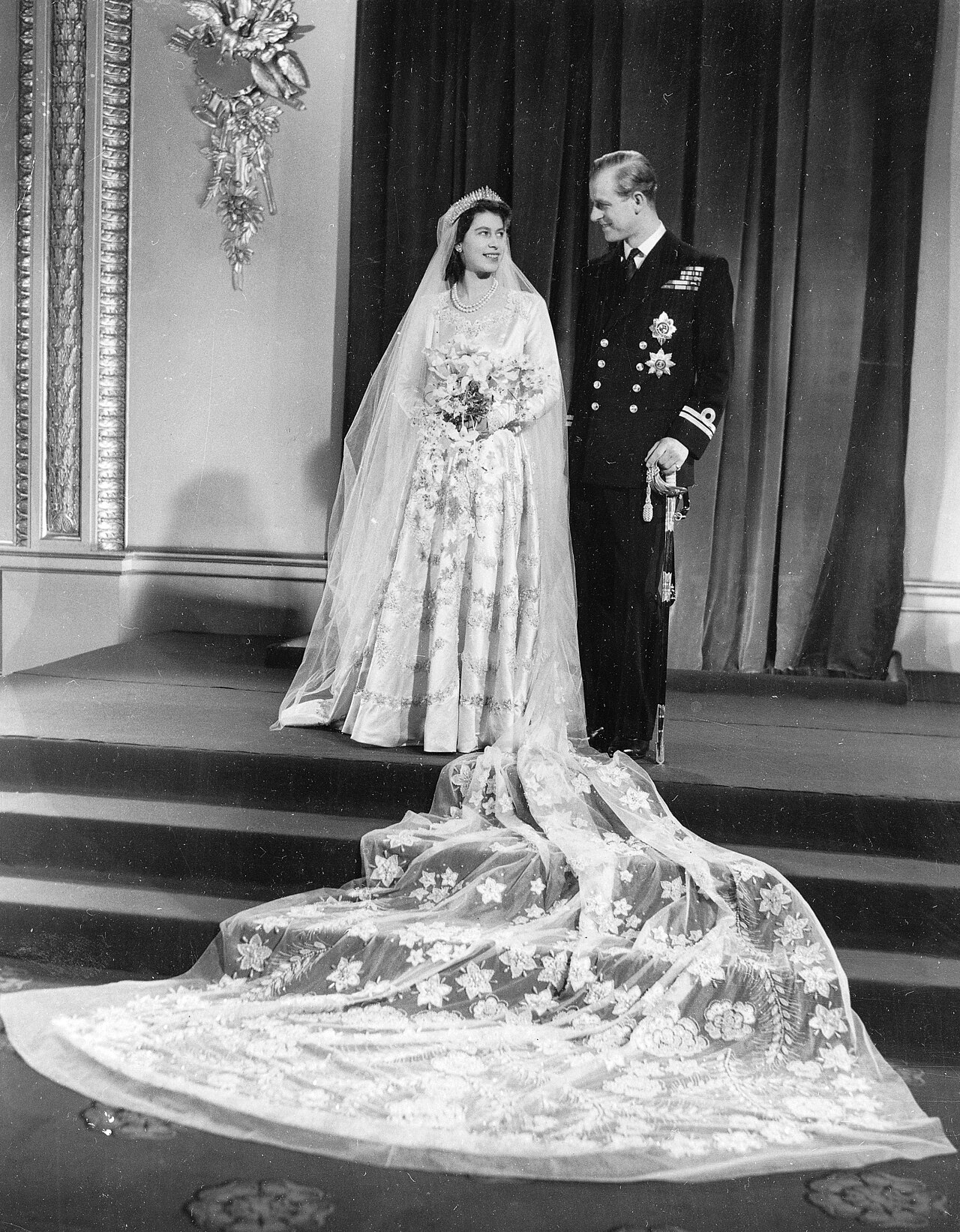
He married Princess Elizabeth, the elder daughter of King George VI, at Westminster Abbey on 20 November 1947.[1][5][6] The service began at 11.30 am; about 2,000 guests attended, a smaller number than usual because of post-war austerity, and the bride was the tenth royal bride married at the Abbey.[5] The service was conducted by the Archbishop of Canterbury, Geoffrey Fisher, after the Dean of Westminster read the opening sentences.[5]
The couple had four children: Charles (born 1948), Anne (born 1950), Andrew (born 1960) and Edward (born 1964).[1] In 1960 a combined surname, Mountbatten-Windsor, was adopted for some descendants of the couple.[1] Their three sons, like their father, went to Gordonstoun.[2]
Princess Elizabeth and Philip, Duke of Edinburgh, on their wedding day in November 1947.
On the eve of the wedding, King George VI made Philip a Royal Highness and a Knight of the Garter and created him Duke of Edinburgh, Earl of Merioneth and Baron Greenwich.[1][4] He was installed as a Knight of the Garter in St George's Chapel, Windsor, in 1948.[9] In 1957 the Queen gave him the rank and title of a Prince of the United Kingdom.[1][4] He was also a Knight of the Order of the Thistle and a Privy Counsellor.[4]
Consort to the Queen
When Elizabeth became queen in 1952, Philip became her consort.[1] The Royal Family's website notes that he was only the fifth consort of a reigning queen in British history, and that he had no constitutional role.[4] As the sovereign's husband he was not crowned or anointed at the 1953 coronation, although he wore a coronation robe and coronet during the service.[4][9] The Royal Collection Trust describes him as Britain's longest-serving consort.[9] He sat in the House of Lords until 1999 but never spoke there.[4]
He supported the Queen at home and abroad.[9] By 2002, according to figures published by the Royal Family that year, he had accompanied her on all 251 of her official overseas visits, beginning with the Commonwealth coronation tour of 1953–54, and had also made hundreds of solo visits overseas.[4] Britannica gives an average of about 350 official engagements a year.[1] He chaired the committee that oversaw the restoration of Windsor Castle after the fire of 1992.[4][9] He suggested the Queen's Gallery at Buckingham Palace, which opened in 1962 in the bomb-damaged former Private Chapel, and he helped design the interior of the royal yacht Britannia.[4]
In May 1961 he became the first member of the royal family to be interviewed on television.[4] Britannica writes that his outspoken right-wing views occasionally embarrassed a monarchy that was trying to move away from its traditional upper-class image.[1]
The Duke of Edinburgh's Award
In 1956 Philip founded the Duke of Edinburgh's Award, a programme of challenges for young people, at the suggestion of his former Gordonstoun headmaster, Kurt Hahn.[6][7] It is awarded at three levels: Bronze, Silver and Gold.[7] He often presented Gold Awards in the gardens of the Palace of Holyroodhouse in Edinburgh.[7] He chaired the Award until 2001 and remained its patron for the rest of his life.[7] The UK charity that runs the Award says that millions of young people have taken part since 1956.[15] Britannica reports that the international form of the programme enabled more than six million young adults to take part in community service, leadership and fitness activities.[1] The House of Commons, in its formal address of sympathy after his death, said the scheme had touched the lives of millions across the world.[12] Its 60th anniversary was marked by a service at Westminster Abbey in November 2016.[6]
Patronages and interests
Philip was patron or president of a very large number of organisations: 814 according to the Royal Family's 2002 list, and more than 750 according to the Royal Collection Trust in 2021.[4][9] He was a long-standing supporter of conservation, as the first President of WWF-UK (1961–1982) and International President of WWF from 1981 to 1996.[1][4] The House of Commons address of sympathy referred to his early and passionate commitment to the environment.[12]
He had a strong interest in science, technology and engineering: he founded the Fellowship of Engineering in 1976, which became the Royal Academy of Engineering, and he set up the Commonwealth Study Conferences, held regularly since 1956 to develop business and industrial leaders.[4] He was chancellor of the universities of Edinburgh (from 1952), Wales (1948–76), Salford (1967–91) and Cambridge (from 1976).[4] He chaired the Westminster Abbey Trust, set up in 1973 to pay for restoration of the Abbey's exterior, and a small carved head of him was added to the Abbey's north-west tower in 1991.[5][6]
He was a pilot, gaining his RAF wings in 1953, helicopter wings in 1956 and a private pilot's licence in 1959, and by his final flight in 1997 he had logged 5,986 hours in 59 types of aircraft.[4] He was president of the International Equestrian Federation from 1964 to 1986 and helped draw up international rules for several equestrian sports.[4] The Royal Collection Trust lists carriage driving, cricket, polo and reading among his interests.[9] He also wrote on environmental, technological, equestrian and animal subjects, with books including Birds from Britannia (1962) and Down to Earth (1988).[4] In 1958 he asked Benjamin Britten to write a setting of the Jubilate for the choir of St George's Chapel, Windsor.[4][13]
Retirement
In May 2017 Buckingham Palace announced that the Duke would stop carrying out his own programme of public engagements later that year, while he might still attend some events alongside the Queen.[1][10] His last solo public engagement was the Captain General's Parade of the Royal Marines at Buckingham Palace on 2 August 2017.[1][10] The Royal Family stated that he had carried out more than 22,000 solo engagements since 1952; in the Commons tribute of April 2021, the Prime Minister gave the figure as 22,219.[10][12]
Death and funeral
Buckingham Palace announced that the Duke had died peacefully on the morning of 9 April 2021 at Windsor Castle.[11] He was 99.[5] The House of Commons met on 12 April 2021 to pay tribute and agreed an address of sympathy to the Queen, which praised his service in the Royal Navy in the Second World War, his work for young people and his support for the Queen throughout his life.[12]
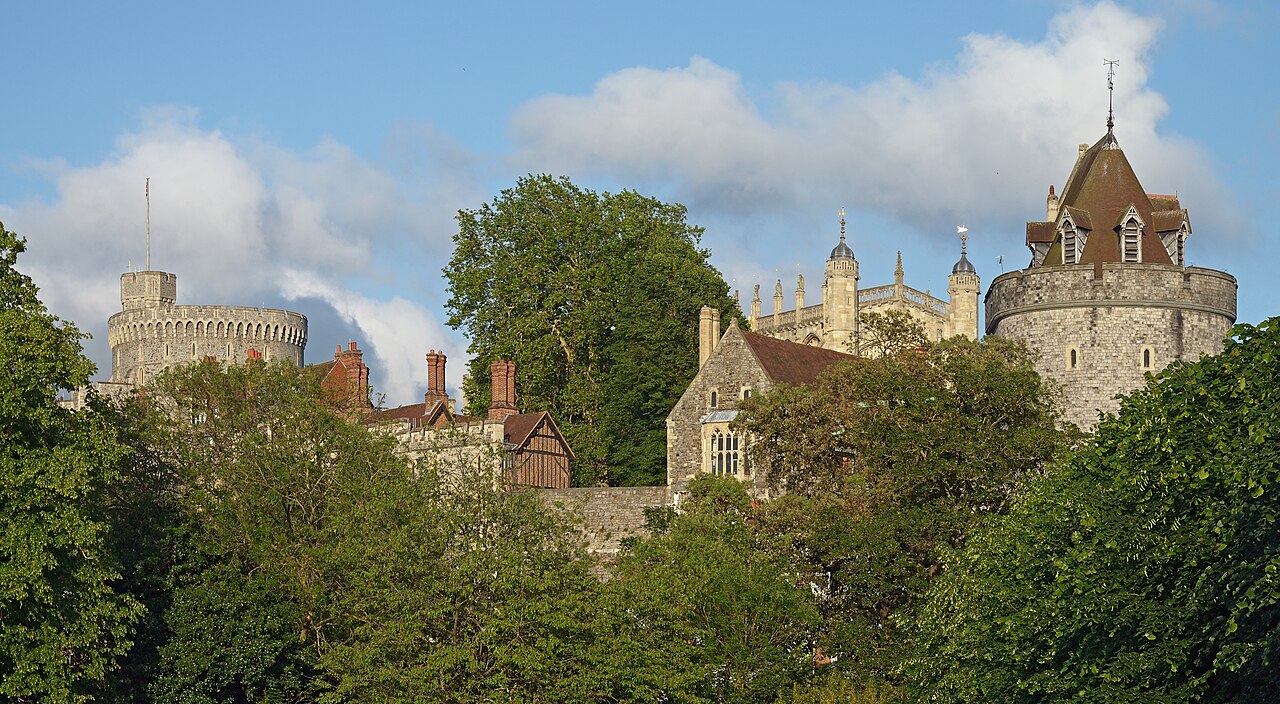
His funeral took place at 3 pm on Saturday 17 April 2021 in St George's Chapel, Windsor Castle.[9][13] The Dean of Windsor, David Conner, led the service, and the Archbishop of Canterbury, Justin Welby, gave the blessing.[13] The music included a setting of Psalm 104 chosen by the Duke and Britten's Jubilate, written for the chapel at his request.[13] Garter Principal King of Arms (the senior herald of England) proclaimed his styles and titles, and his coffin was lowered into the Royal Vault beneath the chapel.[13] A lament was played by a piper of the Royal Regiment of Scotland, and buglers of the Royal Marines sounded the Last Post and, after Reveille, the naval call Action Stations.[13] The coffin was carried to the chapel on a Land Rover that the Duke had helped design.[12]
His coffin remained in the Royal Vault until the death of Elizabeth II.[14] On 19 September 2022, after the Queen's state funeral, she was buried together with the Duke in the King George VI Memorial Chapel, an annexe on the north side of St George's Chapel that also holds the remains of her parents and her sister.[14] Westminster Abbey held a service of thanksgiving for his life on 29 March 2022.[5][6]
St George's Chapel at Windsor Castle, where the Duke's funeral was held in April 2021.