The explosion and fire at reactor No. 4 of the Chernobyl (Chornobyl) nuclear power plant in Soviet Ukraine on 26 April 1986, the most serious accident in the history of nuclear power
The Chernobyl disaster was the explosion and fire that destroyed reactor No. 4 of the Chernobyl (Ukrainian: Chornobyl) nuclear power plant, then in the Soviet Union and now in Ukraine, on 26 April 1986, releasing large amounts of radioactive material into the atmosphere.[1][8]
The plant
The Chernobyl Power Complex lies in northern Ukraine, beside the Pripyat River; the OECD Nuclear Energy Agency (NEA) places it about 130 km north of Kyiv and about 20 km south of the border with Belarus.[5] It had four reactors of the RBMK-1000 type: units 1 and 2 were built between 1970 and 1977, units 3 and 4 were completed in 1983, and two more were under construction at the time of the accident.[3][5] Pripyat, the town built for the plant's workers, lay about 3 km away and had about 49,000 inhabitants; between about 115,000 and 135,000 people lived within 30 km of the plant.[5]
The RBMK reactor
The RBMK was a Soviet design.[4] In it, the neutrons released when uranium atoms split were slowed down, so that they could sustain the chain reaction, by large blocks of graphite (a "moderator"), and the fuel sat in about 7-metre-long vertical tubes (pressure tubes) through which cooling water flowed and boiled, the steam going directly to the turbines.[4][5] The fuel was uranium dioxide slightly enriched to about 2% uranium-235, and fuel could be changed while the reactor was running.[5] Each Chernobyl unit was rated at 3,200 megawatts of heat (1,000 megawatts of electricity), and its core was about 7 m high and 12 m across, with 211 control rods (rods of neutron-absorbing material that are inserted to slow the reaction).[3][5] The core sat in a concrete cavity under a steel cover plate of about 1,000 tonnes; the World Nuclear Association (WNA) notes that there was no secure containment building of the kind accepted in the West.[4]
Two features of the design proved central to the accident.[2] The first was a "positive void coefficient": when the cooling water boils into steam ("voids"), it absorbs fewer neutrons, so in the RBMK more steam could increase the chain reaction, which made more heat and more steam, a self-reinforcing loop.[4] According to the NEA, this effect dominated at low power, below about 20% of maximum, making the reactor unstable and prone to sudden surges.[5] The second was the design of the control rods: each had a graphite section (a "displacer") at its end, so that when a fully withdrawn rod began to drop into the core, it first pushed out water at the bottom of the core and briefly added reactivity there instead of reducing it, an effect known as "positive scram".[2][4]
The accident of 26 April 1986
The test
Unit 4 was due to be shut down for routine maintenance on 25 April 1986, and the shutdown was to be used to carry out a test.[3][5] The test was meant to show how long the turbines, coasting down after a loss of the main electrical power supply, could keep generating enough electricity to run the main cooling pumps; a similar test the year before had run down too quickly, and new voltage regulators were to be tried.[3][5] According to the NEA, the test was run without adequate coordination with the staff responsible for reactor safety.[5]
Sequence of events
The power reduction began on 25 April, but the electricity grid controller refused to allow a further reduction, so the reactor stayed at about half power for some hours; in the meantime, at 14:00, the emergency core cooling system was isolated, and it stayed off for the rest of the test.[2][5] Late that evening the grid controller agreed to a further reduction.[5] Shortly after midnight, at 00:28 on 26 April, the power fell precipitously, to about 30 megawatts of heat.[2][5] To raise it again, the operators withdrew many control rods; the power stabilised at about 200 megawatts of heat at around 01:00, far below the 700 megawatts at which the test had been planned.[2][5] At that point far fewer control rods were in the core than the operating rules required, and several automatic protection signals had been disabled or bypassed.[2][5]
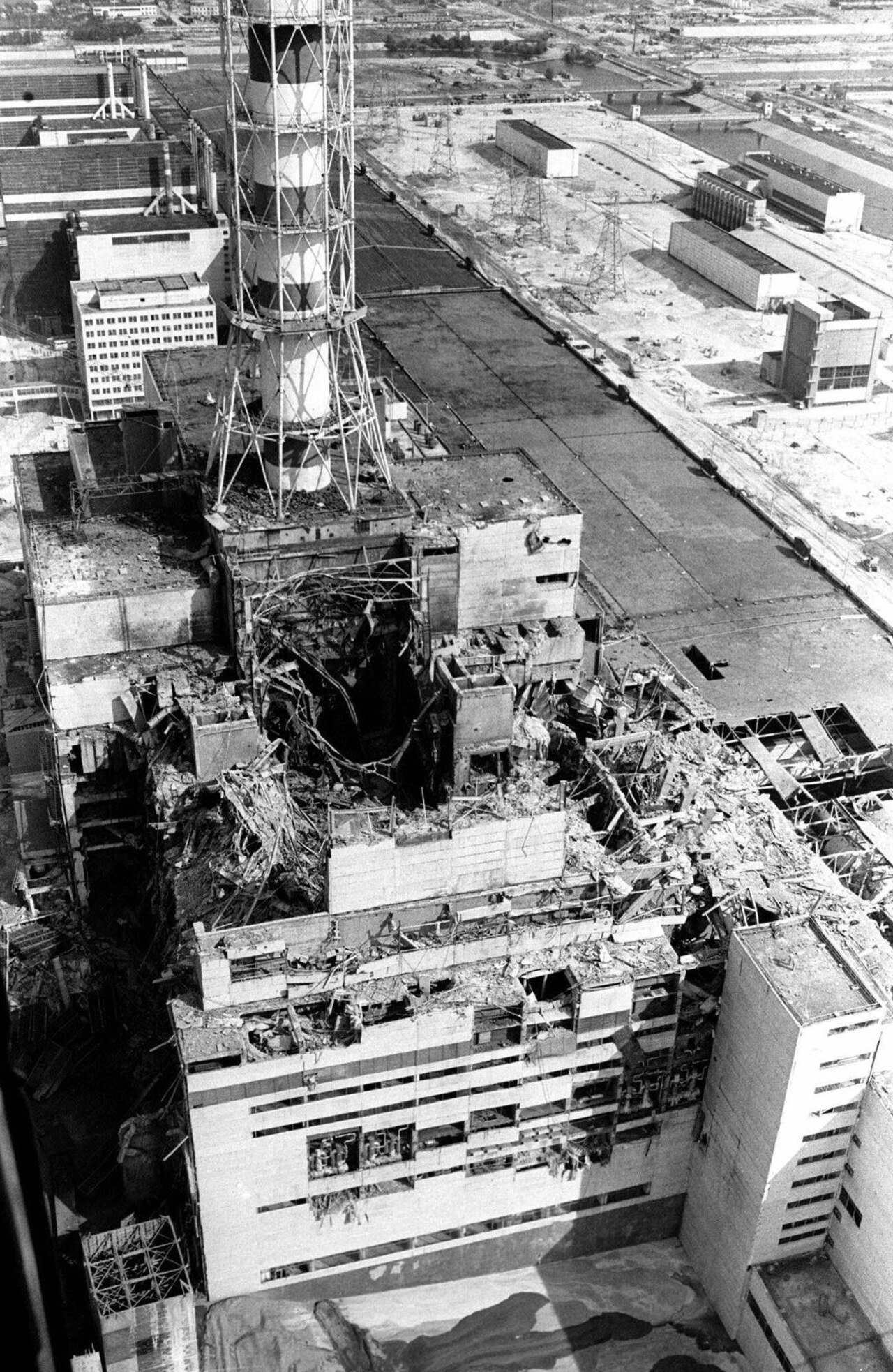
As the test proceeded, the flow of cooling water fell, more water turned to steam in the fuel channels, and, because of the positive void coefficient, the power rose.[5] When the control rods were driven in, the positive scram effect added further reactivity at the bottom of the core, and the power surged to an estimated 100 times the reactor's rated output.[3][4][5] The fuel overheated and broke apart, and at about 01:23 a steam explosion lifted the reactor's cover plate; a second explosion followed two or three seconds later.[3][5] The cause of the second explosion is uncertain; the NEA and the WNA say hydrogen produced by reactions between hot zirconium fuel cladding and steam may have contributed.[3][5] The explosions destroyed the core and the roof of the reactor building and threw hot, radioactive fuel and graphite out of the building.[3][5]
Causes: INSAG-1 (1986) and INSAG-7 (1992)
The International Nuclear Safety Advisory Group (INSAG), an expert group advising the International Atomic Energy Agency (IAEA), reported on the accident twice.[2][9] Its first report, INSAG-1, was a summary of the post-accident review meeting held in Vienna in 1986, and it relied largely on the account given by Soviet experts, which laid the blame almost entirely on violations of procedures by the operating staff.[2][9]
In 1992 INSAG published INSAG-7, which updated INSAG-1 in the light of information that had come out since.[2] INSAG-7 gave much more weight to the design of the reactor: it concluded that, most importantly, the physical characteristics of the reactor had made its unstable behaviour possible, and that the extra reactivity added when the control and safety rods were inserted was probably a decisive contributory factor.[2] It noted that the positive scram effect had first been identified at the Ignalina RBMK plant in Lithuania in 1983 and that other plants had been told of it, but that the recommended changes to operating procedures had not been adopted.[2] INSAG-7 found that some of the actions INSAG-1 had described as violations were not in fact violations, while still judging that key operator actions were ill judged.[2] Overall, it said that the accident could be said to have flowed from a deficient "safety culture" (the attitudes and practices that give safety its proper priority) across Soviet reactor design, operation and regulation, not only at Chernobyl.[2] The NEA likewise attributes the accident to a combination of design deficiencies that made the reactor unforgiving and operator actions that departed from established procedures.[5]
Aerial view of the destroyed reactor No. 4 building at the Chernobyl nuclear power plant shortly after the explosion in 1986.
The first group of 14 firefighters arrived at 01:28, and fires on the roofs of the turbine hall and reactor building were largely out by about 05:00, but by then the graphite in the core had caught fire.[5] From 27 April to 2 May, helicopters made about 1,800 flights to drop about 5,000 tonnes of material onto the burning core, including boron compounds (to absorb neutrons and stop any renewed chain reaction), lead, sand, clay and dolomite.[5][7] According to the NEA, the graphite fire was out by 9 May.[5]
Large releases of radioactive material went on for about ten days, in two main phases: the first from the explosions, and a second, between about the seventh and tenth days, as the core heated up again; smaller releases continued for weeks.[3][6] The WNA puts the total release at about 14 exabecquerels (EBq; a becquerel is one radioactive decay per second, and an exabecquerel is 10^18 of them), more than half of it inert noble gases.[3] The NEA estimates that 50% to 60% of the core's iodine-131 and 20% to 40% of its caesium-137 escaped; the WNA gives about 1.8 EBq of iodine-131 and about 85 petabecquerels of caesium-137.[3][6]
The plume first moved north-west, and radioactivity outside the Soviet Union was first detected in Sweden, where workers at a nuclear power station were found to be contaminated.[6] Deposition followed in Scandinavia, the Netherlands, Belgium and Great Britain, and later, as the wind changed, in central Europe, the northern Mediterranean and the Balkans; the heaviest deposition outside the Soviet Union came where rain fell as the plume passed, as in Austria, parts of Switzerland and southern Germany, and Scandinavia.[6] The plume was detected across the Northern Hemisphere, as far as Japan and North America.[6] The most contaminated land was in northern Ukraine, southern Belarus and western Russia; within the 30 km zone around the plant, caesium-137 deposition exceeded 1,500 kilobecquerels per square metre.[6]
Emergency response and early deaths
Two plant workers were killed by the explosions on the night of the accident.[3] About 1,000 reactor staff and emergency workers received heavy doses of radiation on the first day.[3][10] According to the UN Scientific Committee on the Effects of Atomic Radiation (UNSCEAR), 134 of the roughly 600 workers on the site received high doses and suffered acute radiation syndrome (severe radiation sickness caused by a high dose).[7][8] Of these, 28 died in the first few months.[7][8][9] UNSCEAR records that 19 more of the survivors died between 1987 and 2004, not necessarily because of radiation.[8] UNSCEAR describes the accident as having killed 30 workers within a few weeks.[8] The firefighters who tackled the first fires were among those who received the highest doses.[5]
The IAEA notes that, soon after the accident, it drafted two international treaties that were adopted by its member states: the Convention on Early Notification of a Nuclear Accident and the Convention on Assistance in the Case of a Nuclear Accident or Radiological Emergency.[1]
Evacuation and the exclusion zone
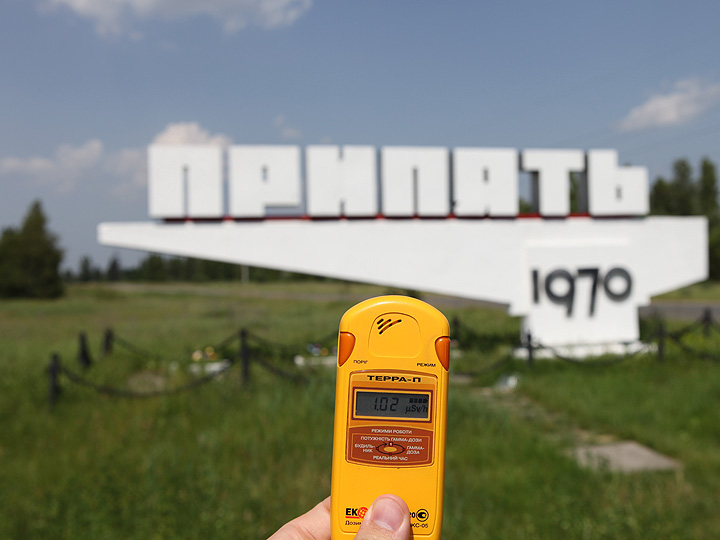
Pripyat, with about 45,000 residents, was evacuated on 27 April 1986, the day after the accident.[3] By 14 May about 116,000 people had been moved from the area within 30 km of the plant.[3][10] According to UNSCEAR, about 115,000 people were evacuated in 1986 and about 220,000 more were relocated in later years; the WHO-led Chernobyl Forum gave a total of more than 350,000 people relocated.[7][8][10] The area within 30 km, about 2,800 square kilometres, was closed to everyone but authorised personnel, and the exclusion zone was later extended to about 4,300 square kilometres.[3][7] The Soviet authorities also cut down and buried about one square mile (about 2.6 square kilometres) of pine forest near the plant.[7] In 2011 Chernobyl was officially declared a tourist attraction.[3]
The liquidators
The emergency and recovery workers who dealt with the consequences of the accident became known as "liquidators".[3][17] About 200,000 of these emergency and recovery workers took part in 1986 and 1987, and the number registered as liquidators later rose to about 600,000, most of whom received low doses.[3][7][17] UNSCEAR estimates the average effective dose (a measure of the overall health risk of a radiation dose) at about 120 millisieverts for 530,000 recovery workers, compared with about 30 millisieverts for 115,000 evacuees and about 9 millisieverts over two decades for residents of contaminated areas.[8]
Health effects
Thyroid cancer in children
The clearest health effect among the public was thyroid cancer in people who were children or adolescents in 1986.[8][9] Radioactive iodine-131 contaminated milk, and without timely countermeasures children who drank it received large doses to the thyroid gland.[9][7] UNSCEAR reported more than 6,000 thyroid cancers by 2005 among those exposed as children or adolescents, and concluded that a large fraction of them were most likely due to radioactive iodine; by 2005, 15 of these cases had proved fatal.[8][9][7] In 2018 UNSCEAR reviewed the later data: of about 20,000 thyroid cancers diagnosed between 1991 and 2015 among people exposed as children or adolescents, it estimated that about a quarter were probably caused by radiation, with a wide range of uncertainty, the rest reflecting factors such as ageing, greater awareness and better diagnosis.[3][9]
Other health effects
Apart from thyroid cancer, UNSCEAR has found no clear evidence of an increase in overall cancer incidence or mortality, or in non-cancer disease, that could be attributed to radiation among the general population.[8][9] Among recovery workers it has noted possible increases in leukaemia and cataracts among those with higher doses, and many survivors of acute radiation syndrome developed radiation-induced cataracts.[8][9] The US Nuclear Regulatory Commission (NRC) reports that a study of a group of emergency workers found a statistically significant increase in the risk of solid cancers.[7] In 2012 UNSCEAR concluded that increases in hereditary effects could not be attributed to the radiation, and advised against estimating deaths by multiplying very low doses by very large numbers of people.[9]
The 2005 Chernobyl Forum, a group of eight United Nations bodies (including the IAEA, the World Health Organization (WHO) and UNSCEAR) together with the governments of Belarus, Russia and Ukraine, described the effect on mental health as the largest public health problem the accident had caused, and found that poverty, lifestyle diseases and mental health problems posed a far greater threat to local communities than radiation did.[10][17] UNSCEAR also reports widespread psychological distress arising from fear of radiation rather than from the doses received.[8]
Estimates of eventual deaths
The number of deaths the accident will eventually cause cannot be counted directly, and estimates depend on which population is considered and on how the risk from low doses is treated.[9][3] The main published figures are:
Chernobyl Forum (WHO, IAEA and others), 2005: fewer than 50 deaths had been directly attributed to radiation by mid-2005, almost all among highly exposed rescue workers; up to about 4,000 people might eventually die of radiation exposure among the roughly 600,000 most exposed (emergency and recovery workers of 1986–1987, evacuees and residents of the most contaminated areas).[10] The Forum's health group stressed in 2006 that the actual number of deaths caused by the accident was unlikely ever to be known precisely.[3]
International Agency for Research on Cancer (IARC, part of WHO), 2006: a study led by Elisabeth Cardis covering 40 European countries, with about 570 million people, estimated that by 2065 the fallout might cause about 16,000 cases of thyroid cancer and 25,000 other cancers, and about 16,000 deaths from these cancers, with a 95% uncertainty range of 6,700 to 38,000 deaths.[11]
UNSCEAR, 2008 and later: UNSCEAR confirmed the 28 early deaths from acute radiation syndrome and 15 fatal thyroid cancers by 2005, found no evidence of a major public health impact from radiation beyond thyroid cancer, and, in 2012, recommended against projecting deaths by multiplying very small doses by large populations.[8][9][3]
The WNA notes that a 2000 publication of the UN Office for the Coordination of Humanitarian Affairs gave exaggerated death figures, which the UNSCEAR chairman and the Chernobyl Forum rejected.[3]
The abandoned town of Pripyat, home to about 49,000 people before it was evacuated on 27 April 1986.
Work on a concrete and steel shelter over the ruined reactor, known as the "sarcophagus", began in May 1986, and it was finished within about six to seven months of the accident.[3][7] It was built in haste and designed to last about 20 to 30 years.[3][12] In 1997 the Group of Seven (G7) countries, the European Commission and Ukraine agreed to fund a Shelter Implementation Plan to make the site safe, financed through the Chernobyl Shelter Fund, managed by the European Bank for Reconstruction and Development (EBRD).[7][13] Its first phase, from 1998 to 2002, covered engineering studies, emergency stabilisation of the sarcophagus and the choice of a new confinement design.[16]
The New Safe Confinement
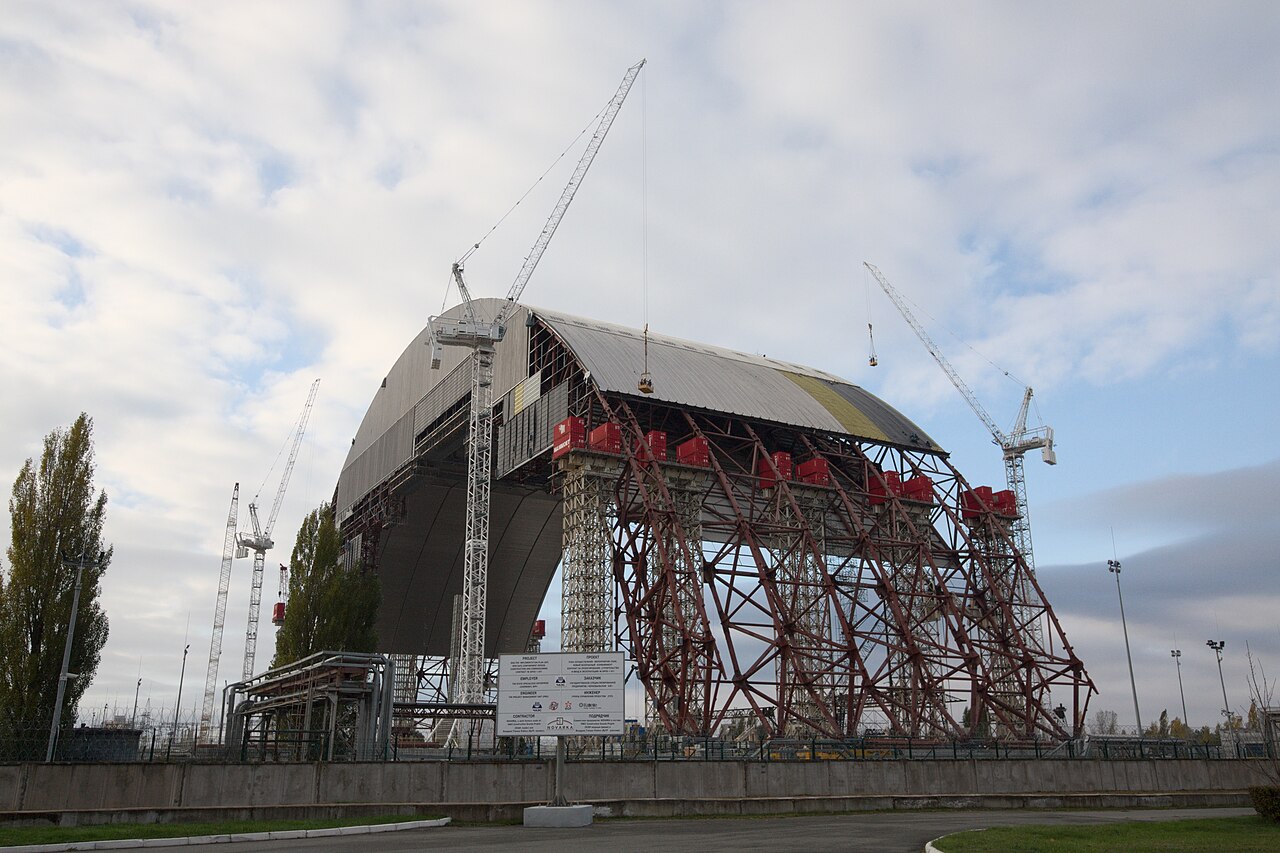
The New Safe Confinement is a steel arch built over reactor 4 and the old sarcophagus.[12][16] To limit the workers' exposure to radiation, it was built in two halves near the site, from 2010 to 2016, by Novarka, a consortium of the French companies Vinci and Bouygues.[13][15][16] In November 2016 the whole structure, weighing about 36,000 tonnes, was slid 327 metres into place over the reactor building.[3][12] It spans 257 metres, is 162 metres long and is about 108 to 110 metres high, and it is designed to last 100 years.[3][12][16] It carries a system of cranes for the future dismantling of the old shelter and the destroyed reactor and the removal of radioactive material.[13][14]
The final commissioning test, a 72-hour trial operation, was completed in April 2019, on the day before the 33rd anniversary of the accident.[14] The EBRD reports that the structure was handed over to the Ukrainian authorities in July 2019; the NRC dates the transfer to 2020, after finishing work and testing.[7][15] The arch cost €1.5 billion and the whole Shelter Implementation Plan €2.1 billion, financed by 45 donor countries and institutions; the EBRD contributed €715 million of its own resources to Chernobyl projects.[12][13]
The New Safe Confinement, the steel arch slid over reactor No. 4 and its original concrete shelter in November 2016.
The plant's other three reactors went back into service after the accident, but all were later closed: unit 2 after a turbine hall fire in 1991, unit 1 in November 1996 and unit 3, the last to operate, in December 2000.[3][7] Decommissioning (the dismantling and clean-up of a closed nuclear plant) involves removing the used fuel from the three reactors.[3][7] An Interim Spent Fuel Storage Facility was completed in 2017, and in 2021 the Ukrainian regulator authorised it to accept the plant's damaged fuel, which began arriving that year.[7] The WNA describes the planned schedule as placing units 1 to 3 in safe storage by 2028, removing further equipment by 2046 and demolishing the units by 2064.[3]
After the accident the RBMK reactors still running elsewhere were modified: extra fixed neutron absorbers were added to reduce the positive void coefficient, the minimum number of control rods kept in the core was raised, the rods were redesigned so that no water column remained beneath them, and a fast-acting emergency shutdown system was added.[4]
Since 2022
According to the WNA, Russian forces took control of the plant on 24 February 2022, and control passed back to Ukrainian staff on 31 March 2022.[3] On 14 February 2025 a drone struck the roof of the New Safe Confinement; the EBRD describes it as a Russian high-explosive drone and reports a breach of about 15 square metres in the inner and outer cladding, damage to about 200 square metres of panels and to the arch's crane and ventilation systems, and initial estimates that repairs could cost at least €500 million.[16] The WNA reports that an IAEA safety assessment in December 2025 found that the arch had lost its main confinement function because of the breach, although its load-bearing structure and monitoring systems were undamaged.[3] As of November 2026 the EBRD says the arch must be fully working again by 2030 and is coordinating donor funding for the repairs.[16]
Sources
International Atomic Energy Agency. "The 1986 Chornobyl nuclear power plant accident". IAEA. No date shown; accessed 25 November 2026. iaea.org/topics/chornobyl
International Nuclear Safety Advisory Group. "The Chernobyl Accident: Updating of INSAG-1" (INSAG-7), Safety Series No. 75-INSAG-7. International Atomic Energy Agency, Vienna, 1992. pub.iaea.org/MTCD/publications/PDF/Pub913e_web.pdf
OECD Nuclear Energy Agency. "Chernobyl: Assessment of Radiological and Health Impact – 2002 Update of Chernobyl: Ten Years On", Chapter I, "The site and accident sequence". OECD-NEA, 2002. oecd-nea.org/rp/chernobyl/c01.html
OECD Nuclear Energy Agency. "Chernobyl: Assessment of Radiological and Health Impact – 2002 Update of Chernobyl: Ten Years On", Chapter II (release, dispersion and deposition of radionuclides). OECD-NEA, 2002. oecd-nea.org/rp/chernobyl/c02.html
International Agency for Research on Cancer. "The Cancer Burden from Chernobyl in Europe" (briefing on E. Cardis et al., "Estimates of the cancer burden in Europe from radioactive fallout from the Chernobyl accident", International Journal of Cancer, published online 20 April 2006). IARC. No date shown; accessed 25 November 2026. iarc.who.int/wp-content/uploads/2018/07/IARCBriefingChernobyl.pdf
European Bank for Reconstruction and Development. "Chernobyl New Safe Confinement named one of the most influential projects of the last 50 years". EBRD, 2019 (no exact date shown; accessed 25 November 2026). ebrd.com/news/2019/chernobyl-new-safe-confinement-named-one-of-the-…
The Chernobyl Forum. "Chernobyl's Legacy: Health, Environmental and Socio-economic Impacts and Recommendations to the Governments of Belarus, the Russian Federation and Ukraine". Chernobyl Forum, 2005 (copy filed on the US NRC docket as exhibit NRC000074, 30 March 2012). nrc.gov/docs/ML1209/ML12090A865.pdf