Ronald Wilson Reagan (6 February 1911 – 5 June 2004) was an American film actor and Republican politician who was twice elected governor of California and served as the 40th president of the United States from 1981 to 1989.[1][4][7]
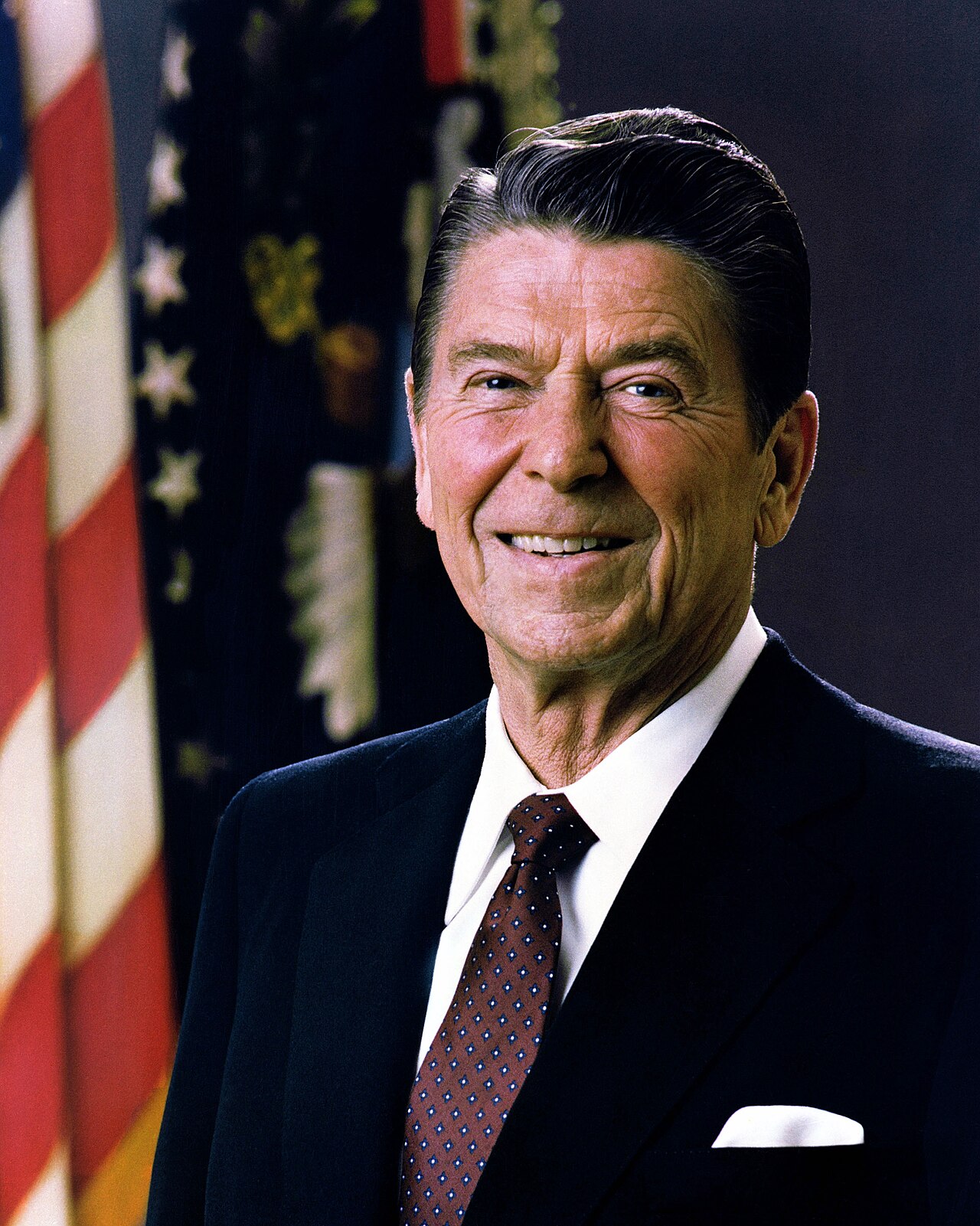
Reagan's official presidential portrait photograph, showing him in a dark suit in front of a flag.
Reagan was born in Tampico, Illinois, to Jack and Nelle Reagan, and had an older brother, Neil.[1] The family moved between several Illinois towns before settling in Dixon in 1920, the town Reagan regarded as home.[1][2] His father, a salesman, struggled with alcoholism.[1][2] Reagan finished Dixon High School in 1928 and went on to Eureka College in Eureka, Illinois, where he studied economics, acted and played football, graduating in 1932.[1][2]
Radio and film career
After college Reagan worked as a radio sports announcer, first at station WOC in Davenport, Iowa, and then at WHO in Des Moines, where much of his income came from broadcasting Chicago Cubs baseball and Big Ten football.[1] In 1937 a screen test in California led to a Warner Bros. contract paying $200 a week.[1] He appeared in more than 50 films between 1937 and 1957[1]; the Miller Center's summary counts 52[2] and a White House biography 53.[4] His breakthrough role was the football player George Gipp in Knute Rockne—All American (1940), which gave him the nickname "the Gipper", and he regarded Kings Row (1942) as his best dramatic work.[1][2]
During the Second World War he was commissioned as a second lieutenant, but poor eyesight kept him out of combat, and he spent most of the war in the Army Air Corps First Motion Picture Unit making training and morale films.[1] In 1954 General Electric hired him to host its television series General Electric Theater and to speak at its plants, work that helped him develop the political message he later used as a candidate; the arrangement ended in 1962.[1]
Reagan married the actress Jane Wyman in 1940; they had a daughter, Maureen, adopted a son, Michael, and divorced in 1948.[1] In 1952 he married Nancy Davis, with whom he had two children, Patricia and Ronald.[1]
Screen Actors Guild
Reagan joined the Screen Actors Guild, the actors' labor union, in 1937 and became a board member in 1941.[1] The guild's own history gives his first period as its president as 1947 to 1952, ending when Walter Pidgeon succeeded him,[3] while a Miller Center account dates it from 1947 to 1954.[1] He was elected president again in 1959.[1][3] According to the Miller Center, he also became a confidential FBI informant in 1953, reporting on suspected Communist activity in Hollywood.[1] A White House biography says his time leading the guild coincided with a shift in his political views from liberal to conservative.[4]
Entry into politics and governorship
Reagan had been a Democrat and an admirer of Franklin D. Roosevelt.[2] He campaigned for the Republican Richard Nixon in 1960 and formally changed his registration to Republican in 1962.[1][2] On 27 October 1964 he gave a nationally televised speech for the Republican presidential nominee Barry Goldwater, later known as "A Time for Choosing", which made him a prominent conservative figure.[1][2]
In 1966 he defeated the Democratic incumbent, Edmund G. "Pat" Brown, by nearly a million votes to become governor of California, and he was re-elected in 1970, serving eight years.[1][2] Facing a large state deficit, he balanced the budget with tax increases totalling a record $1 billion, passed with support from both parties.[1] He worked with Democratic legislative leaders on a 1971 welfare reform law and on property-tax relief, sent the National Guard to the University of California's Berkeley campus in 1969, and supported the creation of Redwood National Park.[1] He made a late bid for the Republican presidential nomination in 1968 and narrowly lost it to President Gerald Ford in 1976.[1][2]
1980 and 1984 elections
Reagan won the 1980 Republican nomination after a contest that included George H. W. Bush, who became his running mate.[2][4] He defeated President Jimmy Carter by 489 electoral votes to 49.[4][5] In 1984 he was re-elected over the Democrat Walter Mondale by 525 electoral votes to 13; Mondale carried only Minnesota and the District of Columbia.[6][7] The Miller Center describes the result as a 49-state landslide.[2]
Presidency (1981–1989)
Economic policy
Reagan took office on 20 January 1981.[7] He asked Congress to cut income tax rates by 30 percent over three years and obtained a 25 percent cut over three years, which he signed as the Economic Recovery Tax Act on 13 August 1981.[7][9] His administration supported the Federal Reserve chairman Paul Volcker's tight-money policy against inflation, which raised interest rates and contributed to a recession.[2][9] According to the Reagan Library, inflation fell from 13.5 percent in 1980 to 5.1 percent in 1982, while unemployment rose above 10 percent in October 1982.[7] He later signed tax increases in 1982 and 1984, a 1983 Social Security rescue plan drawn up by a bipartisan commission, and the Tax Reform Act of 22 October 1986, which lowered rates while closing many deductions.[7][9][4] In 1981 he fired nearly 12,000 striking air traffic controllers after they defied an order to return to work.[9]
Defense spending rose by 35 percent over his two terms, according to a White House biography.[4] Over his presidency the national debt grew from $914 billion to $2.6 trillion, and annual deficits were at least $153 billion each year from 1983 to 1989.[9] The economy shrank in 1982 and then expanded from 1983 onward.[2][9] Assessments differ: the Miller Center reports that some supporters credit the 1981 tax cuts for the expansion and others the 1982 tax increases and the Federal Reserve's later policy, while critics argued that the gains went mostly to wealthier households and that cuts to social programs harmed poor Americans.[9]
1981 assassination attempt
On 30 March 1981, 69 days into his presidency, Reagan was shot by John Hinckley Jr. as he left the Washington Hilton hotel after a speech to a building-trades union conference.[8][4] Six shots were fired; the sixth ricocheted off the presidential limousine and lodged in his left lung.[8] Press Secretary James Brady, police officer Thomas Delahanty and Secret Service agent Timothy McCarthy were also wounded.[8] Surgeons at George Washington University Hospital removed the bullet, and he recovered quickly.[8][4]
Cold War policy and summits with Gorbachev
In his first term Reagan expanded U.S. nuclear and conventional forces.[11] On 8 March 1983 he called the Soviet Union an "evil empire", and in March 1983 he announced the Strategic Defense Initiative, a proposed system to defend against missile attack that critics nicknamed "Star Wars".[10][11] Relations reached a low point in the autumn of 1983, when the Soviet Union shot down Korean Air Lines Flight 007 and Soviet negotiators walked out of arms talks in Geneva.[11] The administration also gave support to anti-Communist forces abroad, a policy later called the "Reagan Doctrine".[10][4] Other major events included the bombing of the U.S. Marine barracks in Beirut on 23 October 1983, which killed 241 U.S. servicemen; the U.S. intervention in Grenada that same month; and air strikes against Libya in 1986 after a bombing in West Berlin was linked to Libya.[10][4]
Mikhail Gorbachev became the Soviet leader in March 1985.[7][11] Reagan met him at summits in Geneva (November 1985), Reykjavik (October 1986), Washington (December 1987) and Moscow (May–June 1988).[7][10] At Reykjavik the two leaders discussed eliminating nuclear weapons, but the talks broke down over the Strategic Defense Initiative.[10] On 12 June 1987, speaking at the Brandenburg Gate in West Berlin, Reagan called on Gorbachev to open the gate, saying "Mr. Gorbachev, tear down this wall!"[12] In Moscow in 1988 Reagan said his "evil empire" description belonged to another era.[11]
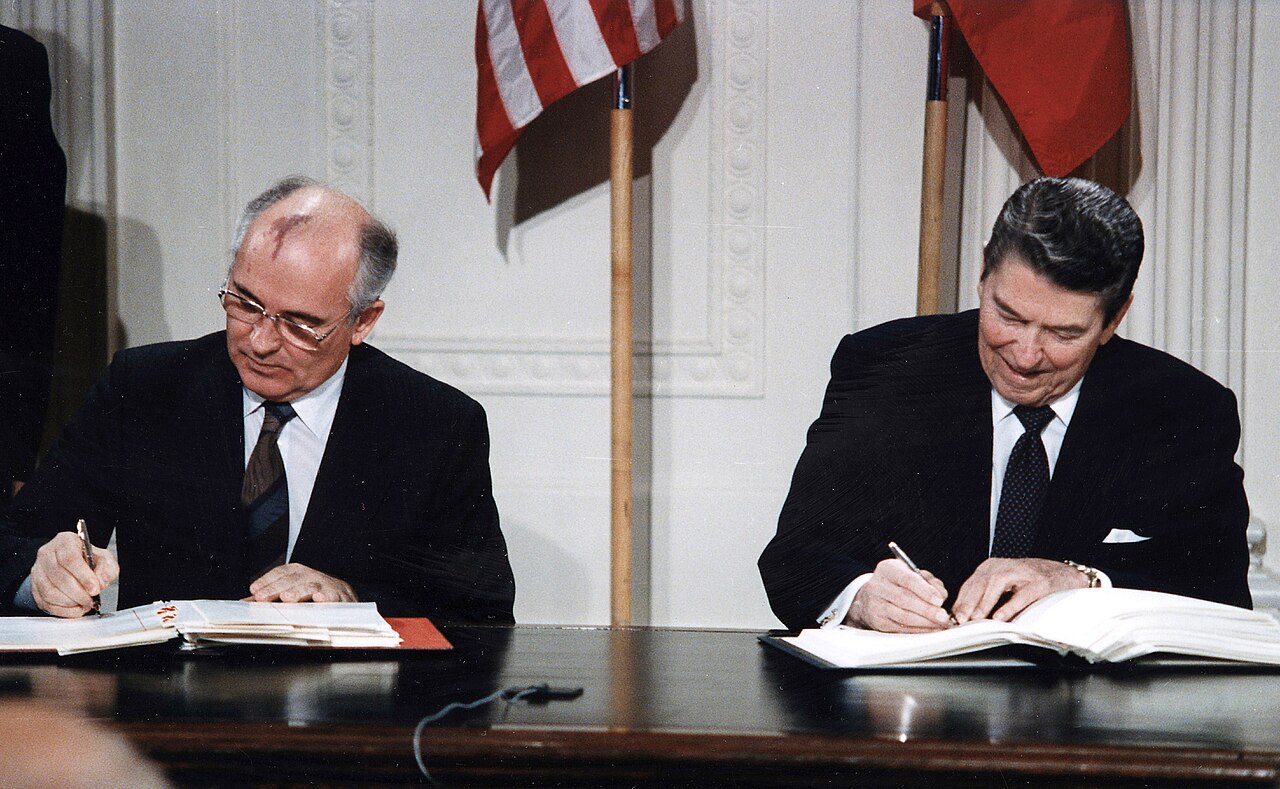
Reagan and Gorbachev seated at a table in the White House East Room signing the INF Treaty in December 1987.
Reagan and Gorbachev signed the Intermediate-Range Nuclear Forces (INF) Treaty in Washington on 8 December 1987.[7] It eliminated an entire class of nuclear missiles.[7][11] According to the Miller Center, it called for destroying more than 2,600 Soviet and American nuclear weapons.[10] The Miller Center describes it as the first Cold War agreement to reduce nuclear arsenals rather than only limit their growth.[2][10] The U.S. Senate approved it on 27 May 1988, and the two sides exchanged ratification documents at the Moscow summit on 1 June 1988.[7] How much credit Reagan deserves for the end of the Cold War is debated; the historian and Reagan biographer Lou Cannon, writing for the Miller Center, gives Reagan and Gorbachev the principal credit while also crediting Secretary of State George Shultz and Soviet foreign minister Eduard Shevardnadze.[10]
Iran-Contra affair
In late 1986 it became public that National Security Council staff had arranged secret arms sales to Iran, then at war with Iraq, in an attempt to free American hostages held in Lebanon, and that some of the proceeds had been diverted to the Contras, rebels fighting Nicaragua's leftist government.[2][7] Reagan appointed a review board, known as the Tower Board, and in a televised address on 4 March 1987 said he took "full responsibility" for his own actions and those of his administration.[10] The independent counsel Lawrence Walsh, in his 1993 final report, found "no credible evidence" that Reagan had broken any criminal law and could not prove that he had authorized or known of the diversion.[13] The same report found that Reagan had authorized arms transfers to Iran in 1985 despite warnings from Secretaries Caspar Weinberger and George Shultz that they might be illegal, and that he had encouraged support for the Contras while the Boland Amendment, a congressional ban on such military aid, was in force.[13] Several officials were convicted or pleaded guilty; the convictions of Oliver North and John Poindexter were later overturned, and President George H. W. Bush pardoned Weinberger and others in December 1992.[13]
Later life and death
Reagan gave his farewell address on 11 January 1989 and returned to California after George H. W. Bush was inaugurated on 20 January 1989.[7] The Miller Center reports that polls showed him leaving office with the highest approval rating of any departing president since Franklin D. Roosevelt.[2] In retirement he lived in Bel Air, Los Angeles, worked on his memoirs and oversaw the building of the Ronald Reagan Presidential Library in Simi Valley, California.[15]
On 5 November 1994 Reagan released a personal letter to the American people saying he had been told he had Alzheimer's disease.[14] He wrote that he and Nancy Reagan had chosen to make the diagnosis public to promote awareness of the disease, as their earlier openness about their cancer treatments had done, and he described the years ahead as a journey "into the sunset of my life".[14] He then withdrew from public life.[2] Reagan died in Bel-Air, California, on 5 June 2004.[4] He received a state funeral and was buried on the grounds of the Reagan Presidential Library.[15]
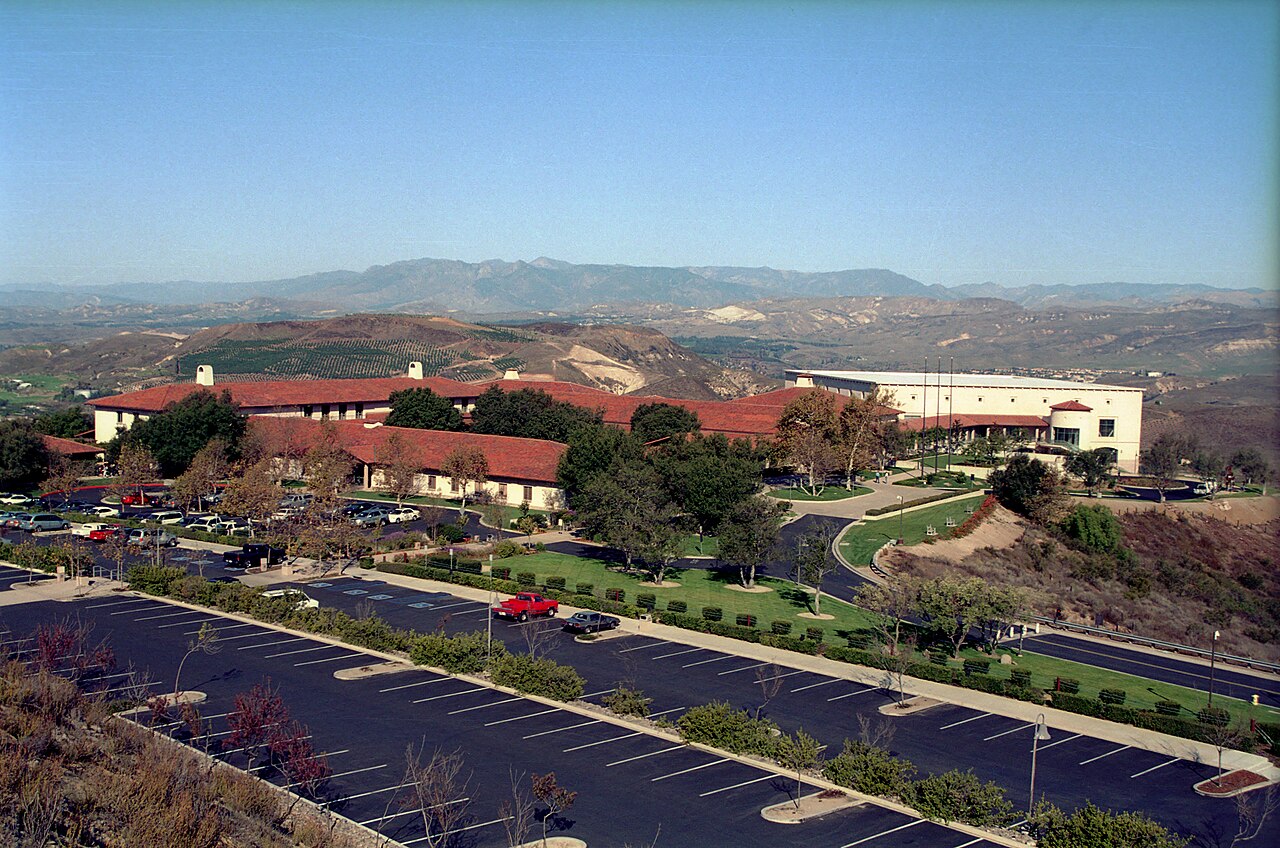
The Ronald Reagan Presidential Library in Simi Valley, California, where Reagan is buried.
Miller Center of Public Affairs, University of Virginia. "Ronald Reagan: Life in Brief." No date shown; accessed 25 November 2026. millercenter.org/node/391
U.S. National Archives and Records Administration. "1980 Electoral College Results." No date shown; accessed 25 November 2026. archives.gov/electoral-college/1980
U.S. National Archives and Records Administration. "1984 Electoral College Results." No date shown; accessed 25 November 2026. archives.gov/electoral-college/1984
Office of the Historian, U.S. Department of State. "U.S.-Soviet Relations, 1981–1991." Milestones in the History of U.S. Foreign Relations. No date shown; accessed 25 November 2026. history.state.gov/milestones/1981-1988/u.s.-soviet-relations
Lawrence E. Walsh. "Executive Summary." Final Report of the Independent Counsel for Iran/Contra Matters, Volume I. 4 August 1993 (copy hosted by the Federation of American Scientists); accessed 25 November 2026. irp.fas.org/offdocs/walsh/execsum.htm
Miller Center of Public Affairs, University of Virginia. "Ronald Reagan: Life After the Presidency." No date shown; accessed 25 November 2026. millercenter.org/node/396