The Soviet Union, officially the Union of Soviet Socialist Republics (USSR), was a federal state of Soviet republics, led by the Communist Party, that was formed in December 1922 and dissolved in December 1991.[1][2][3]
Origins, 1917 to 1922
Unrest in Petrograd in February 1917 led Emperor Nicholas II to abdicate, and when his brother refused the throne, imperial rule in Russia ended.[4] A Provisional Government, which chiefly represented the propertied classes, took office, while the Petrograd Soviet, made up of socialist deputies elected in factories and army regiments, coordinated other soviets across Russia.[4] A soviet is a council: the first appeared among striking workers in St Petersburg in 1905, and in 1917 soviets sprang up in cities and towns across the Russian Empire.[5]
In October 1917 Vladimir Lenin and the Bolshevik party took power by what the Library of Congress describes as a coup d'état.[6][4] The new government created a secret police, the Cheka, and in March 1918 made a separate peace with Germany at Brest-Litovsk, leaving the First World War.[4][7] Anticommunist forces, called the Whites, fought the new regime from April 1918, but by the end of 1920 the communists had won the Civil War.[4]
The USSR was formed in December 1922 as a compromise between communist centralism and demands for autonomy in the non-Russian borderlands.[8] According to the Law Library of Congress, a congress adopted the union treaty on 30 December 1922 with four members: Russia, Ukraine, Belarus and the Transcaucasian federation.[3] The treaty created a federal judiciary and a single Soviet citizenship; it was adopted only as a basic concept and never formally passed in final form, yet it stayed in force until December 1991.[3]
Structure
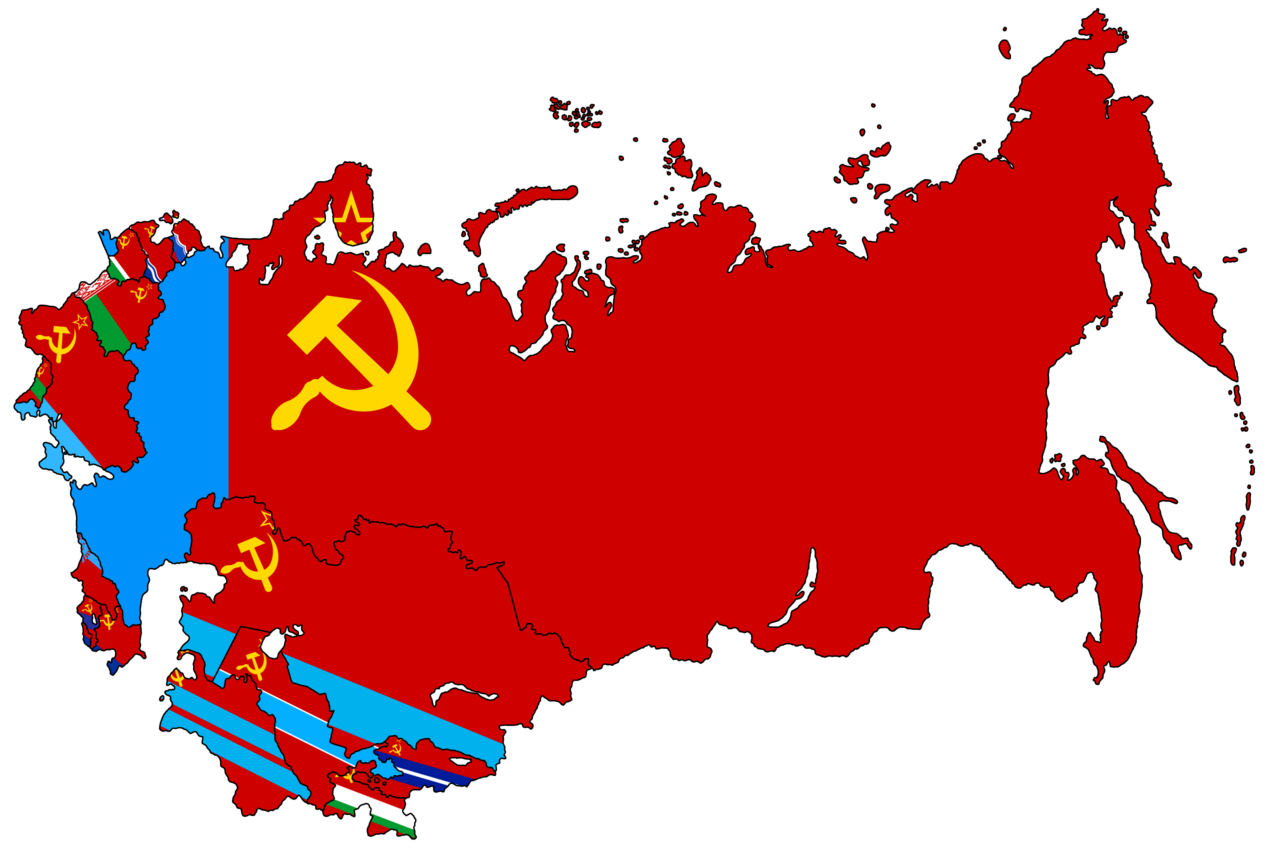
A map of the Soviet Union divided into its fifteen union republics.
The last Soviet constitution, adopted in 1977, called the USSR an "integral, federal, multinational state" formed by the voluntary association of equal Soviet Socialist Republics.[1] It listed fifteen union republics, from the Russian Soviet Federative Socialist Republic to the Estonian Soviet Socialist Republic, and stated that each kept the right to secede.[1] Under the 1936 constitution the national legislature, the Supreme Soviet, had two chambers, the Soviet of the Union and the Soviet of Nationalities, but the Communist Party controlled who could stand as a candidate.[5]
The 1977 constitution called the Communist Party of the Soviet Union "the leading and guiding force of the Soviet society and the nucleus of its political system".[2] Within the party, the Politburo (Political Bureau) became the country's top policy-making body, and the post of general secretary, given to Joseph Stalin in April 1922, became the base of his power.[8]
Lenin and the rise of Stalin
After the Civil War, at the Tenth Party Congress in March 1921, the party turned to the New Economic Policy (NEP), under which markets and money regained their importance.[8] Lenin was temporarily incapacitated by a stroke in May 1922 and died in January 1924.[8] After sidelining his opponents, Stalin forced his rival Leon Trotsky into exile in 1928.[8]
The Stalin era
In 1928 Stalin began the First Five-Year Plan, a "revolution from above" that pushed rapid growth in heavy industry and caused shortages of consumer goods.[9] Peasants were forced into collective farms (kolkhozy) and state farms (sovkhozy), and Stalin sought to eliminate the kulaks, the wealthiest peasants, who were generally only slightly better off than others.[9] The Library of Congress states that about one million kulak households, some five million people, were deported.[6]
A famine struck Ukraine, the northern Caucasus and the lower Volga region in 1932 and 1933; the Library of Congress attributes it to forced collectivization and notes that Stalin raised Ukraine's grain procurement quota by 44 percent in 1932.[6] Estimates of the dead differ. The Library of Congress exhibit gives an estimate of six to seven million deaths in Ukraine.[6] A research group made up of the demographer Oleh Wolowyna of the University of North Carolina at Chapel Hill and researchers at the Institute of Demography and Social Sciences of the National Academy of Sciences of Ukraine estimated famine losses for 1932 to 1934 at about 3.9 million in Ukraine, 3.26 million in Russia, 1.26 million in Kazakhstan and 8.73 million for the whole Soviet Union.[10] Wolowyna reported in 2018 that nearly all scholarly estimates of victims in Ukraine fall between 2.6 and 5.0 million.[10]
The murder of the Leningrad party leader Sergei Kirov on 1 December 1934 set off a wave of purges.[6][9] Old Bolsheviks including Grigory Zinoviev, Lev Kamenev and Nikolai Bukharin were executed after show trials in 1936 to 1938, and about half the army's officer corps was shot or imprisoned.[9] Figures for the Great Terror of 1937 and 1938 also differ: the historian R. W. Davies wrote in 1997 that the official archival figure was 681,692 executions, while the historian Robert Conquest had earlier estimated about one million and by then was advocating 1.5 million.[11] Davies also cited an archival count of 1,668,000 people held in prisons and camps on 1 January 1939, against Conquest's earlier estimate of nine million, which Conquest later accepted was too high.[11] The Library of Congress dates the Soviet system of forced-labour camps, the Gulag, to 1919, when it was first set up under the Cheka.[6]
Germany invaded the Soviet Union on 22 June 1941, and Leningrad was besieged; the Soviet victory at Stalingrad, where German forces surrendered in February 1943, proved decisive, and Soviet troops took Berlin in 1945.[12]
Mark Harrison of the University of Warwick notes that Stalin announced seven million deaths and Nikita Khrushchev later gave 20 million, and the Library of Congress country study of 1996 also used an estimate of 20 million.[13][12] A demographic audit by Andreev, Darskii and Khar'kova, commissioned in the Gorbachev era, put the toll at 26 to 27 million, and Harrison wrote in 2017 that this figure had been broadly accepted for about 25 years.[13] A 1993 study by Krivosheev and colleagues counted about 8.7 million military dead.[13] A 2017 estimate of 42 million by the Russian historian Igor Ivlev was judged by Harrison to be without foundation.[13]
Cold War
In the Library of Congress's words, with Stalin's takeover of Eastern Europe "the wartime alliance ended, and the Cold War began".[14] Stalin sought a buffer zone of subservient East European states, and the Soviet blockade of West Berlin from June 1948 to May 1949 helped prompt Western countries to form NATO in 1949.[15] The US State Department's Office of the Historian dates the US strategy of "containment" against the Soviet Union from 1947 to 1989.[16]
Stalin died in March 1953.[15] Nikita Khrushchev, who became first secretary of the party, revealed in a 1956 speech that Stalin had arbitrarily killed thousands of party members and military leaders, and releases of political prisoners increased.[17] In October 1962 President John F. Kennedy announced the discovery of Soviet missile installations in Cuba, and Khrushchev agreed to withdraw the missiles after the United States blockaded the island.[14][17] The party Presidium removed Khrushchev in October 1964.[17]
Under Leonid Brezhnev, Soviet and other Warsaw Pact troops entered Czechoslovakia in 1968, a period of détente, or relaxation of tensions, followed with the United States, and the two powers began the Strategic Arms Limitation Talks (SALT).[18] In December 1979 Brezhnev sent Soviet forces into Afghanistan to support its communist government; he died in November 1982.[18]
Gorbachev's reforms
In early 1985 the Politburo unanimously elected its youngest member, Mikhail Gorbachev, as general secretary, at a session held less than 24 hours after the death of Konstantin Chernenko.[19][14] Gorbachev launched perestroika ("restructuring") and glasnost ("openness").[20]
In March 1989 voters elected a new Congress of People's Deputies, though 87 percent of its members still belonged to the Communist Party.[21] In February 1990 Gorbachev obtained the repeal of Article 6, which had given the party supremacy over all institutions, and in March 1990 the Congress elected him to a new state presidency.[21][22] National movements grew: Lithuania declared independence in March 1990, and in January 1991 Soviet tanks intervened in Lithuania and Latvia.[23][22] A union-wide referendum in March 1991 approved preserving the union, and on 12 June 1991 Boris Yeltsin was elected president of the Russian Republic with 57 percent of the vote.[23]
Dissolution, 1991
In August 1991 hard-line communists calling themselves the State Emergency Committee tried to seize power; the coup collapsed on 21 August, after Yeltsin led resistance from the Russian parliament building.[22][24] Gorbachev then resigned as head of the party, Ukraine and Belarus declared independence, and in September the Soviet Union and the United States recognized the independence of the Baltic republics.[22][24]
In early December 1991 Yeltsin and the leaders of Ukraine and Belarus formed the Commonwealth of Independent States, which the Office of the Historian says effectively declared the end of the Soviet Union; a further signing took place in Alma-Ata on 21 December.[22][24] On 25 December 1991 Gorbachev resigned as Soviet president, and that evening the Soviet flag over the Kremlin was replaced by the Russian tricolour.[22] The Soviet Union ceased to exist that day.[24] According to the Law Library of Congress, the republics denounced the 1922 treaty and based the dissolution on its article 26, which allowed members to leave the union.[3]
Sources
Supreme Soviet of the USSR (Novosti Press Agency translation, 1985), "Constitution (Fundamental Law) of the Union of Soviet Socialist Republics, 1977", Articles 70 to 88. Hosted by Robert Beard, Bucknell University, 1996. Accessed 25 November 2026. departments.bucknell.edu/russian/const/77cons03.html
Supreme Soviet of the USSR (Novosti Press Agency translation, 1985), "Constitution (Fundamental Law) of the Union of Soviet Socialist Republics, 1977", Part I. Hosted by Robert Beard, Bucknell University, 1996. Accessed 25 November 2026. departments.bucknell.edu/russian/const/77cons01.html
Glenn E. Curtis (ed.), "Revolutions and Civil War", Russia: A Country Study, Federal Research Division, Library of Congress, 1996 (online copy at countrystudies.us). Accessed 25 November 2026. countrystudies.us/russia/8.htm
Library of Congress, "Internal Workings of the Soviet System", Revelations from the Russian Archives (exhibition). No date shown; accessed 25 November 2026. loc.gov/exhibits/archives/intn.html
Office of the Historian, US Department of State, "Recognition of the Soviet Union, 1933", Milestones in the History of U.S. Foreign Relations (retired series). No date shown; accessed 25 November 2026. history.state.gov/milestones/1921-1936/ussr
Glenn E. Curtis (ed.), "The Era of the New Economic Policy", Russia: A Country Study, Federal Research Division, Library of Congress, 1996 (online copy at countrystudies.us). Accessed 25 November 2026. countrystudies.us/russia/9.htm
Glenn E. Curtis (ed.), "Transformation and Terror", Russia: A Country Study, Federal Research Division, Library of Congress, 1996 (online copy at countrystudies.us). Accessed 25 November 2026. countrystudies.us/russia/10.htm
Glenn E. Curtis (ed.), "The War Years", Russia: A Country Study, Federal Research Division, Library of Congress, 1996 (online copy at countrystudies.us). Accessed 25 November 2026. countrystudies.us/russia/11.htm
Library of Congress, "The Soviet Union and the United States", Revelations from the Russian Archives (exhibition). No date shown; accessed 25 November 2026. loc.gov/exhibits/archives/sovi.html
Glenn E. Curtis (ed.), "Reconstruction and Cold War", Russia: A Country Study, Federal Research Division, Library of Congress, 1996 (online copy at countrystudies.us). Accessed 25 November 2026. countrystudies.us/russia/12.htm
Office of the Historian, US Department of State, "Kennan and Containment, 1947", Milestones in the History of U.S. Foreign Relations (retired series). No date shown; accessed 25 November 2026. history.state.gov/milestones/1945-1952/kennan
Glenn E. Curtis (ed.), "The Khrushchev Era", Russia: A Country Study, Federal Research Division, Library of Congress, 1996 (online copy at countrystudies.us). Accessed 25 November 2026. countrystudies.us/russia/13.htm
Glenn E. Curtis (ed.), "The Brezhnev Era", Russia: A Country Study, Federal Research Division, Library of Congress, 1996 (online copy at countrystudies.us). Accessed 25 November 2026. countrystudies.us/russia/14.htm
Glenn E. Curtis (ed.), "Gorbachev's Reform Dilemma", Russia: A Country Study, Federal Research Division, Library of Congress, 1996 (online copy at countrystudies.us). Accessed 25 November 2026. countrystudies.us/russia/18.htm
Office of the Historian, US Department of State, "The Collapse of the Soviet Union", Milestones in the History of U.S. Foreign Relations (retired series). No date shown; accessed 25 November 2026. history.state.gov/milestones/1989-1992/collapse-soviet-union
Glenn E. Curtis (ed.), "Nationality Ferment", Russia: A Country Study, Federal Research Division, Library of Congress, 1996 (online copy at countrystudies.us). Accessed 25 November 2026. countrystudies.us/russia/19.htm
Glenn E. Curtis (ed.), "The August Coup and Its Aftermath", Russia: A Country Study, Federal Research Division, Library of Congress, 1996 (online copy at countrystudies.us). Accessed 25 November 2026. countrystudies.us/russia/20.htm