J. Robert Oppenheimer (1904–1967) was an American theoretical physicist who directed the Los Alamos laboratory, the central weapons laboratory of the Manhattan Project, from 1943 to 1945.[2][8]
Early life and education
Oppenheimer was born in New York City on 22 April 1904.[2][8] His family belonged to the Ethical Culture Society, a movement founded by Felix Adler that stressed social justice, civic responsibility and secular humanism, and in September 1911 he entered the Ethical Culture School.[8] By the age of ten he was studying minerals, physics and chemistry.[8]
After graduating from high school in 1921 he fell seriously ill with dysentery, which delayed his entry to Harvard.[8] In the summer of 1922 he recovered at a ranch northeast of Santa Fe, New Mexico, where long horseback trips gave him a lasting attachment to the desert high country.[8] He entered Harvard in September 1922, majored in chemistry, and finished his degree in three years, graduating in 1925.[2][8]
In 1925 he began graduate work in physics at the Cavendish Laboratory of the University of Cambridge under J. J. Thomson, and there he concluded that his talent lay in theoretical rather than experimental physics.[8] In 1926 he moved to the University of Göttingen in Germany to work with Max Born, director of its Institute of Theoretical Physics, at the time when quantum mechanics (the physics of matter at the scale of atoms and electrons) was being developed.[8] According to the university's archive, he was at first admitted in November 1926 only as a guest auditor, because the curriculum vitae he submitted was too sketchy for doctoral admission; once he supplied a fuller one, he was allowed to proceed.[3] His dissertation was a paper on the quantum theory of continuous spectra, which Born graded "excellent" while noting that its only flaw was that it was hard to read.[3] He passed his oral examination on 11 May 1927 and received his doctorate about two weeks later.[3] From 1928 to 1929 he held a fellowship of the International Education Board at Leiden University and the University of Zürich.[2]
Physics career
One result of his student years is the Born–Oppenheimer approximation, set out in a 1927 paper he wrote with Born, "On the Quantum Theory of Molecules."[10] The approximation is a way of simplifying the very complex problem of describing molecules at the level of atoms, and it remains part of chemistry research and teaching.[10] Although it carries both names, a Trinity University (Texas) article, citing one of its chemistry professors, states that most historians regard the theory as mainly Oppenheimer's work.[10]
From 1929 to 1947 he held posts as assistant professor, associate professor and professor of physics at both the University of California, Berkeley, and the California Institute of Technology (Caltech).[2][7] At Berkeley he became a close friend of Ernest Lawrence, inventor of the cyclotron, a type of particle accelerator.[8] He married Katherine ("Kitty") Harrison, a botanist, in 1940; they had two children.[2][8]
In 1939 he published two papers on the fate of collapsing stars.[9] With George Volkoff of Berkeley he combined general relativity, Einstein's theory of gravity, with a quantum description of matter made of neutrons and found no stable solution for a neutron core heavier than about 70 percent of the Sun's mass, implying that heavier cores must keep collapsing.[9] Later that year, with his graduate student Hartland Snyder, he described how a collapsing star could become so dense that light could no longer escape it, an object that John Wheeler would later call a black hole.[9] The Oppenheimer–Snyder paper attracted little attention until the 1960s.[9]
Manhattan Project and Los Alamos
Before the Manhattan Project, Oppenheimer worked on fast-neutron physics, including estimates of how much material a bomb would need and how efficient it might be.[8] In January 1942 he organised a fast-neutron theory programme at Berkeley, and from July to September 1942 he led a Berkeley study group on bomb design.[8] On 15 October 1942 General Leslie R. Groves asked him to head "Project Y," a planned central weapons laboratory, and Vannevar Bush approved the appointment four days later.[8] According to the Atomic Heritage Foundation, Groves chose him for his scientific ability despite his limited experience as a manager and his past associations with people and causes linked to the Communist Party.[8] On 16 November 1942 Groves and Oppenheimer selected a mesa at Los Alamos, New Mexico, as the site.[8] He directed the Los Alamos laboratory from 1943 to 1945.[2][7]
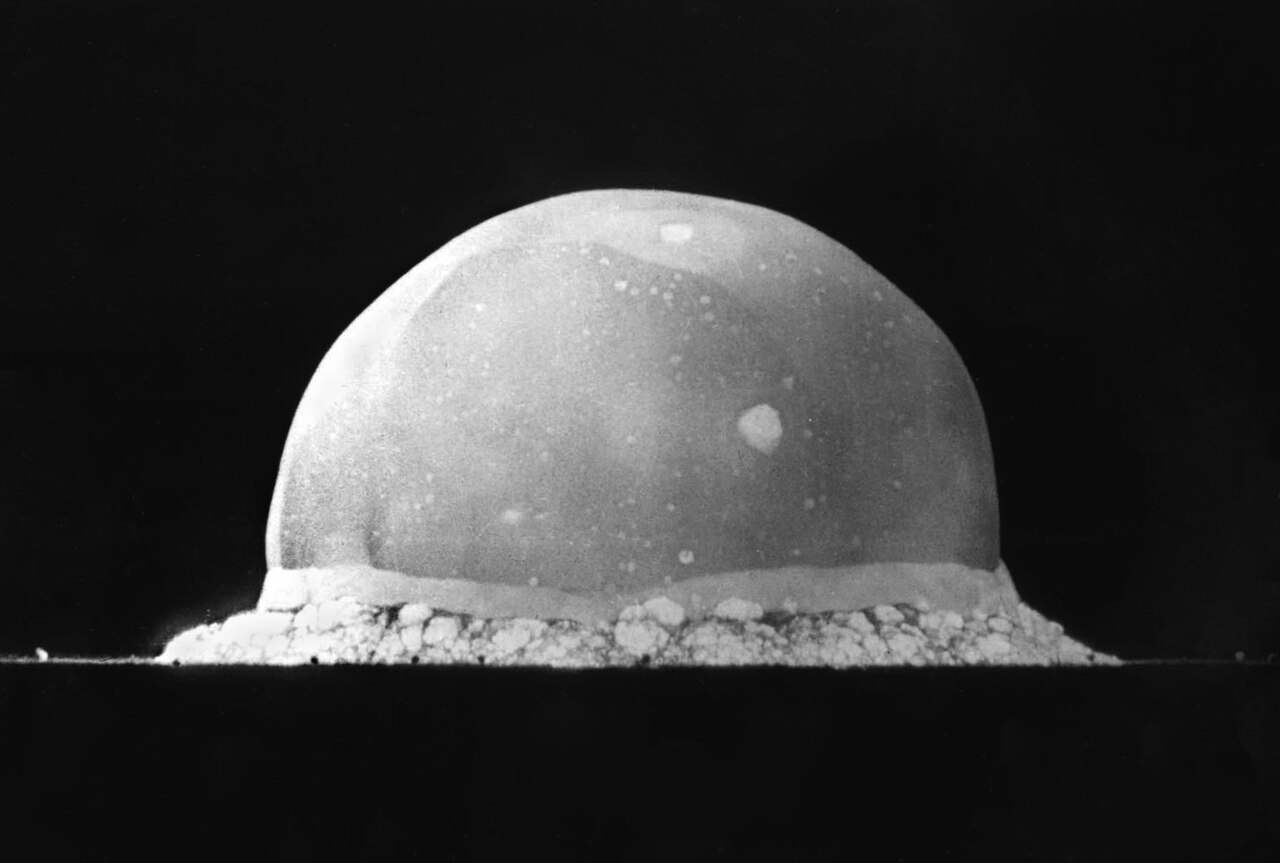
In February 1944 Oppenheimer, as laboratory director, recommended a full-scale test of the bomb at a remote location.[5] The test, code-named Trinity, took place at 5:30 a.m. on 16 July 1945 on the Jornada del Muerto, in the northwest corner of the Alamogordo Bombing Range about 100 miles south of Albuquerque.[5] The device, a plutonium bomb nicknamed the "Gadget," was raised to the top of a 100-foot tower; the physicist Kenneth Bainbridge directed preparations for the test.[5] Oppenheimer watched the explosion, and the Atomic Heritage Foundation records that its success was a great relief to him.[8]
The fireball of the Trinity test, the first explosion of a nuclear device, in the New Mexico desert on 16 July 1945.
Via Wikimedia Commons: Trinity Test Fireball 16ms by Berlyn Brixner / Los Alamos National Laboratory, public domain.
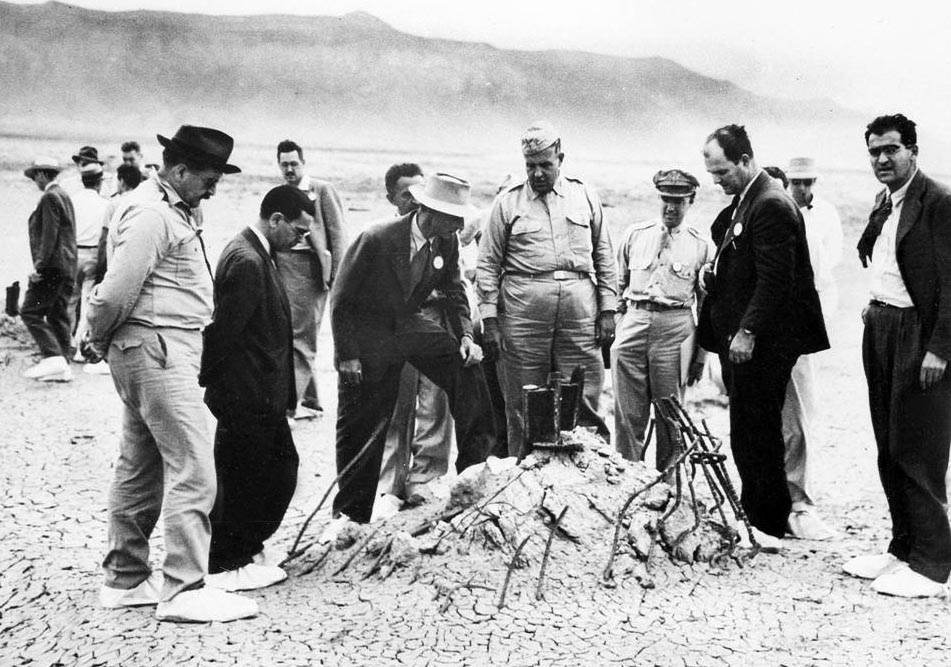
On 6 August 1945 a uranium bomb known as Little Boy was dropped on Hiroshima, Japan, and on 9 August a plutonium bomb known as Fat Man was dropped on Nagasaki.[6] The National Park Service states that about 80,000 people in Hiroshima were killed or gravely injured at once, with more than 100,000 further deaths from the bomb's effects in the following months, and that between 40,000 and 75,000 people died instantly in Nagasaki.[6] On 16 October 1945 Oppenheimer resigned as director of Los Alamos to take up a post at Caltech.[8] He is often called the "father of the atomic bomb."[8]
Oppenheimer and General Leslie Groves at the remains of the Trinity test tower in September 1945.
After the war Oppenheimer advised the new U.S. Atomic Energy Commission (AEC) and argued for international control of atomic weapons.[8] He chaired the AEC's General Advisory Committee (GAC) until 1952; the Library of Congress dates the chairmanship from 1946 and the Institute for Advanced Study from 1947.[2][7] In 1947 he also became director of the Institute for Advanced Study in Princeton, New Jersey, a post he held until 1966, the longest tenure of any of its directors.[7]
In late 1949 the GAC considered whether the United States should make an all-out effort to build the "Super," the thermonuclear or hydrogen bomb.[4] In a letter dated 30 October 1949, Oppenheimer as chairman sent the committee's report to AEC Chairman David Lilienthal; the report recommended against giving the hydrogen bomb high priority.[4] Two statements by committee members were attached.[4] One, signed by James Conant, Hartley Rowe, Cyril Smith, Lee DuBridge, Oliver Buckley and Oppenheimer, warned that the weapon could become "a weapon of genocide" and stated "We believe a super bomb should never be produced."[4] The other, signed by Enrico Fermi and Isidor Rabi, urged the President to declare that developing such a weapon was wrong on ethical grounds and to invite other nations to pledge not to build one.[4] Glenn Seaborg, a member of the committee, did not attend because he was in Europe.[4]
The 1954 security hearing
In December 1953 Oppenheimer was told that his access to restricted (classified atomic) information had been suspended, and he asked for a hearing.[1] The hearing before an AEC Personnel Security Board chaired by Gordon Gray began on 12 April 1954.[1] The physicist Edward Teller testified against him, and the Atomic Heritage Foundation notes that many scientists condemned Teller for doing so.[8] The hearing took place during the anti-communist period sometimes called the Second Red Scare, and the Atomic Heritage Foundation notes that his past Communist sympathies were raised again.[8]
On 27 May 1954 the board voted 2–1 against restoring his clearance.[1] It found "no evidence of disloyalty" but based its recommendation on his past associations and on his opposition to the hydrogen bomb, which it said might have slowed that programme.[1] The AEC's general manager then recommended the same outcome on different grounds, finding "no sinister motives" in Oppenheimer's views on the hydrogen bomb and focusing instead on whether he had been candid about his associations.[1] On 29 June 1954, two days before his consulting contract with the commission was due to expire, the AEC upheld the board's recommendation by a 4–1 vote, with Commissioner Henry D. Smyth dissenting.[1] The commission did not accuse him of revealing or mishandling secrets or question his loyalty; it based its ruling on what it called "fundamental defects" in his character.[1] The Atomic Heritage Foundation states that the loss of his clearance stripped him of political influence.[8]
The case was later re-examined; the 2022 order cites a 1959 internal AEC review, a former AEC lawyer's reflections in 1977 and a 1989 book by historians as identifying irregularities.[1] In 2022 the Department of Energy stated that historical evidence suggested the review had "less to do with a bona fide concern for the security of restricted data" than with a wish by the AEC's political leadership to discredit Oppenheimer in public debates over nuclear weapons policy.[1]
Later life and death
Oppenheimer remained director of the Institute for Advanced Study until 1966 and then served on the faculty of its School of Natural Sciences from July 1966 until his death.[7] He published the books Science and the Common Understanding (1954) and The Open Mind (1955).[2] On 2 December 1963 he received the Enrico Fermi Award.[2][8] He died of throat cancer in Princeton, New Jersey, on 18 February 1967.[2][8] His widow gave the bulk of his papers to the Library of Congress in 1967.[2]
The 2022 order
On 16 December 2022 Secretary of Energy Jennifer Granholm signed an order vacating (formally setting aside) the AEC's 1954 decision.[1] The review had been requested by 43 U.S. senators, current and former directors of Idaho National Laboratory and living directors of Los Alamos National Laboratory.[1] The order found that the AEC had failed to follow its own rules: the attorneys presenting the case against him worked with the board for a week before the hearing without Oppenheimer or his lawyers present, and his lawyers were not told of the general manager's findings until after the commission had decided, so they could not answer them.[1] The department stated that it would "not reconsider the substantive merits" of the case.[1]
J. Robert Oppenheimer to David E. Lilienthal, 30 October 1949, with attachments (Document 211). Foreign Relations of the United States, 1949, Volume I. Office of the Historian, U.S. Department of State. No date shown for the web page; accessed 25 November 2026. history.state.gov/historicaldocuments/frus1949v01/d211
David Lindley. "Landmarks: Forgotten Black Hole Birth." Physical Review Focus 13, 23. American Physical Society. No date shown; accessed 25 November 2026. physics.aps.org/story/v13/st23