Mary, Queen of Scots (1542–1587), also called Mary Stuart, was queen of Scotland from infancy until she was forced to abdicate in 1567, and was executed in England in 1587 after nearly 19 years as a prisoner.[1][2]
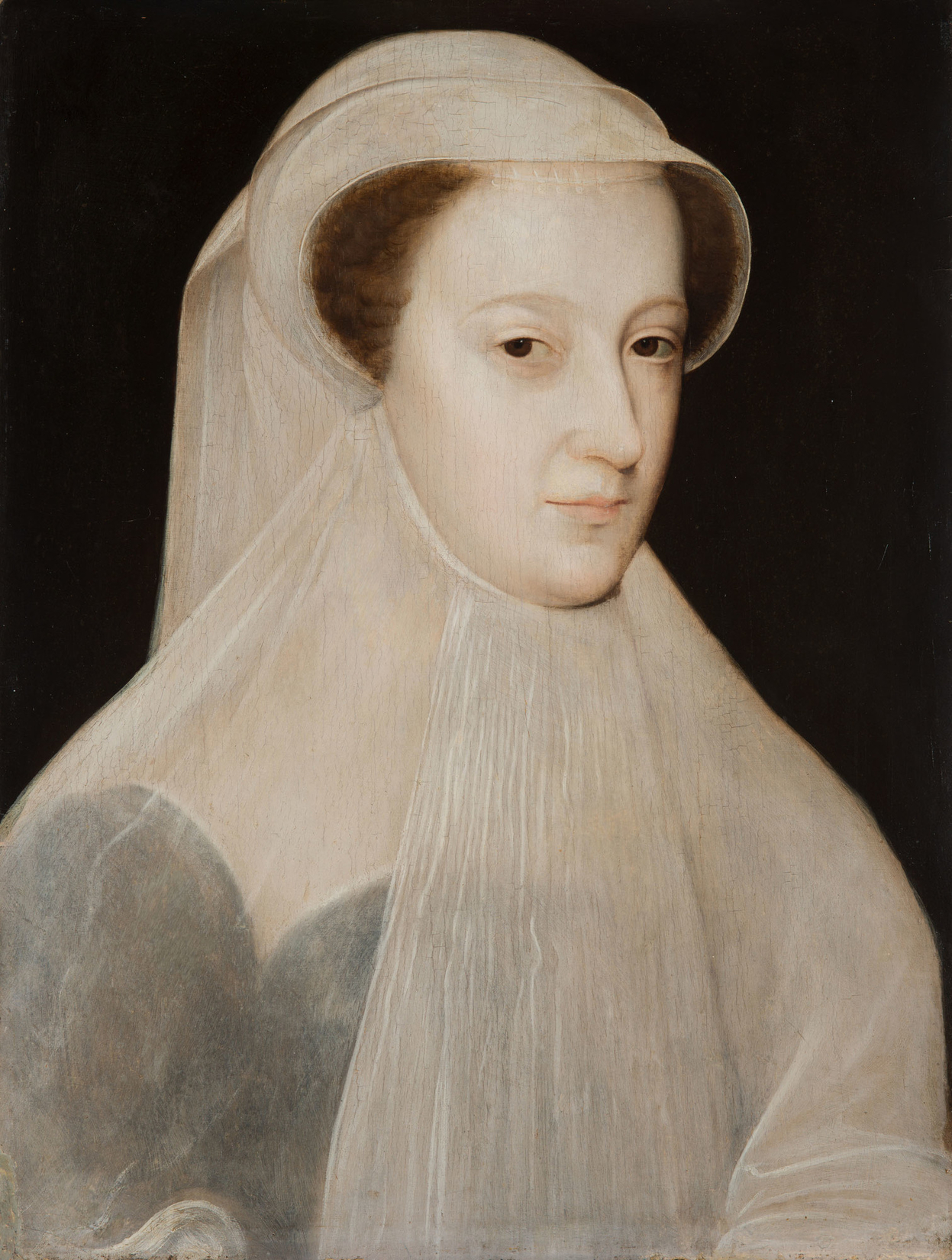
Portrait of Mary, Queen of Scots, in white mourning dress, after a drawing by François Clouet.
Mary was born at Linlithgow Palace in West Lothian on 8 December 1542, the daughter of King James V of Scotland and his French wife, Mary of Guise.[1][2] She became queen when she was six days old, and the National Records of Scotland dates her reign from 14 December 1542.[1][2] Because she was a great-granddaughter of Henry VII of England, she stood next in line to the English throne after the children of Henry VIII.[1]
Childhood: the Rough Wooing and France
While Mary was a baby, the Scottish nobility agreed by treaty that she would marry Henry VIII's son, the future Edward VI.[1] Catholic opponents of the match took the young queen to Stirling Castle and the agreement collapsed.[1] Henry answered with a series of destructive raids into Scotland known as "the Rough Wooing", in which English forces set fire to the Abbey of Holyroodhouse, where James V was buried, burned crops in the Tweed Valley and set the Border abbeys of Melrose, Jedburgh and Dryburgh ablaze.[1]
Scotland instead returned to its traditional alliance with France. In 1548 Mary was promised in marriage to the Dauphin Francis, heir to the French throne, and sent to be brought up at the French court, where she lived from that year.[1][2] She married Francis in Paris on 24 April 1558.[1] When he succeeded his father as king in 1559, Mary became queen of France as well as of Scotland.[1] Francis died in 1560, of an ear infection according to the Royal Household's account.[1]
Return to Scotland
Mary came back to Scotland in August 1561, a year after the Scottish Reformation, the religious reforms that made the country officially Protestant.[1][2] She remained a Roman Catholic, in a country whose religious reforms had been led by the Protestant preacher John Knox, yet her Protestant subjects gave her an unexpectedly warm welcome.[1] In 1561 the Italian David Rizzio (also spelled Riccio) arrived in Scotland with the ambassador of Savoy; he entered Mary's service as a musician and later became her secretary and close companion.[3]
Darnley, Rizzio and the birth of James
In 1565 Mary married her cousin Henry Stewart, Lord Darnley.[1][2] The Old Parish Register of the Canongate in Edinburgh, held by the National Records of Scotland, shows that the couple had been proclaimed three times.[2]
The marriage soon soured. On the night of 9 March 1566 a group of conspirators led by Darnley, who resented Rizzio's influence over the queen, climbed the private staircase from Darnley's rooms at the Palace of Holyroodhouse to Mary's apartments.[3] They burst into the small supper room where Mary, who was pregnant, sat with her ladies and Rizzio.[1][3] Rizzio clung to the queen's skirts but was dragged into the next room and stabbed 56 times, according to the Royal Collection Trust.[3]
On 19 June 1566 Mary gave birth at Edinburgh Castle to a son, James, the future James VI of Scotland and James I of England.[2]
The death of Darnley and the marriage to Bothwell
On 10 February 1567 Darnley was killed at Kirk o' Field, near Edinburgh, after an explosion there.[1][2] Many people suspected that Mary had a part in the crime.[1] About three months later she married James Hepburn, 4th Earl of Bothwell, who was widely believed to have been the chief murderer.[1][2]
How far Mary was involved in Darnley's death has never been settled. The main evidence against her is the "Casket Letters", eight letters and a set of irregular sonnets that the Earl of Morton said were found in a silver casket on 20 June 1567 in the possession of one of Bothwell's retainers.[4] They were shown on 14 December 1568 to commissioners appointed by Elizabeth I of England, who were examining the quarrel between Mary and the Scottish lords who had risen against her.[4] If genuine, the most important of them would show that Mary acted together with Bothwell in the murder.[4] Only copies survive: the originals, which were in French, were returned to Morton after being shown in England and vanished some years after his execution in 1581.[4] Britannica notes that historians argued for centuries over whether the letters were genuine or forged without reaching a conclusive answer, and that even if they were false, other circumstantial evidence may still point to Mary's guilt.[4]
Carberry Hill, Lochleven and abdication
The Bothwell marriage united much of the Scottish nobility against the queen. On 15 June 1567 her army faced the rebel lords at Carberry Hill and she surrendered.[1] Bothwell escaped to Scandinavia, where he was arrested and held as a prisoner until his death.[1]
Mary was taken to Lochleven Castle, on an island in Loch Leven in Kinross-shire, and held there by the Douglas family who owned it.[1][5] She was pregnant on arrival and, according to Historic Environment Scotland, miscarried twins about two months later.[5] While still ill she was made to abdicate in favour of her infant son.[1][5] The National Records of Scotland gives 24 July 1567 as the end of her reign, and on 29 July the laird of Lochleven fired guns and lit bonfires to mark the accession of James VI.[2][5]
Escape, Langside and flight to England
On the evening of 2 May 1568, helped by George Douglas, the laird's brother, and a young man named Willie Douglas, who had earlier smuggled her letters, Mary escaped from the island by boat in disguise.[5] On 13 May 1568 her forces were defeated at the Battle of Langside, near Glasgow.[1] She then fled south into England to seek protection from her cousin Elizabeth I, but was instead arrested and held captive.[1][2]
Captivity and plots
Mary spent the rest of her life as Elizabeth's prisoner, about 19 years in the Royal Household's reckoning.[1] As a Catholic with a strong claim to the English throne, she became the focus of a series of Catholic plots against Elizabeth.[1]
The first major one, the Ridolfi plot of 1570–71, was organised by Roberto Ridolfi, a Florentine banker living in London.[6] It aimed to kill Elizabeth, bring in a Spanish invasion and place Mary on the throne as the wife of Thomas Howard, 4th Duke of Norfolk.[6] The plot came apart in April 1571 when Ridolfi's messenger was arrested at Dover.[6] Norfolk was executed for treason on 2 June 1572, but Elizabeth spared Mary.[6]
In 2023 three codebreakers, George Lasry, Norbert Biermann and Satoshi Tomokiyo, published in the peer-reviewed journal Cryptologia their decipherment of 57 enciphered letters held by the Bibliothèque nationale de France, which had catalogued them as early sixteenth-century papers on Italian affairs.[7] The letters, dated 1578 to 1584 and mostly addressed to the French ambassador in London, Michel de Castelnau de Mauvissière, turned out to be written by Mary; about 50 of them had been unknown to historians.[7] They deal with her health and conditions in captivity, her distress when her son was abducted in August 1582, and her distrust of Elizabeth's secretary and spymaster, Sir Francis Walsingham.[7] The historian John Guy called the find the most important new discovery about Mary in a hundred years.[7]
The Babington plot
In 1586, while Mary was held at Chartley in Staffordshire, Walsingham set up a secret channel through which her coded letters were carried in beer barrels.[8] Every letter was intercepted, opened, deciphered by his codebreaker Thomas Phelippes, sealed again and passed on, so Walsingham read all of her correspondence.[8] Through this channel Mary exchanged letters with Anthony Babington, an English Catholic, at a time when secret plans were being made to murder Elizabeth and put Mary on the throne.[8][9]
On 17 July 1586 Mary wrote to Babington in cipher.[8] The British Library, which calls this the "Gallows Letter", describes it as approving the plot and giving advice on carrying it out, including an instruction to set "the six gentlemen" to work, meaning the men who were to kill Elizabeth.[8] After deciphering it, Phelippes drew a gallows on the outside of the letter.[8] Before the letter was passed on, Walsingham had some passages altered and a postscript added asking Babington to name the six men.[8] Babington burned the letter after reading it, and the surviving text is a contemporary copy in The National Archives.[8] Babington was arrested and was hanged, drawn and quartered on 20 September 1586, and Mary's secretaries, after their arrest, confessed that they had written the letter at her command.[8]
Trial and execution
Mary was tried and condemned for her part in the plot on the evidence of the intercepted letters.[9] Elizabeth was reluctant to act, but in February 1587 she signed the death warrant, and her councillors quickly sent it to Fotheringhay Castle in Northamptonshire.[9] Mary was beheaded there on 8 February 1587, aged 44.[1] Elizabeth afterwards claimed that she had not meant the sentence to be carried out.[9]
Burial and reburial
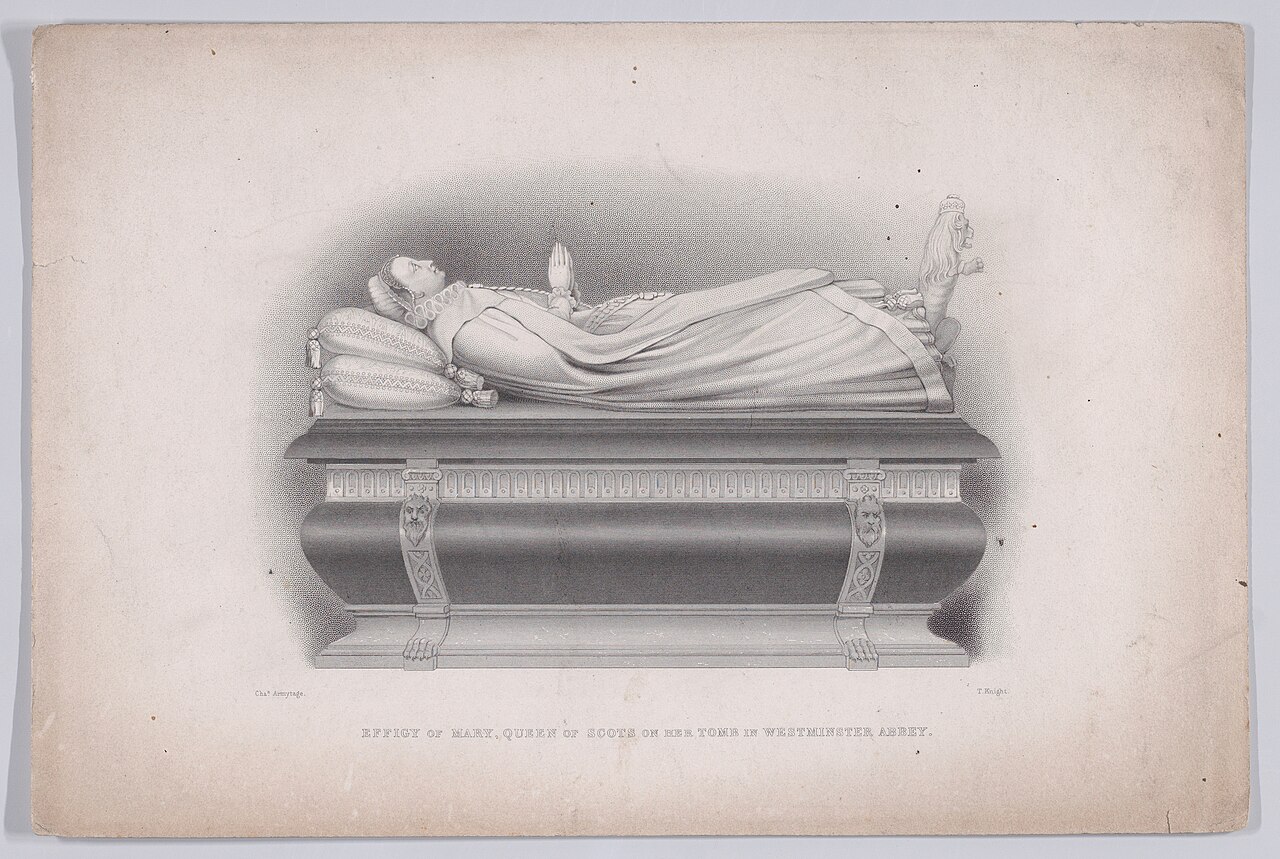
On Elizabeth's orders, Mary was buried with great ceremony in Peterborough Cathedral.[10] In 1612 her son, by then also King James I of England, had her remains moved to Westminster Abbey: his warrant is dated 28 September 1612, and the reburial took place on 11 October that year.[10] She was laid in the vault of Henry VII's Chapel, and James commissioned a marble tomb for her in the south aisle of the Lady Chapel, with a white marble effigy under a canopy carved by William and Cornelius Cure.[1][10]
The white marble effigy on the tomb of Mary, Queen of Scots, in Westminster Abbey.
Taylor & Francis Group. News release on George Lasry, Norbert Biermann and Satoshi Tomokiyo, "Deciphering Mary Stuart's Lost Letters from 1578-1584", Cryptologia (2023), DOI 10.1080/01611194.2022.2160677. EurekAlert! (AAAS). 7 February 2023. eurekalert.org/news-releases/978662