Martin Luther King Jr. (15 January 1929 – 4 April 1968) was an American Baptist minister who led nonviolent campaigns against racial segregation and discrimination in the United States and received the 1964 Nobel Peace Prize.[1][2]
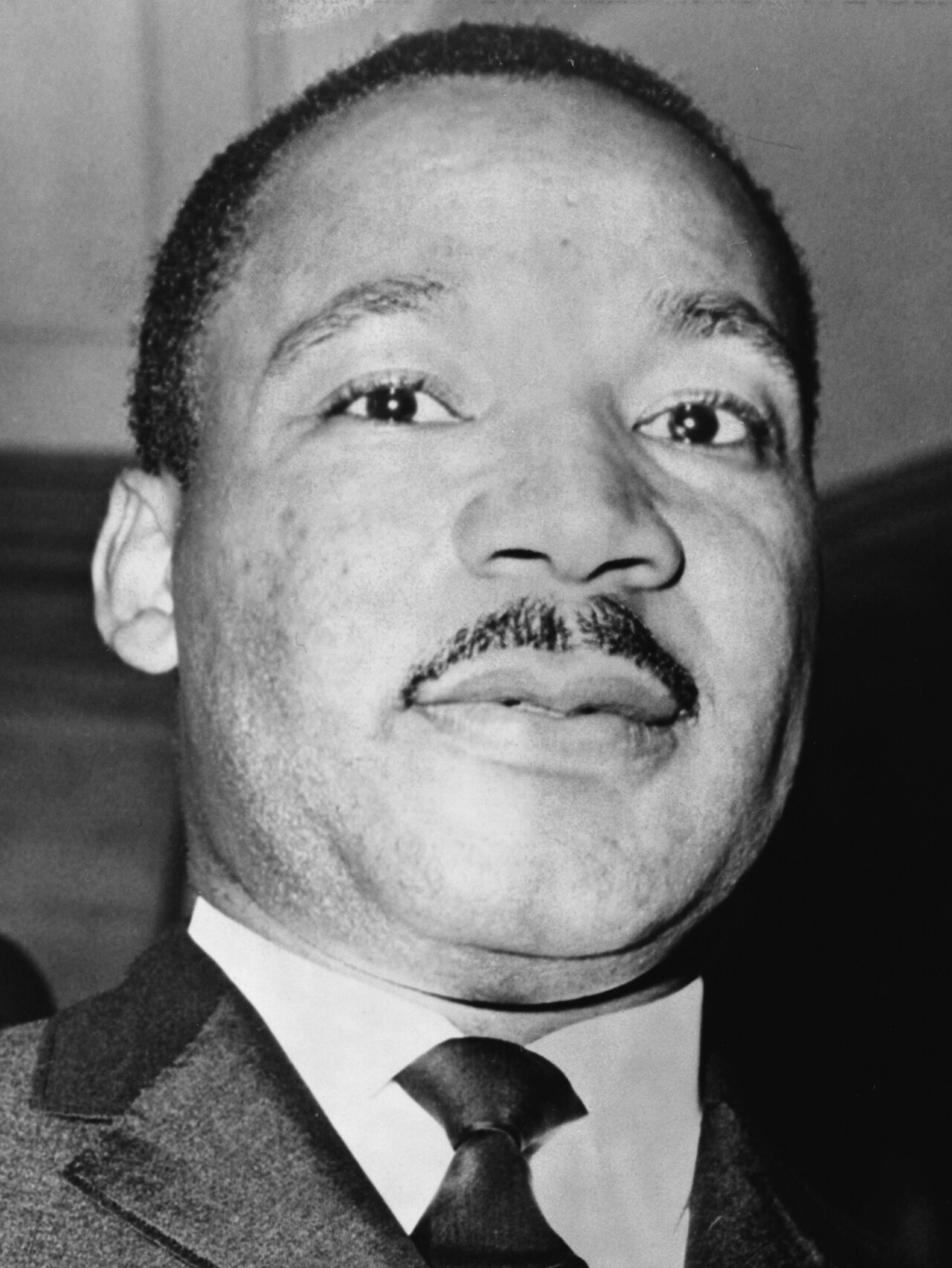
Via Wikimedia Commons: Martin Luther King Jr with medallion NYWTS (cropped) by Phil Stanziola , NYWT&S staff photographer, public domain.
Early life and education
King was born in Atlanta, Georgia, on 15 January 1929, the son of the Reverend Michael King and Alberta Williams King, and was first named Michael King Jr.[1] In 1934 his father changed both of their names to Martin Luther King.[1] The family was closely tied to Atlanta's Ebenezer Baptist Church, where King's grandfather had been pastor since 1894.[1]
From 1944 to 1948 he studied at Morehouse College in Atlanta, where the college president Benjamin E. Mays and the teacher George Kelsey influenced his view of Christianity as a force for social change; he was ordained as a minister during his final semester.[1] He then attended Crozer Theological Seminary in Pennsylvania from 1948 to 1951 and graduated at the top of his class.[1] In 1951 he began doctoral studies in systematic theology (the branch of theology that sets out Christian beliefs as an ordered whole) at Boston University's School of Theology, and he completed the doctorate in 1955.[1] On 18 June 1953 he married Coretta Scott in Marion, Alabama.[1]
In 1991 a committee of scholars appointed by Boston University reported that King had plagiarized parts of his 1955 dissertation, using material from sources that were not credited, were credited incorrectly, or were credited too far from the borrowed passage.[8] The committee said King was at fault for failing to cite sources accurately and fully, but concluded that his doctorate should not be revoked and that the dissertation still had scholarly value; it recommended that a letter describing its findings be placed with the library copy of the dissertation, and the university's provost accepted the recommendations.[8] The historian Clayborne Carson has likewise written that some of the papers King wrote during his Boston years, including the dissertation, contained extensive plagiarism.[1]
Montgomery bus boycott
In 1954 King became pastor of Dexter Avenue Baptist Church in Montgomery, Alabama.[1] After Rosa Parks was arrested in December 1955, the Montgomery Improvement Association was formed and King was chosen to lead it.[1] The association led a boycott of the city's segregated buses that lasted about a year and ended after the United States Supreme Court outlawed Alabama's bus segregation laws in late 1956.[1] During the boycott King took up the nonviolent methods of the Indian leader Mohandas Gandhi, and in 1959 he spent a month in India as the guest of Prime Minister Jawaharlal Nehru.[1]
Southern Christian Leadership Conference
In 1957 King became the founding president of the Southern Christian Leadership Conference (SCLC).[1] He was serving as its leader when he received the Nobel Peace Prize.[2] In early 1960 he moved his family to Atlanta to become co-pastor of Ebenezer Baptist Church with his father.[1]
Birmingham and the "Letter from Birmingham Jail"
In 1963 SCLC led a campaign against segregation in Birmingham, Alabama.[1] On 12 April 1963, just over a week after the campaign began, King and Ralph Abernathy were arrested for violating Alabama's law against mass public demonstrations.[3] Eight Birmingham clergy had published a statement in the Birmingham News calling the protests "unwise and untimely".[3] King's reply, dated 16 April 1963 and written in his jail cell, defended nonviolent direct action and civil disobedience and criticized white moderates for their inaction.[3] The letter first circulated as a mimeographed copy and was then printed as a pamphlet and in several magazines and newspapers; King revised it as a chapter of his 1964 book Why We Can't Wait.[3] Police violence against demonstrators in Birmingham, together with Alabama governor George Wallace's attempt to keep Black students out of the University of Alabama, prompted President John F. Kennedy to introduce major civil rights legislation.[1]
March on Washington and the Nobel Peace Prize
On 28 August 1963 King spoke at the March on Washington for Jobs and Freedom at the Lincoln Memorial, delivering the speech now known as "I Have a Dream".[1][2] Carson puts the crowd at more than 200,000 people, while the Nobel Foundation's summary gives 250,000.[1][2] At the end of 1963 Time magazine named him its Man of the Year.[1]
The Norwegian Nobel Committee awarded King the 1964 Nobel Peace Prize "for his non-violent struggle for civil rights for the Afro-American population", and he received it in December 1964.[2][1]
Selma and the Voting Rights Act
In early 1965 King took part in Alabama voting-rights protests that began in Selma.[1] On 7 March 1965 state troopers and local officers attacked marchers with clubs and tear gas as they crossed the Edmund Pettus Bridge, and television coverage of the attack caused national outrage.[4] Two days later King led more than 2,000 marchers back to the bridge, where they knelt in prayer and then turned back.[4] After a federal judge approved the march, marchers left Selma on 21 March and reached the state capitol in Montgomery on 25 March, after a 54-mile journey; the crowd at the final rally was about 25,000.[4] President Lyndon B. Johnson signed the Voting Rights Act on 6 August 1965, with King among the civil rights leaders present.[4]
Chicago, Vietnam and the Poor People's Campaign
In 1966 King took his movement north to Chicago, where a campaign against urban poverty and housing discrimination met opposition from Mayor Richard J. Daley and, in Carson's assessment, produced no significant gains.[1] On 4 April 1967, at Riverside Church in New York, he publicly condemned the Vietnam War.[1] The Nobel Foundation's summary notes that his opposition to the war cost him the favour of President Johnson.[2] In November 1967 he announced the formation of the Poor People's Campaign.[1] In 1968 he became involved in a strike by sanitation workers in Memphis, Tennessee, and on 3 April he told an audience at Bishop Charles J. Mason Temple there, "I've been to the mountaintop".[1] After his death the Poor People's Campaign went ahead for a few months but did not reach its goals.[1]
FBI surveillance
From 1962 the Federal Bureau of Investigation (FBI) investigated King's alleged links to the Communist Party, citing his association with a few advisers it suspected of being Communists.[5] Wiretaps began in 1963; according to Carson, FBI director J. Edgar Hoover set up the phone taps and listening devices with the approval of President Kennedy and Attorney General Robert F. Kennedy.[5][1] The FBI passed information from the wiretaps to the White House and offered it to reporters to discredit him, and its surveillance also gathered material about his private life that was later leaked to some reporters.[5] King himself consistently rejected communism and wrote that "Communism and Christianity are fundamentally incompatible".[5]
In 1975 and 1976 the Senate Select Committee to Study Governmental Operations with Respect to Intelligence Activities, known as the Church Committee after its chairman, Senator Frank Church, examined these activities.[6] Its staff studied COINTELPRO, an FBI programme of covert action meant to "disrupt and discredit" groups and people seen as threats, whose targets included SCLC and King.[6] In its 1976 report the committee stated that it had seen no evidence that either of the advisers in question had tried to use the civil rights movement to carry out the plans of the Communist Party.[5]
Assassination and the James Earl Ray case
At about 6:01 p.m. on 4 April 1968, King was shot and fatally wounded by a single rifle bullet while standing on a balcony of the Lorraine Motel in Memphis.[7] James Earl Ray was arrested in London about two months later.[7] In March 1969 Ray pleaded guilty to the murder and was sentenced to 99 years in prison, but for the next 30 years he repeatedly tried to withdraw his plea and obtain a trial.[7] He died in prison in April 1998.[7] A 1979 report by the House Select Committee on Assassinations broadly agreed with earlier investigations, but found that one or both of Ray's brothers might have been his accomplices.[7]
Questions about a wider conspiracy have continued. In a civil wrongful-death suit brought by members of the King family against Loyd Jowers, a former Memphis restaurant owner, a Tennessee state jury in December 1999 found that Jowers and "others, including government agencies" took part in a conspiracy to kill King.[7] The United States Department of Justice, which the Attorney General had directed in August 1998 to investigate claims made by Jowers and by a former FBI agent, Donald Wilson, reported in June 2000 that neither set of claims was credible.[7] It found nothing to disturb the 1969 judicial finding that Ray murdered King and concluded that no further investigation was warranted.[7] The Nobel Foundation's biographical summary describes it as undetermined whether the killer acted alone or as part of a conspiracy.[2]
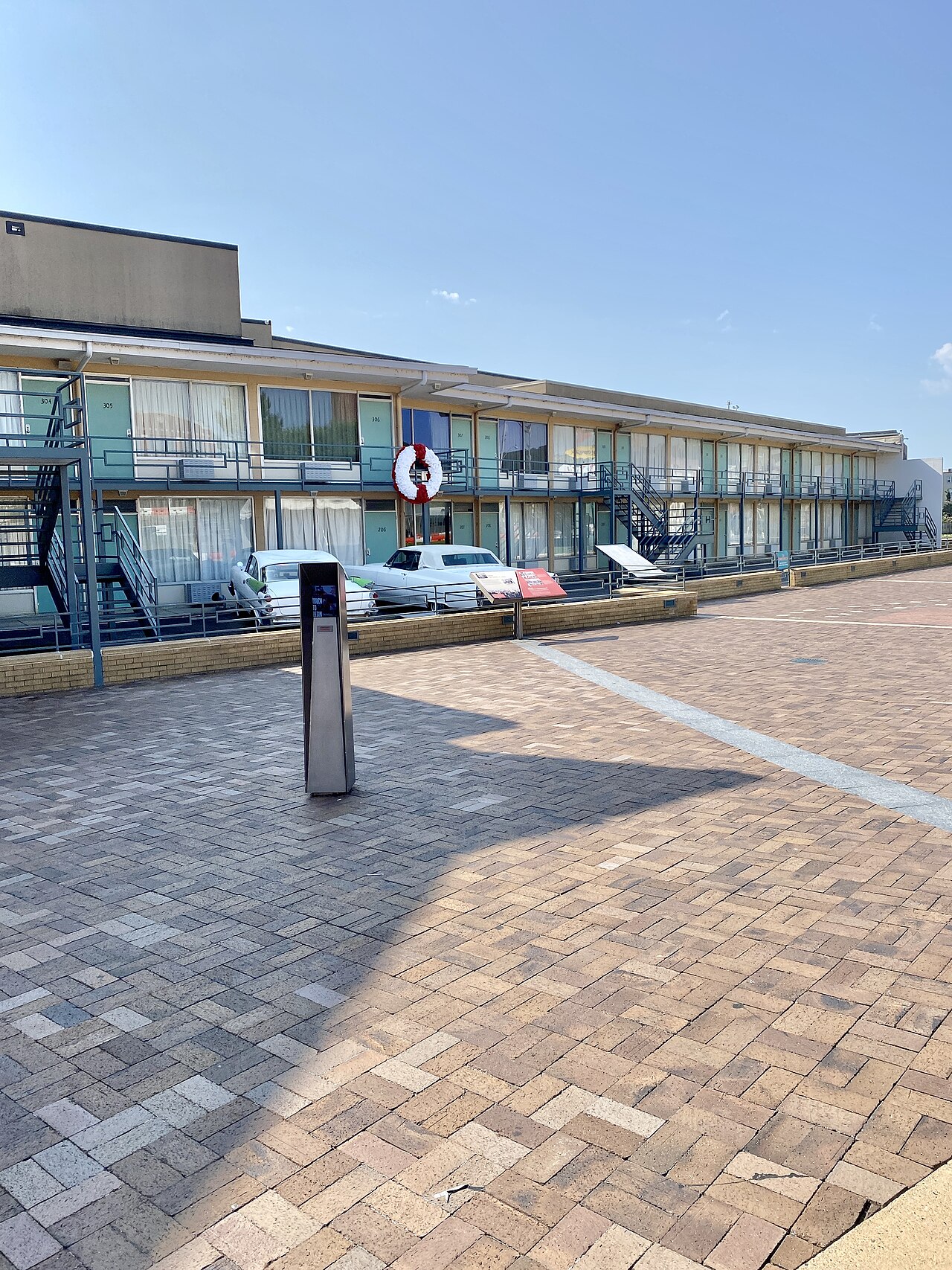
Via Wikimedia Commons: The Lorraine Motel, National Civil Rights Museum, Mulberry Street, Mem by Warren LeMay from Chicago, IL, United States, CC BY-SA 2.0.
Legacy, national holiday and memorial
After King's death, Coretta Scott King founded the Martin Luther King, Jr., Center for Nonviolent Social Change in Atlanta and led the effort to create a federal holiday in his honour.[1] On 2 November 1983, in the White House Rose Garden, President Ronald Reagan signed H.R. 3706 (Public Law 98-144), setting aside a day each year to honour King, with Coretta Scott King present.[9] The holiday was first observed in 1986.[1]
In 1996 Congress authorized Alpha Phi Alpha, the fraternity King had joined, to build a memorial to him in Washington, D.C.[10] The Martin Luther King, Jr. Memorial stands in West Potomac Park on the Tidal Basin, on the line between the Lincoln and Jefferson memorials, and centres on a 30-foot sculpture of King, carved by the Chinese sculptor Lei Yixin, emerging from a stone called the Stone of Hope.[10] Its dedication, planned for 28 August 2011, was postponed by Hurricane Irene and held on 16 October 2011.[10] It was the first memorial on the National Mall to honour an individual African American.[10] A paraphrased quotation carved on the Stone of Hope, "I was a drum major for justice, peace and righteousness", drew criticism, including from the poet Maya Angelou; its removal was announced in December 2012 and the words were carved over in 2013.[10]
Sources
- Clayborne Carson. "Martin Luther King, Jr." In American National Biography, ed. John A. Garraty and Mark C. Carnes. Oxford University Press, 1999; text hosted by Stanford University. No date shown; accessed 25 November 2026. web.stanford.edu/~ccarson/articles/King,%20Martin%20Luther,%20Jr.,%…
- "Martin Luther King Jr. – Facts." NobelPrize.org, Nobel Prize Outreach. No date shown; accessed 25 November 2026. nobelprize.org/prizes/peace/1964/king/facts/
- "'Letter from Birmingham Jail'." King Encyclopedia, Martin Luther King, Jr. Research and Education Institute, Stanford University. No date shown; accessed 25 November 2026. kinginstitute.stanford.edu/encyclopedia/letter-birmingham-jail
- "Selma to Montgomery March." King Encyclopedia, Martin Luther King, Jr. Research and Education Institute, Stanford University. No date shown; accessed 25 November 2026. kinginstitute.stanford.edu/selma-montgomery-march
- "Communism." King Encyclopedia, Martin Luther King, Jr. Research and Education Institute, Stanford University. No date shown; accessed 25 November 2026. kinginstitute.stanford.edu/communism
- "Senate Select Committee to Study Governmental Operations with Respect to Intelligence Activities (The Church Committee)." United States Senate. No date shown; accessed 25 November 2026. senate.gov/about/powers-procedures/investigations/church-committee.htm
- United States Department of Justice, Civil Rights Division. "United States Department of Justice Investigation of Recent Allegations Regarding the Assassination of Dr. Martin Luther King, Jr." June 2000 (section opened: introduction and background). Accessed 25 November 2026. justice.gov/crt/about/crm/mlk/part2.php
- "King's plagiarism shouldn't taint his rights reputation, panelists agree." Deseret News, 11 October 1991. Accessed 25 November 2026. deseret.com/1991/10/11/18945697/king-s-plagiarism-shouldn-t-taint-h…
- Ronald Reagan. "Remarks on Signing the Bill Making the Birthday of Martin Luther King, Jr., a National Holiday." 2 November 1983. The American Presidency Project, University of California, Santa Barbara. Accessed 25 November 2026. presidency.ucsb.edu/documents/remarks-signing-the-bill-making-the-b…
- "Building the Memorial." Martin Luther King, Jr. Memorial, National Park Service. No date shown; accessed 25 November 2026. nps.gov/mlkm/learn/building-the-memorial.htm
