In the teaching of Jehovah's Witnesses, the "great crowd" is the large, unnumbered group of Revelation 7:9, which they identify as faithful Christians who will survive the great tribulation and live forever on earth.[1][4]
The term and the passage
"Great crowd" is the wording Witness publications use for the group in Revelation 7:9 that many other translations call a "great multitude", described just after the 144,000 sealed from the tribes of Israel.[1][9] In the passage, the crowd is too large for anyone to count, comes from every nation, tribe, people and language, wears white robes, holds palm branches and stands before God's throne and before the Lamb.[9] The same vision says that its members have come out of "the great tribulation" and serve God in his temple.[1]
Jehovah's Witnesses teach that the great crowd is a different group from the 144,000, who they say rule with Christ in heaven (see the entry 144,000).[1] The Witness reference work Insight on the Scriptures reasons that John presents the crowd as separate from the 144,000, unnumbered and drawn from all nations.[1] Its conclusion is that the great crowd stands for all those who are not of the heavenly "bride" class but who stand approved at the time of the great tribulation and are preserved alive on earth.[1] Witness publications also speak of "a great crowd of other sheep", linking the group to the wider earthly-hope class described in the entry Other sheep.[5]
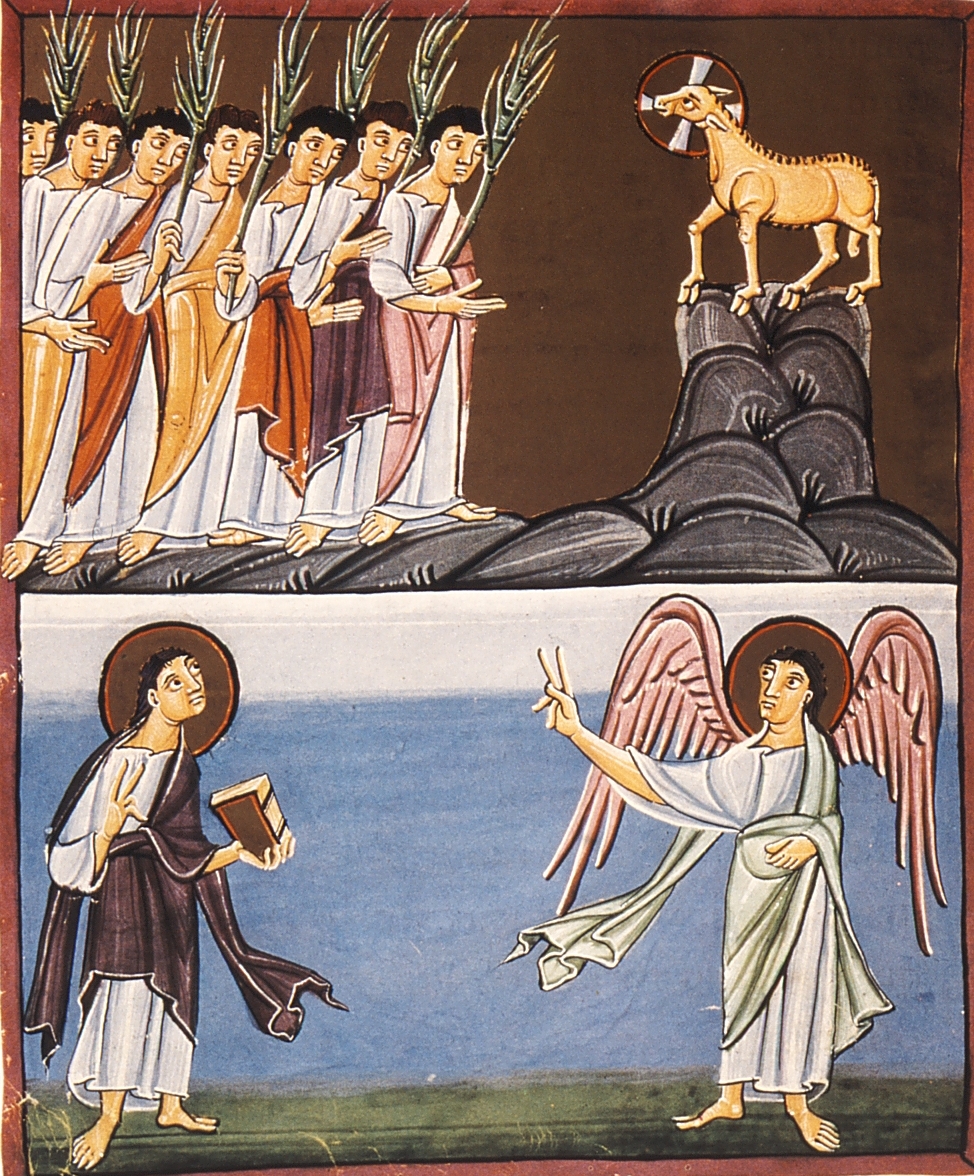
An early 11th-century illumination from the Bamberg Apocalypse showing the crowd before the throne and the Lamb described in Revelation 7.
Before 1935, the Bible Students (as the movement was then known) did not see the great crowd as an earthly group.[4] A 2019 Watchtower study article explains that they expected it to live in heaven, as Christians who had been less zealous than the 144,000: its members would stand "before the throne" but would not sit on thrones.[4] The same article says the Bible Students then saw three groups: the 144,000 ruling with Christ in heaven, the less zealous great crowd before the throne in heaven, and millions of others who would be taught God's ways on earth during Christ's thousand-year reign.[4]
Identification as an earthly class (1935)
In 1935 the Watch Tower Society changed this view, and Witness publications say the identity of the great crowd was "clarified" that year: the group did not have to be literally in heaven to stand "before the throne", and its members would instead live on earth.[4] The change was announced by Joseph Rutherford, the movement's leader at the time, at a convention in Washington, D.C., held from 30 May to 3 June 1935; the story of that convention is told in the entry 144,000.[5][7]
A 2024 article in the Journal of the Royal Anthropological Institute describes a wider change in Witness preaching that began in the 1920s.[7] Over a few decades, it says, preaching moved from a search for the anointed 144,000 towards teaching the great crowd; the great crowd came to be understood as far larger over the twentieth century, and the article writes that this understanding fuels an ever-growing zeal for preaching.[7]
What the great crowd is taught to expect
Jehovah's Witnesses teach that the great crowd will come through the great tribulation alive; the 2019 study article describes the hope of its members as being "to survive the great tribulation and live forever on earth".[4] The sequence of that tribulation is covered in the entry Great tribulation.
The Witness commentary Revelation—Its Grand Climax At Hand! teaches that only a minority of humankind will "stand", or survive, the day of God's wrath: any of the 144,000 still alive on earth, together with "a great crowd of other sheep".[5] The war itself, and who survives it in general terms, is covered in the entry Armageddon. The life the great crowd is taught to expect afterwards is the subject of the entry Paradise earth.
Where the great crowd "stands"
Revelation says that the great crowd stands "before the throne" and serves God "in his temple".[1][9] Because Jehovah's Witnesses teach that the great crowd is on earth, their publications explain both phrases in earthly terms, and the explanation has been restated over time.
"Before the throne." The 2019 Watchtower study article explains that the great crowd can stand "before the throne" by recognising God's authority and submitting to his rule, without being in heaven.[4] Revelation—Its Grand Climax At Hand! similarly presents the crowd as standing in the view of God and of Christ while on earth.[5]
"In his temple" (1980). A study article in The Watchtower of 15 August 1980, titled "The 'Great Crowd' Renders Sacred Service—Where?", argued that the Greek word naos, translated "temple" in the passage, does not mean just the inner sanctuary of a temple but the entire temple area.[2] On that basis it taught that the great crowd serves God "in the earthly courtyards of his great temple arrangement", while expecting to remain on earth forever.[2] Revelation—Its Grand Climax At Hand! states the same teaching: the temple where the great crowd serves is "the earthly courtyard of God's spiritual temple", not the inner sanctuary, and the crowd is not a priestly class.[5]
Which courtyard (2002). A "Questions From Readers" column in The Watchtower of 1 May 2002 adjusted the teaching on which courtyard is meant.[3] It noted that it had been said that the great crowd is in a spiritual counterpart of the Court of the Gentiles, the outer court of the temple rebuilt by Herod, and stated that further research had shown at least five reasons why that is not so.[3] Among the reasons given were that the Court of the Gentiles appears in no temple plan given by God, that Herod built it partly for his own glory, and that almost anyone could enter it.[3] The column concluded that the great crowd worships in one of the earthly courtyards of God's spiritual temple, the one that corresponds to the outer courtyard of Solomon's temple; it described the inner courtyard as standing for the condition of the anointed "holy priesthood" while on earth, a place the great crowd does not occupy.[3]
Size
Witness publications emphasise that Revelation calls the crowd too large to count, and they point to the growth of the movement as its fulfilment.[4] The 2019 study article recalls that in 1935 there were about 56,000 publishers worldwide (a publisher, in Witness usage, is a member who takes part in the preaching work), many of them anointed, and that to some at the time "the great crowd did not seem very great".[4][6] Revelation—Its Grand Climax At Hand! reports 176,456 Witnesses active in the ministry worldwide in 1946.[5] The 2019 article states that the great crowd then numbered "more than eight million".[4]
As of the 2025 service year (1 September 2024 to 31 August 2025), the official worldwide report of Jehovah's Witnesses gave a peak of 9,205,326 publishers, in 241 lands.[6] That figure counts publishers, not the great crowd as such: it includes the small number of Witnesses who consider themselves anointed, and the report does not label it as the size of the great crowd.[4][6] The yearly count of those who consider themselves anointed is covered in the entry 144,000.
Other readings of the "great multitude"
Other Christians and scholars read the multitude of Revelation 7 differently, and the Witnesses' own reference work acknowledges this. Insight on the Scriptures records that many commentators see the 144,000 as spiritual Israel, the Christian congregation, and the great crowd as that same congregation in heaven, while others take the great crowd to be the Gentile (non-Jewish) Christians.[1]
The notes of the New American Bible, Revised Edition, the Catholic translation published by the Confraternity of Christian Doctrine, treat the 144,000 as a symbol of "the new Israel" that embraces people from every nation, race, people and tongue, cross-referring to the multitude of verse 9.[9] Those notes take the "time of great distress" of verse 14 ("the great tribulation" in Witness publications) as the fierce persecution of Christians by the Romans.[9] In Catholic worship, Revelation 7:2–4 and 9–14 is read as the first reading on the Solemnity of All Saints, 1 November.[10]
A 2020 article in The Heythrop Journal on the numbers in Revelation reads the contrast between the 144,000 from Israel and the uncountable crowd from the nations as a theological point.[8] It sets out three possible meanings: that God's people are now made up overwhelmingly of the nations, with Jews a minority; that Israel is redefined as a holy nation drawn from all peoples; or simply that those who will be saved far outnumber the Christians of John's own day.[8]
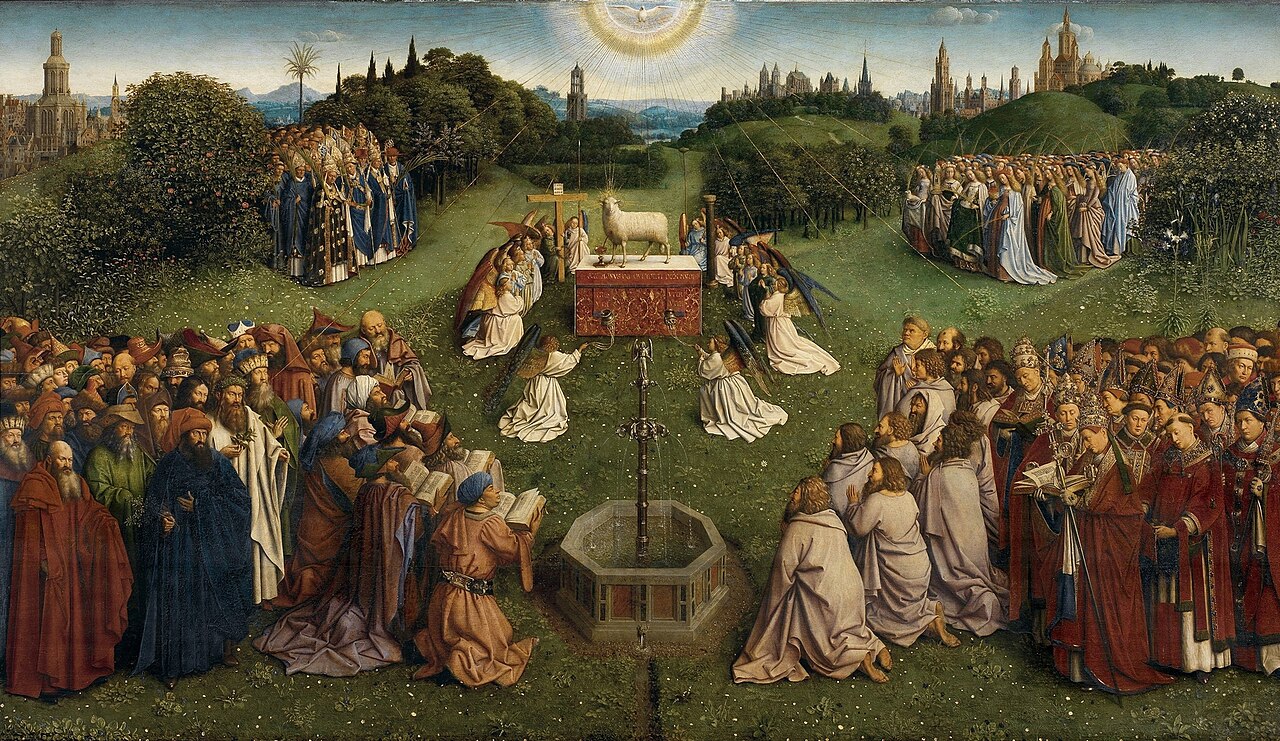
The Adoration of the Mystic Lamb by Jan van Eyck, the central panel of the Ghent Altarpiece (about 1430 to 1432), in which groups of worshippers gather around t
The Witness reading, by contrast, sees two distinct groups with different destinies: the 144,000 in heaven and the great crowd on earth.[1][4]
Sources
"Great Crowd." Insight on the Scriptures, vol. 1. Watch Tower Bible and Tract Society of Pennsylvania (Watchtower Online Library). No date shown; accessed 25 November 2026. wol.jw.org/en/wol/d/r1/lp-e/1200001762
"The 'Great Crowd' Renders Sacred Service—Where?" The Watchtower, 15 August 1980, pp. 14–20. Watch Tower Bible and Tract Society of Pennsylvania (Watchtower Online Library). wol.jw.org/en/wol/d/r1/lp-e/1980606
"Questions From Readers." The Watchtower, 1 May 2002, pp. 30–31. Watch Tower Bible and Tract Society of Pennsylvania (Watchtower Online Library). wol.jw.org/en/wol/d/r1/lp-e/2002327
"Look! A Great Crowd." The Watchtower (Study Edition), September 2019, pp. 26–31. Watch Tower Bible and Tract Society of Pennsylvania (Watchtower Online Library). wol.jw.org/en/wol/d/r1/lp-e/2019566
"A Multitudinous Great Crowd." Chapter 20 of Revelation—Its Grand Climax At Hand! Watch Tower Bible and Tract Society of Pennsylvania (jw.org). No date shown (the online edition gives figures up to 2005); accessed 25 November 2026. jw.org/en/library/books/Revelation-Its-Grand-Climax-At-Hand/A-Multi…
Cardoza, D. "Epiphenomenal suasion: Jehovah's Witnesses and the politics of preaching against the state." Journal of the Royal Anthropological Institute 30, no. S1 (2024): 25–42. John Wiley & Sons, published 23 March 2024. doi.org/10.1111/1467-9655.14106
Newton, J. K. "Apocalyptic Arithmetic: Numbers and Worldview in the Book of Revelation." The Heythrop Journal 63, no. 6 (November 2022): 1163–1177. John Wiley & Sons; first published online 9 December 2020. doi.org/10.1111/heyj.13797
Revelation, chapter 7, with notes. New American Bible, Revised Edition. Confraternity of Christian Doctrine (via YouVersion, bible.com). No date shown; accessed 25 November 2026. bible.com/bible/463/REV.7.NABRE