David Bowie (born David Robert Jones; 8 January 1947 – 10 January 2016) was an English singer, songwriter, record producer and actor whose career ran from the 1960s until his death in 2016.[1][2]
Early life and name
David Robert Jones was born in Brixton, south London, on 8 January 1947.[1][10] His mother, Margaret "Peggy" Jones, was a waitress, and his father, Haywood "John" Jones, worked for a charity.[10] The family moved to south-east London in 1953, and he finished at Bromley Technical High School at 16.[10]
As a teenager and young man he sang with a series of bands, which his official biography lists as the Kon-Rads, the King Bees, the Mannish Boys and the Lower Third.[1] He first fronted groups as Davy Jones, then changed his name to David Bowie to avoid confusion with Davy Jones of the Monkees; the Press Association (PA) obituary says the surname was supposedly inspired by a knife developed by the 19th-century American pioneer Jim Bowie.[10] His official biography says that "by 1966 he was David Bowie", and that Kenneth Pitt became his manager.[1]
Space Oddity
The single "Space Oddity" was released by Philips in July 1969.[3][10] It reached number 5 in the United Kingdom and was his first top-five hit there.[1][3] The album that contained it was first titled David Bowie, then Man of Words, Man of Music, and was later reissued as Space Oddity.[1] When RCA reissued the song in the UK on 26 September 1975, it became his first number-one single in Britain.[3]
In March 1970 he married Angela, known as Angie.[10] The couple had a son, Duncan Zowie Haywood, who as of November 2026 is known professionally as the film director Duncan Jones.[1][10] The couple separated in 1980.[10]
Ziggy Stardust and glam rock
Mercury Records released The Man Who Sold the World in April 1971, to little attention.[1] He then signed with RCA, which released Hunky Dory, an album that grew from a six-song demo and includes "Changes" and "Life on Mars?".[1]
The Rise and Fall of Ziggy Stardust and the Spiders from Mars, released in 1972, introduced Ziggy Stardust, an alien alter ego through whom Bowie performed.[1][10] His official biography calls 1972 the year he rose to international stardom, and describes his performance on the television programme Top of the Pops on 6 July 1972 as a landmark; his American tour as Ziggy began that September.[1] In the same period he produced other artists' records, including Lou Reed's Transformer and Mott the Hoople's All the Young Dudes, and later Iggy Pop's The Idiot and Lust for Life.[1]
Aladdin Sane followed in April 1973.[1] In 1973 he announced on stage at a London concert that he was retiring the Ziggy character.[1][10] Diamond Dogs, which the official biography calls a "dystopian epic", followed in May 1974.[1]
Changes in the later 1970s
In 1975 he released Young Americans; the rhythm-and-blues singer Luther Vandross was among those who worked on it.[1] "Fame", a collaboration with John Lennon, gave Bowie his first number-one single in the United States in 1975.[1][3][10]
He played the lead role in Nicolas Roeg's science-fiction film The Man Who Fell to Earth (1976).[1][10] The album Station to Station introduced another stage character, the "Thin White Duke", whom he played on the tour that followed.[1]
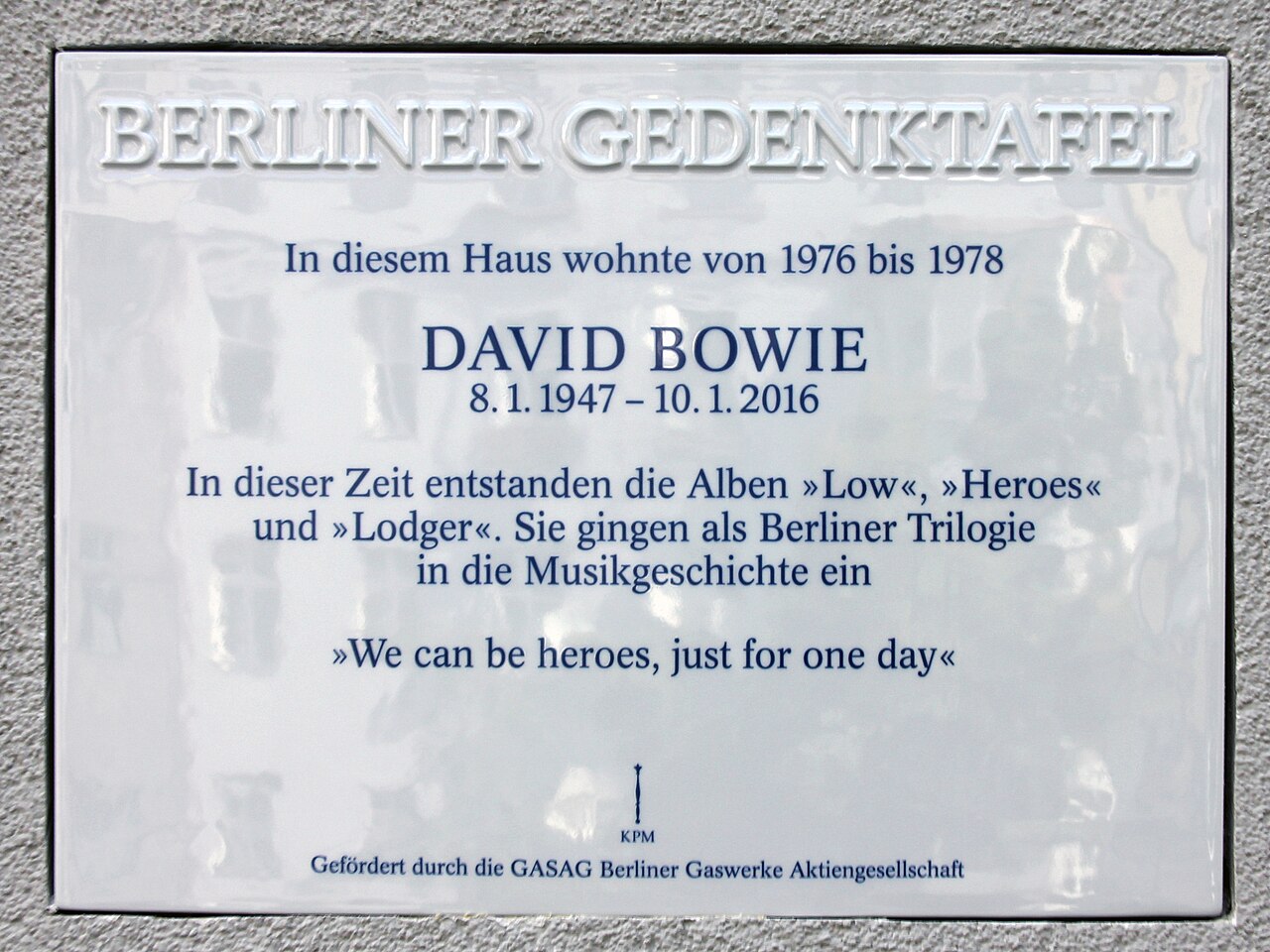
He then moved to Berlin, which was divided at the time by the Berlin Wall.[10] Three albums from this period, Low (1977), "Heroes" and Lodger (1979), are often grouped together as the "Berlin Trilogy".[1][10] Low was co-produced by Bowie and Tony Visconti, working with the musician Brian Eno; "Heroes" features Robert Fripp on guitar; and Lodger was the last of his 1970s albums made with Eno.[1] His official biography places sessions of this period at the Hansa studio, which it calls "Hansa Studio by the Wall".[1]
In September 1980 Bowie made his Broadway debut in the title role of The Elephant Man, and released the album Scary Monsters (and Super Creeps) the same month.[1] Its single "Ashes to Ashes" reached number one in the UK.[1] "Under Pressure", written and recorded with the band Queen in Switzerland, was released in October 1981 and also reached number one in the UK.[1] On screen he played the male lead in The Hunger and appeared in Merry Christmas, Mr. Lawrence and Absolute Beginners.[1][10]
Let's Dance, produced by Nile Rodgers and released in April 1983, sold about seven million copies, according to his official biography.[1] Its title track reached number one in more than half a dozen countries, and "Modern Love" and "China Girl" were also international top-ten hits.[1] The album reached number 4 on the US album chart.[5] The Serious Moonlight tour that followed sold more than 2.5 million tickets in 15 countries.[1] Tonight (1984) and Never Let Me Down (1987) followed.[1]
In 1988 he formed the rock band Tin Machine with the brothers Hunt and Tony Sales and the guitarist Reeves Gabrels.[1][10] The band released two albums, plus a limited live record, and went on hiatus not long after its second studio album in 1991.[1] His 1990 Sound + Vision tour played 108 shows in 27 countries.[1]
1990s and 2000s
Black Tie White Noise (1993) marked his return as a solo artist and reached number one on the UK album chart.[1][10] He married the model Iman in 1992; the couple, who had a daughter, remained together until his death.[1][10] Outside, made with Brian Eno, was released in 1995 under a new contract with Virgin Records, and Earthling followed in February 1997.[1] He launched his own online service, BowieNet, in 1998, and released 'hours...' in October 1999.[1]
In 2000 he headlined the final night of the Glastonbury festival, in front of an estimated 150,000 people.[1] Heathen was released in June 2002 and Reality in 2003.[1] Film roles of these years included Basquiat, Lost Highway, a cameo in Zoolander, the inventor Nikola Tesla in Christopher Nolan's The Prestige (2006), and himself in the comedy series Extras.[1][10]
The tour for Reality turned out to be his last large tour.[1] In June 2004, after a concert in Scheessel, Germany, doctors examining him for what had been described as a trapped nerve in his shoulder found an acutely blocked artery in his heart and carried out an emergency angioplasty, a procedure that reopens a narrowed blood vessel.[9] He cancelled the rest of the European tour.[9][10]
The Bowie Bonds
In 1997 Bowie raised 55 million US dollars by issuing a 10-year bond, a loan that pays investors interest, and promising investors the income generated by his back catalogue of 25 albums.[8] These "Bowie Bonds" were devised by the banker David Pullman, who said it was the first time a musician had sold rights to intellectual property through a bond, and Prudential Insurance was the original backer.[8] The ratings agency Moody's at first rated the bonds "investment grade", meaning a low risk of default, and said it was the first music-royalty deal it had rated.[8] As record sales fell with the rise of online music sharing, Moody's cut the bonds to near "junk" status, meaning a higher risk of default, in March 2004.[8]
Final years, Blackstar and death
On his 66th birthday, 8 January 2013, Bowie announced The Next Day, his first album of new material in ten years, and released the single "Where Are We Now?".[1][10] The Next Day reached number one in the UK and 18 other countries and number 2 in the United States, his highest US album position at that time.[1][5] In 2014 he won the Brit Award for Best British Male, which according to PA made him the oldest person to receive it.[10]
Lazarus, a stage musical written by Bowie with the playwright Enda Walsh, opened in New York on 7 December 2015.[1] His final album, ★ (pronounced "Blackstar"), co-produced with Tony Visconti and recorded with the New York jazz saxophonist Donny McCaslin and his quartet, was released on his 69th birthday, 8 January 2016.[1] His official site counts it as his 28th album; the PA obituary called it his 25th studio album.[1][10]
David Bowie died on 10 January 2016, two days after the album's release.[1][5] A statement on his official website said he had died peacefully, surrounded by his family, after an 18-month battle with cancer.[2] Blackstar entered the US album chart at number one, his first number-one album there, selling 174,000 copies in its first week.[5] New York City Mayor Bill de Blasio proclaimed 20 January 2016, the closing date of the New York run of Lazarus, David Bowie Day.[1]
Honours and legacy
Bowie was inducted into the Rock & Roll Hall of Fame as a performer in 1996; David Byrne of Talking Heads inducted him and Madonna accepted the honour on his behalf.[4] He received the Grammy Lifetime Achievement Award in 2006 and a lifetime achievement award at the 11th Webby Awards.[1][10] He also received an honorary doctorate in music from Berklee College of Music and the French Légion d'honneur.[1] PA reported that he turned down a knighthood.[10]
In 2023 the Victoria and Albert Museum (V&A) in London acquired his archive, through the David Bowie Estate with a donation of 10 million pounds from the Blavatnik Family Foundation and Warner Music Group.[7] The David Bowie Centre opened on 13 September 2025 at V&A East Storehouse in east London as the archive's permanent home.[6] The V&A has described the archive as holding more than 90,000 items, including 414 costumes and accessories, nearly 150 musical instruments and other sound equipment, and more than 70,000 photographic prints, negatives and transparencies.[6] Visitors can see rotating displays, such as stage costumes made for the Ziggy Stardust and Aladdin Sane periods by Freddie Burretti and Kansai Yamamoto, and can book to see individual objects free of charge.[6]
The Berlin memorial plaque on Hauptstraße 155 in Schöneberg, marking the building where Bowie lived from 1976 to 1978.