John Lennon (born John Winston Lennon, 9 October 1940, Liverpool; died 8 December 1980, New York City) was an English musician who co-led the Beatles and later made solo records, many of them with his second wife, Yoko Ono.[1][2]
Early life in Liverpool
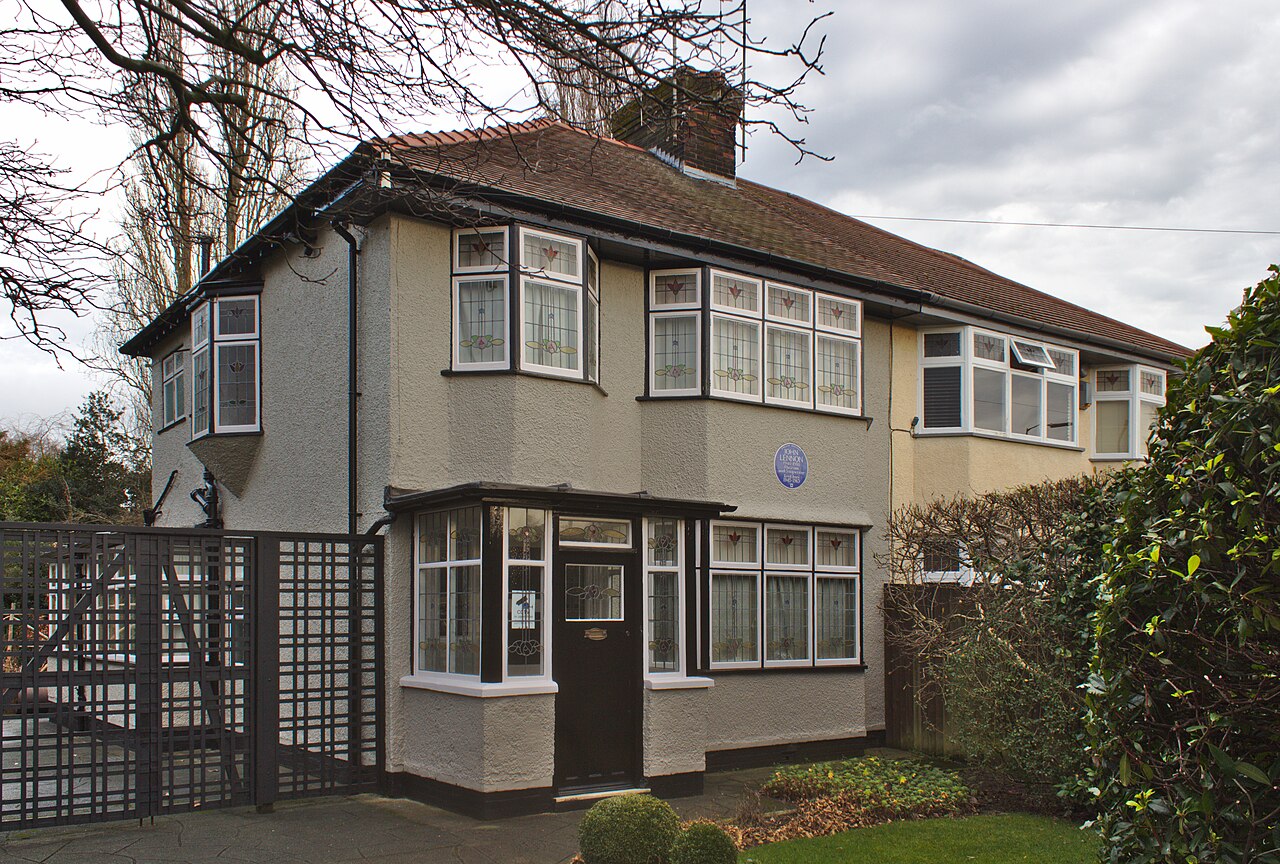
Lennon's parents, Alfred and Julia Lennon, did not raise him, and by the age of five he had been separated from both of them.[1] From 1946 to 1963, roughly from age 5 to 22, he lived with his maternal aunt and her husband, Mimi and George Smith, at a house called Mendips, at 251 Menlove Avenue in Woolton, a suburb of Liverpool.[1][3] George Smith died while Lennon was a teenager.[1] Julia Lennon, who taught her son the banjo and bought him his first guitar, was killed in a road accident when he was 17.[1][3]
Lennon did poorly at school; National Museums Liverpool notes that he got a D in Art in his O-level exams (the national exams usually taken at about age 16) in 1957.[4] He nonetheless entered Liverpool College of Art in October 1957.[4] Visual art was the only subject in which he ever had formal training.[1] At the college he met Stuart Sutcliffe, who became his closest friend and who, according to the museum, probably gave the Beatles their name; he also met Cynthia Powell there, who became his first wife.[4] He was eventually asked to leave the college.[4]
Mendips, the house in Woolton, Liverpool, where Lennon lived with his aunt and uncle from 1946 to 1963.
At 16 Lennon started a skiffle group, a do-it-yourself style of folk and blues music popular in 1950s Britain, called the Quarrymen.[1][4] On 6 July 1957 the Quarrymen played at the garden fete of Woolton Parish Church, and that was where Lennon met the 15-year-old Paul McCartney.[4] Britannica dates the first performances of Lennon and McCartney together to 1957, and by the end of that year George Harrison had joined as lead guitarist.[5] The group went through several names, including the Quarrymen and the Silver Beetles, before settling on the Beatles.[5]
Between 1960 and 1962 the band made several long trips to Hamburg, West Germany, to play in clubs there.[5] In autumn 1961 Brian Epstein, who managed a Liverpool record store, saw the group and became its manager; he secured a contract with Parlophone, part of the EMI record company, where George Martin became their producer.[5] At Martin's suggestion the band brought in a more polished drummer, Ringo Starr, in place of Pete Best.[5] "Please Please Me" became the group's first big hit in Britain.[5]
Songwriting with McCartney
Britannica describes Lennon and McCartney as precocious and largely self-taught composers.[5] The two wrote numerous songs at Mendips, where the band practised in the enclosed porch; Historic England's listing for the house names "Please Please Me" among the songs written there.[3] Britannica's biography of Lennon characterises the Beatles as a joint venture between McCartney, whom it calls a practical pop musician, and Lennon, whom it calls a rock-and-roll rebel.[1] It credits Lennon with a distinct stamp on the group's records, giving as examples his vocal on Smokey Robinson's "You've Really Got a Hold on Me" and the bridge he added to McCartney's "Getting Better" (1967).[1]
The "more popular than Jesus" remark
In March 1966 the London Evening Standard published a profile of Lennon by the journalist Maureen Cleave, in which he said, "We're more popular than Jesus now; I don't know which will go first—rock 'n' roll or Christianity."[6] The remark drew little notice in Britain at the time.[6] After the American teen magazine Datebook reprinted it in July, two radio hosts in Birmingham, Alabama, called it blasphemous and started a "Ban the Beatles" campaign; dozens of stations stopped playing the band's records, and some held public burnings of them.[6] Cleave said that Lennon had not been comparing the Beatles to Christ.[6] At a press conference in Chicago in August 1966, Lennon apologised, saying he had never meant the remark as an attack on religion.[6] The US tour went ahead and was the Beatles' last; in 1966 the band gave up public performing to concentrate on studio work.[5][6]
Yoko Ono and the breakup of the Beatles
Lennon married Cynthia Powell when he was 21, and they had a son, Julian, in 1963; they divorced in 1968.[1] Britannica describes Lennon as gradually withdrawing from the Beatles, a process that sped up in 1968 when he began his relationship with Yoko Ono, a Japanese avant-garde artist seven years older than he was.[1] He married Ono when he was 28.[1] According to Britannica, her influence can be heard on the Beatles' 1968 double album The Beatles and on his later solo work.[1] Relations between Lennon and McCartney broke down into arguments and mutual accusations, and in spring 1970 the Beatles formally disbanded.[5]
Peace activism
Lennon was an outspoken opponent of the Vietnam War.[1] In March 1969 he and Ono staged a "bed-in for peace" at the Amsterdam Hilton, vowing to stay in bed for a week; on 26 May 1969 they began a second week-long bed-in in room 1742 of the Queen Elizabeth Hotel in Montreal.[7] At the end of the Montreal bed-in, a spontaneous performance of "Give Peace a Chance" was recorded.[7] The Recording Academy counts that single, recorded with Ono while Lennon was still a Beatle, as his solo debut.[2] Britannica's biography states that his most lasting political commitment was to feminism.[1]
Solo career
Britannica calls Plastic Ono Band (1970) Lennon's solo debut album and says it is generally considered a masterpiece.[1] It was followed by Imagine (1971); Britannica notes that the idea behind the title song was attributed to Ono.[1] The Rock & Roll Hall of Fame describes his solo career as marked by experimentation, political activism and an embrace of the counterculture, and names "Imagine," "Working Class Hero," "Instant Karma!" and "#9 Dream" among the songs of that period.[8] His political work with Ono reached its peak in 1972 with Some Time in New York City, an album Britannica calls a failure.[1]
The US immigration case
Lennon's long fight to stay in the United States grew out of a British drug conviction.[10] On 18 October 1968, Scotland Yard detectives searched his London flat without a warrant and found a small amount of hashish (cannabis resin); on 28 November 1968 he pleaded guilty to possession at Marylebone Magistrates' Court and was fined.[10] He and Ono arrived in New York on 13 August 1971 on temporary visas, which the Immigration and Naturalization Service (INS) granted despite the conviction.[10] After the visas expired, the INS began deportation proceedings; on 23 March 1973 an immigration judge ordered Lennon deported, and on 10 July 1974 the Board of Immigration Appeals upheld the order.[10]
Britannica states that the administration of President Richard Nixon was trying to deport Lennon during this period.[1] The Federal Bureau of Investigation's own records, published on its online "Vault," include material from investigations that mention Lennon's links with anti-war and related groups in the late 1960s and early 1970s.[9] On 7 October 1975 the US Court of Appeals for the Second Circuit ruled, with one judge dissenting, that the 1968 conviction did not make Lennon excludable under US immigration law, because the British law under which he was convicted did not require proof that the accused knew he possessed the drug.[10] The court vacated the deportation order and sent the case back for reconsideration; it did not rule on Lennon's separate claim of selective enforcement, that is, that the government had singled him out for deportation.[10] Judge Mulligan dissented, arguing that Lennon's guilty plea brought him within the statute.[10]
Later years in New York
From autumn 1973 Lennon spent more than a year in Los Angeles apart from Ono, a period Britannica calls his "lost weekend."[1] The couple later reunited, and their son Sean was born on Lennon's birthday in 1975.[1] Lennon then withdrew from public life, becoming what Britannica calls a reclusive househusband, and left his business affairs to Ono.[1] In 1980 he and Ono released Double Fantasy, an album to which each contributed half; it came out a few weeks before his death.[1][2] The FBI's records also include a 1978 investigation of a violent threat made against him.[9]
Death
On 8 December 1980 Lennon was shot and killed by Mark David Chapman in front of the Dakota, the Manhattan apartment building where he lived.[1] Britannica's article on the Beatles describes the killer as a fan who had become a stalker.[5]
Honours and legacy
Double Fantasy won the Grammy Award for Album of the Year at the 24th Grammy Awards in 1982, given after Lennon's death and his only Grammy as a solo artist.[2] The Recording Academy gave him its Lifetime Achievement Award in 1991, and gave it again to him in 2014 as a member of the Beatles; his recording of "Imagine" entered the Grammy Hall of Fame in 1999.[2] The Beatles were inducted into the Rock and Roll Hall of Fame in 1988, and Lennon was inducted as a solo performer in 1994, with McCartney giving the induction speech.[5][8]
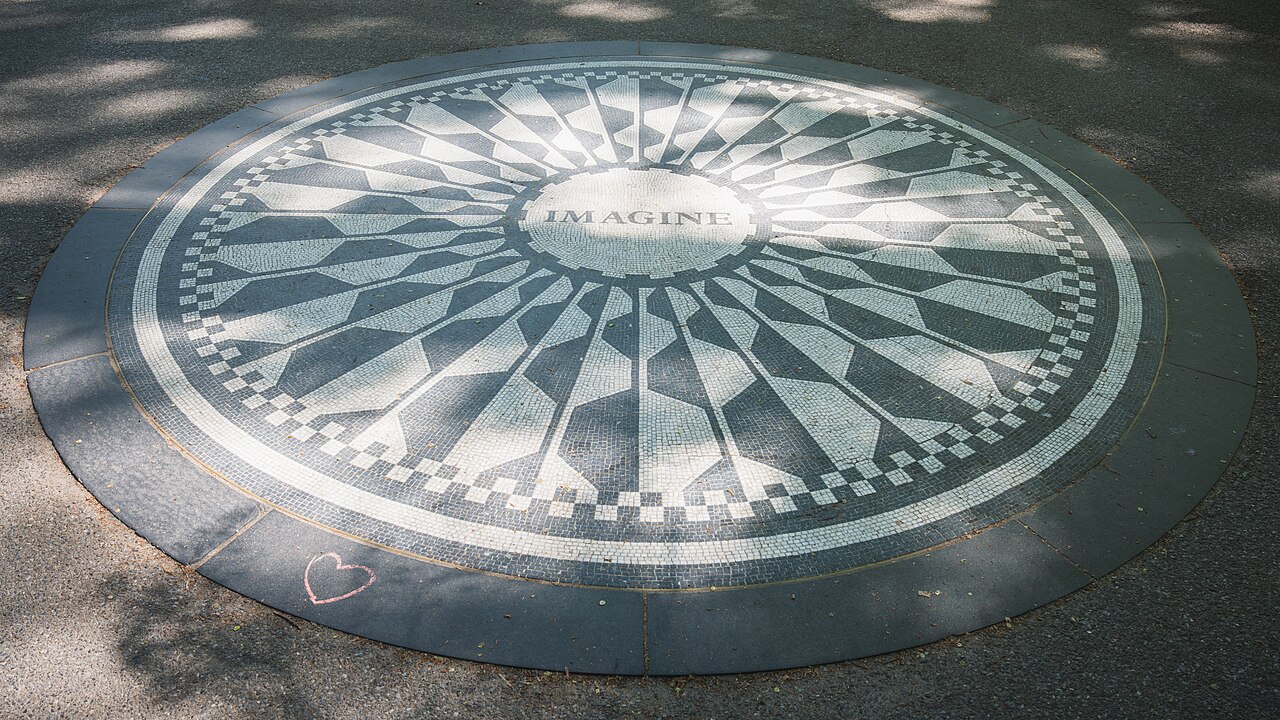
In Liverpool, English Heritage put a blue plaque on Mendips on 8 December 2000, the 20th anniversary of his death; it was the first such plaque outside London.[3] In 2002 Ono bought the house and gave it to the National Trust, which restored it in the style of the late 1950s and opens it for booked tours; it is a Grade II listed building.[3] In New York, Ono landscaped Strawberry Fields, a section of Central Park, in his memory.[5]
The circular black-and-white "Imagine" mosaic set into the path at Strawberry Fields, the memorial garden to Lennon in Central Park, New York.
"John Winston Lennon." FBI Records: The Vault, Federal Bureau of Investigation. No date shown; accessed 25 November 2026. vault.fbi.gov/john-winston-lennon
Kaufman, Irving R. (Chief Judge), opinion of the court; Mulligan (Circuit Judge), dissenting. Lennon v. Immigration and Naturalization Service, 527 F.2d 187 (2d Cir. 1975). US Court of Appeals for the Second Circuit, decided 7 October 1975; text hosted by Public.Resource.Org. law.resource.org/pub/us/case/reporter/F2/527/527.F2d.187.18.74--218…