Hell, Hades, Sheol and Gehenna (Jehovah's Witnesses). (2026, November 25). In Micwyn Encyclopedia. https://micwyn.com/t/3426/hell-hades-sheol-and-gehenna-jehovah-s-witnesses
Chicago
"Hell, Hades, Sheol and Gehenna (Jehovah's Witnesses)." Micwyn Encyclopedia. November 25, 2026. https://micwyn.com/t/3426/hell-hades-sheol-and-gehenna-jehovah-s-witnesses.
BibTeX
@misc{hell_hades_sheol_and_gehenna_jehovah_s_w_2026,
  title = {Hell, Hades, Sheol and Gehenna (Jehovah's Witnesses)},
  howpublished = {Micwyn Encyclopedia},
  year = {2026},
  month = nov,
  url = {https://micwyn.com/t/3426/hell-hades-sheol-and-gehenna-jehovah-s-witnesses},
  urldate = {2026-11-26}
}
Jehovah's Witnesses teach that the Bible words often translated "hell" (Hebrew Sheol, Greek Hades) mean the common grave of mankind, and that Gehenna stands for eternal destruction, not a place of everlasting conscious torment.[1][3]
Overview
Several different words in the Hebrew and Greek texts of the Bible have been translated "hell" in English Bibles.[1] A jw.org article lists them as Sheol and Hades, which Jehovah's Witnesses take to mean "the Grave"; Gehenna, which they take to mean eternal destruction; and Tartarus, which they apply to the demons.[1] For the movement in general, see Jehovah's Witnesses. Their teaching on the nature of the soul is covered in the entry Soul (Jehovah's Witnesses), and their teaching on who will be raised from the dead in the entry Resurrection (Jehovah's Witnesses).
Sheol and Hades
Jehovah's Witnesses teach that Sheol means "the common grave of mankind, gravedom," and not an individual burial place or grave.[2] Their Bible dictionary, Insight on the Scriptures, notes that the King James Version translates the word 31 times as "hell," 31 times as "grave" and 3 times as "pit," and it quotes outside reference works that judge "hell" a poor translation of it.[2] The same entry teaches that the Greek word Hades refers to the same thing as Sheol, pointing to the speech of the apostle Peter in Acts 2, where a quotation of Psalm 16:10 appears in Greek with Hades in place of Sheol.[2]
In Witness teaching, Sheol is a place of no consciousness: its dead neither praise God nor mention him.[2] Their publications cite passages such as Ecclesiastes 9:5, 10 and Psalm 146:3, 4 for this, and a jw.org article states that "the dead are unconscious and so cannot feel pain."[1][2] The same article says that Jesus himself was in "hell," in the sense of the Grave, between his death and his resurrection, citing Acts 2:31, 32.[1] It also reads the account of the rich man and Lazarus in Luke 16 as a parable, "not a real-life account."[1]
Jehovah's Witnesses teach that Sheol, or Hades, will be "emptied and destroyed, through a resurrection of all of those in it," citing Revelation 20:13, 14.[2] Who is raised, and when, is covered in the entry Resurrection (Jehovah's Witnesses); for the setting of that hope, see Paradise earth.
Gehenna
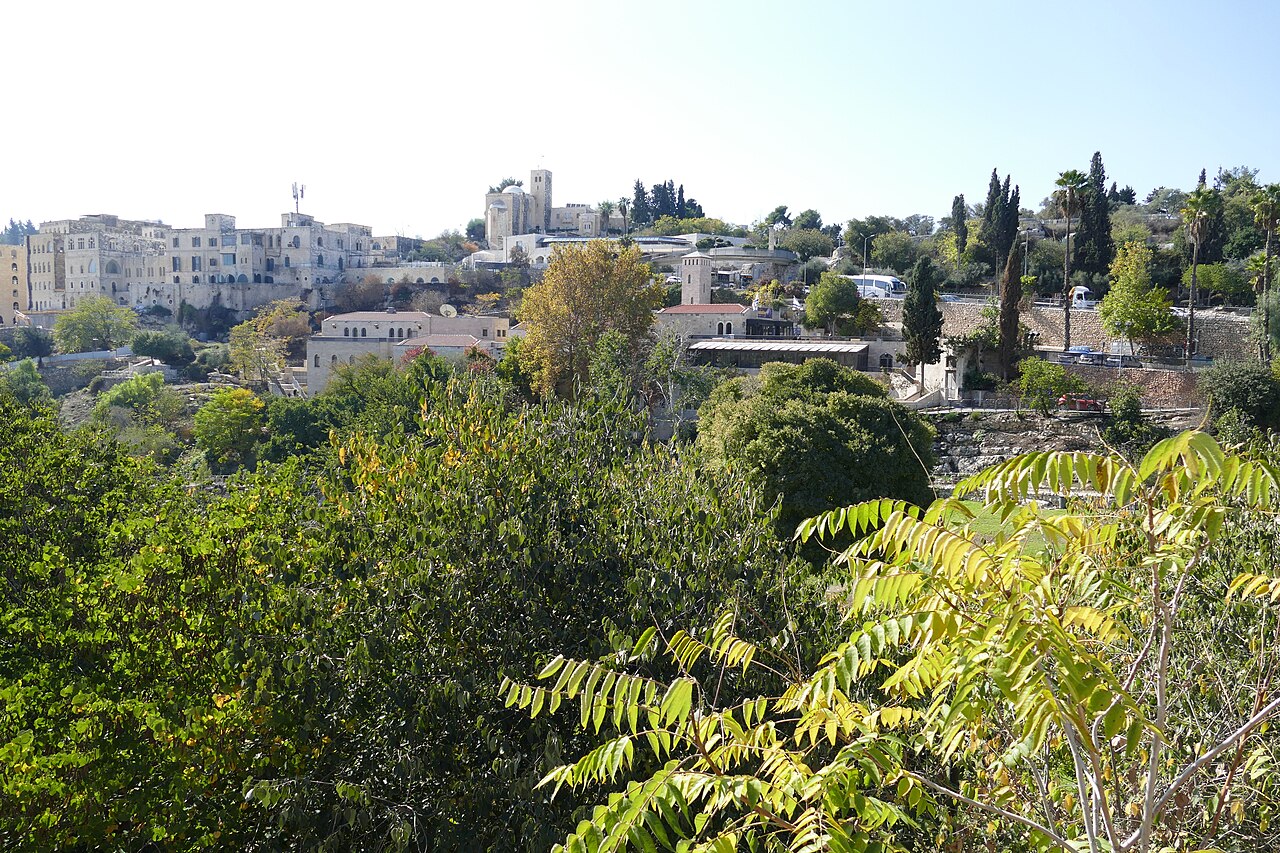
The name Gehenna comes from the Valley of Hinnom, which lay to the south and south-west of ancient Jerusalem.[3] Insight on the Scriptures describes the valley as later used for disposing of the city's waste, with a fire "perhaps increased in intensity by the addition of sulfur."[3]
The Hinnom Valley in Jerusalem, looking up toward St Andrew's Church. The valley's Hebrew name is the source of the word Gehenna.
Jehovah's Witnesses teach that Jesus used Gehenna "as representative of utter destruction resulting from adverse judgment by God," with no resurrection possible for those it describes.[3] Among the passages their publications cite are Matthew 5:22, 10:28 and 23:33, Mark 9:43-48 and Luke 12:4, 5.[3] Under the heading "No Symbol of Everlasting Torment," the Insight entry points to Jeremiah 7:31, where God says of the human sacrifices once burned in the valley that it was "a thing that I had not commanded," and it states that God "expressed repugnance for such practice."[3] On this reading, a person in Sheol or Hades may be resurrected, while one judged to be in Gehenna will not be.[2][3]
The lake of fire
The "lake of fire" appears in five verses of the Book of Revelation: Revelation 19:20; 20:10, 14, 15; and 21:8.[4] Jehovah's Witnesses teach that it is "a symbol of eternal destruction," the same as Gehenna but different from hell in the sense of the common grave.[4][3] They identify it with what Revelation calls "the second death," which they describe as a different kind of death from the first, since "the Bible says nothing about a resurrection from the second death."[4]
Revelation 20:10 says that the Devil will be "tormented day and night forever" in the lake. A jw.org article explains that the word translated "torment" can also mean "a condition of restraint," pointing to Matthew 18:34, where many translations render the Greek word for "tormentors" as "jailers."[4] The same article teaches that the Devil "will be brought to nothing, or put out of existence," citing Hebrews 2:14.[4] When Revelation 20:14 says that death and hell (Hades) are thrown into the lake of fire, Witness publications take this to mean that death, which they describe as "a state of inactivity" rather than a literal thing, and the Grave itself will come to an end forever.[1][4]
Tartarus
The Greek word Tartarus, used once in the Bible at 2 Peter 2:4, is explained in a jw.org article as the "abased condition of the demons, who are wicked spirit creatures."[1]
How the New World Translation renders the terms
Earlier editions of the New World Translation of the Holy Scriptures, the Bible translation published by Jehovah's Witnesses, printed "Sheol" and "Hades" in the main text.[5] In the 2013 revision, both words were replaced in the main text with "the Grave," with the original terms moved to footnotes.[5] The revision's own notes explain that Sheol and Hades both refer to "the common grave of mankind," that the terms are "unknown to many," and that Hades carries a second meaning from its use in Greek mythology.[5]
Reasons given for rejecting eternal torment
Witness publications give several reasons for rejecting the teaching that the wicked suffer conscious torment forever. As stated in a jw.org article:
The dead are unconscious and cannot feel pain.[1]
The penalty for sin is death, not torment, and a person who has died has been "acquitted from his sin."[1]
"The idea of eternal torment is repugnant to God," a statement the article supports with Jeremiah 32:35, and God is love.[1]
God wants people to worship him out of love, not out of fear of punishment.[1]
The same article attributes belief in a fiery hell to outside influences. It quotes works stating that the ancient Egyptians believed in a fiery hell, that from the middle of the 2nd century C.E. Christians trained in Greek philosophy began to express their faith in its terms, and that Plato had the greatest influence of any classical Greek philosopher on traditional views of hell.[1]
History
Charles Taze Russell (1852-1916), the first president of the Watch Tower Society, rejected the doctrine of eternal hell as a young man.[6][7] According to Encyclopaedia Britannica, by the time he was 20 he had left both the Presbyterian and Congregational churches because he could not reconcile the idea of an eternal hell with God's mercy.[7] In 1879 he started the Bible journal later called The Watch Tower, and in 1884 he founded the Watch Tower Bible and Tract Society.[7]
A 1997 issue of The Watchtower quotes Russell writing in 1896 that the Bible shows "no such place of everlasting torture as the creeds and hymn-books" describe, but rather a "hell," Sheol or Hades, which is "the tomb—the death condition."[6] The same article says Witnesses had by then taught this view "for more than a century."[6] The main dated change found for this entry is one of wording: the 2013 Bible revision's use of "the Grave" in place of "Sheol" and "Hades."[5]
Comparison with other Christian teaching
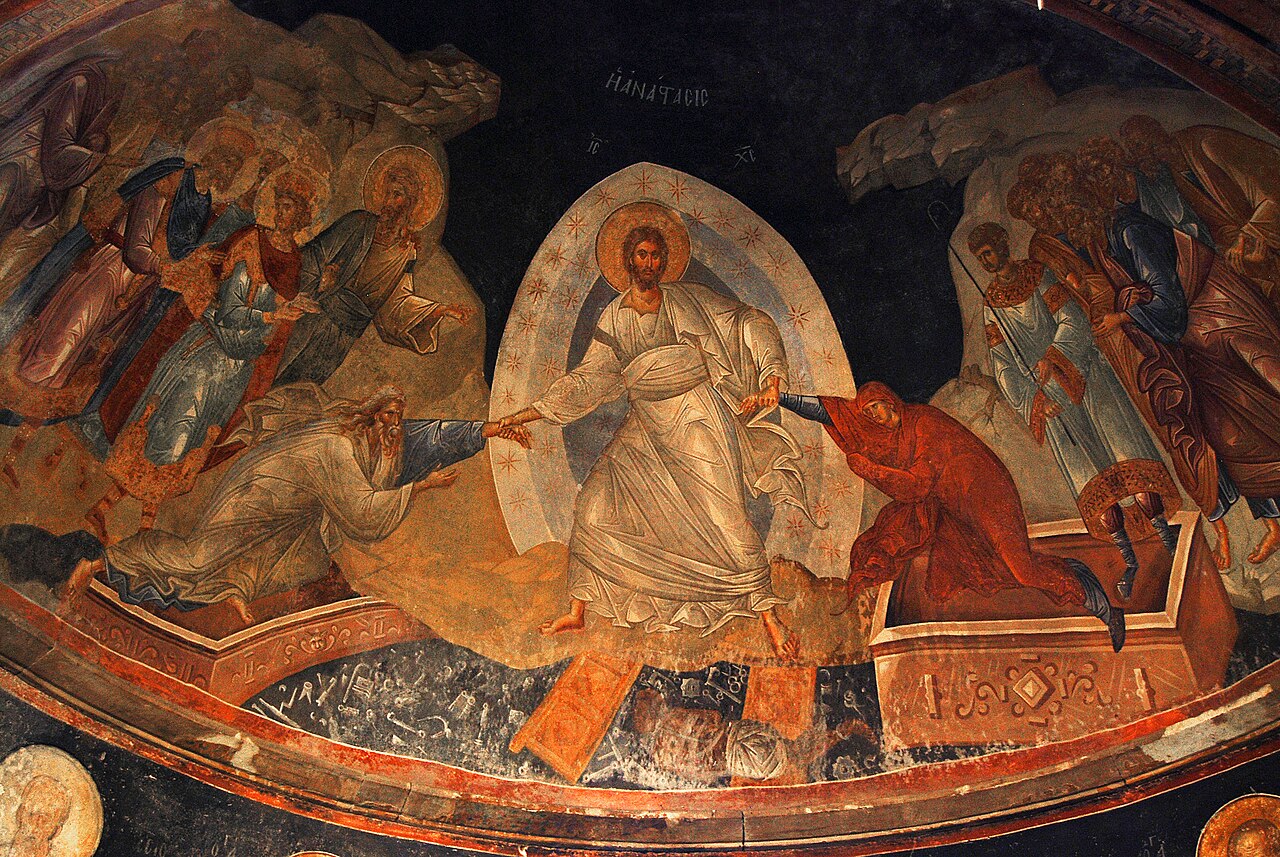
Other Christian traditions read these terms differently. Encyclopaedia Britannica states that the major branches of Christianity have traditionally affirmed eternal punishment for the damned alongside eternal reward for the blessed, and that in the New Testament Gehenna is described with terrors for the wicked, "where the worm never dies, and their fire is never quenched."[8] Britannica also notes that modern religious writers tend to interpret the pains of hell metaphorically.[8] It describes the older biblical idea of "Hades-Sheol as the gathering place of the dead" as keeping its importance in Christian reflection on Holy Saturday, the day between Jesus' death and resurrection, and notes that Eastern Christian icons of the Resurrection show Christ breaking the jaws of hell.[8]
The Anastasis fresco in the side chapel of the Chora Church, Istanbul: Christ pulls Adam and Eve from their tombs, an Eastern Christian image of his descent to
The Catechism of the Catholic Church defines hell as a "state of definitive self-exclusion from communion with God and the blessed."[9] It cites Jesus' words about Gehenna and "the unquenchable fire," and states that the Church "affirms the existence of hell and its eternity."[9] According to the Catechism, "immediately after death the souls of those who die in a state of mortal sin descend into hell," where they suffer "eternal fire," and "the chief punishment of hell is eternal separation from God."[9] It adds that "God predestines no one to go to hell": this requires a willful turning away from God and "persistence in it until the end."[9]
Within Protestantism, some hold that the wicked are not punished forever. Annihilationism is the view that the unrepentant are finally destroyed rather than punished forever; conditional immortality is the related view that immortality is given only to the saved. In 2000 the Evangelical Alliance in the United Kingdom, through its Alliance Commission on Unity and Truth among Evangelicals (ACUTE), published a report titled The Nature of Hell.[10] It concluded that annihilationism and conditional immortality represented a "significant minority evangelical view" that fell within the Alliance's 1970 Basis of Faith.[10]
Sources
"Is Hell Real? What Is Hell According to the Bible?" Bible Questions Answered. Watch Tower Bible and Tract Society of Pennsylvania (jw.org). No date shown (copyright 2026); accessed 25 November 2026. jw.org/en/bible-teachings/questions/is-hell-real/
"What Is the Lake of Fire? Is It the Same as Hell or Gehenna?" Bible Questions Answered. Watch Tower Bible and Tract Society of Pennsylvania (jw.org). No date shown (copyright 2026); accessed 25 November 2026. jw.org/en/bible-teachings/questions/lake-of-fire/
"The Truth About Hell." The Watchtower, 15 February 1997, p. 32. Watch Tower Bible and Tract Society of Pennsylvania (Watchtower Online Library). 15 February 1997; accessed 25 November 2026. wol.jw.org/en/wol/d/r1/lp-e/1997127
Catechism of the Catholic Church, Part One, Section Two, Chapter Three, Article 12, "IV. Hell," paragraphs 1033-1037. The Holy See (vatican.va). No date shown; accessed 25 November 2026. vatican.va/archive/ENG0015/__P2O.HTM