In the teaching of Jehovah's Witnesses, resurrection is God's restoring of a dead person to life as the same individual, either to spirit life in heaven for a limited group or to human life on earth for most of the dead.[1][2]
What resurrection means in Witness teaching
Jehovah's Witnesses teach that the Greek word translated "resurrection", anastasis, means "raising up" or "standing up again", and that a resurrected person is restored to life as the person he or she was before death.[1] They teach that the hope already appears in the Hebrew Scriptures even where the word is not used, and they cite Hosea 13:14 for it.[1] Their website also states that the Bible gives detailed accounts of nine resurrections, each with eyewitnesses.[1]
Because Witnesses teach that no immortal soul survives death, they do not describe resurrection as a soul rejoining a body; their website states that a resurrected person "is recreated as a living soul" (the nature of the soul is covered in the separate entry Soul (Jehovah's Witnesses)).[1] Witness literature presents God's memory as what links the person who died with the person raised: their study book What Can the Bible Teach Us? says that "all those whom Jehovah remembers will come back to life."[2] An earlier Watch Tower book, Is This Life All There Is? (1974), as quoted in a 2011 journal article, said that the resurrected person will have the same memory acquired during his lifetime.[3] Witnesses also teach that Jesus was not raised with a human body but "was brought back to life as a powerful spirit person."[2]
Two resurrections
Jehovah's Witnesses teach two kinds of resurrection: a small group raised to life in heaven, and the great majority of the dead raised to life on earth.[2]
The "first resurrection" to heaven
Witnesses call the heavenly resurrection "the first resurrection", a phrase they take from the Book of Revelation.[1] They teach that only 144,000 people share in it (see 144,000 and Anointed), and that those raised receive a body suited to life in heaven.[4] What Can the Bible Teach Us? describes this as resurrection "as a spirit person", not as a human with a human body.[2]
Witnesses connect the timing of the first resurrection to Christ's "presence", which they teach began in 1914.[1] A study article in The Watchtower of 1 January 2007, titled "'The First Resurrection'—Now Under Way!", reasoned that it "began sometime between 1914 and 1935".[4] The same article put forward the spring of 1918, three and a half years after 1914, as a possible starting point, while stating that this "cannot be directly confirmed in the Bible".[4] The article teaches that the first resurrection takes place over a period of time rather than at one moment, and that anointed Christians who finish their earthly life during Christ's presence are changed "in the twinkling of an eye" (a phrase from 1 Corinthians 15:52) into spirit creatures.[4] A 2019 chapter by a Witness author, published in an interfaith volume from Brigham Young University's Religious Studies Center, describes this ascension as "thought to be immediate".[5] As of November 2026, What Can the Bible Teach Us? states that most of the 144,000 have already been resurrected to heaven.[2]
The earthly resurrection of "the righteous and the unrighteous"
For the rest of the dead, Witnesses cite the apostle Paul's statement in Acts 24:15 that there will be a resurrection of both "the righteous and the unrighteous".[2] They teach that this resurrection takes place on earth during the Thousand Year Reign of Jesus Christ, after the battle of Armageddon (see Armageddon).[1][7] The conditions on the restored earth to which the dead are raised are described in the entry Paradise earth.[2]
In this teaching, "the righteous" are those who obeyed God before they died, including faithful servants of God who lived before Jesus and faithful servants of God who die in the present day.[2][6] "The unrighteous" are described as the billions who died without a sufficient opportunity to learn about Jehovah.[2][6] Witnesses teach that the unrighteous will be taught about God after they are raised; a September 2022 study article says that "the greatest educational program in all human history" will be needed.[2][7] A footnote in the same article suggests that the resurrection "may proceed backward, generation by generation", without stating it as certain.[7]
The same article teaches that at the end of the thousand years Satan will be released and all humans on earth will face a final test, and that those not found "written in the book of life" will be destroyed (the final test is described further in Paradise earth).[7] Witnesses teach that those raised to earthly life are raised on the basis of Jesus' sacrifice (see Ransom sacrifice).[4]
Who is taught not to be resurrected
What Can the Bible Teach Us? states that "anyone who is judged as wicked and unwilling to change will not be resurrected."[2] The 2019 chapter by a Witness author explains that such people are understood to go to Gehenna, which in Witness teaching "symbolizes complete and eternal destruction" rather than a place of torment, and that they are the only ones who will not be resurrected (the meaning of Gehenna is covered in the entry Hell, Hades, Sheol and Gehenna (Jehovah's Witnesses)).[5]
A Watchtower study article of September 2022 states that people who have deliberately sinned against the holy spirit "will not be resurrected", and describes those it calls "the goats", destroyed at Armageddon, as departing into "everlasting cutting-off".[6] A study article of May 2024 says that the Bible offers "only a few examples" of individuals who will not be resurrected, and names Judas Iscariot, some of the religious leaders who opposed Jesus, and unrepentant apostates (people who have deliberately abandoned and opposed the faith).[8]
Changes in the teaching
Witness publications themselves record several adjustments to this teaching.
Timing of the first resurrection (2007). The 1 January 2007 Watchtower presented the spring of 1918 as a possible but unconfirmed start for the heavenly resurrection, within a period it placed between 1914 and 1935.[4]
"Resurrection of life" and "resurrection of judgment" (2022). Jesus' words in John 5:28-29 speak of those who "did good things" coming out to "a resurrection of life" and those who "practiced vile things" to "a resurrection of judgment".[6] A study article in the September 2022 Watchtower stated: "In the past, we understood Jesus' words to refer to the deeds the resurrected ones will practice after their resurrection."[6] The adjusted teaching is that these deeds took place before death: the righteous receive "a resurrection of life" because their names are already written in the book of life, while the unrighteous receive "a resurrection of judgment", meaning that they will be evaluated over time during the Thousand Year Reign.[6] A footnote in that article explains "judgment" here as "a process of evaluation and probation".[6] As of November 2026, the Witnesses' website states that the unrighteous will be judged on what they do after they are resurrected, not before.[1]
Daniel 12:2 (2022). A second study article in the same issue stated that the prophecy in Daniel 12:2 about the dead awakening "is not referring to a symbolic resurrection", as Witness publications had previously understood it, but to a literal resurrection in the new world after Armageddon.[7]
Sodom and Gomorrah and other past judgments (2024). The May 2024 study article "Trust in the Merciful 'Judge of All the Earth'!" acknowledged that Witness publications had said that for people such as those of Sodom and Gomorrah "there is no hope of a future resurrection".[8] It then answered its own question of whether this could be said with certainty: "No, we cannot say for sure!"[8] The article applied the same caution to those killed in the Flood and to the nations of Canaan, saying "we do not know" whether all of them had an opportunity to learn about Jehovah, and it linked these adjustments to the 2022 change on John 5:28-29.[8]
Comparison with other Christian teaching
The Catechism of the Catholic Church teaches that at death the soul separates from the body and goes to meet God "while awaiting its reunion with its glorified body", and that God will grant incorruptible life to human bodies "by reuniting them with our souls".[9] It teaches that "all the dead will rise", those who have done good to "the resurrection of life" and those who have done evil to "the resurrection of judgment", that they will rise "with their own bodies", and that this will happen definitively "at the last day", closely tied to Christ's return (the Parousia).[9] The Catechism also states that Christ "is raised with his own body".[9] Jehovah's Witnesses, by contrast, list the idea that resurrection reunites a soul with a body among what they call myths about the resurrection, teach that Jesus was raised as a spirit person, and place the earthly resurrection over the course of a thousand-year reign rather than on a single last day.[1][2]
Seventh-day Adventists, like Jehovah's Witnesses, teach that the dead are unconscious until the resurrection: their Fundamental Belief 26 states that "death is an unconscious state for all people."[10] The Adventist statement places the resurrection of the righteous at Christ's appearing, when they are "glorified and caught up to meet their Lord", and states that "the resurrection of the unrighteous, will take place a thousand years later."[10] Witnesses, as described above, teach instead that both the righteous and the unrighteous who are raised to earthly life return during the thousand years.[1][7]
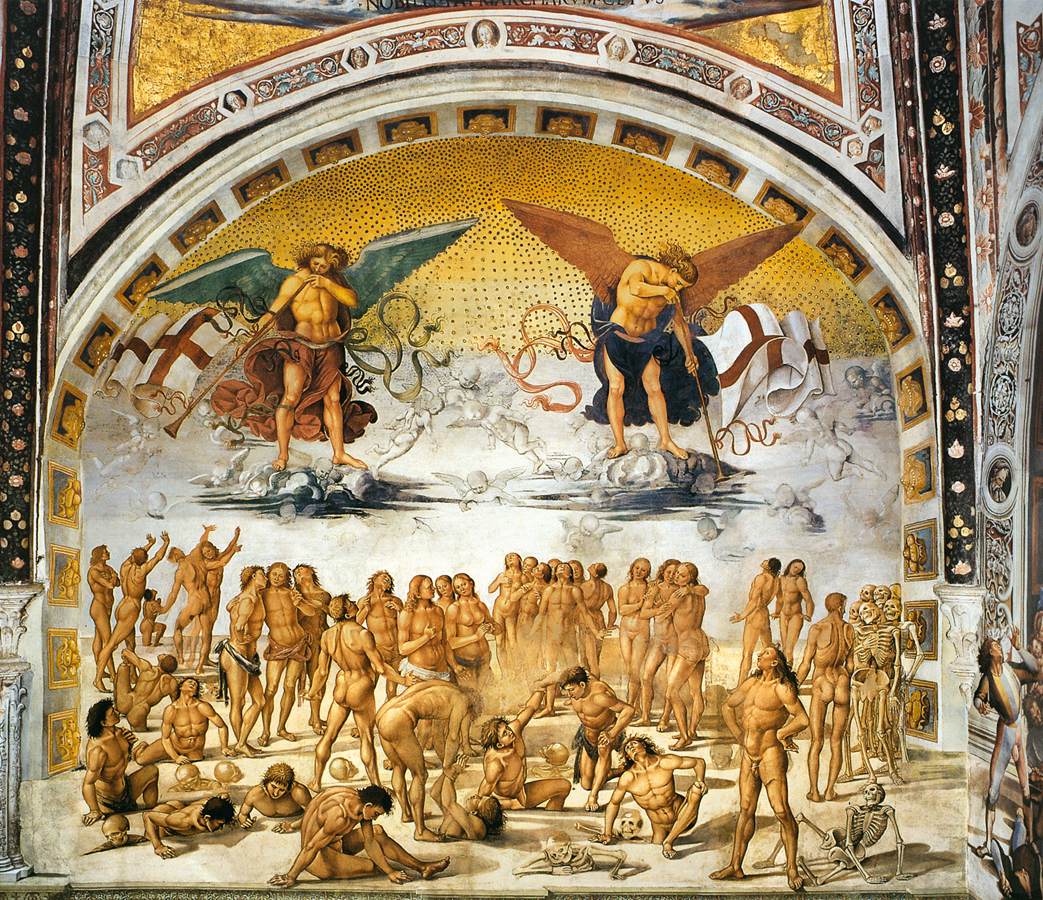
The Resurrection of the Flesh, a fresco by Luca Signorelli in Orvieto Cathedral (1499-1502): angels sound trumpets as the dead rise bodily from the earth. (The
Jehovah's Witnesses. What Can the Bible Teach Us?, chapter 7, "There Will Be a Resurrection!", pp. 71-82. Watch Tower Bible and Tract Society of Pennsylvania. No date shown; accessed 25 November 2026. jw.org/en/library/books/bible-study/there-will-be-a-resurrection/
Steven B. Cowan. "Personal Identity and the Jehovah's Witness View of the Resurrection." Journal of the International Society of Christian Apologetics 4, no. 1 (2011): 73-82. theologicalstudies.org.uk/pdf/jisca/04-1_073.pdf
"'The First Resurrection'—Now Under Way!" The Watchtower, 1 January 2007, pp. 25-30. Watchtower Online Library. wol.jw.org/en/wol/d/r1/lp-e/2007006
Cary E. Valentine. "The Condition of the Dead in Jehovah's Witness Soteriology." In Life Beyond the Grave: Christian Interfaith Perspectives, ed. Alonzo L. Gaskill and Robert L. Millet, pp. 137-152. Religious Studies Center, Brigham Young University / Deseret Book, 2019. rsc.byu.edu/life-beyond-grave/condition-dead-jehovahs-witness-soter…
"Is Your Name in 'the Book of Life'?" Study Article 39, The Watchtower (Study Edition), September 2022, pp. 14-19. Watchtower Online Library. wol.jw.org/en/wol/d/r1/lp-e/2022567
"'Bringing the Many to Righteousness'." Study Article 40, The Watchtower (Study Edition), September 2022, pp. 20-25. Watchtower Online Library. wol.jw.org/en/wol/d/r1/lp-e/2022568
"Trust in the Merciful 'Judge of All the Earth'!" Study Article 18, The Watchtower (Study Edition), May 2024, pp. 2-7. Watchtower Online Library. wol.jw.org/en/wol/d/r1/lp-e/2024404
Seventh-day Adventist Church. "Death and Resurrection" (Fundamental Belief 26). adventist.org. No date shown; accessed 25 November 2026. adventist.org/death-and-resurrection/